Peekapoo (Pekingese Poodle Mix): Complete Owner’s Guide
A small dog with a big personality — the Peekapoo combines the Poodle’s sharp intelligence with the Pekingese’s regal confidence. But this mix isn’t for everyone. Here’s what 2026 buyers and owners genuinely need to know before committing.
Quick Answer: What Is a Peekapoo?
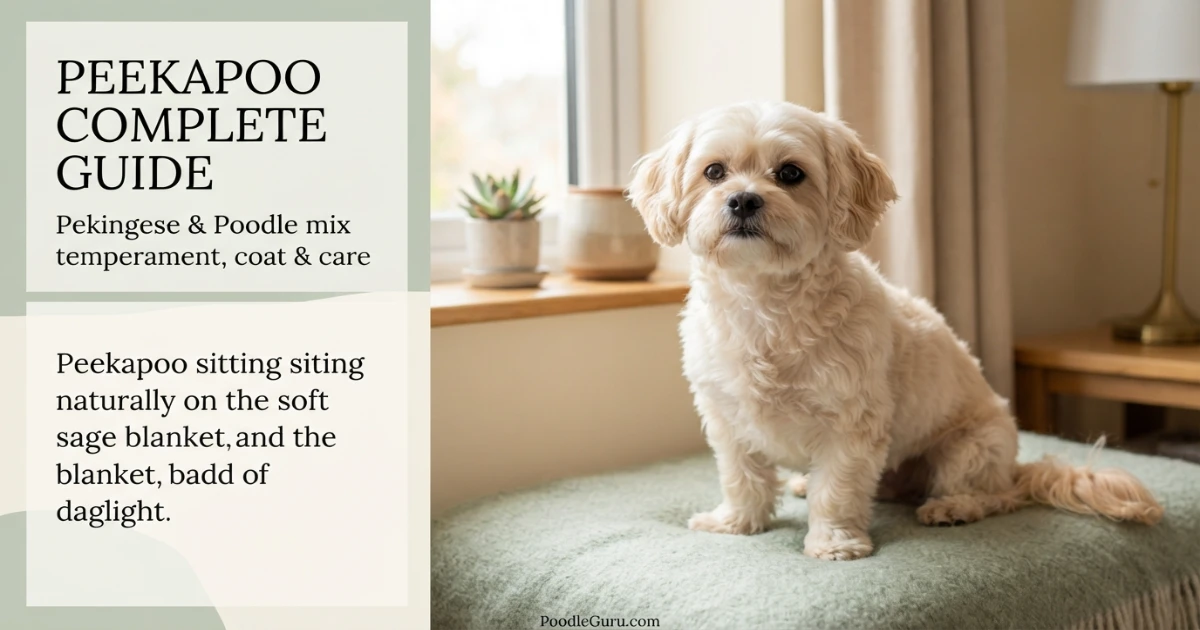
A Peekapoo is a designer hybrid dog created by crossing a Pekingese with a Toy or Miniature Poodle. Most weigh between 8 and 18 pounds and stand under 11 inches tall. They’re known for being deeply loyal, alert, and surprisingly confident for their size. The mix is often bred as a small companion dog that may inherit a lower-shedding Poodle-type coat alongside the Pekingese’s devoted, watchful nature — but every litter varies, and that variability is the single most important thing to understand before you start looking.
What Is a Peekapoo?
A Peekapoo is a first-generation designer hybrid dog that crosses a purebred Pekingese with a purebred Toy or Miniature Poodle. For poodle owners, this means you’re getting a compact companion that may inherit the Poodle’s quick mind and lower-shedding coat potential alongside the Pekingese’s steadfast loyalty and self-assured demeanor. The most important thing to understand is that no two Peekapoo puppies are the same — each one lands somewhere unique on the spectrum between its two parent breeds, and predicting adult traits from a young puppy is imperfect even when you meet the individual dog.
The Peekapoo emerged in the United States during the 1950s and 1960s, making it one of the earliest intentionally bred designer dogs. Unlike purebred Poodles, which have a clearly defined AKC breed standard, the Peekapoo has no universal breed standard. That absence of standardization is exactly why buyer education matters so much.
Size Range
8–18 lbs, typically 8–11 inches at the shoulder. Toy Poodle parent produces smaller Peekapoos; Miniature Poodle parent pushes toward the upper end.
Coat Type
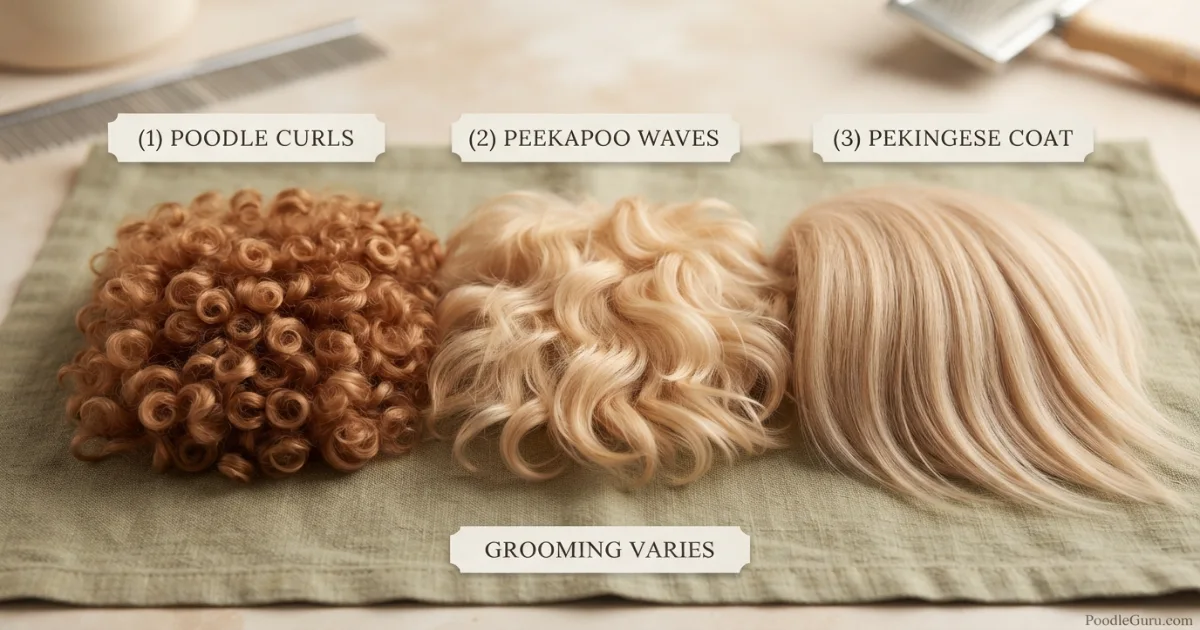
Wavy to curly, medium-length. Not guaranteed hypoallergenic. Shedding varies from very low to moderate depending on which parent’s coat dominates.
Lifespan
12–15 years on average. Well-bred Peekapoos from health-tested parents often reach the upper end of that range.
Best Suited For
Singles, couples, retirees, and families with older children. Thrives on close companionship — not ideal for homes where it’s left alone for long hours.
Energy Level
Moderate. A daily walk plus indoor play satisfies most Peekapoos. They’re lapdogs at heart but need mental stimulation to stay content.
Barking Tendency
High alertness. Both parent breeds are watchdogs by nature. Early training helps, but expect a dog that notices everything.
Peekapoo Appearance & Size: Expect Variety
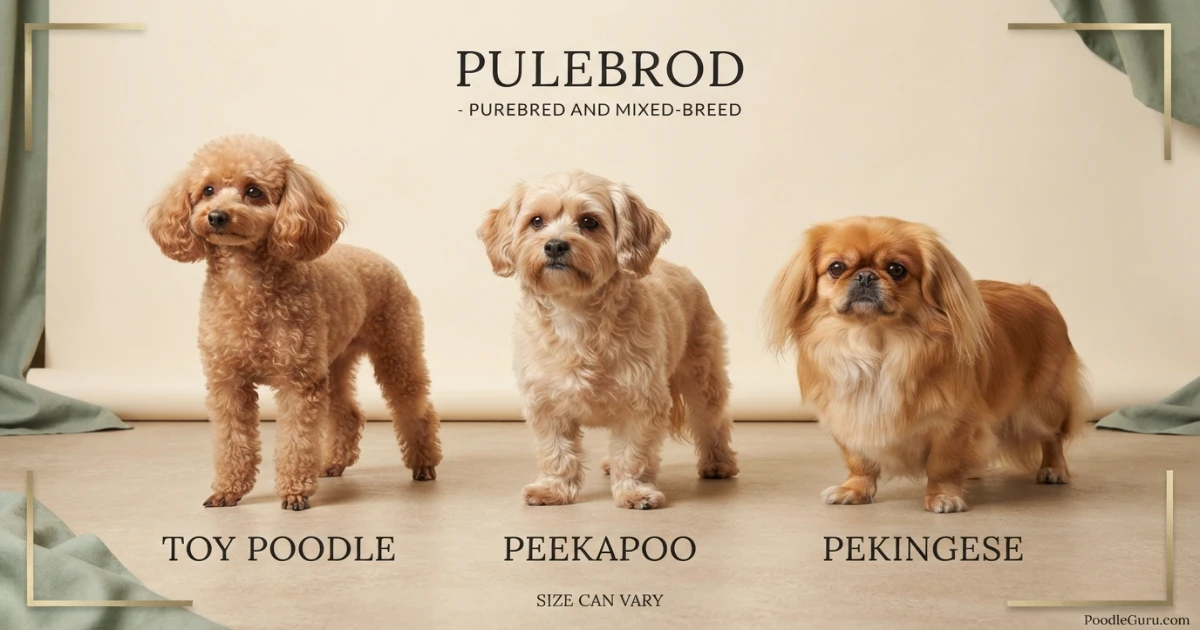
Peekapoo looks run a wide spectrum. Some puppies favor the Poodle side — leaner muzzle, tighter curls, longer legs. Others take after the Pekingese — flatter face, thicker body, a more pronounced underbite. Most land somewhere in the middle with a soft, wavy coat and a sturdy compact frame.
Size predictability is one area where the parent Poodle’s variety matters enormously. A Toy Poodle crossed with a Pekingese typically yields an 8–12 pound adult. A Miniature Poodle parent can push that toward 14–18 pounds. Breeders should be transparent about which Poodle size they’re working with — if they dodge the question, walk away.
Expert Insight: Coat Color Variability
Peekapoos come in cream, apricot, black, white, gray, sable, and parti-color patterns. Solid-color puppies may fade or lighten as they mature — this is inherited from the Poodle’s fading gene. Don’t expect a puppy’s 8-week coat color to be its lifetime shade. If color matters to you, ask to see photos of the parents and any previous littermates as adults.
Peekapoo Temperament: Loyal, Alert, and Sometimes Stubborn
A well-socialized Peekapoo bonds fiercely with its person. These dogs don’t just coexist with you — they shadow you. That intensity is endearing to the right owner and overwhelming to the wrong one. Separation anxiety is a genuine risk in this mix, and it’s not something you can train away overnight.
From the Poodle side, the Peekapoo inherits sharp observational intelligence. They read routines, learn patterns quickly, and notice when something is out of place. From the Pekingese side comes a quiet self-regard — these aren’t desperate-to-please dogs. They’ll learn commands readily but obey on their own terms unless you’ve built genuine trust.
Stranger wariness is common. Most Peekapoos aren’t aggressive, but they are discriminating. They’ll hang back, assess, and warm up slowly. This is not usually the type of dog that greets every stranger instantly — and many owners prefer that watchful companion style. Early socialization matters enormously. A Peekapoo raised without exposure to varied people, sounds, and environments can tip from watchful into fearful.
Peekapoo vs. Purebred Poodle vs. Pekingese: A Side-by-Side Look
Understanding the Peekapoo means understanding both parent breeds. Here’s how the three compare across the traits that matter most in daily ownership:
| Trait | Peekapoo | Toy Poodle | Pekingese |
|---|---|---|---|
| Weight | 8–18 lbs | 4–6 lbs | 7–14 lbs |
| Coat Type | Wavy to curly, medium | Tight curls, single coat | Long, straight, double coat |
| Shedding | Low to moderate | Very low | Moderate to heavy |
| Grooming Frequency | Every 4–6 weeks | Every 4–6 weeks | 2–3 times per week brushing |
| Trainability | Moderate (intelligent but independent) | High (eager, quick learner) | Low to moderate (stubborn streak) |
| Barking Level | High alertness | Moderate to high | Moderate |
| Stranger Response | Wary, slow to warm | Alert, may bark | Aloof, discriminating |
| Separation Tolerance | Low — bonds intensely | Moderate | Low — bred for companionship |
| Brachycephalic Risk | Variable — depends on face shape | None | High — flat-faced breed |
| Lifespan | 12–15 years | 12–15 years | 12–14 years |
This table reveals something most Peekapoo listings won’t tell you: the Peekapoo occupies a middle ground that can lean toward either parent in any given trait. That’s not a flaw — but it demands more careful evaluation than buying a purebred.
The PoodleGuru 5-Point Peekapoo Evaluation Framework
At PoodleGuru, we evaluate designer mixes by looking past the marketing and into the mechanics of what makes a healthy, well-adjusted dog. Use this framework when you meet a Peekapoo puppy or speak with a breeder. It’ll save you from making an emotional decision you might regret.
Assess the Poodle Influence
Ask which Poodle size was used — Toy or Miniature. Look at the puppy’s muzzle length, leg proportion, and coat texture. A longer muzzle and tighter curl suggest stronger Poodle genetics. This affects shedding, grooming needs, and breathing health.
Outcome: You’ll know roughly where this puppy sits on the Poodle-Pekingese spectrum before any breeder claims are made.
Evaluate the Pekingese Contribution
Check facial structure carefully. A very flat face (brachycephalic) signals stronger Pekingese influence. This isn’t cosmetic — it directly impacts breathing, heat tolerance, and anesthesia risk during any future procedures. A moderate face with defined nostrils is ideal.
Outcome: You’ll spot potential respiratory concerns before they become veterinary bills.
Check Coat Predictability
Run your fingers through the puppy’s coat. Is it tightly curled, loosely wavy, or nearly straight? Ask the breeder about shedding in previous litters from the same pairing. No Peekapoo is truly hypoallergenic — but wavier coats shed less than straighter ones.
Outcome: You’ll have realistic grooming and allergy expectations, not breeder promises.
Observe Temperament in Person
Watch the puppy interact with its littermates and with you. Does it approach confidently, hang back and observe, or seem timid? A Peekapoo that’s curious but not frantic — and recovers quickly from startles — is showing good emotional balance.
Outcome: You’ll choose a puppy whose baseline temperament fits your household, not just the cutest face.
Verify Health Clearances
Request documentation for both parent dogs. At minimum, look for documented patella screening, eye exams such as CAER/OFA eye certification, cardiac evaluation, and a veterinarian-informed discussion of airway and face structure for the Pekingese parent. No paperwork means no sale.
Outcome: You’ll filter out breeders who skip health testing — the single biggest predictor of long-term veterinary costs.
Peekapoo Health & Lifespan: What the Parent Breeds Tell Us
Peekapoos typically live 12 to 15 years. That’s a solid lifespan for a small dog, and mixed-breed diversity may reduce some inherited risks in certain pairings, but it is never a health guarantee. A poorly bred Peekapoo can inherit health problems from both sides simultaneously.
Veterinary guidance generally recommends watching for these conditions in Peekapoos:
- Patellar luxation — loose kneecaps, common in small breeds. May cause intermittent limping. Severe cases require surgery.
- Brachycephalic airway concerns — if the puppy inherits a flatter Pekingese face, breathing efficiency, heat tolerance, and anesthesia safety are affected. Brachycephalic airway syndrome is well-documented in flat-faced breeds.
- Progressive retinal atrophy (PRA) — inherited from the Poodle side. Reputable breeders screen for this via DNA testing.
- Dental crowding — small jaw size combined with a full set of teeth creates overcrowding. Professional cleanings and daily tooth brushing are non-negotiable.
- Mitral valve disease — a heart condition seen in aging small dogs. Annual vet checks with cardiac auscultation help catch it early.
When to Call Your Vet
Contact your veterinarian if your Peekapoo shows labored breathing, exercise intolerance, persistent limping, sudden vision changes, or any episode of collapse — especially in warm weather. These are not wait-and-see symptoms in a brachycephalic-adjacent breed.
Grooming & Coat Care: A Realistic Routine
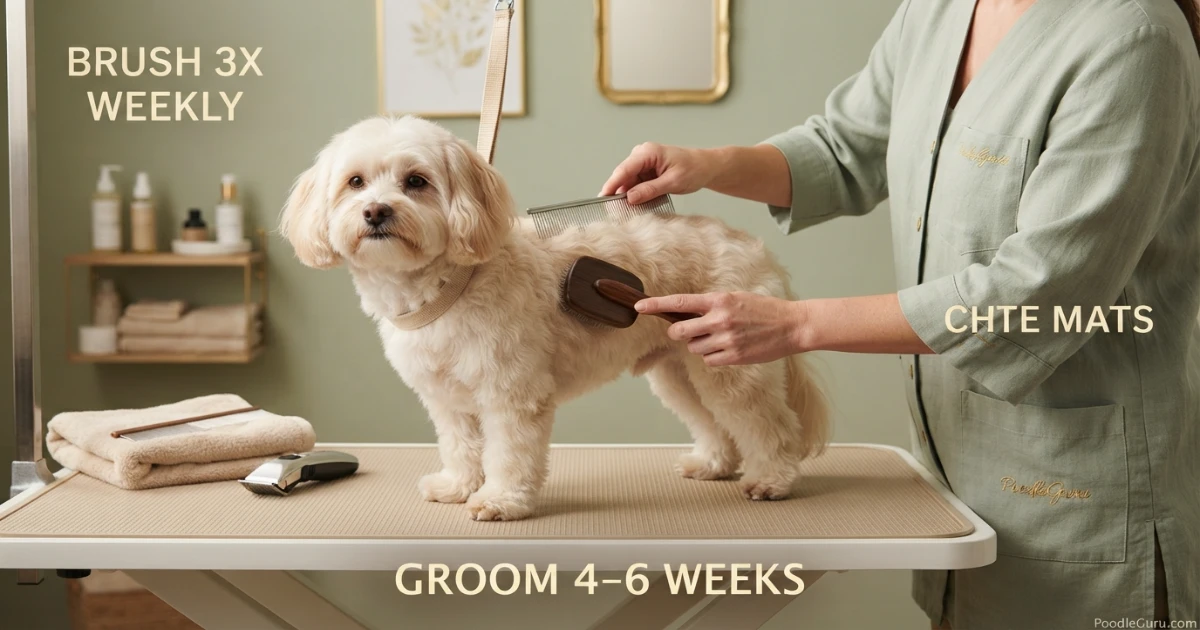
Peekapoo grooming isn’t optional — it’s essential. That wavy-to-curly coat mats quickly at friction points: behind the ears, under the collar, in the armpits, and along the belly. Professional groomers commonly watch for hidden mats in these exact spots, and owners who skip brushing between appointments often discover painful tangles that require shaving.
Plan on a full professional groom every 4 to 6 weeks. Between appointments, brush your Peekapoo at least three times a week using a slicker brush followed by a metal comb. Pay special attention to the areas mentioned above. If you hear the comb scraping against a mat, stop — don’t pull through it. Work it apart with your fingers or have a groomer handle it.
Ear care deserves special attention. Peekapoos with drop ears (common when the Pekingese ear type dominates) trap moisture and wax more readily than Poodle-style ears. Clean ears weekly with a vet-recommended solution, and watch for redness, odor, or head-shaking — these signal an infection that needs prompt treatment.
For a deeper dive into coat maintenance that applies directly to Peekapoos with Poodle-dominant coats, see our Complete Poodle Grooming Guide — the brushing techniques and tool recommendations transfer seamlessly.
Training & Socialization: Work With the Mind, Not Against It
Peekapoos are smart enough to learn almost anything a Poodle can learn. The difference is motivation. A Poodle often works for the joy of pleasing you. A Peekapoo frequently asks, “What’s in it for me?” That’s the Pekingese influence, and fighting it is pointless — you work with it instead.
Use high-value treats, keep sessions short (5–10 minutes), and never turn training into a battle of wills. Peekapoos can shut down under harsh corrections. Positive reinforcement builds the trust that makes them willing partners. Crate training and alone-time practice should start within the first week — separation anxiety prevention is far easier than separation anxiety rehabilitation.
Socialization needs to be proactive and varied. Introduce your Peekapoo puppy to different people, calm dogs, household sounds, and handling routines before 16 weeks. A Peekapoo that misses this window often becomes a one-person dog that struggles with visitors, vet visits, and groomer appointments.
Finding a Responsible Peekapoo Breeder
Peekapoos aren’t recognized by the AKC, which means there’s no breed club oversight. That absence makes breeder vetting entirely your responsibility. Here’s what separates a responsible breeder from a backyard operation:
| Green Flag | Red Flag |
|---|---|
| Both parent dogs are on-site or visible via video call | Breeder won’t show you the parents or makes excuses |
| Full health testing documentation for both parents (patella, eyes/CAER, cardiac, and airway discussion where relevant) | “Vet-checked” is the only health claim — no actual test results |
| Breeder asks you questions about your lifestyle and home | Breeder asks only about payment and pickup logistics |
| Puppies raised in a home environment with early socialization | Puppies kept in kennels, barns, or outdoor setups only |
| Transparent about which Poodle size was used and why | Vague about parent breeds or claims “teacup” sizing |
| Contract includes a health guarantee and return policy | No contract, or contract waives all health responsibility |
The AKC Pekingese breed page and the AKC Poodle breed page are useful references for understanding what health-tested purebred parents should look like — even though the Peekapoo itself isn’t an AKC breed.
Peekapoo Price Guide (2026)
In 2026, a responsibly bred Peekapoo from health-tested parents may cost between $1,500 and $3,200, depending on region, breeder support, and documented parent screening. Puppies at the lower end of that range usually come from smaller-scale breeders in lower-cost regions. Prices above $3,200 may reflect extensive parent health documentation, multi-generation lineage tracking, breeder support, or high-demand coat colors in competitive urban markets.
What Affects Peekapoo Pricing
- Parent health clearances — OFA, CERF, and cardiac testing add cost but dramatically reduce long-term risk. This is worth paying for.
- Poodle parent size — Toy Poodle crosses often command a slight premium over Miniature Poodle crosses due to higher demand for smaller dogs.
- Coat color rarity — Parti-color, sable, and true red Peekapoos tend to cost more than cream or black. Color doesn’t affect health, so don’t overpay purely for aesthetics.
- Geographic location — Urban coastal markets regularly price $500–$800 higher than rural or Midwestern regions.
Be cautious with unusually cheap Peekapoo listings. Very low pricing can indicate skipped health testing, weak early socialization, or a high-volume seller rather than a careful breeding program. The savings evaporate the first time you face a preventable veterinary emergency.
Is a Peekapoo Right for You?
This isn’t a question to answer with a quick yes. The Peekapoo fits a specific owner profile beautifully — and misfires badly when placed in the wrong home. Here’s the honest breakdown:
A Peekapoo may be right for you if: you work from home or are retired, you want a devoted shadow dog, you’re prepared for consistent grooming, you value alertness and don’t mind some barking, and you’re willing to invest in early training and socialization.
A Peekapoo is probably not right for you if: you’re away from home for 8+ hours daily, you want a dog that’s instantly friendly with every stranger, you prefer a low-maintenance wash-and-wear coat, or you have very young children who may handle a small dog roughly.
The Peekapoo’s intensity — that deep, focused loyalty — is either exactly what you want or exactly what will exhaust you. Be honest with yourself before you start contacting breeders.
Frequently Asked Questions About Peekapoos
Are Peekapoos hypoallergenic?
No dog is completely hypoallergenic, and Peekapoos are no exception. Dogs with wavier, Poodle-dominant coats shed less dander and may be more tolerable for mild allergy sufferers. If allergies are severe, spend time with the specific adult dog before committing — puppy coats change.
Do Peekapoos bark a lot?
Yes, Peekapoos tend to be alert barkers. Both parent breeds can be alert, people-focused companion dogs. You can reduce excessive barking with early training and consistent redirection, but you’re unlikely to eliminate it entirely. This is a breed that notices and announces visitors, delivery trucks, and passing dogs.
Are Peekapoos good with children?
Peekapoos can do well with older, gentle children who understand how to handle a small dog respectfully. They’re not ideal for households with toddlers or rough-playing kids — their small size makes them vulnerable to injury, and they may snap if frightened or mishandled.
How much exercise does a Peekapoo need?
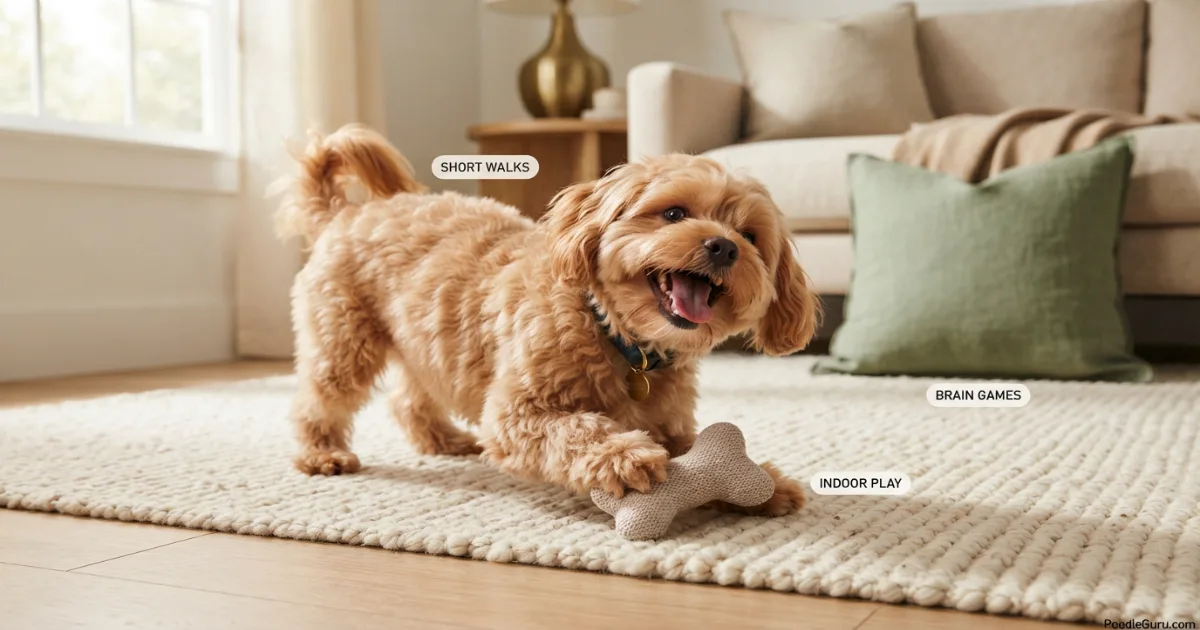
A daily 20–30 minute walk plus some indoor playtime satisfies most Peekapoos. They’re companion dogs, not athletes. Mental stimulation — puzzle toys, short training sessions, scent games — tires them out as effectively as physical exercise and prevents boredom-based behaviors.
Do Peekapoos shed?
Shedding varies widely. Peekapoos with tighter, Poodle-like curls shed very little. Those with straighter, Pekingese-influenced coats shed moderately. There’s no way to guarantee a non-shedding Peekapoo puppy — anyone promising otherwise is overselling.
Can Peekapoos be left alone during the day?
Peekapoos are prone to separation anxiety and do best in homes where someone is present most of the day. If you must leave, gradual alone-time training from puppyhood is essential. A Peekapoo left alone for 8+ hours daily without preparation is likely to develop destructive behaviors or chronic anxiety.
What’s the difference between a Peekapoo and a Cavapoo?
Both are Poodle mixes, but the non-Poodle parent differs. A Cavapoo crosses a Cavalier King Charles Spaniel with a Poodle — generally producing a more easygoing, stranger-friendly temperament. A Peekapoo (Pekingese cross) tends to be more watchful, more independent, and more bonded to a single person.
Final Summary: Key Takeaways for Peekapoo Buyers & Owners
The Peekapoo is a small dog with a substantial presence — deeply loyal, alert, and more complex than its fluffy appearance suggests. Here’s what to remember:
- A Peekapoo is a Pekingese-Poodle cross weighing 8–18 lbs with a lifespan of 12–15 years, but no two puppies are identical in coat, face shape, or temperament.
- Coat type ranges from wavy to curly, with shedding levels that vary from very low to moderate — “hypoallergenic” should never be assumed or guaranteed.
- The PoodleGuru 5-Point Peekapoo Evaluation Framework helps buyers assess Poodle influence, Pekingese contribution, coat predictability, temperament, and health clearances before committing.
- Responsible breeders provide documented health testing for both parents; a Peekapoo from tested parents in 2026 may cost $1,500–$3,200 depending on region, demand, and breeder support.
- Peekapoos thrive with owners who are home often, value a watchful companion, and commit to consistent grooming every 4–6 weeks plus between-appointment brushing.
- Separation anxiety, alert barking, and stranger wariness are common — early socialization and alone-time training dramatically improve long-term outcomes.
Next step: If you’re serious about a Peekapoo, use the 5-Point Evaluation Framework above to interview breeders — and walk away from any who can’t produce health clearances. Your future dog’s wellbeing depends on the choices you make before you ever bring a puppy home.