Aussiedoodle (Australian Shepherd Poodle Mix): Complete Guide
An Aussiedoodle blends the poodle’s keen intelligence with the Australian shepherd’s working-drive loyalty.
This guide covers what prospective owners actually need to know — beyond the cute photos — about temperament unpredictability, coat commitment, and whether this high-energy cross truly fits your household.
Quick Answer
An Aussiedoodle is a cross between an Australian shepherd and a poodle — typically a standard or miniature poodle. Most are F1 hybrids, which means coat type, size, and temperament can vary considerably even within a single litter.
They’re sharp, athletic dogs that thrive with active owners who can commit to daily mental and physical exercise plus regular professional grooming.
They’re not a low-maintenance choice, and the biggest mistake buyers make is underestimating the energy requirement.
What Is an Aussiedoodle?
An Aussiedoodle is a crossbreed dog produced by pairing an Australian shepherd with a poodle.
For poodle owners, this means the resulting dog carries roughly half poodle genetics and half Australian shepherd genetics — but exactly which traits surface in any individual puppy is never guaranteed.
The most important thing to understand is that Aussiedoodles are not a stabilized breed. No major kennel club recognizes them, and there is no breed standard that breeders must follow.
Most Aussiedoodles on the market are first-generation crosses, often called F1.
Some breeders produce F1b Aussiedoodles by backcrossing an Aussiedoodle to a poodle, which typically increases the likelihood of a low-shedding coat but doesn’t eliminate variability.
A smaller number produce multigenerational Aussiedoodles, sometimes marketed as “Australian poodles,” though that label is more marketing than substance.
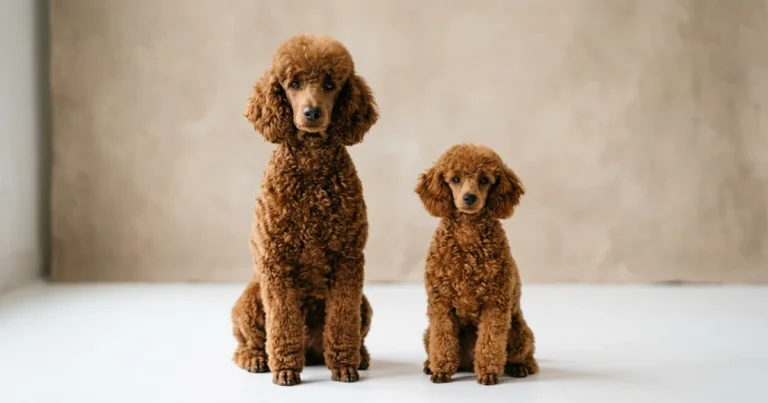
The Poodle contribution matters enormously. A standard poodle parent produces a larger, more substantial Aussiedoodle — often 40 to 70 pounds. A miniature poodle parent yields a smaller dog, typically 15 to 30 pounds.
The AKC recognizes three official poodle sizes, and the size of the poodle parent is the single biggest predictor of your Aussiedoodle’s adult size.
Quick Facts
Size Range
Standard cross: 40–70 lbs, 18–23″ tall. Miniature cross: 15–30 lbs, 12–17″ tall. Toy poodle crosses exist but are uncommon and carry additional health scrutiny.
Coat Type
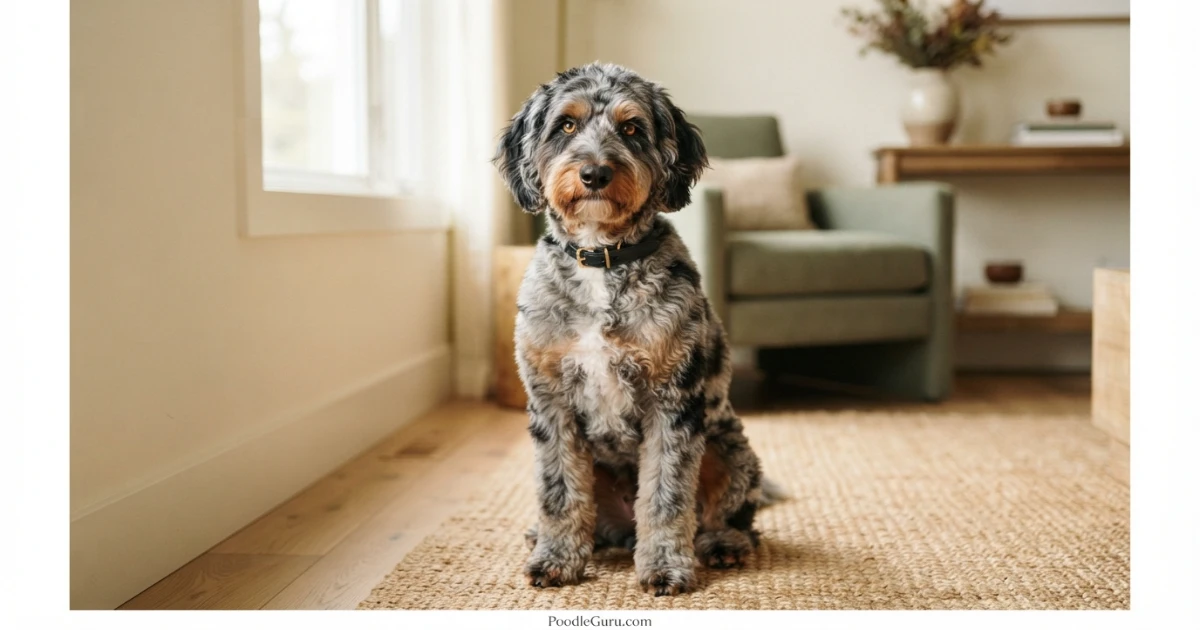
Wavy to curly, typically 2–4 inches long when maintained. Color possibilities include merle, solid, parti, and phantom. Merle is the most sought-after pattern.
Lifespan
12 to 15 years on average. Smaller Aussiedoodles from miniature poodle lines tend toward the upper end of this range when well-bred and properly cared for.
Energy Level
High. This is not a casual companion dog. Expect 60–90 minutes of dedicated exercise daily plus mental work. Under-stimulated Aussiedoodles develop destructive habits fast.
Shedding
Variable. Some shed minimally like a poodle. Others shed moderately and continuously. F1b backcrosses to poodles generally shed less, but there are no guarantees.
Good With
Active singles, couples, and families with older children. They need engagement. Not ideal for sedentary households, full-time absent owners, or first-time dog owners without support.
Why Aussiedoodles Captured So Much Attention
The Aussiedoodle sits at the intersection of two powerful trends: the sustained popularity of poodle crosses and the Australian shepherd’s reputation as a strikingly beautiful, whip-smart working dog. Social media amplified both.
Photos of merle-coated Aussiedoodles with ice-blue eyes spread quickly, and suddenly everyone wanted one.
But online popularity obscures a more complicated reality. The Australian Shepherd is a demanding herding breed. It was developed to work livestock across rough terrain for hours. That drive doesn’t disappear when you cross it with a poodle.
Many Aussiedoodle owners discover, several months in, that they brought home a dog that needs substantially more than they anticipated.
At PoodleGuru, we evaluate crossbreeds like the Aussiedoodle through a poodle-owner lens.
That means asking: does this cross preserve what poodle lovers value most — intelligence, trainability, and that distinctive coat — while adding something genuinely useful? The answer with Aussiedoodles is complicated.
For the right owner, the combination works beautifully. For the wrong one, it’s a mismatch that shows up in chewed furniture, reactive barking, and grooming overwhelm.
Size, Coat, and Appearance
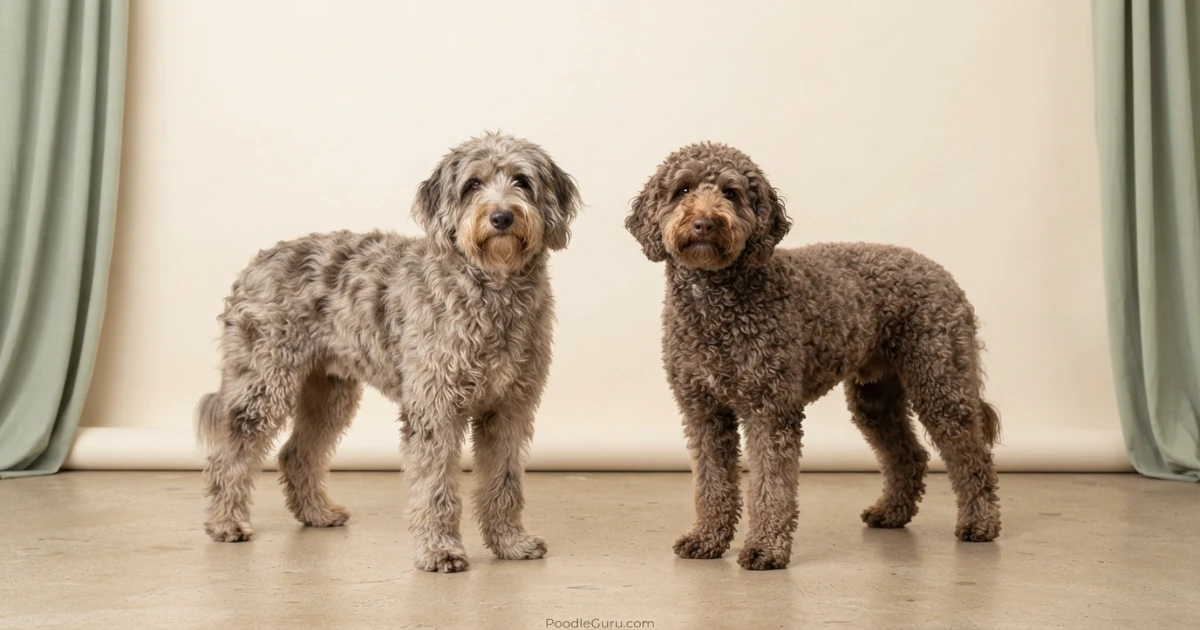
Aussiedoodle appearance spans a wide spectrum. Unlike purebred poodles, where the size categories are clearly defined, Aussiedoodles land anywhere between their two parental poles.
A standard poodle crossed with a standard Australian shepherd typically produces a dog between 40 and 70 pounds. A miniature poodle cross yields 15 to 30 pounds.
Toy Aussiedoodles — from toy poodle lines — occasionally appear but represent a tiny fraction of the market and deserve extra breeder scrutiny.
Coat Types: Wavy, Curly, and What to Expect
Aussiedoodle coats generally fall into three patterns, and they matter enormously for both grooming commitment and allergy considerations:
- Wavy coat (most common in F1): Loose waves, moderate shedding, easier to maintain between grooms but still requires brushing 3–4 times weekly. Most F1 Aussiedoodles land here.
- Curly coat (more common in F1b): Tighter curls resembling a poodle coat. Lowest shedding, highest grooming demand. Mats form quickly without daily attention.
- Straight or flat coat (less common): Leans heavily toward the Australian shepherd parent. Sheds more, requires less coat-specific maintenance, but disappoints buyers who expected the classic doodle look.
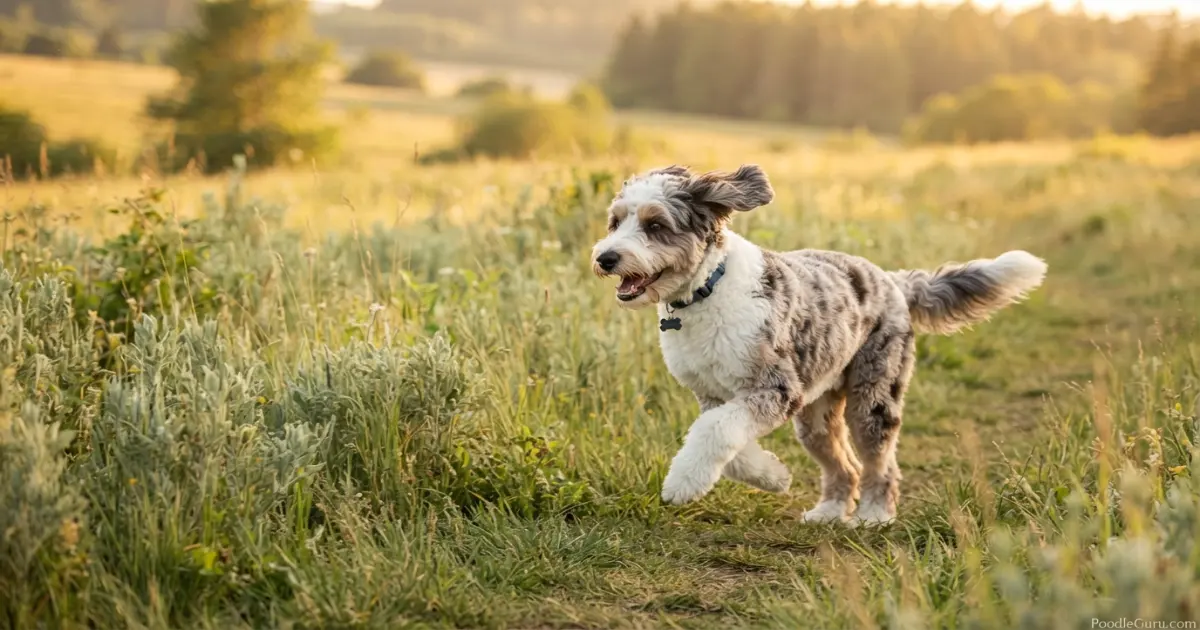
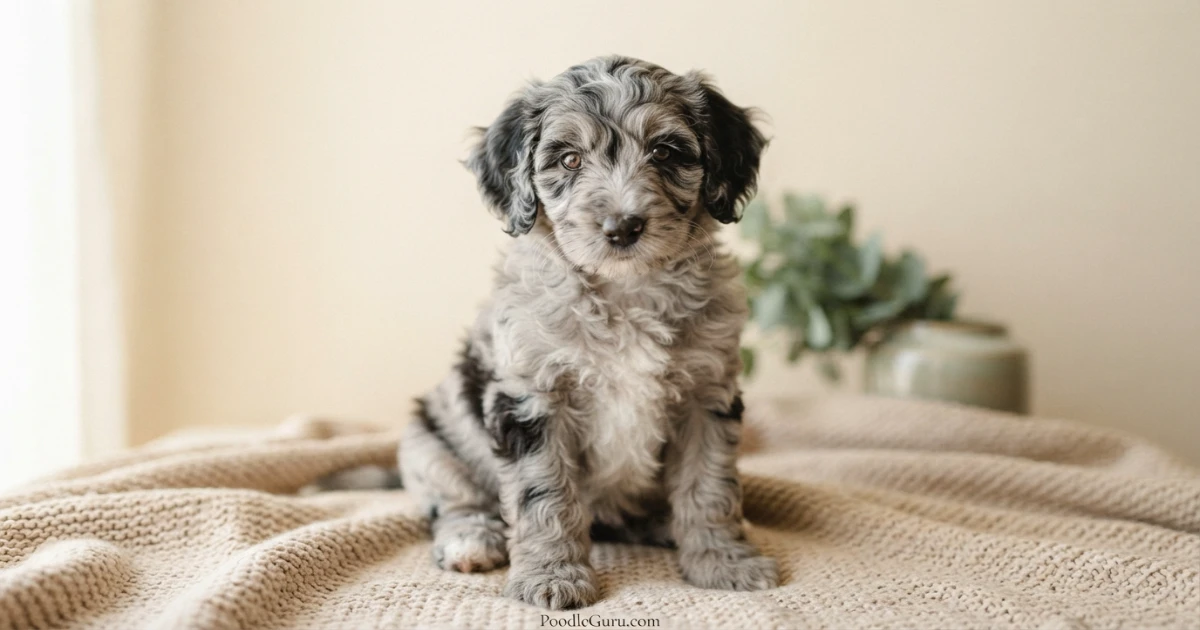
Color is where Aussiedoodles truly dazzle. The Australian shepherd contributes the merle gene, producing marbled patches of color across a lighter base — often with striking blue or parti-colored eyes.
Solid black, red, chocolate, cream, and parti-color Aussiedoodles also exist. Phantom coloring, where tan points appear above the eyes and on the legs, shows up in some lines.
Merle Aussiedoodles command the highest prices in 2026, often $1,000 to $2,000 more than solid-colored littermates.
The PoodleGuru Aussiedoodle Evaluation Framework
At PoodleGuru, we developed a four-point evaluation method to help prospective Aussiedoodle owners cut through marketing language and assess whether this cross genuinely fits their life. We call it the PoodleGuru Aussiedoodle Evaluation Framework.
Energy Honesty Check
Write down exactly how many minutes of active exercise you can realistically provide daily — not aspirational, but actual. If the number is under 60, an Aussiedoodle will likely struggle in your home. These dogs need to move, think, and work. Two 15-minute walks won’t cut it.
Grooming Reality Check
Calculate the monthly grooming cost for your area. Professional Aussiedoodle grooms run $80–$150 every 6–8 weeks. Add home brushing tools, detangling spray, and the time commitment of 15–25 minutes of brushing 3–7 times weekly depending on coat type.
If that number or time commitment makes you pause, reconsider.
Breeder Transparency Test
A quality Aussiedoodle breeder willingly shares health clearances for both parents — OFA hips, elbows, and eye certifications at minimum. They don’t dodge questions about parent temperaments. They don’t guarantee non-shedding coats.
They let you meet at least one parent dog. If any of these elements is missing, walk away.
Temperament Expectation Mapping
List what you actually want in a dog’s daily personality: couch companion? Running partner? Weekend hiker? Office buddy? Then compare that list honestly against the Aussiedoodle’s typical profile — high energy, high intelligence, high need for engagement.
Where the lists don’t match, those gaps become friction points in ownership.
Temperament and Behavior
Aussiedoodles are clever, alert, and deeply bonded to their people. That’s the upside. The downside: that same intelligence, when underutilized, turns into restlessness, hypervigilance, and sometimes neurotic behavior.
Australian shepherds were bred to notice everything and react fast. Poodles were bred to work closely with humans.
Combine the two and you get a dog that notices every squirrel, every delivery truck, every guest at the door — and has strong opinions about all of it.
Separation anxiety appears with notable frequency in Aussiedoodles. This isn’t surprising. Both parent breeds form intense attachments.
An Aussiedoodle left alone for eight hours daily without preparation often develops barking, destructive chewing, or house-soiling. Crate training and gradual alone-time conditioning from puppyhood are not optional — they’re essential.
Expert Insight: The Herding Instinct
Many Aussiedoodles inherit the Australian shepherd’s herding drive. This shows up as nipping at heels, circling children, or chasing running pets. It’s not aggression — it’s instinct — but it requires management.
Professional trainers who understand herding breeds can help redirect this behavior before it becomes a problem. Early socialization with children and other dogs reduces the intensity, but the underlying drive rarely disappears entirely.
With strangers, Aussiedoodles tend toward reserve. They’re rarely aggressive without cause, but they’re also not the kind of dog that greets every visitor like a long-lost friend.
This makes them decent watchdogs and somewhat less reliable as social butterflies. Early, positive exposure to varied people and situations makes a meaningful difference in adult temperament.
Aussiedoodle vs. Other Doodle Breeds
If you’re considering an Aussiedoodle, you’re probably also looking at other poodle crosses. Each brings a different parental influence. Here’s how the Aussiedoodle stacks up against the three most popular doodle varieties in 2026.
| Trait | Aussiedoodle | Goldendoodle | Labradoodle | Bernedoodle |
|---|---|---|---|---|
| Energy Level | Very high — needs 60–90 min daily | High — 45–75 min daily | High — 45–75 min daily | Moderate — 30–60 min daily |
| Coat Predictability | Low — wide variation even in F1b | Moderate — F1b fairly consistent | Moderate — F1b fairly consistent | Moderate — tends toward wavy |
| Herding Instinct | Strong — nipping, circling common | Mild — occasional in some lines | Mild to absent | Absent |
| Stranger Friendliness | Reserved — needs socialization | Friendly — typically outgoing | Very friendly — social butterfly | Gentle — warm but calm |
| Best For | Active, experienced owners | Active families, first-timers | Families, service work | Calmer households, families |
| 2026 Puppy Price Range | $1,800–$4,500 | $1,500–$3,500 | $1,200–$3,000 | $1,800–$4,000 |
The Aussiedoodle consistently ranks as the highest-energy option in this group. That’s not a flaw — for the right owner, it’s exactly the draw. But if you’re choosing between an Aussiedoodle and a bernedoodle, you’re looking at two fundamentally different daily experiences.
Health Considerations and Lifespan
Aussiedoodles live 12 to 15 years on average, with smaller individuals from miniature poodle lines typically reaching the upper end. Like all crossbreeds, they can inherit health conditions from either parent line. Being aware of these risks before you commit matters enormously.
Conditions to Watch For
- Hip dysplasia: Both parent breeds carry risk. Responsible breeders screen both parents through OFA or PennHIP before breeding. This is non-negotiable.
- Progressive retinal atrophy (PRA): An inherited eye disease that causes gradual vision loss. DNA testing can identify carriers. Ask to see PRA-prcd test results for both parents.
- MDR1 drug sensitivity: The Australian shepherd is one of the breeds commonly affected by the MDR1 gene mutation, which causes severe reactions to certain common medications. VCA Animal Hospitals explains that MDR1-affected dogs can have life-threatening reactions to drugs including ivermectin, loperamide, and certain chemotherapy agents. Testing is available and any Aussiedoodle with Australian shepherd lineage should be screened.
- Epilepsy: Idiopathic epilepsy appears in both poodles and Australian shepherds. There is no genetic screening test yet, which makes breeder transparency about lineage health history critical.
- Merle-to-merle breeding risks: When two merle dogs are bred together, roughly 25% of puppies inherit double merle genetics, which carries a high risk of deafness and eye abnormalities. Ethical Aussiedoodle breeders never breed merle to merle.
When to Call a Vet
Contact your veterinarian if your Aussiedoodle shows any of these: sudden lameness or stiffness (possible hip or joint issue), cloudiness or change in eye appearance, unexplained seizures or tremors, persistent digestive upset after medication, or progressive hearing loss.
This guide is educational and not a substitute for professional veterinary assessment.
 https://poodleguru.com/wp-content/uploads/2026/07/aussiedoodle-groomed-teddy-bear-trim.webp
Grooming and Coat Care
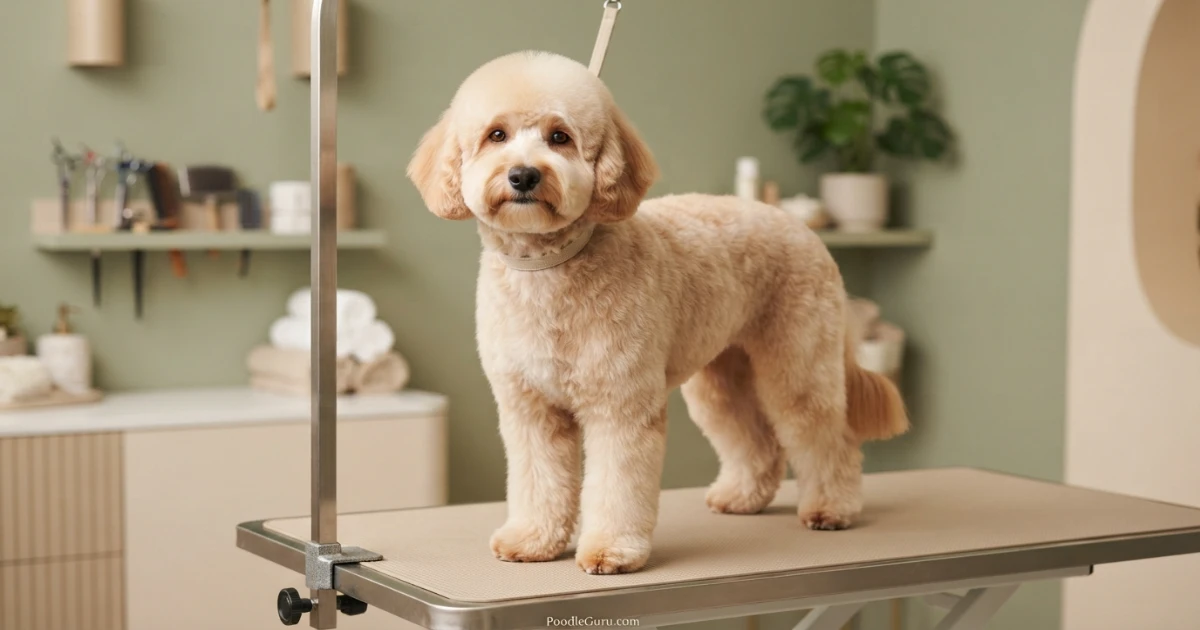
Aussiedoodle grooming is not optional maintenance you can catch up on later. It’s a continuous commitment that directly affects your dog’s comfort and health. Mats pull on skin, trap moisture, and create conditions for hot spots and infections.
An Aussiedoodle with a neglected coat is a dog in pain.
At minimum, plan for:
- Brushing: 3–4 times weekly for wavy coats; daily for curly coats. Use a slicker brush followed by a metal comb to check for hidden mats near the skin.
- Professional grooming: Every 6–8 weeks. Budget $80–$150 per session depending on your location and your dog’s size.
- Ear care: Weekly ear checks and cleaning. Both parent breeds can be prone to ear infections, and Aussiedoodles with drop ears are especially vulnerable.
- Nail trims: Every 3–4 weeks. Overgrown nails alter gait and contribute to joint stress over time.
When to Ask a Professional Groomer
If you notice mats forming close to the skin — especially behind the ears, under the collar, in the armpits, or around the tail base — don’t try to cut them out with scissors. It’s dangerously easy to cut skin that’s pulled up into a mat.
A professional groomer has the tools and experience to remove mats safely. Also consult a groomer if your Aussiedoodle’s coat texture changes significantly after spay/neuter, which is common and may require a different grooming approach.
For more on coat maintenance fundamentals that apply to Aussiedoodles, see our complete poodle grooming guide — the brushing techniques and tool recommendations transfer directly.
Buyer’s Guide: What to Look For (2026)
Aussiedoodle puppies in 2026 range from roughly $1,800 to $4,500 in the United States, with merle-coated puppies from health-tested parents commanding the highest prices.
Geographic location matters — coastal urban markets tend toward the upper end, while rural areas may be lower. What’s worth paying for and what inflates the price without adding value?
What Actually Justifies a Higher Price
- Both parents with verifiable OFA hip, elbow, and eye clearances
- MDR1 genetic testing on the Australian shepherd parent (and puppy if indicated)
- PRA-prcd DNA testing on both parents
- Breeder who raises puppies in-home with early neurological stimulation
- Health guarantee that covers genetic conditions for at least two years
- Breeder who asks you questions — about your lifestyle, experience, and plans
Red Flags That Should Make You Walk Away
- “Non-shedding guaranteed” — nobody can honestly guarantee this in an F1 cross
- No health clearances available for review
- Multiple litters available simultaneously with no waitlist
- Merle-to-merle breeding (ask directly — ethical breeders will answer clearly)
- Puppies available before 8 weeks of age
- Pressure to pay a deposit before you’ve had your questions answered
2026 Aussiedoodle Price Guide
Standard Aussiedoodle (solid color): $1,800–$2,800
Standard Aussiedoodle (merle): $2,500–$4,500
Miniature Aussiedoodle (solid color): $2,000–$3,200
Miniature Aussiedoodle (merle): $2,800–$4,500+
Prices reflect 2026 US market averages. Adoption through breed-specific rescues typically costs $300–$600 and often includes adult dogs past the highest-energy puppy phase — a practical option worth considering.
How to Evaluate an Aussiedoodle Breeder
Request Health Clearances First
Ask for OFA certification numbers for both parents before discussing price or availability. Look up the numbers yourself on the OFA website. A breeder who hesitates or deflects is telling you something important.
Meet At Least One Parent Dog
Observe temperament directly. Is the parent dog calm, friendly, and comfortable with strangers? Or anxious, reactive, or withdrawn? Puppies learn a great deal about how to be a dog from their mother in those first eight weeks.
Ask About Return Policy
Ethical breeders contractually commit to taking a dog back at any point in its life if you cannot keep it. If a breeder has no return policy and no interest in what happens to their puppies after sale, that’s a volume operation, not a responsible breeding program.
Common Myths and Misunderstandings
“Aussiedoodles are hypoallergenic.”
No dog is truly hypoallergenic. Aussiedoodles with curlier coats produce less dander and shed less hair, but they still produce allergens in saliva and skin oils. F1 Aussiedoodles with wavier coats may shed enough to trigger allergies.
If allergies are a serious concern, spend time with adult Aussiedoodles of the specific cross you’re considering before committing.
“Hybrid vigor means Aussiedoodles are healthier than purebreds.”
Hybrid vigor is real in theory — outcrossing can reduce the expression of certain recessive disorders. But it only works when both parent lines are genetically healthy. Breeding two dogs with hip dysplasia doesn’t produce puppies with better hips.
Health testing matters more than the crossbreed label.
“You’ll get the best of both breeds.”
Genetics doesn’t work like a smoothie. You don’t automatically get the poodle’s coat and the Aussie’s loyalty in equal measure. You might get the Aussie’s shedding, the poodle’s aloofness with strangers, and the combined intensity of both working drives.
A good Aussiedoodle is wonderful. But the outcome isn’t guaranteed by the cross alone.
Owner Action Plan
If you’re moving forward with an Aussiedoodle, here’s your practical roadmap.
Before You Commit
Interview at least three breeders. Verify health clearances. Meet adult Aussiedoodles in person if possible. Calculate total first-year costs including purchase price, supplies, vet care, and grooming — expect $4,000–$7,500 all-in for year one.
First Week Home
Schedule the first vet visit within 72 hours. Begin crate training immediately. Start name recognition and basic engagement games. Introduce the grooming table and tools gently — no full grooms, just positive exposure.
First Six Months
Enroll in positive-reinforcement puppy classes. Socialize broadly but carefully. Establish a professional grooming schedule. Begin alone-time training in small increments. Watch for emerging herding behaviors and redirect early.
Frequently Asked Questions
Do Aussiedoodles shed a lot?
It depends entirely on which coat type they inherit. Curly-coated Aussiedoodles (more common in F1b backcrosses) shed minimally. Wavy-coated F1 Aussiedoodles typically shed moderately. Flat-coated individuals shed more heavily.
There is no way to guarantee a non-shedding Aussiedoodle, especially in first-generation crosses.
Are Aussiedoodles good with children?
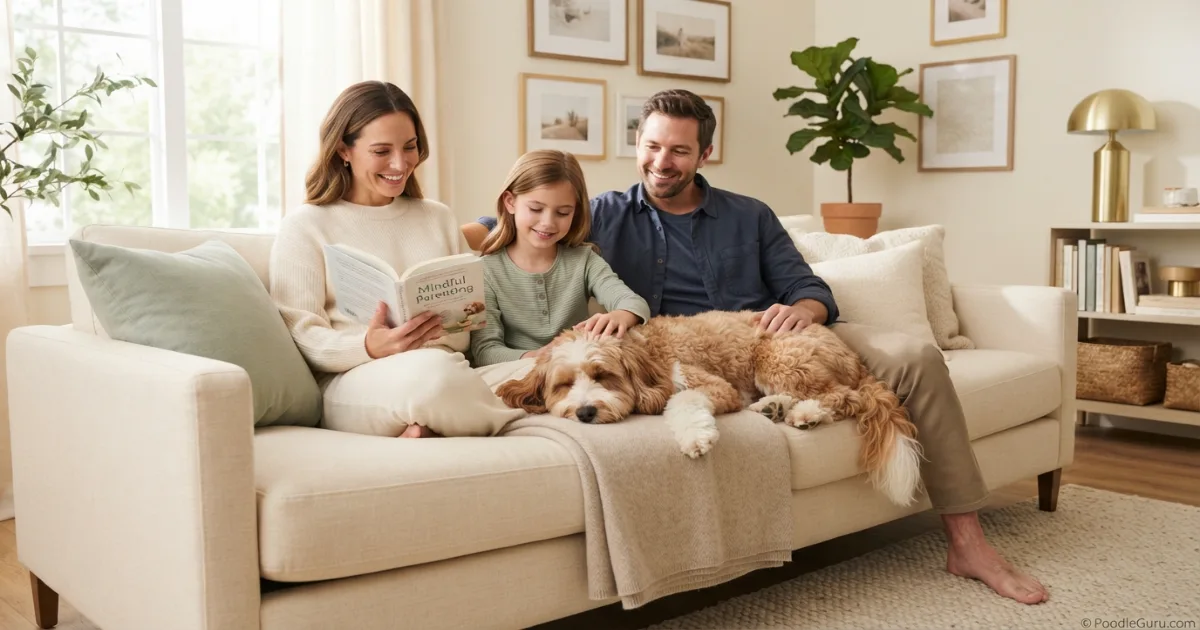
They can be excellent family dogs with proper training and supervision, but their herding instinct — nipping at heels and circling running children — requires management.
Aussiedoodles generally do better with older children who can follow instructions about how to interact with the dog calmly. Early socialization with kids is essential.
How much exercise does an Aussiedoodle need?
Plan for 60 to 90 minutes of dedicated physical exercise daily, plus mental stimulation through training, puzzle toys, or scent work. This is not a dog satisfied by a quick walk around the block.
Under-exercised Aussiedoodles often develop barking, digging, and destructive chewing habits.
What is the difference between an F1 and F1b Aussiedoodle?
An F1 Aussiedoodle is a first-generation cross: Australian shepherd bred to poodle. An F1b Aussiedoodle is a backcross: an F1 Aussiedoodle bred back to a poodle.
F1b dogs typically have curlier, lower-shedding coats and temperaments that lean slightly more toward the poodle side, but variability remains significant.
How much does an Aussiedoodle cost in 2026?
Expect to pay $1,800 to $4,500 from a reputable breeder, with merle-coated puppies at the high end. Adoption fees through rescues typically range from $300 to $600.
The purchase price is only part of the picture — budget an additional $2,000–$3,500 for first-year expenses including veterinary care, supplies, training, and grooming.
Do Aussiedoodles bark a lot?
Many Aussiedoodles are vocal. Both parent breeds are alert and responsive to environmental stimuli. Without training, Aussiedoodles may bark at passing dogs, delivery personnel, squirrels, and unexpected sounds.
Early training focused on quiet cues and impulse control makes a measurable difference, but a naturally quiet Aussiedoodle is the exception rather than the rule.
Can Aussiedoodles be left alone during the day?
Most Aussiedoodles struggle with long periods alone. They form strong bonds and are prone to separation anxiety.
If you work full-time away from home, plan for a dog walker, doggy daycare, or a carefully structured alone-time training program starting from puppyhood. An Aussiedoodle left alone for eight-plus hours daily is likely to develop behavioral problems.
Final Summary: Is an Aussiedoodle Right for You?
The Aussiedoodle is a striking, intelligent, and deeply engaged companion — for the right owner. That qualifier matters more here than it does for many other poodle crosses. This is not a breed-adjacent dog that molds itself to a sedentary household.
It needs work, movement, mental challenge, and a grooming routine that doesn’t slip.
If you’re active, home enough to meet their social needs, financially prepared for grooming costs, and willing to invest in training from day one, an Aussiedoodle can be an extraordinary dog.
If any of those pieces is missing, a goldendoodle, bernedoodle, or even a well-bred standard poodle might fit your life more smoothly.
Key Takeaways
- Aussiedoodles are an Australian shepherd–poodle cross with high energy, high intelligence, and significant grooming needs — not a low-maintenance breed.
- Coat type, shedding level, and adult size vary widely even within a single litter. No breeder can honestly guarantee a non-shedding F1 Aussiedoodle.
- Expect 60–90 minutes of daily exercise plus mental stimulation. Under-stimulated Aussiedoodles develop behavioral problems quickly.
- Both parent breeds contribute health risks — hip dysplasia, PRA, and MDR1 drug sensitivity among them. Health-tested parents are non-negotiable.
- Professional grooming every 6–8 weeks ($80–$150 per session) plus home brushing 3–7 times weekly is the baseline coat-care commitment.
- Prices range from $1,800 to $4,500 in 2026. Merle coloring inflates price without improving health or temperament. Invest in health clearances, not coat color.