Do Poodles Get Cold Easily? Cold Tolerance By Coat & Size
Your poodle shivers after five minutes outside while the neighbor’s Labrador romps happily through the snow. It’s not your imagination. Poodles experience cold differently from double-coated breeds, and a Toy Poodle’s winter reality is nothing like a Standard’s. Here’s exactly how cold is too cold — and what to do about it.
Quick Answer: Do Poodles Get Cold Easily?
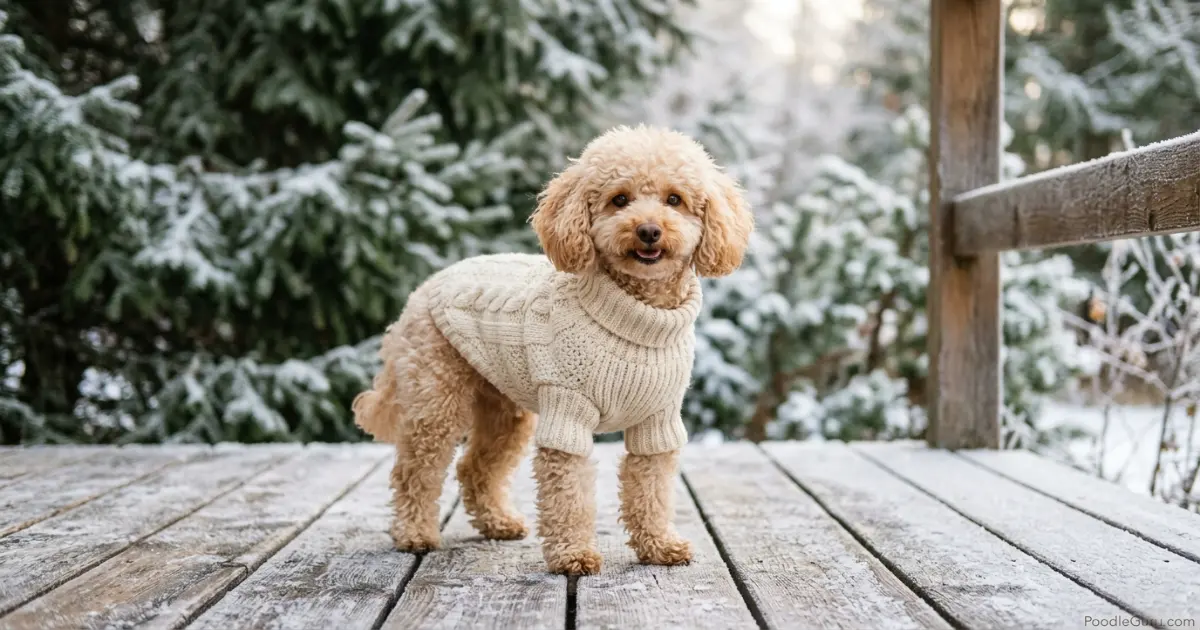
Yes, most poodles have low to moderate cold tolerance compared to double-coated breeds. Their single-layer, hair-like coat provides minimal insulation. A Toy Poodle may start shivering at 45°F, while a thick-coated Standard might stay comfortable into the mid-30s. Age, coat density, haircut length, and activity level all shift those thresholds — but the short answer is that poodles need more cold-weather support than their fluffy appearance suggests.
Single-Coat Breed
Poodles have hair, not fur — a single-layer coat with no insulating undercoat, leaving them more exposed to cold.
Size Matters Most
Toy Poodles chill fastest due to high surface-area-to-volume ratio. Standards retain heat better but still need protection.
Shivering = Act Now
Shivering is a late-stage cold signal. Stiffness, lifted paws, and seeking shelter are earlier signs to watch for.
Why Poodles Lack Natural Cold Protection
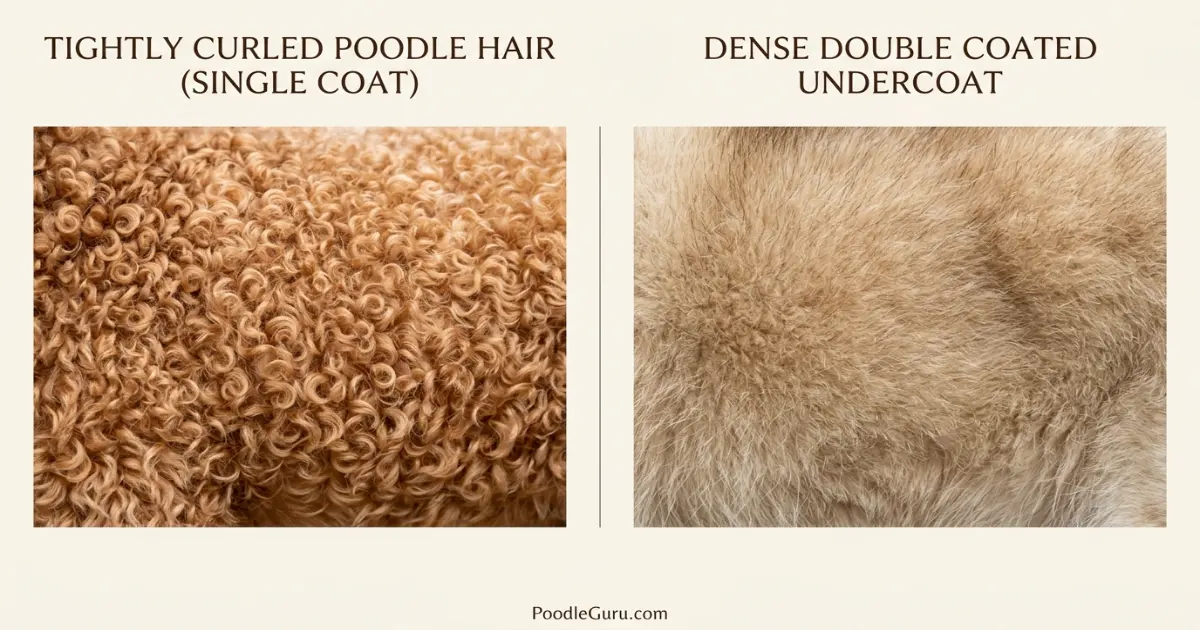
Poodle cold tolerance is a coat structure problem, not a hardiness problem. Most cold-weather dog breeds — Huskies, Golden Retrievers, Bernese Mountain Dogs — have a double coat: a dense, woolly undercoat beneath a protective outer layer of guard hairs. That undercoat traps warm air against the skin. It’s natural insulation, and it works remarkably well.
Poodles don’t have that. They have a single-layer coat of tightly curled hair that evolved for water retrieval, not for snow. The tight curls were designed to protect the skin from cold water during retrieval work while allowing freedom of movement. That same coat structure, on land, offers very little thermal retention. The curls leave air gaps that cold air penetrates easily, especially when the coat is clipped short.
The most important thing to understand is that poodle coat insulation is almost entirely dependent on length and density. A poodle in a full continental clip with several inches of hair has measurably better cold protection than one in a short summer clip. But even a long-coated poodle lacks the undercoat that truly cold-weather breeds rely on. For poodle owners, this means cold-weather management isn’t optional — it’s part of responsible breed care.
This coat structure also explains why poodles benefit from regular grooming in winter, not less. Mats and tangles disrupt what little insulation the coat does provide. A well-brushed, even-length coat insulates better than a matted one. For more on maintaining coat health year-round, our complete poodle grooming guide covers seasonal coat care in detail.
Cold Tolerance by Size: Toy vs Miniature vs Standard
Body size is the single biggest variable in poodle cold tolerance. A Toy Poodle and a Standard Poodle might share the same coat structure, but their experience of cold is dramatically different. The reason is physics — specifically, the surface-area-to-volume ratio.
Small dogs have proportionally more skin surface relative to their body mass than large dogs. Heat escapes through that surface. A Toy Poodle weighing 5 pounds loses body heat much faster than a Standard weighing 50 pounds, even at the same temperature. This isn’t about toughness. It’s about thermodynamics. A Toy Poodle’s internal furnace is simply smaller, and the heat it generates dissipates more quickly into cold air.
| Poodle Size | Typical Weight | Comfort Zone (No Gear) | Needs Sweater/Jacket Below | Limit Outdoor Time Below |
|---|---|---|---|---|
| Toy Poodle | 4–6 lbs | 55–65°F | 50°F | 35°F |
| Miniature Poodle | 10–15 lbs | 50–60°F | 45°F | 30°F |
| Standard Poodle | 40–70 lbs | 40–55°F | 35–40°F | 20°F |
These thresholds are starting points, not hard rules. A Standard Poodle with a long, dense coat who is actively running may stay comfortable well below 35°F. A senior Toy Poodle with a short clip and arthritis may shiver at 55°F. Individual factors always modify the baseline, but the size gradient is consistent: the smaller the poodle, the sooner and more aggressively cold protection is needed.
At PoodleGuru, we evaluate cold tolerance as a size-first variable because it predicts risk more reliably than coat length or age alone. For a deeper understanding of how size affects every aspect of poodle care, our poodle size comparison guide breaks down the practical differences across all three sizes.
Temperature Comfort Zones for Poodles
Temperature tolerance isn’t binary — “fine” versus “freezing.” It’s a gradient, and poodles give signals at every stage. Learning those signals helps you intervene before your dog is genuinely uncomfortable or at risk.
50–65°F: The sweet spot for most poodles. A Toy Poodle may seek a sunbeam or curl up, but no intervention is needed. Standards are actively comfortable at the lower end of this range. This is ideal poodle weather.
40–50°F: Toy and Miniature Poodles begin to feel the chill, especially if stationary. A sweater or light jacket is appropriate for walks longer than 10–15 minutes. Standards are still comfortable, particularly if moving.
30–40°F: All poodles need protection. Toy Poodles should wear insulated jackets and limit outdoor time to quick potty breaks unless actively exercising. Miniatures need jackets for walks. Standards benefit from a light coat if they’ll be out more than 20 minutes.
20–30°F: Serious cold for Toys and Miniatures — outdoor time should be brief and supervised. Standards need jackets and may start lifting paws or showing discomfort on icy surfaces. Booties become relevant for all sizes at this range.
Below 20°F: Potty breaks only for Toys and Miniatures. Standards need insulated jackets and limited exposure. Frostbite risk to ears, paws, and tail tip increases significantly. No poodle should be left unattended outdoors at these temperatures.
The PoodleGuru Cold-Weather Readiness Checklist
At PoodleGuru, we approach cold-weather care as a system, not a single decision. The temperature outside is only one variable. Your poodle’s coat length, activity level, age, and health status all shift the equation. This five-point framework helps you assess cold risk quickly before every winter outing.
Check the Real-Feel Temperature
Wind chill and dampness matter as much as the thermometer number. A 40°F day with steady wind and drizzle chills a poodle faster than a still, dry 30°F day. Check the “feels like” temperature, not just the air temperature. Wet poodle hair loses whatever insulating value it had — water conducts heat away from the body 25 times faster than air.
Assess Your Poodle’s Coat Status
A poodle in a short summer clip has essentially no natural insulation. One in a full winter coat with 2+ inches of hair has modest protection. Coat length is the single biggest factor you control through grooming decisions. Many poodle owners let the coat grow slightly longer from November through March, then clip shorter for summer.
Factor in Activity Level
A poodle sprinting at the dog park generates significant body heat and can tolerate colder temperatures than one standing still on a leash. But activity also creates risk: a wet, tired poodle who stops running cools down dangerously fast. Always have a drying plan — a towel and a warm, draft-free space — ready when winter exercise ends.
Adjust for Age and Health
Puppies under six months, seniors over eight years, and poodles with arthritis, kidney disease, or low body fat have reduced cold tolerance. Their thermoregulation systems are less efficient. These dogs need protection at temperatures 5–10°F warmer than the general guidelines suggest.
Watch for Early Chill Signals
Don’t wait for shivering. Earlier signs include lifting paws off the ground, tucking the tail tightly, stiffening the body, or seeking shelter behind your legs. These are your poodle asking for help before they’re in distress. Respond to these signals, and you’ll rarely see full-body shivering.
How to Tell If Your Poodle Is Too Cold
Poodles can’t say “I’m cold” in words, but they communicate it clearly through body language. The signs appear in a predictable sequence. Learning that sequence means you intervene early — before discomfort becomes danger.
| Stage | Signs | What It Means | Action |
|---|---|---|---|
| Mild Discomfort | Lifting paws, tucking tail, slowing pace, looking toward home | Surface cold is setting in; extremities are cooling first | Add a coat, shorten the walk, or move to a sheltered area |
| Moderate Cold Stress | Shivering, hunched posture, seeking shelter behind you, reluctance to walk | Core body temperature is beginning to drop; the dog is actively uncomfortable | Pick up small poodles inside your coat; head home immediately for all sizes |
| Concerning Cold Stress | Persistent shivering, whining, stiff movements, cold ears and paws to the touch | Body temperature has dropped measurably; prolonged exposure risks hypothermia | Get indoors, wrap in a warm dry towel, offer lukewarm (not hot) water, monitor closely |
| Emergency | Shivering stops abruptly, lethargy, weakness, pale gums, unresponsiveness | Severe hypothermia — the body has stopped trying to warm itself | Emergency veterinary attention needed; wrap in warm blankets during transport |
When to Call the Vet
If your poodle has been exposed to cold and shows persistent shivering that doesn’t stop after 10–15 minutes indoors, seems lethargic, has pale or blue-tinged gums, or if their ears, paws, or tail tip appear pale and cold — contact your veterinarian. Frostbite can occur on ear tips, tail tips, and paw pads even at moderately cold temperatures, especially in Toy Poodles with thin ear leather.
Winter Gear: What Actually Helps and What’s Just Cute
The pet winter-gear market is vast and largely unregulated. Some products genuinely improve cold tolerance. Others are fashion with no functional value. Here’s what matters.
Insulated Jackets and Sweaters
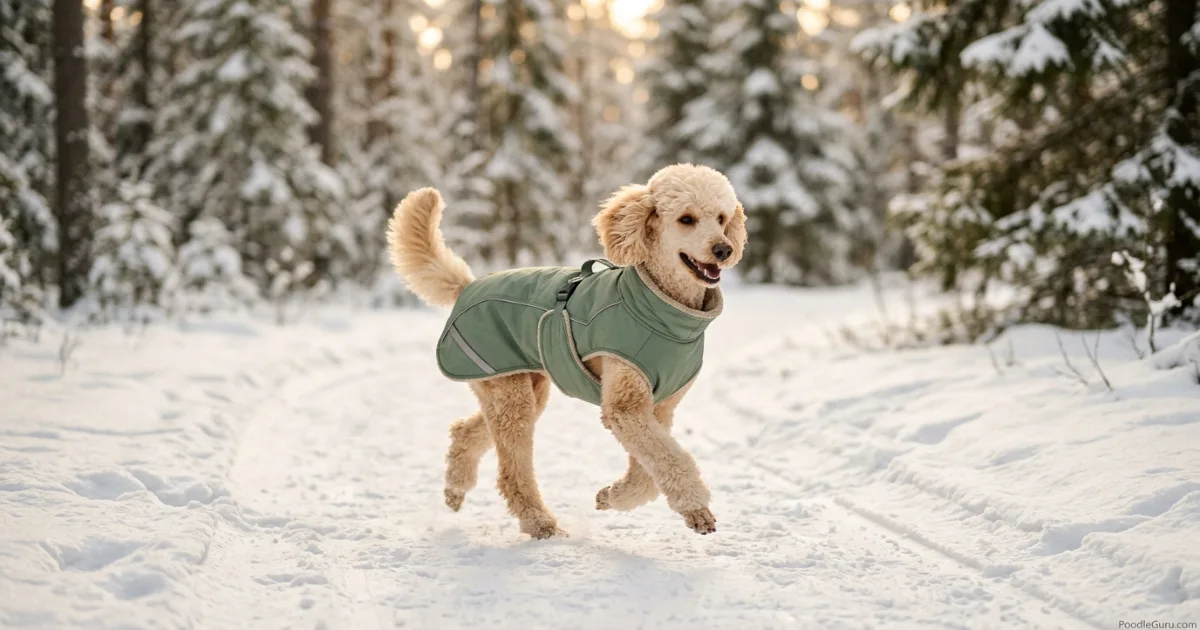
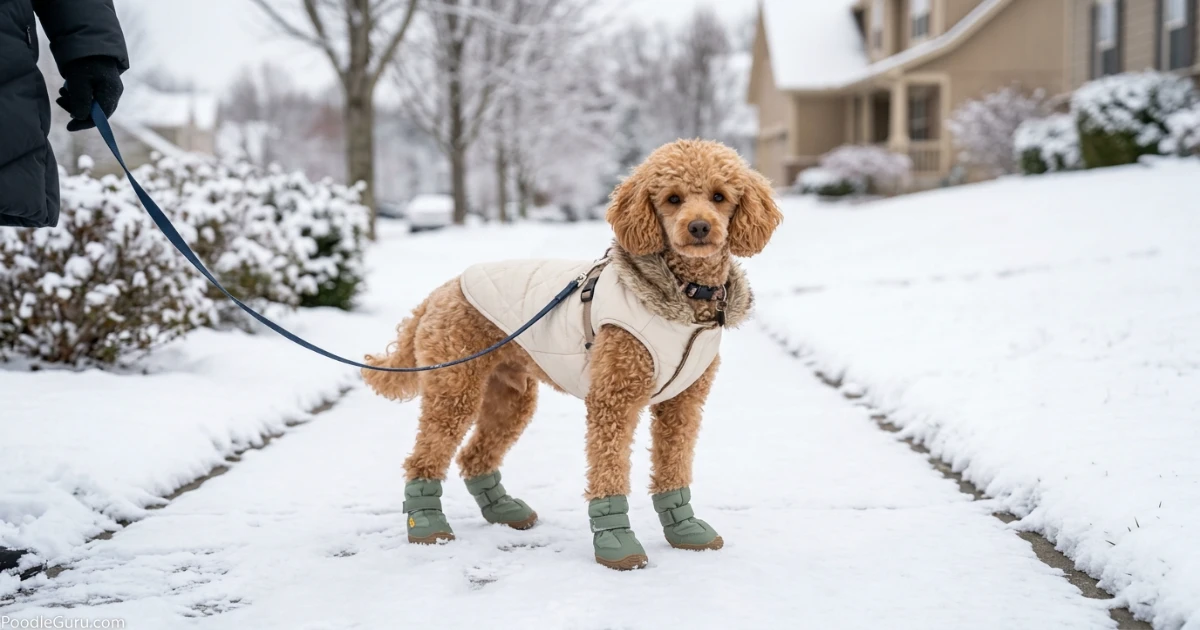
A properly fitted jacket should cover the chest and belly — the areas with the least natural hair coverage on a poodle. Fleece-lined, water-resistant outer shells offer the best combination of warmth and practicality. Knitted sweaters without a windproof layer lose effectiveness quickly in damp or windy conditions. Fit matters as much as material: a jacket that’s too loose lets cold air circulate underneath; one that’s too tight restricts movement. Measure your poodle’s neck, chest girth, and back length before purchasing.
Paw Protection
Poodle paws face two winter threats: cold surfaces and chemical de-icers. Salt and ice-melt products irritate paw pads and can cause chemical burns. Booties solve both problems but require acclimation — most poodles walk awkwardly in them at first. Short acclimation sessions indoors with treats build tolerance. If booties aren’t workable, a paw balm applied before walks creates a protective barrier, and wiping paws thoroughly with a warm damp cloth after every winter walk removes salt residue.
What Doesn’t Help
Thin fashion sweaters with no insulating layer, coats that don’t cover the belly, and tight garments that compress the coat (flattening what little insulation the hair provides) offer minimal cold protection. A poodle’s winter wardrobe doesn’t need to be extensive. One well-fitted insulated jacket and a set of booties or paw balm covers the functional essentials for most climates.
What Changes With Age: Winter Care Across Life Stages
Cold tolerance isn’t static. It shifts across a poodle’s lifetime. What works for a three-year-old adult may be inadequate for a twelve-week-old puppy or a ten-year-old senior.
Puppies have a high surface-area-to-volume ratio and immature thermoregulation. They chill quickly and don’t always show clear discomfort signals. Limit puppy winter outings to 5–10 minutes in temperatures below 40°F, and dry them thoroughly afterward. Puppy coats are often softer and less dense than adult coats, offering even less insulation.
Healthy adults have the best cold tolerance of any life stage, but the size rules still apply. A Standard in good condition with a winter coat length can handle extended cold-weather exercise with appropriate gear. A Toy in a short clip remains vulnerable even in peak adulthood.
Senior poodles often lose muscle mass and body fat, both of which contribute to heat retention. Arthritis — common in aging poodles — worsens in cold weather. A senior poodle who seems reluctant to walk in winter may be communicating joint stiffness, not just temperature discomfort. Cold exacerbates arthritis pain. Shorter, more frequent outings with warm-up time indoors before and after can help. For more on senior poodle care, our guide on poodle lifespan and aging covers health management through the later years.
The VCA Hospitals cold-weather safety guide provides additional veterinary-reviewed guidance on winter pet care. For breed-specific coat and color information that may influence your grooming choices across seasons, the AKC Poodle breed standard covers official coat descriptions.
Frequently Asked Questions
At what temperature do poodles need a sweater?
Toy Poodles generally benefit from a sweater below 50°F. Miniature Poodles below 45°F. Standard Poodles below 35–40°F, especially if they have a short clip. These thresholds drop slightly for active dogs and rise for seniors, puppies, or stationary dogs.
Can poodles get hypothermia?
Yes. Hypothermia occurs when a dog’s body temperature drops below normal (roughly 99–102.5°F). Toy and Miniature Poodles are at higher risk due to rapid heat loss, but any poodle exposed to prolonged cold, especially when wet, can develop hypothermia.
Do poodles need boots in winter?
Booties protect against both cold surfaces and chemical de-icers. They’re especially useful for Toy and Miniature Poodles below 30°F, or for any poodle walking on salted sidewalks. If boots aren’t tolerated, paw balm and post-walk wiping are the next-best alternatives.
Does a longer coat keep a poodle warmer?
Yes, but with limits. A poodle with 2+ inches of dense, well-brushed hair retains measurably more heat than one in a short clip. But even a long poodle coat lacks the insulating undercoat of cold-weather breeds, so the warmth difference is modest, not transformative.
Why does my poodle shiver even inside the house?
Indoor shivering can signal anxiety, pain, illness, or true cold sensitivity — especially in very small Toy Poodles or seniors. If the room temperature is above 65°F and your poodle still shivers regularly, a veterinary check is appropriate to rule out underlying causes.
Can I let my Standard Poodle play in the snow?
Yes, with precautions. Standards tolerate cold better than smaller poodles, especially when running. But snow clings to poodle hair and melts against warm skin, accelerating heat loss. Dry your poodle thoroughly after snow play, and watch for paw discomfort from ice between pads.
How do I know if my poodle’s paws are too cold?
Lifting paws off the ground, licking paws excessively, or stopping mid-walk to stare at you are common paw-cold signals. Touch the paw pads — if they feel cold to your hand, they’re cold to your poodle. Paw balm or booties are the practical solutions.
Do poodle puppies have worse cold tolerance than adults?
Yes. Puppies have a higher surface-area-to-volume ratio and less efficient thermoregulation. They lose heat faster than adults and may not show clear discomfort signals. Limit puppy winter outings to 5–10 minutes below 40°F and dry them thoroughly afterward.
Key Takeaways: Poodle Cold Tolerance
- Poodles have a single-layer coat with no insulating undercoat, giving them inherently lower cold tolerance than double-coated breeds.
- Toy Poodles chill fastest and need protection starting around 50°F; Standards tolerate cold better but still benefit from winter gear below 35°F.
- The PoodleGuru Cold-Weather Readiness Checklist evaluates real-feel temperature, coat status, activity level, age, and early chill signals before every winter outing.
- Shivering is a late-stage cold signal — watch for earlier signs like lifted paws, tucked tail, and slowed movement.
- Coat length, age, and health status all shift cold tolerance thresholds; a senior Toy Poodle with a short clip needs protection at temperatures a young Standard with a full coat would find comfortable.
- Winter gear that works includes insulated, belly-covering jackets, paw protection from cold and salt, and thorough drying after any cold or wet exposure.