Why Does My Poodle Eat Poop? Coprophagia Causes & Solutions
You’re not alone if you’ve watched your elegant, intelligent poodle do something that seems completely beneath them. Coprophagia — the technical term for eating feces — is more common in poodles than most owners expect. It’s unpleasant, but it’s rarely a sign that something is deeply wrong with your dog. What matters is understanding why it’s happening and knowing which solutions actually work.
Quick Answer
Most poodle poop-eating is a normal, if repulsive, canine behavior rooted in ancestral scavenging or maternal instinct. It can also be a learned habit, an attention-seeking tactic, or a signal of a digestive issue. Start by ruling out diet gaps and health problems with your vet. Then, shift to management: immediate cleanup, taste deterrents, and enrichment. Punishment usually makes it worse. The fix is methodical, not magical.
What Is Coprophagia? A Clear Definition
Coprophagia is a feeding behavior where a dog consumes its own feces, the feces of other dogs, or the stool of other animals. For poodle owners, this means the deliberate, repeated ingestion of waste — not a one-time accidental mouthful during a curious sniff.
The most important thing to understand is that in adult dogs, coprophagia is rarely a primary problem. It’s almost always a symptom of something else: a nutritional gap, a digestive inefficiency, a behavioral need, or an environmental trigger. Treating only the act without finding that underlying thread is why so many owners struggle with this for months.
In the canine world, this isn’t a moral failing. Dogs don’t share our disgust reflex. What they do share is a scavenging evolutionary history, and for a sensitive, intelligent breed like the poodle, that history can intersect with modern life in frustrating ways.
Quick Facts: Poodles & Poop Eating
It’s Widespread
Veterinary behaviorists estimate that roughly 16% of dogs are serious stool eaters, with many more trying it at least once. Poodles are not overrepresented, but their owner’s attentiveness means it gets noticed faster.
Females Do It More
Intact females, likely driven by maternal den-cleaning instincts, show higher rates. Spayed females can still carry this hardwired behavior.
Multi-Dog Homes Raise Risk
Poodles living with other dogs are exposed to more feces and more social learning opportunities. The behavior can spread within a household.
Why Poodles? The Breed Behavior Connection
Poodles don’t eat poop because they’re poodles. They do it because they’re dogs. But certain poodle traits make the behavior feel more jarring and sometimes harder to interrupt.
Poodles are operant learners. They clock cause and effect fast. If eating stool once led to a big reaction from you — shouting, chasing, arm-waving — a bored or understimulated poodle may file that under “effective attention-getting strategy.” This isn’t spite. It’s a bright dog solving the problem of “how do I get my human to engage with me?”
Their sensitivity also matters. Poodles are often more affected by environmental stress than hardier breeds. A change in routine, a new pet, or a tense household can spike anxiety-driven behaviors, including coprophagia. And because poodles are often fastidious about their living space, some will eat stool to “clean up” a confined area — a trait more common in puppy-mill survivors or dogs with early crate-soiling histories.
The breed’s high social attunement cuts both ways. It makes them wonderfully responsive to positive training. It also makes them vulnerable to reinforcement of behaviors we don’t want. Understanding this poodle-specific learning style is the first step toward a real fix. For a deeper look at the breed’s overall temperament, our Complete Poodle Temperament Guide lays out what makes these dogs tick.
Why Does My Poodle Eat Poop? 6 Root Causes
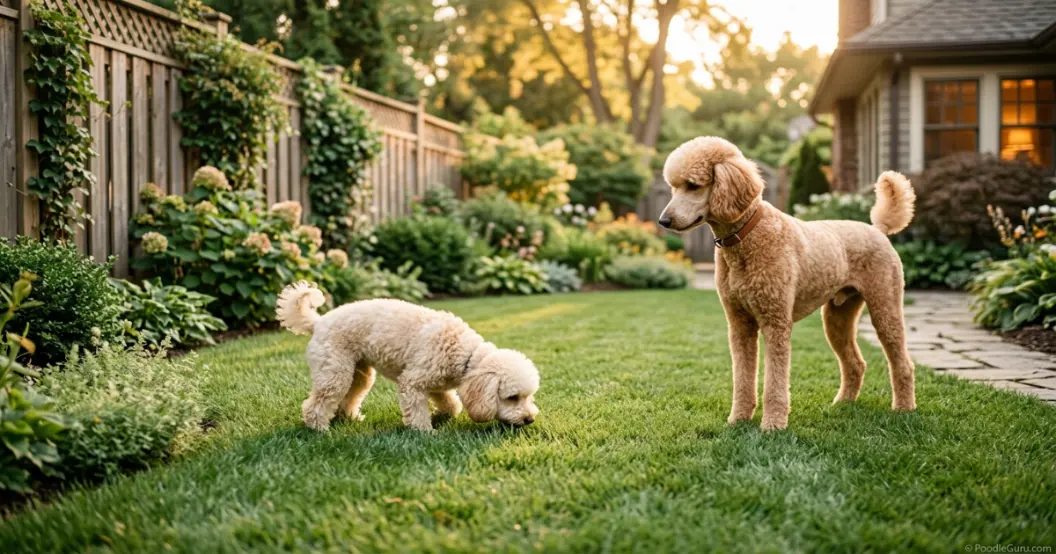
Effective solutions depend on matching the fix to the cause. Most poodle coprophagia falls into one of these six categories. Some dogs have more than one factor at play, which is why a layered approach often works best.
1. Nutritional Gaps or Poor Absorption
A poodle whose diet is marginally low in B-complex vitamins, digestive enzymes, or certain minerals may seek nutrients in stool. More commonly, the dog is eating an adequate diet but not absorbing it well. Exocrine pancreatic insufficiency, though not widespread in poodles, does occur. Mild chronic malabsorption from food sensitivity can also trigger the behavior. The stool may still contain undigested nutrients that the dog can smell.
2. Digestive Enzyme Deficiency
In the wild, canines consume entire prey, including enzyme-rich organ tissues. Modern commercial diets, even premium ones, are cooked at high temperatures that denature enzymes. A minority of poodles seem to compensate by seeking enzymes in feces. Owners who switch to raw or add targeted enzyme supplements sometimes see the behavior stop within days — a clue that enzyme deficit was the driver.
3. Learned Attention-Seeking
This is the most underestimated cause in poodles. A dog who is bored, under-exercised, or left alone for long stretches discovers that eating poop reliably summons the owner. Even negative attention — a sharp “no,” a chase — registers as social interaction. For a poodle craving engagement, it works. The behavior gets reinforced.
4. Stress or Confinement Anxiety
Poodles who were crated for excessive hours, especially as puppies, may develop stool-eating as a den-cleaning compulsion. The dog learns that eliminating in the crate leads to punishment or discomfort, so it “removes the evidence.” This pattern can persist long after the dog is reliably house-trained. Separation anxiety can also trigger it.
5. Maternal Instinct
Mother poodles clean their puppies by consuming their waste for the first three weeks of life. This instinct doesn’t always switch off. Some females continue the behavior after weaning, especially during phantom pregnancies or hormonal fluctuations. Spaying reduces but doesn’t always eliminate the drive.
6. Medical Conditions
Diabetes, thyroid imbalances, Cushing’s disease, and intestinal parasites can all increase appetite or alter stool consistency in ways that trigger coprophagia. Certain medications, including steroids, can ramp up hunger dramatically. These are less common causes, but they must be ruled out — particularly in Standard Poodles, who have a higher predisposition to hypothyroidism and Addison’s disease. The VCA Animal Hospitals guide to coprophagia provides a solid medical overview worth reviewing with your vet.
Medical vs. Behavioral: How to Tell the Difference
This distinction determines whether your next call goes to the vet or the trainer. Use this table as a conversation starter, not a diagnostic tool.
| Factor | Leans Medical | Leans Behavioral |
|---|---|---|
| Appetite | Ravenous, stealing food, losing weight | Normal appetite |
| Stool appearance | Greasy, pale, loose, or contains mucus | Normal, well-formed stool |
| Timing | Happens regardless of owner presence | Often happens when owner is watching |
| Other symptoms | Vomiting, coat dullness, lethargy, weight change | No other physical symptoms |
| Onset | Sudden, in an adult dog with no prior history | Gradual, often traceable to a change in routine |
| Response to management | Persists even with immediate cleanup | Decreases significantly with cleanup + supervision |
If your poodle shows two or more factors in the medical column, a veterinary workup is the right next step. Bloodwork, fecal analysis, and a diet review can uncover issues that behavioral training cannot fix.
The PoodleGuru Coprophagia Solution Method
At PoodleGuru, we evaluate coprophagia through a four-step framework that moves from least invasive to most intensive. The goal is to solve the problem without adding stress to an already sensitive dog. This method works best when you commit to each step for at least two weeks before escalating.
Rule Out Medical Causes
Before assuming it’s behavioral, schedule a vet visit. Request a full fecal exam, a basic blood panel, and a discussion about your poodle’s diet. This step alone can resolve some cases because it catches enzyme deficiencies, parasites, or early metabolic issues.
Remove Access Completely
For two weeks, become obsessive about immediate cleanup. Leash-walk your poodle in the yard so you control access. Pick up stool the moment it hits the ground. Inside, use a belly band or a basket muzzle with a stool guard during unsupervised moments if needed. This isn’t forever — it’s an extinction trial. If the behavior drops to near zero, you have confirmed it’s a habit, not a compulsion.
Apply Taste Deterrents Correctly
Many owners try deterrents and declare them failures because they applied them wrong. The target isn’t the poodle’s mouth — it’s the stool itself. Products containing yucca, parsley, or monosodium glutamate (like For-Bid or CoproBan) must be fed to every dog in the household so all stool becomes unpalatable. This takes 3–5 days to become effective. Adolph’s meat tenderizer or crushed pineapple are old-school alternatives, but commercial enzyme-targeted formulas are more reliable for poodles.
Redirect & Enrich
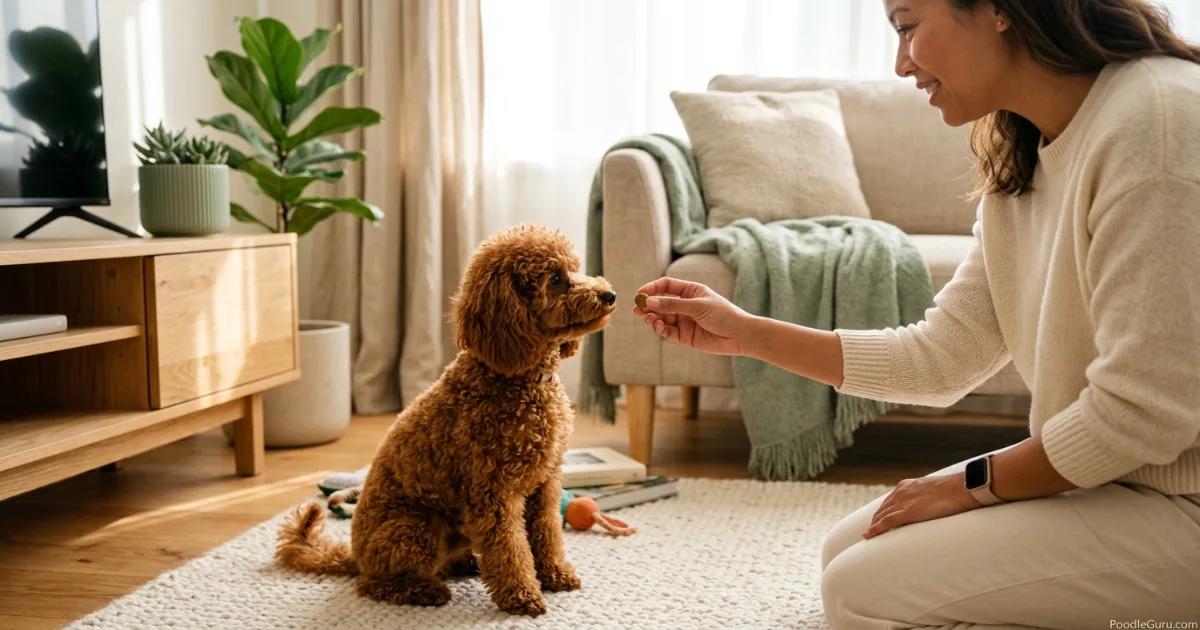
If the behavior is attention-seeking, you must replace it with a competing behavior that earns a better reward. The moment your poodle finishes eliminating, call them away with a high-value treat and a cue like “leave it” followed by a quick training game or a short play session. The sequence becomes: eliminate → come to owner → get something amazing. The stool becomes irrelevant. For poodles, mental enrichment is non-negotiable. A bored poodle will invent its own entertainment. Poodle training basics build the foundation for this kind of redirection work.
Diet Adjustments That Can Help
Diet alone rarely fixes coprophagia, but the right adjustments can tip the scales when combined with management. The goal is to make the poodle’s own body less interested in stool as a food source.
Nutritional Levers Worth Trying
- Add a high-quality probiotic. Look for strains like Lactobacillus acidophilus and Enterococcus faecium. A healthier gut biome changes stool odor and composition.
- Supplement with digestive enzymes. Papain (from papaya) and bromelain (from pineapple) are common. Prozyme and similar products are widely used. Start with the dose on the label and give it two weeks.
- Increase fiber modestly. A teaspoon of plain canned pumpkin or a small amount of green beans can increase satiety. Don’t overdo fiber — it can block nutrient absorption if pushed too high.
- Review the protein source. Some poodles do better on novel proteins (duck, venison, fish) than on chicken or beef. Food sensitivities don’t always show up as skin issues; sometimes they manifest as mild malabsorption.
Make one change at a time. If you add enzymes, probiotics, and switch protein all at once, you’ll never know what actually helped. Poodle owners who keep a simple stool-and-behavior log for three weeks gain clarity faster than those who guess.
4 Mistakes That Make Poop Eating Worse
Good intentions go sideways fast with this behavior. These are the most common patterns we see poodle owners fall into.
1. Punishing After the Fact
Dragging your poodle back to the evidence and scolding them doesn’t connect the dots. It creates anxiety around you, not around the behavior. Fearful poodles sometimes escalate to eating stool faster to “hide” it.
2. Using Unpleasant Taste Sprays on the Dog
Spraying bitter apple into your poodle’s mouth after stool-eating teaches them to fear your approach, not the stool. The deterrent belongs on the feces, not on the dog.
3. Switching Foods Constantly
Flipping between four different kibbles in a month looking for a magic fix destabilizes the gut. Each switch takes 7–10 days to normalize. Pick one diet adjustment, stick with it, and assess methodically.
4. Ignoring the Multi-Dog Factor
Treating only the “guilty” poodle while ignoring the other dogs’ stool is a half-measure. All dogs in the household need to be on the same deterrent protocol, or the behavior continues because the source remains available.
When to Call Your Veterinarian
Most coprophagia is a management problem. But some signs should never be handled with training alone. Contact your vet promptly if your poodle:
- Starts eating stool suddenly after years of never doing it.
- Also shows weight loss, increased thirst, or coat changes.
- Has stool that looks greasy, pale, or consistently loose.
- Begins eating non-food items beyond stool (rocks, fabric, dirt) — this can signal pica, which has different medical implications.
- Seems distressed, lethargic, or vomits after eating stool from unknown sources (risk of parasites or toxins).
For poodles with diagnosed conditions like Addison’s or hypothyroidism, mention the behavior at your next checkup even if it seems minor. It can be an early indicator that medication levels need adjustment.
Frequently Asked Questions
Is eating poop dangerous for my poodle?
Eating their own stool is low-risk, though it can cause mild stomach upset. Eating other animals’ feces carries higher risks: parasites, bacteria like salmonella, and residual medications. Keep your poodle on a consistent parasite prevention plan and mention the behavior to your vet.
Will my poodle grow out of coprophagia?
Some puppies stop by 12–18 months as their digestive system matures and house-training solidifies. But if the behavior has been heavily reinforced — especially through owner attention — it can persist well into adulthood without intervention. Don’t count on outgrowing it.
Do certain poodle sizes eat poop more than others?
There’s no evidence that Toy, Miniature, or Standard Poodles differ significantly in coprophagia rates. Multi-dog households and under-stimulated individuals are the stronger predictors across all sizes.
Can I use hot sauce or pepper to stop the behavior?
Avoid this. Strong spices can cause gastrointestinal pain and erode trust. Stick to veterinary-formulated deterrents designed to be added to food, which change stool taste safely without harming your dog or your relationship.
How long does it take to break the habit?
With consistent management and deterrents, many poodles show a significant drop within 2–3 weeks. Deeply ingrained attention-seeking cases can take 6–8 weeks of unbroken consistency. The key is preventing even a single “rehearsal” of the behavior during the extinction period.
Should I muzzle my poodle to stop poop eating?
A basket muzzle with a stool guard can be a humane short-term management tool during walks, but it’s not a standalone solution. It should always be paired with training and a medical check. Never leave a muzzled dog unsupervised.
Key Takeaways
- Coprophagia is a common canine behavior driven by instinct, diet, or learned attention-seeking — not a sign your poodle is broken or dirty.
- Poodles’ intelligence and sensitivity mean they can learn this habit fast, but they also respond well to methodical, positive redirection.
- Ruling out medical causes — enzyme deficiency, malabsorption, parasites — should always be the first step before behavioral work begins.
- The PoodleGuru method works in sequence: vet check, access removal, proper deterrent use, and enrichment-based redirection.
- Punishment and harsh deterrents make the problem worse in sensitive poodles; steady management over 2–6 weeks gets better results.
- If the behavior appears suddenly or comes with weight loss, dull coat, or lethargy, call your veterinarian without delay.
Your poodle isn’t trying to disgust you. Something is driving the behavior, and with patience and the right sequence of steps, you can almost always resolve it. Start with the vet. Get religious about cleanup. And remember: your poodle would rather earn a treat than eat poop — they just need you to show them the better deal.