Are Poodles Protective Dogs? The Real Owner’s Guide
Poodles are famous for their intelligence and elegance — but underneath those curls is a dog with a deeply loyal streak. So, are poodles protective dogs in real daily life? Yes, but their protection is usually loyal, watchful, and alert rather than aggressive. Understanding that difference will change how you interpret your poodle’s behavior every day.
Quick Answer: Are Poodles Protective Dogs?
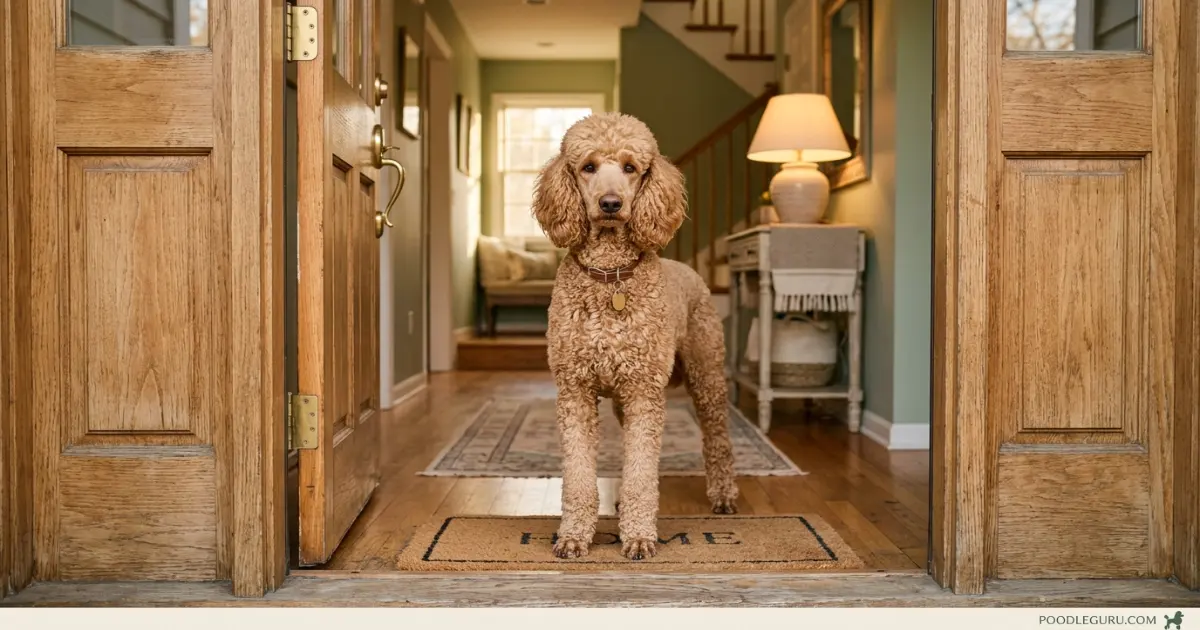
Yes, poodles are protective dogs — but in a specific, loyalty-driven way. A poodle’s protectiveness typically shows up as alert barking, positioning themselves between you and a perceived stranger, and heightened vigilance when unfamiliar people approach.
They are not naturally aggressive or confrontational, and their protective instinct is deeply tied to their bond with their specific humans rather than general territoriality. In short: they’ll warn you, they’ll watch, and they’ll stand by you — but they’re unlikely to physically engage unless they feel you are in immediate danger.
What “Protective” Means for a Dog
Before we can answer the question “are poodles protective dogs?” in the way owners expect, we need to define the word itself. Protective behavior in dogs exists on a spectrum, and misunderstanding where poodles fall on it leads to mismatched expectations.
A protective dog is one that perceives a potential threat to its social group and responds with behaviors intended to increase safety — typically alerting, monitoring, positioning, and only rarely physically intervening. For poodle owners, this means your dog’s protectiveness will likely look like sharp barking at the doorbell, standing between you and an approaching stranger, or refusing to leave your side when they sense something off. The most important thing to understand is that healthy protectiveness is rooted in confidence and discernment, not fear or aggression.
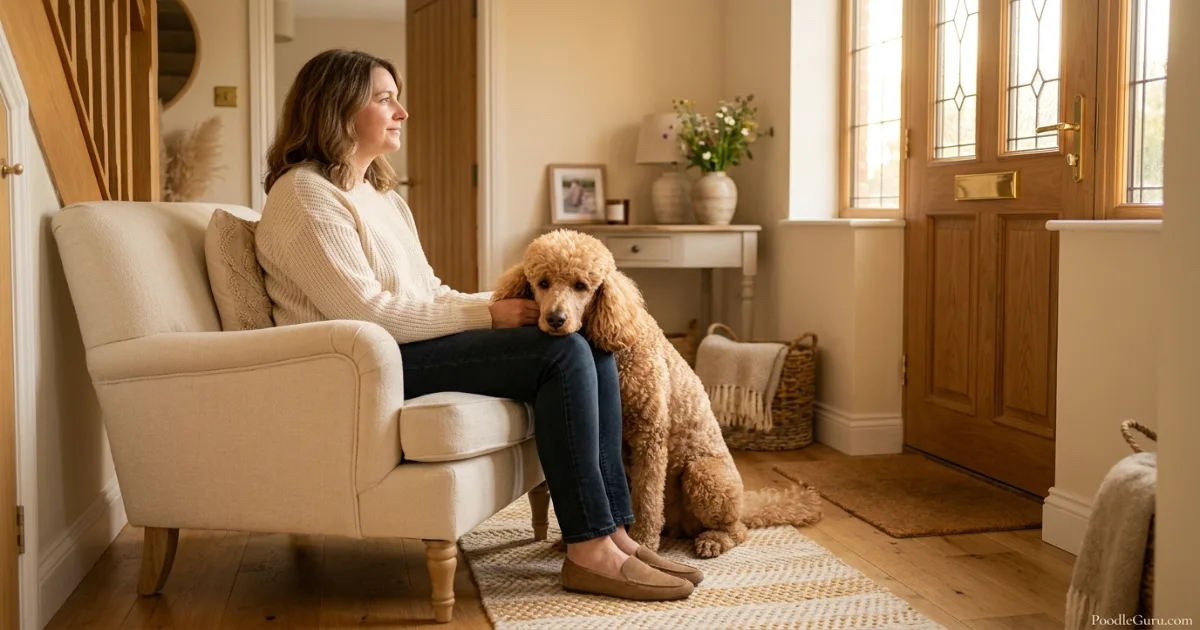
Many poodle owners describe their dogs as “velcro protective” — the dog doesn’t patrol the property line, but they’ll physically press against their owner when an unknown person enters the room. This close-contact guarding is a hallmark of the breed’s protective style.
🧠 Motivation
Poodle protectiveness stems from intense social bonding, not territorial instinct. They protect you, not the yard.
👂 Alertness
All poodle sizes are exceptionally alert. They rarely miss a new sound or approaching person and will vocalize to warn you.
⚖️ Discernment
A well-socialized poodle distinguishes between normal and suspicious activity, reducing false alarms.
The Root of Poodle Protectiveness: Breed History
The poodle’s protective nature makes more sense when you understand what they were bred to do. Unlike traditional guard breeds, poodles were developed as water retrievers and close companions — jobs that required working closely with a human handler, paying sharp attention to commands, and maintaining strong social bonds.
According to the AKC breed standard for poodles, the breed is described as “very active, intelligent, and elegant” with a “proud carriage.” That proud carriage isn’t just for show rings. It reflects a dog that carries itself with awareness and confidence — two prerequisites for protective behavior. A poodle notices its environment acutely and cares deeply about the people in it. That combination creates a dog who will naturally alert to potential threats.
What poodles were not bred for is equally important. They weren’t asked to guard flocks, patrol estates, or engage intruders. So while they’ll absolutely sound the alarm, they don’t carry the genetic drive to escalate to physical confrontation that a Rottweiler or German Shepherd might. Their protectiveness is vocal, positional, and relationship-based.
How Poodles Show Protective Behavior
Poodle protectiveness doesn’t always look the way people expect. It’s rarely dramatic, and it’s easy to misinterpret if you don’t know what to look for.
| Behavior | What It Looks Like | What It Signals |
|---|---|---|
| Alert Barking | Sharp, directed barking at doorbells, knocks, or approaching strangers | “Someone is here — be aware.” This is the most common protective response. |
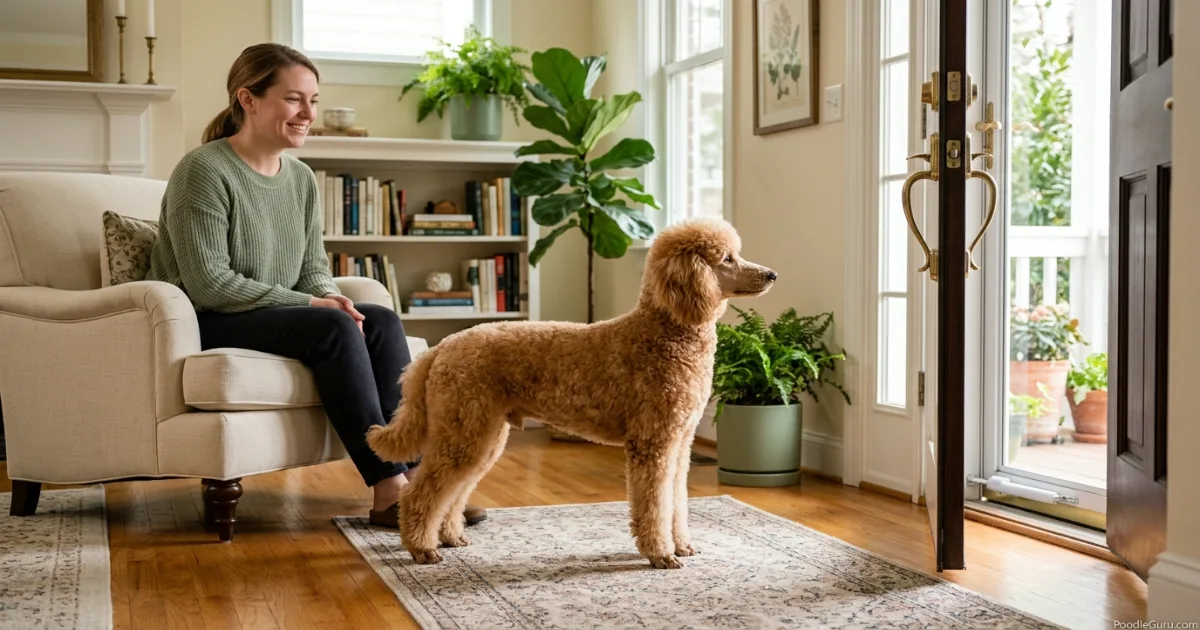
| Interposing | Moving between owner and a perceived stranger, standing sideways or leaning against the owner’s legs | “I’m placing myself as a barrier.” Common in Standard Poodles especially. |
| Vigilant Staring | Fixed gaze on the unfamiliar person or situation, ears forward, body still | Monitoring the threat. The dog is assessing, not yet acting. |
| Low Growl | A quiet, rumbling growl directed at a specific person or direction | Escalation warning. The dog is uncomfortable and communicating clearly. This should be respected, not punished. |
| Shadowing | Following the owner closely, refusing to settle, staying in physical contact | “I’m staying with you until this situation resolves.” Common when strangers enter the home. |
These behaviors are normal, healthy expressions of protectiveness. They don’t mean your poodle is aggressive — they mean your poodle is bonded to you and taking its role as your companion seriously.
Are Poodles Protective Dogs by Size? Standard vs. Miniature vs. Toy
Protective instinct is present across all three poodle sizes, but how that instinct expresses itself — and how seriously it’s taken — varies dramatically.
| Size | Protective Instinct | Typical Expression | Deterrent Effect | Escalation Risk |
|---|---|---|---|---|
| Standard Poodle | Strong | Alert barking, interposing, watchful stance; may stand ground | High — size and deep bark are intimidating | Moderate — size means more physical capability; needs training to ensure appropriate responses |
| Miniature Poodle | Strong | Persistent alert barking, shadowing, some interposing | Moderate — vocal presence but small stature | Low — too small to be a physical threat, but can become yappy and anxious if not managed |
| Toy Poodle | Strong | High-pitched alert barking, clinging to owner, hiding behind legs while barking | Low — no physical deterrent | Very low — fear-based reactions can develop if over-stimulated |
A Toy Poodle’s protective bark is every bit as sincere as a Standard’s — but the world receives them differently. A Standard Poodle’s protective stance can genuinely deter an intruder. A Toy Poodle’s bark alerts you, but you’re the one who will need to handle the situation. Understanding this difference prevents both over-reliance on a small dog and under-appreciation of a larger one’s serious intent.
Protective, Reactive, or Fearful? Reading Your Poodle’s Signals
This is where many well-meaning owners get confused. Not every intense bark or growl is protectiveness. Sometimes it’s fear, sometimes it’s reactivity, and mistaking one for the other can lead you to mishandle the situation.
Protective dogs are confident and composed. They assess, alert, and stand their ground. Fearful dogs are uncertain — their barking may be high-pitched, they retreat while barking, and their body language shows stress (tucked tail, ears back, whale eye). Reactivity is an over-response to triggers that may include excitement, frustration, or anxiety. A reactive poodle barks and lunges at everything; a protective poodle discriminates between genuine novelty and normal daily life.
If your poodle barks at every leaf that blows past the window, that’s not protectiveness — it’s under-stimulation or anxiety. If they quietly growl only when a stranger approaches you on a dark street, that’s protectiveness. The difference lies in discernment and emotional state.
If you’re unsure which category your dog falls into, the ASPCA’s guide to common dog behavior issues offers a helpful framework. But in short: protective = controlled, targeted, settles when threat leaves. Fearful/reactive = uncontrolled, generalized, remains agitated long after the trigger is gone.
The PoodleGuru Protective Instinct Evaluation
At PoodleGuru, we’ve developed a five-step method to help owners assess whether their poodle’s behavior is healthy protectiveness or something that needs attention. Use this framework to understand your dog — and to decide if you need to involve a professional.
Observe the Trigger
What sets your poodle off? Healthy protectiveness is triggered by genuine novelty: a stranger approaching, an unexpected knock, someone acting unusually. If the trigger is broad — all dogs, all people, all sounds — it’s likely reactivity, not protection.
Check the Body Language
Protective dogs stand tall or square, ears forward, tail up or level, eyes fixed but not wide with whites showing. Fearful dogs crouch, tuck their tail, pant, or show the whites of their eyes (whale eye). Confident posture = protection; anxious posture = fear.
Measure the Recovery Time
When the trigger is gone, how fast does your poodle settle? A protective dog should return to baseline within 2–3 minutes. A fearful or reactive dog may stay agitated for 15+ minutes. Slow recovery signals an emotional regulation problem, not noble guarding.
Test the Deference Response
Can you call your dog off with a calm command? A protective poodle should be able to stop barking and look to you for direction. If your dog cannot disengage even when you ask, the behavior has crossed into reactivity or obsession and needs training attention.
Assess the Daily Baseline
A healthy protective poodle is relaxed and confident when no threat is present. If your dog is constantly on edge, scanning windows, or unable to rest, they’re not protective — they’re anxious. That’s a quality-of-life issue for the dog and should be addressed with a behavior professional.
Score your dog on each dimension. Poodles scoring high on trigger discernment, confident body language, fast recovery, and strong deference have healthy protective instincts. Low scores on recovery or deference, or signs of constant vigilance, warrant a consultation with a positive-reinforcement trainer or veterinary behaviorist.

Training to Shape Healthy Protectiveness
You can’t — and shouldn’t — train a poodle to be more protective. What you can do is channel their natural watchfulness into reliable, controlled behaviors that serve you without creating a liability.
Teach a “Thank You” Protocol
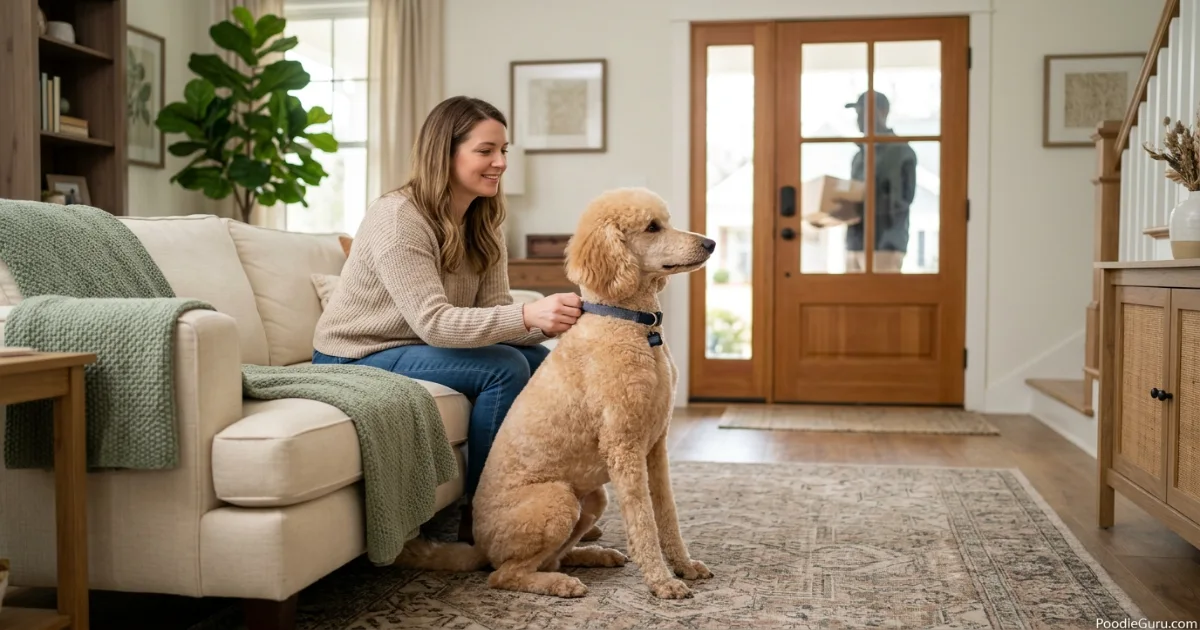
When your poodle barks to alert you, acknowledge it calmly — “thank you, I see it” — then ask for a quiet sit. Reward the quiet, not the barking. Over time, your poodle learns that the job is to alert, then check in with you. This reinforces discernment and prevents endless barking.
Socialize Extensively — Yes, Even for a Watchdog
A common mistake is thinking a protective dog should be kept isolated to “sharpen” their instincts. The opposite is true. Well-socialized poodles have a rich mental catalog of what’s normal, so their alerts are meaningful. Under-socialized poodles become fearful and reactive, barking at everything and unable to tell friend from threat.
Build a Rock-Solid “Quiet” Cue
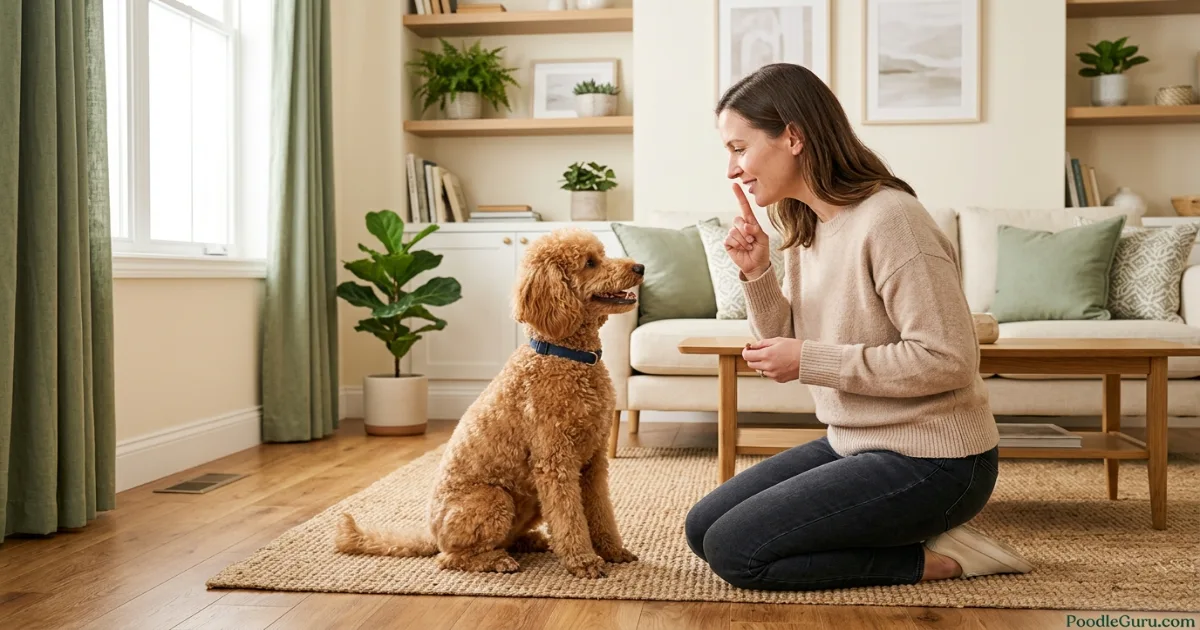
This is non-negotiable. Practice in low-distraction settings first. Bark, say “quiet,” and reward the instant the barking stops — even for a breath. Gradually add more triggers. A poodle who won’t stop barking on command isn’t protective — they’re out of control. Our Poodle Training Essentials guide walks through impulse control in detail.
Never punish growling. A growl is communication — your dog telling you they’re uncomfortable. If you suppress the growl, you remove the warning and may end up with a dog that bites without signaling. Instead, acknowledge the growl, remove your dog from the situation, and work with a professional on the underlying discomfort.
When Protection Becomes a Problem
Healthy protectiveness has boundaries. When those boundaries blur, it stops being an asset and starts being a serious behavioral issue.
Signs that protectiveness has crossed the line: your poodle growls or snaps at family members, cannot have visitors in the home without extreme stress, guards you from other household pets, or escalates to biting. These are not protective behaviors — they’re resource guarding, fear aggression, or territorial dominance, and they require immediate professional intervention.
Poodles are sensitive dogs. Harsh corrections or “alpha” training will worsen these problems. Seek a certified positive-reinforcement behavior consultant who can assess the root cause and build a desensitization plan. Protectiveness should keep your family safer, not make your home feel like a war zone.
Owner Action Plan: Nurturing Healthy Protectiveness
Know What You Have
Use the PoodleGuru Protective Instinct Evaluation to honestly assess your dog’s current behavior. Determine whether you’re working with healthy protectiveness, fear, or reactivity — because the path forward is different for each.
Train the Alert-to-Settle Sequence
Teach your poodle that the job is to bark 2–3 times, then find you and be quiet. Practice weekly. This single habit transforms a nuisance barker into a reliable watchdog.
Prioritize Socialization Throughout Life
Expose your poodle to a wide variety of people, places, and situations — always at a pace the dog can handle. A poodle who understands the world is a poodle who only alerts when something is genuinely unusual.
Respect the Growl
If your poodle growls, listen. Remove them from the situation, assess the trigger, and seek help if you don’t understand why. Never punish communication.
Know When to Call a Pro
If your poodle’s protective behavior includes snapping, biting, resource guarding you from family members, or extreme distress when visitors arrive, call a certified behavior consultant. These are not DIY fixes.
Frequently Asked Questions
Are poodles protective of their owners?
Yes. Poodles form intense bonds with their people, and this attachment naturally translates into protective behavior. They will alert bark, shadow you in uncertain situations, and often position themselves between you and strangers. This is loyalty-driven protection, not territorial aggression.
Do Standard Poodles protect more than Toy Poodles?
The protective instinct is equally strong across all sizes, but the expression differs. Standard Poodles can physically interpose and act as a visible deterrent. Toy Poodles rely entirely on barking and clinging. The drive to protect is the same; the physical capability is not.
Can a poodle be trained to protect the house?
Poodles can be trained to be reliable watchdogs — alerting to visitors and unusual activity. But training them for true protection work (bite work, apprehension) is not recommended. They lack the genetic predisposition for this role, and attempting it can create anxiety and unpredictability.
Is a protective poodle the same as an aggressive poodle?
No. Healthy protectiveness is controlled, targeted, and de-escalates when the threat is gone. Aggression is indiscriminate, disproportionate, and persists after the trigger disappears. A protective poodle barks to warn; an aggressive poodle bites to harm. The two are completely different.
Why does my poodle growl at strangers but not bite?
Growling is communication, not necessarily a precursor to biting. Your poodle is saying, “I’m uncomfortable; give me space.” This is a valuable warning signal. Punishing the growl can suppress it, leading to a dog that bites without warning. Instead, respect the communication and address the discomfort.
At what age do poodles become protective?
Protective behaviors usually emerge during adolescence, around 7–12 months, as the dog matures and becomes more aware of its environment. The intensity often peaks around 1–2 years. Early socialization during puppyhood helps shape this into healthy discernment rather than fear-based reactivity.
How do I know if my poodle is being protective or just scared?
Protective dogs have confident body language — upright posture, steady eyes, controlled barking. Scared dogs show tucked tails, ears back, panting, and may retreat while barking. If your dog cannot settle after the trigger leaves, it’s fear, not protection.
Are male or female poodles more protective?
There is no consistent difference between sexes. Both male and female poodles are equally capable of strong protective behavior. Individual personality, socialization, and training matter far more than whether the dog is male or female.
Key Takeaways: Are Poodles Protective Dogs?
Poodles are deeply protective — but their protection is quiet, loyal, and relationship-based, not aggressive or territorial.
- Poodle protectiveness is rooted in intense bonding and alertness, not in guarding instinct — they protect you, not property.
- Common protective behaviors include alert barking, interposing, shadowing, and watchful monitoring; these are healthy and normal.
- Standard Poodles provide the strongest visual deterrent, but Miniatures and Toys are equally alert and vocal.
- The PoodleGuru Protective Instinct Evaluation helps distinguish healthy protectiveness from fear or reactivity — a critical distinction every owner should make.
- Training a “thank you” protocol and reliable quiet cue channels natural protectiveness into useful, controllable behavior.
- If protective behavior escalates to biting, resource guarding people, or extreme household stress, seek a certified behavior professional immediately.
Next step: Explore our Complete Poodle Temperament Guide to deepen your understanding of your dog’s personality and how to work with it.