Why Do Poodles Have Curly Hair? The Genetics Explained
That iconic curly coat isn’t just beautiful — it comes from curl-linked genetics that set poodles apart from most straight-coated breeds. Understanding why poodles have curly hair will change how you care for the coat, what you expect from a puppy, and how you talk to groomers and breeders.
Why Do Poodles Have Curly Hair? Quick Answer
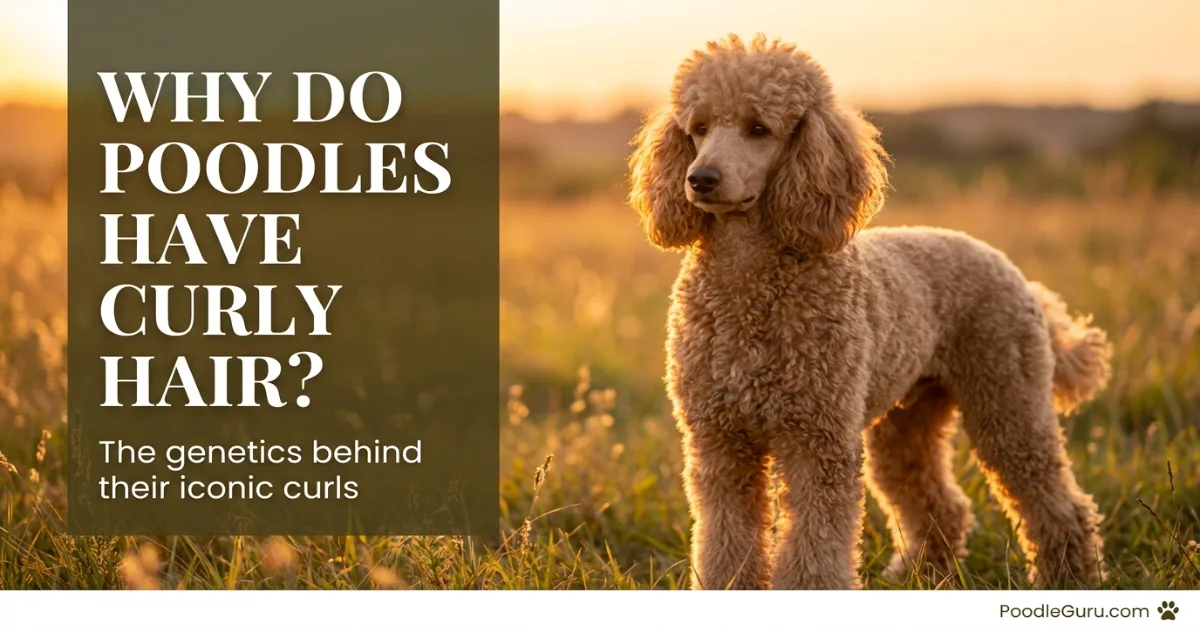
Poodles have curly hair mainly because of curl-associated variants in the KRT71 gene. These variants affect how the hair shaft forms, so the coat grows in waves or tight curls instead of lying straight. Poodles are also low-shedding because loose hairs tend to stay trapped inside the curls until they are brushed out, which is why the breed needs consistent grooming.
Why Do Poodles Have Curly Hair? The KRT71 Gene Explained
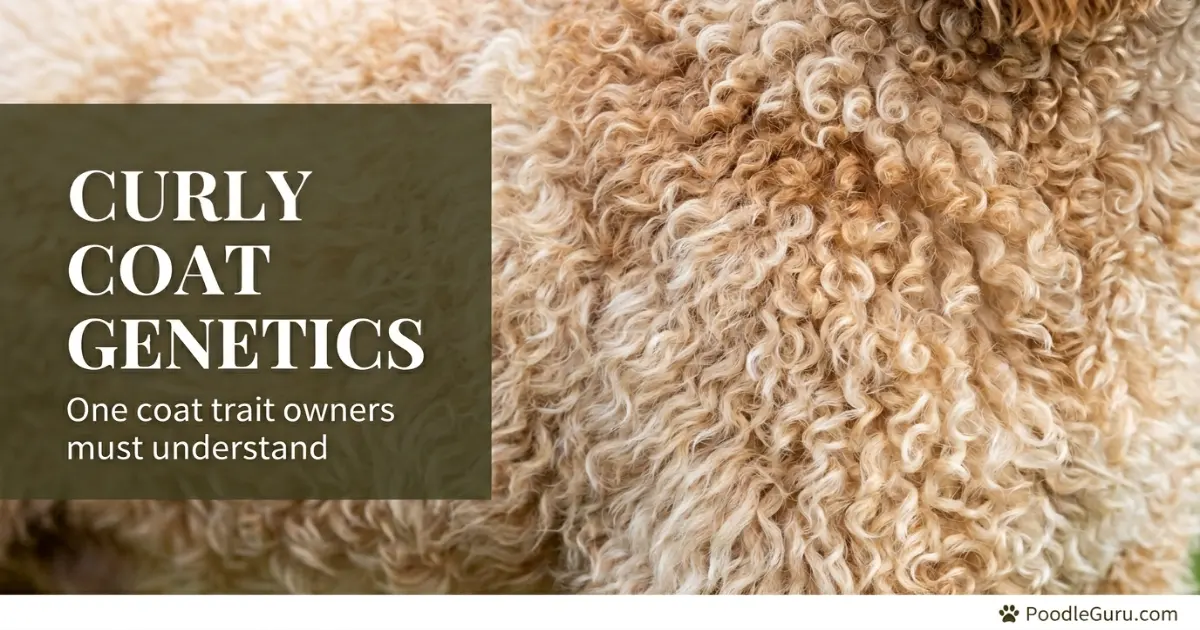
Curly coat in dogs is a genetic trait — and in poodles, the main curl signal is linked to the KRT71 gene.
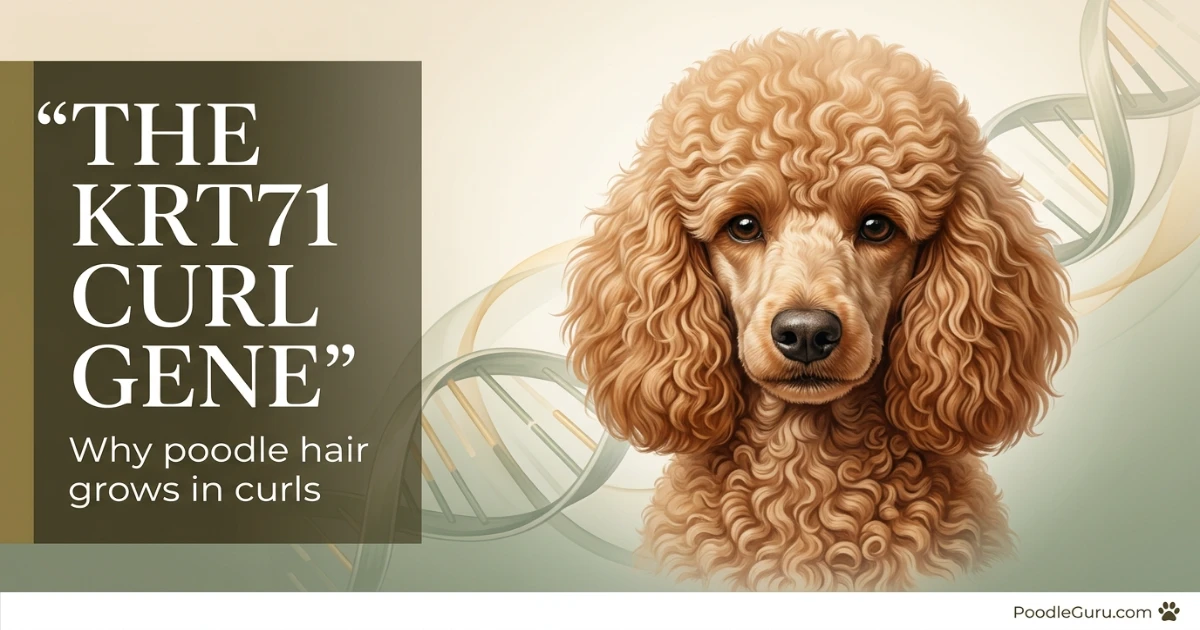
A poodle’s curly hair is strongly associated with curl variants in KRT71, a keratin gene involved in hair structure. For poodle owners, this means the curl you see and feel is hardwired, not a temporary texture created by grooming. The most important thing to understand is that curl genetics affect the way each strand forms, while the poodle’s low-shed reputation also depends on coat density, hair growth cycle, and loose hairs being trapped inside the curls.
KRT71 stands for keratin 71. In dogs, variants in this gene are associated with wavy and curly coats. Dogs with one copy of a curl allele may show a wavy coat, while dogs with two copies are more likely to show a curly coat. Broader canine coat research also shows that three genes work together across breeds: KRT71 for curl, FGF5 for longer coat, and RSPO2 for furnishings such as longer eyebrows and mustache hair. That distinction matters because RSPO2 is not the main poodle curl gene — it is more closely tied to furnishings and improper coat testing.
Is the Curl Dominant?
Not in the simple “one copy always equals tight curls” way. Current curl testing describes KRT71 curl alleles as likely incomplete dominant: one copy can produce a wavy coat, while two copies are more likely to produce a curly coat. Because poodles have been selectively bred for a curly coat, the trait is highly consistent in the breed, but curl tightness can still vary from dog to dog and becomes less predictable in poodle mixes.
Main curl gene: KRT71 (keratin 71)
Inheritance pattern: Likely incomplete dominance
One curl allele: Often wavy
Two curl alleles: Usually curly
Important distinction: RSPO2 is mainly associated with furnishings, not the core poodle curl pattern
Grooming effect: Loose shed hairs become trapped inside curls, so brushing is essential
Not All Curls Are Equal: The Three Poodle Coat Types
While all poodles carry the curl gene, how tightly that curl expresses itself varies. The AKC breed standard for poodles recognizes two coat textures, but in practice, owners see three distinct patterns that affect everything from grooming frequency to how the dog looks between appointments.
| Coat Type | Curl Tightness | Texture | Shedding Level | Grooming Demand | Best For |
|---|---|---|---|---|---|
| Tight Curly | Very tight, corkscrew curls | Dense, springy, wool-like | Minimal | High — mats quickly if not brushed daily | Show coats, owners committed to frequent maintenance |
| Wavy / Fleece | Loose waves or soft ringlets | Silky, soft, less dense | Very low | Moderate — needs brushing 3–4 times per week | Pet homes wanting easier upkeep, allergy-sensitive families |
| Corded | Forms naturally separating cords (dreadlocks) | Woolly, mat-like cords | None — shed hair trapped inside cords | Very high — cords must be intentionally formed and maintained | Specialized show or highly dedicated owners |
The tight curly coat is what most people picture. It’s the show-ring ideal and the most common type in Standards. The wavy coat appears more often in Miniatures and Toys, though you can find it across all sizes. The corded coat is rare — it doesn’t happen naturally without human intervention, but the coat’s structure makes cording possible when the curls are left to mat together in a controlled way.
Don’t assume a puppy’s fuzzy coat predicts the adult pattern. A wavy puppy can develop tight curls, and a curly-looking puppy can relax into softer waves. The final texture usually settles between 12–18 months. More on that in the puppy coat section below.
Why Curls Matter: Shedding, Allergies, and Grooming
The curl gene does not work alone. Poodle coat behavior comes from the combination of curl, coat length, density, and growth cycle. Poodle hair grows for a long period and shed strands often stay trapped inside the curls instead of dropping around the house. That is why poodles are low-shedding in the home but still need regular brushing to remove dead hair before it forms mats.
This is why poodles are often called hypoallergenic. No dog is completely allergen-free — allergens come from dander, saliva, and urine, not just hair. But because poodles shed so little, they release far fewer airborne allergens into the home. For people with mild to moderate dog allergies, this can make a meaningful difference. The trade-off is that the trapped hair demands consistent grooming. Without regular brushing, those curls turn into painful mats that pull on the skin and can lead to infections.
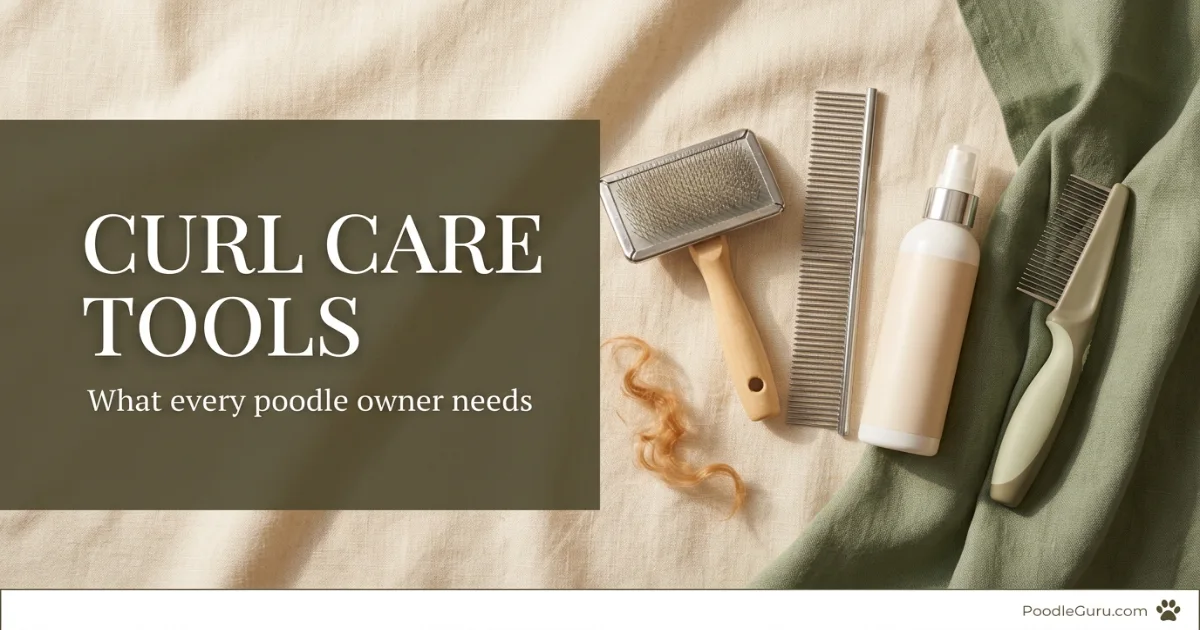
Our Complete Poodle Grooming Guide covers the exact routine you’ll need for each coat type. But here’s the essential framework: brush to the skin daily if you keep a long coat, every other day for a shorter clip. Use a slicker brush and a metal comb. Never brush a dry curly coat — always mist with water or a conditioning spray first to prevent breakage.
How the Curl Develops: Puppy Coat to Adult Coat
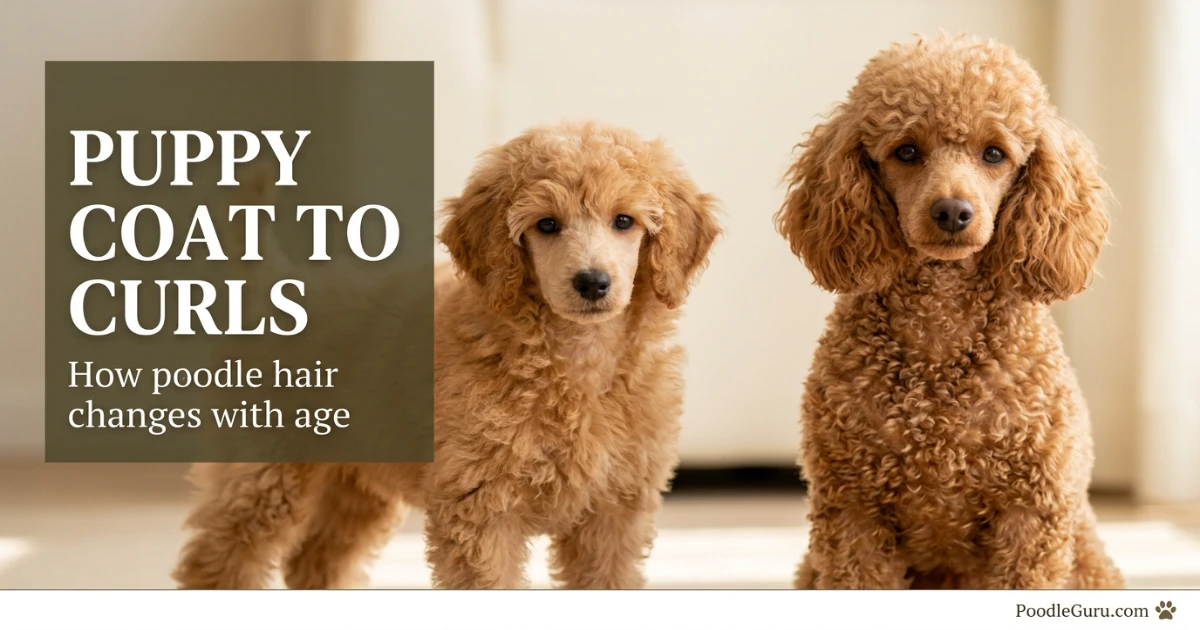
Poodle puppies aren’t born with the iconic curly coat. They arrive with a soft, fine, almost straight puppy coat that gradually transitions. This process is called coat change, and it’s one of the most misunderstood phases of poodle ownership.
The puppy coat starts loosening around 4–6 months of age. By 8–10 months, most poodles are in the thick of the change — a phase where the adult curls push through while the puppy fluff hangs on. This creates a prime matting window. The two textures grab each other, and if you’re not brushing thoroughly down to the skin every single day during this period, mats form almost overnight. Professional groomers commonly see poodles at 9–12 months with severe matting that requires a full shave-down, which is avoidable with consistent home care.
By 12–18 months, the adult coat has fully established. The curl pattern you see at 18 months is likely the curl pattern your poodle will keep for life. The color may still shift somewhat — reds and apricots often fade, blacks can develop silvering — but the texture and curl tightness stabilize. If you’re evaluating a puppy and want to guess the adult curl, ask the breeder to show you both parents’ coats. That’s your best predictor.
The PoodleGuru Curl Assessment Method
At PoodleGuru, we’ve developed a simple, practical way for owners to evaluate their poodle’s coat type, health, and grooming needs. This method gives you a consistent framework whether you’re assessing a puppy, monitoring an adult coat, or deciding on a grooming routine. Use it every few months to stay ahead of coat changes.
Strand Isolation
Gently part the coat down to the skin in several places — behind the ears, along the back, and on the chest. Look at individual hairs. Are they tightly coiled from root to tip (tight curly), loosely S-shaped (wavy), or somewhere in between? This tells you your baseline curl type.
Stretch Test
Take a small lock of hair and gently stretch it. Healthy curly coat should stretch slightly and spring back when released. If it snaps immediately, the coat may be dry or damaged. If it doesn’t spring back, it’s over-conditioned or lacking protein. This simple test catches moisture and protein imbalance before it shows as breakage.
Mat Density Check
Run a metal comb from the skin outward in several spots. Does it glide through or catch? Catching near the skin signals early matting — the most dangerous kind because it pulls on the skin unnoticed. Do this check weekly, especially behind the ears, under the collar, and in the armpits.
Shedding Assessment
After brushing, collect what comes out. A poodle with a healthy curly coat should yield a small amount of loose hair — enough to fill a teaspoon or two per session. Large clumps or noticeably increased shedding can signal thyroid issues, skin allergies, or coat change phase, and warrants a vet check if persistent.
Visual Sheen and Feel
A well-moisturized curly coat has a subtle natural sheen, not a greasy shine. Run your hand over the coat after brushing — it should feel cool, smooth, and resilient, not rough or brittle. Dryness often shows up first on the ears and tail, where the hair is finer.
If you find mats you can’t gently work out with your fingers and a comb, or if the coat feels consistently dry despite conditioning, consult a poodle-experienced groomer. They can assess whether a reset shave-down is needed and recommend the right product routine for your dog’s specific curl type. Never cut mats out with scissors — poodle skin is thin and easily injured.
Common Myths About Poodle Curls
❌ Myth: “Shaving makes the coat grow back curlier.”
Reality: Shaving doesn’t change curl genetics. The coat may feel different because you’re starting from a blunt-cut surface, but the underlying curl pattern is unchanged. Frequent shaving won’t tighten or loosen the curl.
❌ Myth: “A poodle’s coat is just like wool.”
Reality: It looks woolly, but it is still canine hair, not sheep wool. The curled strands can trap loose hair, dirt, and moisture, which makes mats possible when the coat is not brushed to the skin. Products meant for wool fibers are not appropriate for a poodle’s living coat and can cause buildup.
❌ Myth: “Poodles don’t need grooming if you keep the coat short.”
Reality: Even a short-clipped poodle needs regular brushing and combing. The hair still grows continuously and will mat at the skin if ignored. A shorter clip reduces the frequency but doesn’t eliminate the need.
❌ Myth: “All poodles have the same curl tightness.”
Reality: There’s natural variation. Some Standards have looser waves, some Toys have extremely tight curls. It doesn’t mean they aren’t purebred. The curl tightness is influenced by other modifier genes and varies legitimately within the breed.
❌ Myth: “Curly coat means the dog is healthier.”
Reality: Coat curl is purely cosmetic. A wavy-coated poodle is just as healthy as a tightly curled one. Health is determined by genetics, care, and nutrition — not curl pattern. Don’t let a breeder charge more for “show-quality curl.”
What Buyers Often Get Wrong About Curls
The curly coat is one of the biggest reasons people fall in love with poodles — and one of the biggest sources of misunderstanding. If you’re considering bringing a poodle home, these are the gaps between expectation and reality you need to close before you commit.
Color and Curl Are Independent
A common mistake is assuming that a certain color comes with a certain curl texture. Apricots aren’t consistently wavier, and blacks aren’t always tighter-curled. Color genes and coat texture genes are inherited separately. A breeder can show you parents with the same color and different curl patterns — or vice versa. Our poodle colors guide explains the genetics behind the shades, but don’t let color expectations anchor your curl predictions.
Puppy Photos Lie
As we covered, the puppy coat tells you almost nothing reliable about adult curl. That fluffy, wavy 8-week-old might grow into tight ringlets — or might not. Ask the breeder about the parents’ adult coats, and ask to see photos of previous puppies from the same pairing at 12–18 months. Reputable breeders can show you exactly what to expect.
The Grooming Commitment Isn’t Optional
Curly coats are high-maintenance coats. If you’re not prepared to brush at least every other day (daily for long coats), schedule professional grooming every 4–6 weeks, and invest in quality tools, a poodle is not the right breed for you. The coat won’t take care of itself, and neglecting it leads to matting that’s painful and requires a shave-down. There’s no shortcut.
Be wary of any breeder who claims their poodles have a “rare easy-care coat” or “non-shedding straight coat.” Poodles shed minimally due to the curl trapping loose hair. A truly straight-coated poodle is a genetic anomaly that may indicate mixed breeding. The breed standard explicitly requires a “curly or corded” coat.
Grooming the Curl: What Every Owner Should Know
The care your poodle’s curls need depends on which coat type you’re working with, but some principles apply universally. If you master these, you’ll avoid the most common coat disasters.
Brush before the bath, not after. Wetting matted hair tightens the mats. Always fully brush and comb out the coat before water touches it. After the bath, use a conditioning spray and work in sections with a slicker brush followed by a metal comb to confirm no tangles remain.
Hydration is everything. Curly hair is naturally drier than straight hair because the scalp oils can’t travel down the twisted shaft as easily. A leave-in conditioning spray used every time you brush makes a dramatic difference. Look for products formulated for curly coats — not generic dog conditioners, which can be too heavy.
Professional grooming schedule matters. Most poodles do best on a 4–6 week professional grooming cycle. Even if you do all the brushing at home, a groomer can do a proper sanitary trim, clean the ears, and check for skin issues you might miss. If you’re learning to groom at home, our Complete Poodle Grooming Guide walks you through every step.
When a Coat Problem Needs a Vet
Not every coat change is a grooming issue. If your poodle’s curl suddenly loosens, becomes brittle, or shows patchy thinning, it’s time for a veterinary check. Thyroid imbalances are relatively common in poodles and often first show up as coat changes — dullness, thinning, or loss of curl. Skin allergies can cause excessive licking that damages the coat texture. A good rule: if the coat change is symmetrical (both sides of the body) and accompanied by other symptoms like weight changes or lethargy, see your vet. If it’s a single patch and the skin underneath looks inflamed, it may be a hot spot or localized allergy that also warrants veterinary attention.
Frequently Asked Questions
Why do poodles have curly hair and not fur?
Poodles have curly hair mainly because of curl-associated KRT71 variants that affect hair structure. Their coat also grows long and traps loose shed strands inside the curls. That combination gives poodles their famous low-shed coat, but it also makes regular brushing and professional grooming essential.
Do all poodles have curly hair?
Almost all purebred poodles carry the curly-coat gene and express it to some degree. The tightness varies — some have extremely tight corkscrews, others have softer waves — but a truly straight coat in a purebred poodle is extremely rare and not consistent with the breed standard. If an adult poodle’s coat is completely straight, it may indicate mixed breeding or a genetic anomaly.
At what age does a poodle’s hair get curly?
Poodle puppies are born with soft, straight or wavy coats. The transition to adult curls begins around 4–6 months and intensifies between 8–12 months. By 12–18 months, the permanent adult curl pattern is established. During the transition, the mixing of puppy and adult coat textures creates a high-risk matting window that requires daily brushing.
Can a poodle’s coat change from curly to straight?
No, not permanently. A poodle’s curl pattern is genetically determined and won’t change from curly to straight. However, coat texture can temporarily appear different due to hormonal shifts (like after a heat cycle or during pregnancy), poor nutrition, or thyroid issues. If your adult poodle’s curl suddenly loosens, consult your veterinarian to rule out underlying health problems.
Is poodle hair really hypoallergenic?
No dog is completely hypoallergenic. Poodles produce dander, saliva, and urine proteins that can trigger allergies. However, because the curly coat traps shed hair and dander instead of releasing them into the air, poodles distribute far fewer allergens into the home environment. Many people with mild allergies find they tolerate poodles well, but spend time with the breed before committing if allergies are a concern.
Why is my poodle’s hair not as curly as others?
Natural variation within the breed means some poodles have tighter curls and others have looser waves. This is normal and doesn’t indicate a health problem. Coat tightness can also be influenced by grooming — a very short clip can make the curl appear less defined. If the curl has changed significantly from its previous state, however, a vet check for hormonal or nutritional issues is warranted.
Do poodles shed their curly hair?
Poodles do shed, but very minimally. Instead of falling out, shed hairs become trapped in the surrounding curls. Without regular brushing, these trapped hairs form mats. So while you won’t find much hair on your furniture, the trade-off is that you must manually remove the dead hair through grooming. This is why the breed is often considered low-shed but high-maintenance.
Key Takeaways: Why Poodles Have Curly Hair
The poodle’s signature curl is a genetic gift — and a responsibility. Understanding it completely changes how you care for your dog.
- KRT71 is the main curl-associated gene behind the wavy or curly coat poodles are famous for; RSPO2 should be treated as a furnishings gene, not the core curl explanation.
- Poodle coats fall into three practical categories — tight curly, wavy, and corded — each with different grooming demands and owner commitments.
- Puppy coat is not predictive of adult curl. The final pattern stabilizes between 12–18 months, and the coat-change period (4–12 months) is the highest-risk time for matting.
- The curly coat traps shed hair rather than releasing it, making poodles low-shed but not zero-maintenance — daily to every-other-day brushing is non-negotiable.
- Coat texture changes in an adult poodle — sudden loosening, brittleness, or thinning — can signal underlying health issues like thyroid imbalance and warrant a veterinary evaluation.
- The PoodleGuru Curl Assessment Method gives owners a structured way to monitor coat health, catch problems early, and match grooming routines to their dog’s specific curl type.
Next step: Read our Complete Poodle Grooming Guide for the step-by-step brushing, bathing, and clipping routines that keep every curl type healthy and beautiful.