Are Poodles Good Guard Dogs? The Honest Breed Guide
Poodles are brilliant, alert, and deeply bonded to their people. That combination makes many owners wonder: can my poodle protect me? The answer is more nuanced than a simple yes or no — and understanding it fully can shape how you train, trust, and live with your dog.
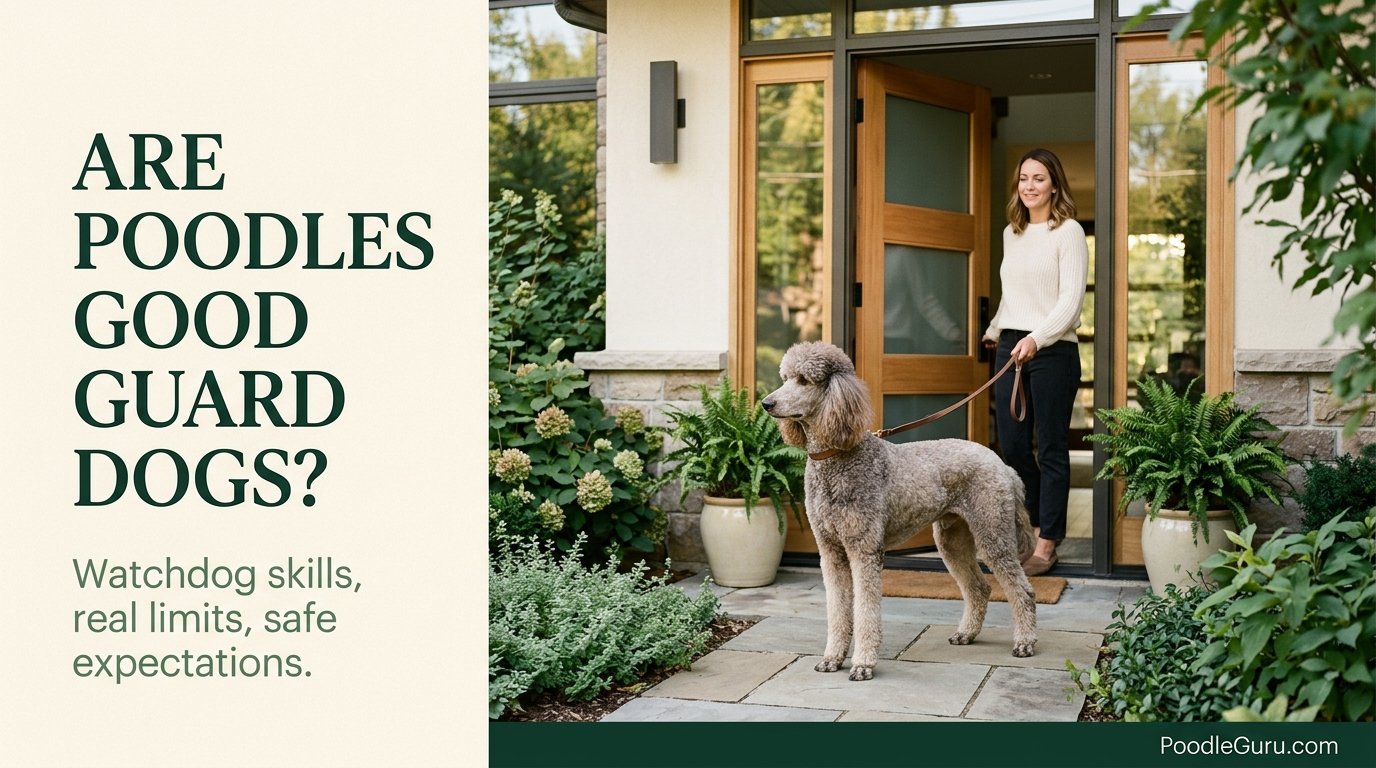
Quick Answer: Are Poodles Good Guard Dogs?
Poodles are excellent watchdogs but limited guard dogs. They usually alert their owners to strangers, unusual sounds, and unexpected visitors with sharp, persistent barking. Standard Poodles can also look imposing enough to deter a casual intruder. However, poodles were bred as water retrievers and companion dogs, not for bite work, apprehension, or independent property protection. If you want a smart dog that warns you early, a poodle can do that very well. If you need a dog that reliably physically intervenes, a poodle is not the right breed for that job.
What Does Guard Dog Actually Mean?
Most people use “guard dog” as a catch-all term, but there is a critical distinction that changes how you should evaluate a poodle’s protective potential.
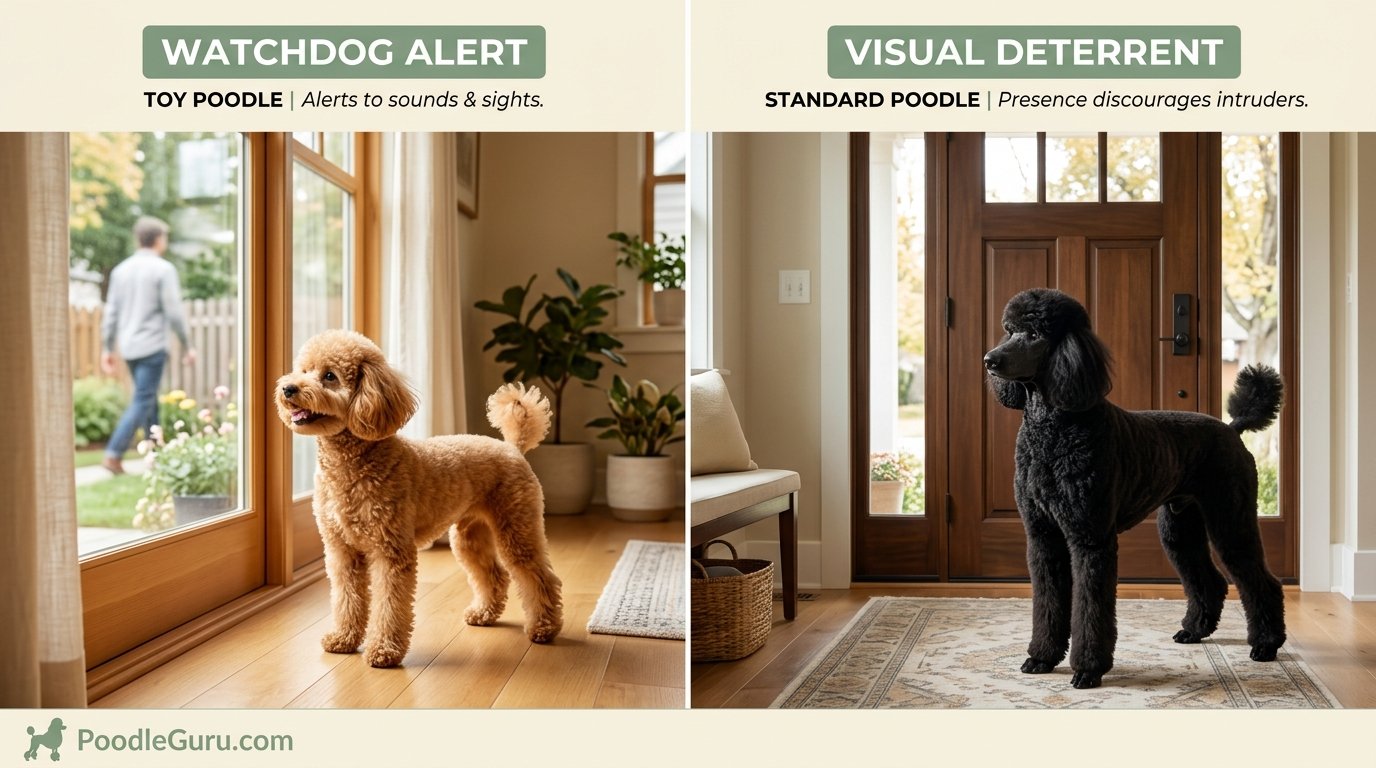
A watchdog alerts. A watchdog barks, growls, or signals when something unusual happens — a stranger at the door, a car in the driveway, or an unexpected sound at night. The dog’s job is to notice and notify. A dog does not need to be large or aggressive to be useful in this role. Even a Toy Poodle can be an outstanding watchdog.
A guard dog intervenes. A true guard dog goes further. These dogs are trained or genetically inclined to physically deter, confront, or restrain a threat. They need nerve stability, body size, bite confidence, and the judgment to distinguish real danger from normal daily activity.
For poodle owners, this distinction matters. Poodles were developed as water retrievers and companion dogs, not estate guardians, livestock protectors, or military working dogs. That history explains why poodles often alert beautifully but should not be expected to physically protect a home.
The Poodle Temperament: Alert, Intelligent, and Discerning
If you have lived with a poodle, you already know they do not miss much. They track movement, notice patterns, remember routines, and quickly learn what belongs in their environment and what feels unfamiliar. This high awareness is the foundation of their watchdog ability.
The AKC breed profile describes poodles as highly intelligent, active, and proud. In daily life, that often means a dog that carries itself with confidence and reacts quickly when something changes near the home.
Poodles are also deeply bonded to their families. Their protective behavior is usually personal rather than territorial. They are often alerting for you, not guarding property in the abstract. That makes them emotionally responsive and useful as family watchdogs, but it also means their alerting can become anxious if owners do not train an off-switch.
Many poodle owners report that their dogs distinguish between familiar and unfamiliar people with impressive accuracy. A Standard Poodle may ignore the mail carrier they see every day but bark sharply at a delivery driver they have never met before. That discernment is what separates a useful watchdog from a nuisance barker.
🧠 Intelligence
Poodles learn quickly and can be taught specific alert routines, quiet cues, door manners, and check-in behaviors. This makes them easier to shape into reliable watchdogs than many less trainable breeds.
👂 Alertness
Across all three sizes, poodles are usually quick to notice new sounds, visitors, doors opening, and movement outside windows. This makes them strong early-warning dogs.
🤝 Family Bond
Poodles form intense attachments to their people. Their alert behavior is often strongest when their owner is present, which is useful for home awareness but limited for independent property guarding.
Standard vs. Miniature vs. Toy: Does Size Matter for Guarding?
Yes. Size affects both physical capability and how seriously strangers may perceive the dog. It also changes how the poodle responds under pressure.
| Trait | Standard Poodle | Miniature Poodle | Toy Poodle |
|---|---|---|---|
| Typical Size | Over 15 inches at the shoulder; often 40–70 lbs | 10–15 inches; often 10–15 lbs | 10 inches or under; often 4–6 lbs |
| Visual Deterrent | High: athletic frame, confident posture, deeper bark | Moderate: alert presence but small body | Low: unlikely to deter by appearance alone |
| Watchdog Ability | Excellent: loud, persistent, highly aware | Excellent: sharp bark and fast response | Excellent: sensitive to sounds and visitors |
| Physical Protection | Limited: may intimidate, but not bred for bite work | Minimal: too small to physically stop a determined person | None: should never be expected to physically protect |
| Best Role | Watchdog plus visual deterrent | Audio alert system | Apartment or indoor alert dog |
The takeaway is simple: only the Standard Poodle has enough presence to function as a partial visual deterrent. Miniature and Toy Poodles can be excellent watchdogs, but expecting physical protection from them is unrealistic and unfair.
The PoodleGuru Protection Instinct Evaluation
At PoodleGuru, we evaluate a poodle’s protective potential by looking at the individual dog rather than making broad assumptions. Not every poodle is equally suited to watchdog work, and some dogs may need more impulse-control training before their alerting is useful.
Environmental Awareness
Does your poodle notice changes such as new sounds, unfamiliar cars, visitors, or movement outside windows? High awareness is the foundation of good watchdog behavior.
Stranger Discrimination
A useful watchdog distinguishes between a stranger at the door and a person across the street. Dogs that bark at everything need training before their alerts become meaningful.
Bark Purposefulness
An alarm bark is sharp, directed, and focused on the trigger. Excitement barking is looser and often paired with jumping or wagging. Watch the body language, not just the noise.
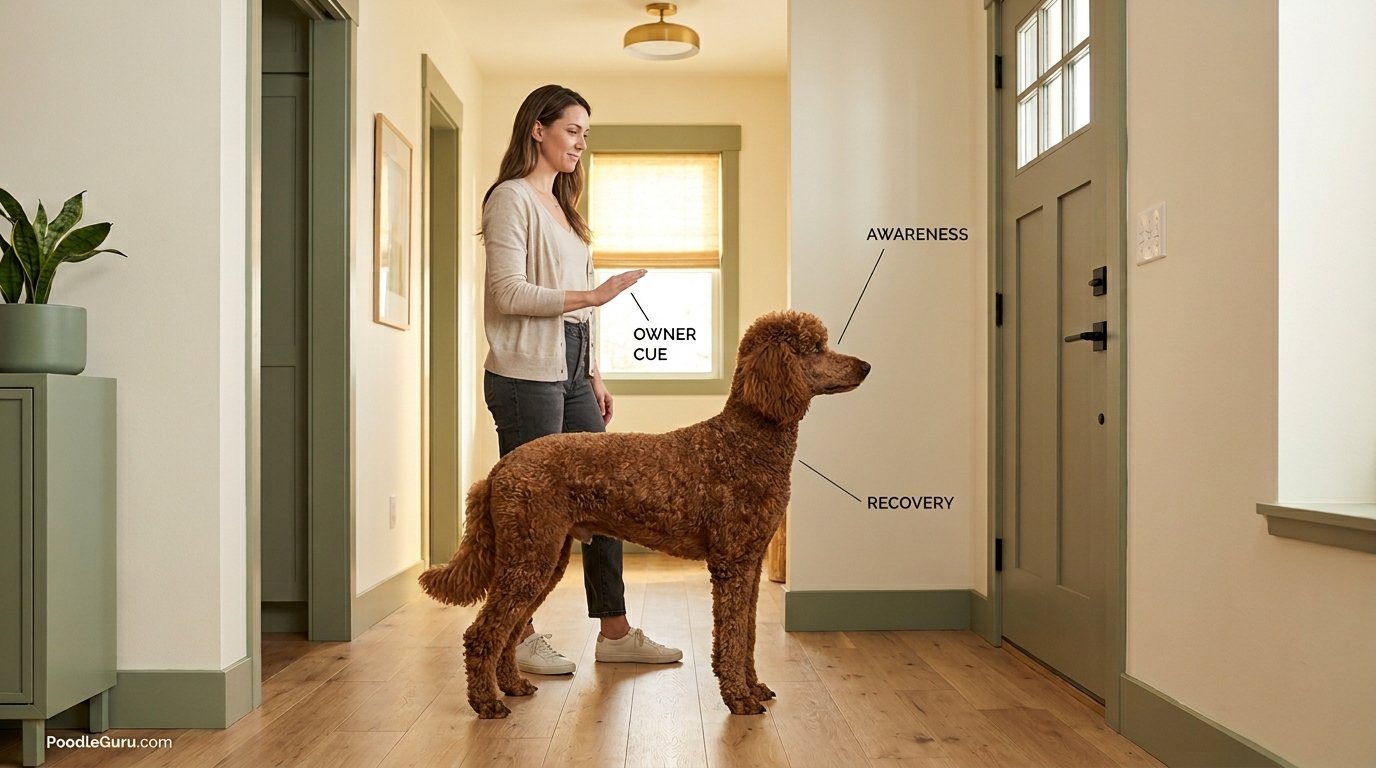
Recovery Time
A stable watchdog should settle after you acknowledge the situation. If your poodle stays anxious for 20 minutes after a visitor leaves, the issue is stress, not protection.
Owner-Directed Deference
The most important question is whether your poodle stops when you say “quiet” or “enough.” A dog that will not stand down on cue is not reliable as a household watchdog.
Poodles scoring high across all five dimensions have strong watchdog potential. Dogs that score low on recovery time or owner deference need calm impulse-control work before being relied on for alerting. A dog that cannot settle is a risk, not a protector.
What Poodles Actually Do: Alert Barking vs. Physical Protection
This is where expectations matter. A poodle may look serious at the door, but that does not mean the dog is prepared to physically confront a dangerous person.
What Most Poodles Will Do
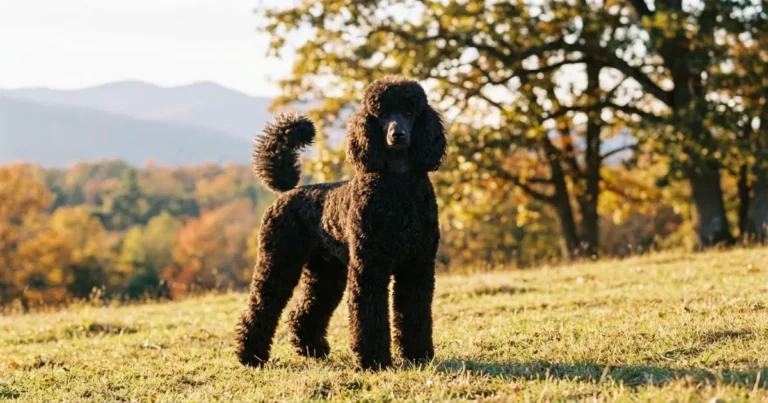
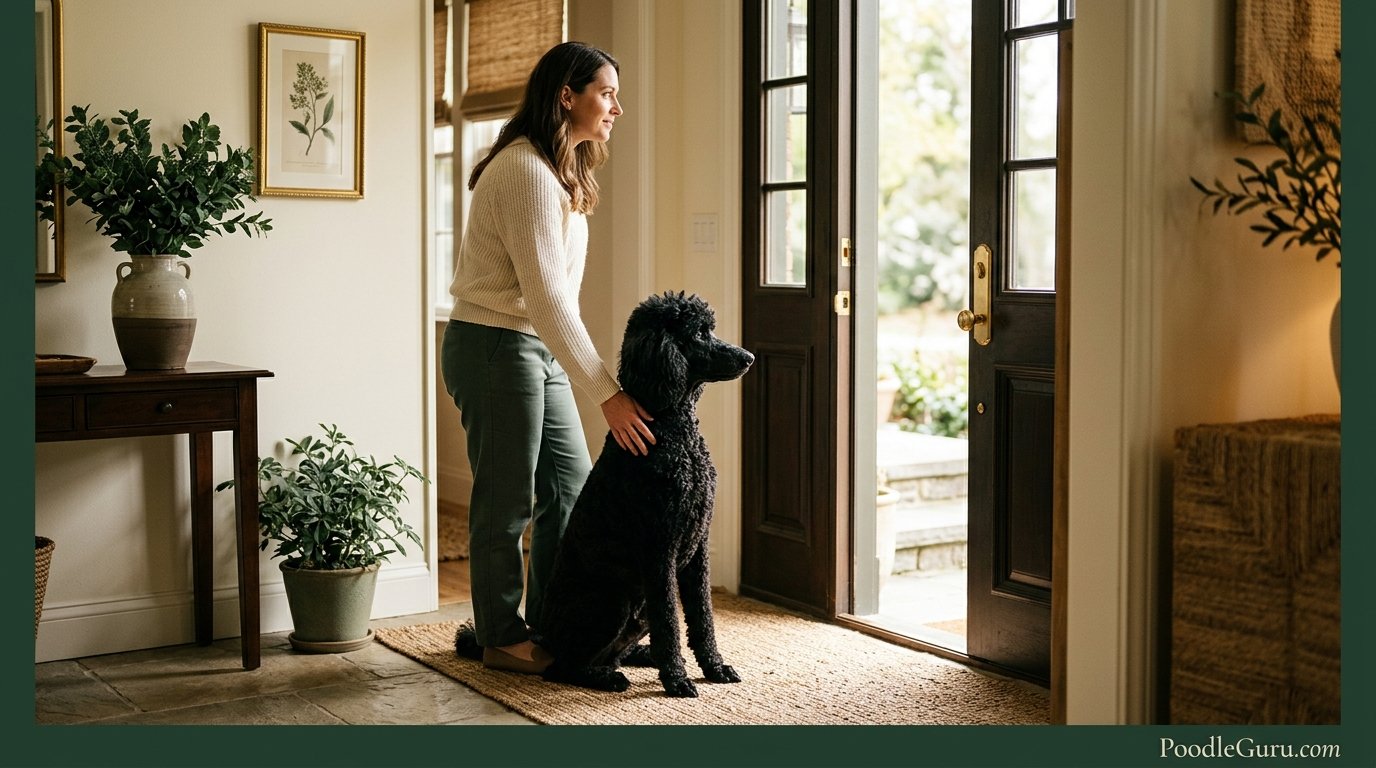
Most poodles will bark sharply when someone approaches the home. They may move toward the door, position themselves near the owner, or stand between the owner and the unfamiliar person. Standard Poodles can look confident and imposing, especially when they bark with purpose. This early warning can absolutely make a home a harder target.
What Most Poodles Will Not Do
Most poodles will not bite a stranger unprompted, independently patrol a property, or sustain a physical confrontation. Their protective response is usually owner-present and owner-directed. Under real pressure, many poodles will choose distance rather than a fight.
Never deliberately place a poodle in a situation where physical protection is expected. Their value is in early warning, not confrontation. Expecting a companion breed to physically defend you can put both you and the dog in danger.
How Poodles Compare to Traditional Guard Breeds
When owners ask whether poodles are good guard dogs, they often compare them with breeds that were developed for protection. That comparison is useful because it shows exactly where poodles shine and where they have limits.
| Breed | Bred For | Watchdog Ability | Guard Ability | Family Compatibility |
|---|---|---|---|---|
| Standard Poodle | Water retrieving, companionship | Excellent | Low–Moderate | Excellent |
| German Shepherd | Herding, protection, police work | Excellent | High | Good with training |
| Rottweiler | Livestock and estate protection | Excellent | High | Good with socialization |
| Doberman Pinscher | Personal protection | Excellent | High | Good with structure |
| Miniature/Toy Poodle | Companionship | Excellent | None | Excellent |
Poodles can compete with traditional guard breeds in alertness and alarm barking, but they fall away sharply on physical guard ability. Most households do not truly need a protection dog. They need a smart early-warning system with a loud bark and a loyal heart — and that is exactly where poodles perform well.
Training a Poodle for Watchdog Reliability
You cannot train a poodle into a protection dog if the genetics are not there. But you can absolutely train a poodle to be a reliable, discerning, and controllable watchdog.
Start With Impulse Control
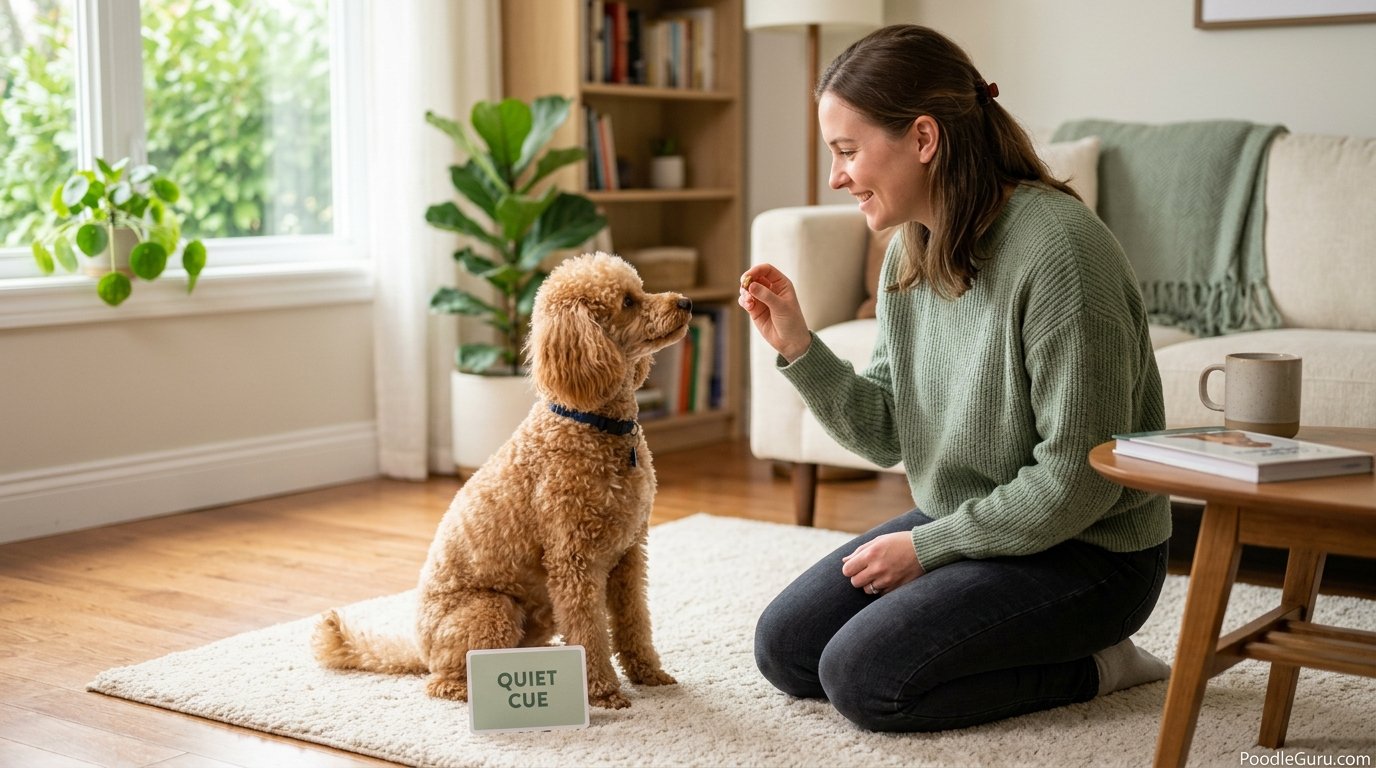
A watchdog that cannot stop barking on command is exhausting. Teach a strong “quiet” cue first. Wait for a bark, say “quiet” calmly, and reward the instant your poodle stops, even for one second. Build from easy practice to real door and window triggers.
Shape the Alert Behavior You Want
Most poodles already bark at knocks or doorbells. Shape that into a useful routine: two or three barks, then the dog comes to check in with you. Reward the check-in heavily. This teaches the poodle that alerting you is the job, not barking endlessly at the door.
Socialize Extensively
Do not isolate a poodle to “sharpen” guarding instinct. Under-socialization creates fear and reactivity, not protection. A well-socialized poodle has a better mental catalog of normal events, which makes real alerts more meaningful.
If your poodle shows fear-based behavior such as retreating while growling, snapping, barking with a tucked tail, or staying stressed long after the trigger is gone, work with a qualified positive-reinforcement trainer or veterinary behaviorist. Fear is not protection.
Common Myths About Poodles as Guard Dogs
Poodle owners hear many contradictory claims about protective ability. The truth is simple when you separate watchdog value from protection work.
❌ Myth: Standard Poodles are natural guard dogs.
Reality: They are natural watchdogs, not true guard dogs. They usually alert well, but most are not genetically suited for physical confrontation.
❌ Myth: Toy Poodles are too small to be useful.
Reality: Size does not decide watchdog ability. Toy Poodles can be loud, fast, and highly alert. They simply cannot physically deter anyone.
❌ Myth: Aggressive training will make a poodle protective.
Reality: Harsh or aggressive training can create fear, anxiety, and liability. It does not turn a companion breed into a safe protection dog.
❌ Myth: Poodles are too friendly to be protective at all.
Reality: Friendliness and alertness can coexist. A well-socialized poodle may greet invited guests warmly and still bark at unusual activity.
❌ Myth: A poodle will fight to defend the family.
Reality: Rare individual dogs may intervene, but relying on that is dangerous. Plan for alerting, not fighting.
✅ Truth: Early warning is the real value.
Reality: A poodle that barks the moment someone approaches gives you time to assess, lock a door, call for help, or respond safely.
Owner Action Plan: What to Expect and How to Proceed
Here is the practical plan for poodle owners who want the benefits of watchdog behavior without creating unsafe expectations.
Assess Your Real Need
If you need a dog that alerts you to visitors and strange noises, a poodle can serve you well. If you need physical protection, choose a breed developed for that work.
Evaluate Your Individual Dog
Use the five-part PoodleGuru framework above. Focus especially on recovery time and owner deference.
Train Alert-and-Settle
Practice staged door knocks. Reward two or three barks followed by a check-in with you.
Install a Quiet Cue
Your poodle must stop barking when asked. Without this off-switch, watchdog behavior can become a household problem.
Keep Your Poodle Out of Harm’s Way
Do not encourage confrontation, bite work, or outdoor guarding. Your poodle’s job is to warn you. Your job is to handle the situation safely.
Frequently Asked Questions
Are poodles good guard dogs for families with children?
Poodles make excellent family watchdogs because they naturally alert parents to visitors, sounds, and unusual activity. Standard Poodles can also provide visual deterrent value. However, poodles should not be relied upon for physical protection of children. Their role is early warning, not intervention.
Do poodles bark a lot when acting as guard dogs?
Poodles are naturally vocal and may bark at visitors, delivery people, and unfamiliar sounds. Without training, that can become excessive. Teach a quiet cue and reward controlled alerting so the dog barks purposefully and then settles.
Can a Standard Poodle be trained as a protection dog?
Standard Poodles are intelligent and trainable, but they were not bred for reliable bite work or physical confrontation. Some individual Standards may show stronger protective instincts, but true protection work is not a normal breed expectation.
Are male or female poodles better guard dogs?
There is no consistent difference in watchdog ability between male and female poodles. Individual temperament, training, confidence, and owner control matter much more than sex.
Will a poodle protect its owner during a walk?
A poodle may bark or move closer to the owner when something feels threatening, especially a Standard Poodle. That is alert behavior, not guaranteed protection. Do not expect a poodle to physically defend you during a confrontation.
At what age do poodles start showing guarding behavior?
Watchdog alertness often becomes more noticeable between 6 and 12 months as poodles mature and become more aware of their environment. This should be shaped with training so it does not become fear-based reactivity.
Do poodles guard the house when owners are away?
Usually not in the way traditional guard breeds might. Poodle alerting is often owner-directed. Many are less vigilant when home alone because their watchdog behavior is tied to their person’s presence.
Key Takeaways: Are Poodles Good Guard Dogs?
Poodles are exceptional watchdogs, especially for families who want early warning, strong alertness, and a loyal dog that notices what is happening around the home. They are not true guard dogs in the physical protection sense.
- Poodles are excellent watchdogs but limited guard dogs.
- Standard Poodles offer the strongest combination of bark depth, size, alertness, and visual deterrent presence.
- Miniature and Toy Poodles are strong audio watchdogs but have no realistic physical protection ability.
- A poodle’s real security value is early warning, not confrontation.
- Training a reliable quiet cue turns alert barking into useful watchdog behavior.
- Never expect a poodle to physically confront an intruder or dangerous person.
Next step: Read our Complete Poodle Temperament Guide to understand the full behavioral picture before deciding what role your poodle should play at home.