Poodle Color Genetics Chart: A Complete Breakdown for Owners and Buyers
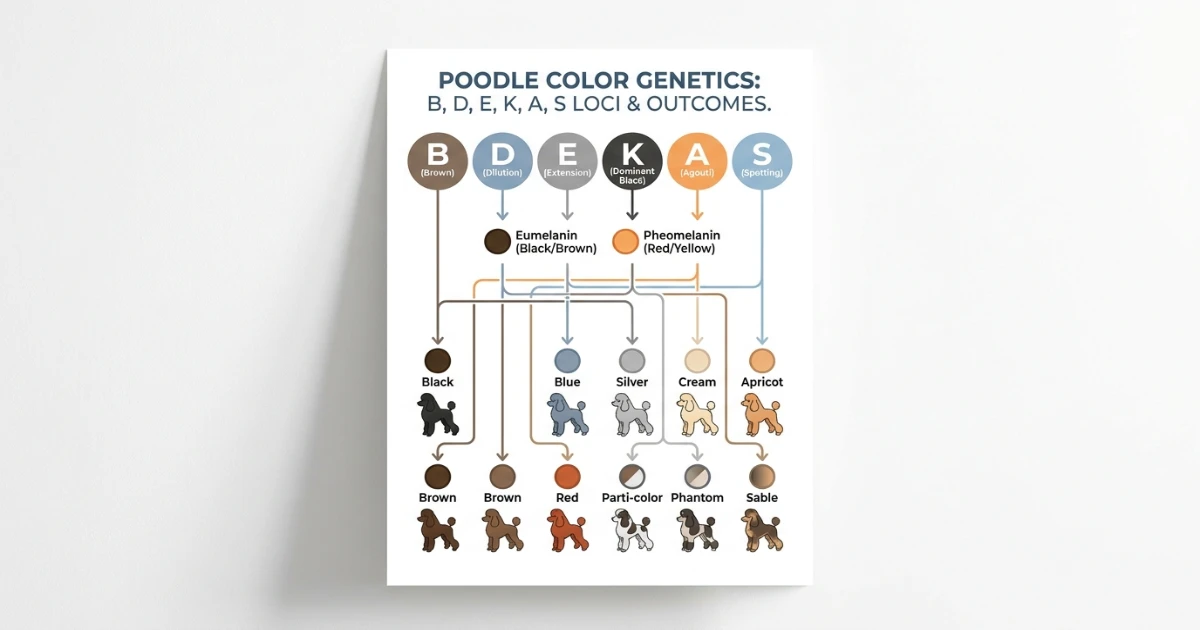
A poodle color genetics chart maps how dominant and recessive genes interact to produce each recognized coat color—from solid black and apricot to parti, phantom, and sable. Poodle coloring is controlled by at least six major gene loci (A, B, D, E, K, and S), and understanding those combinations helps breeders predict litter outcomes while giving buyers a clearer picture of why the color they see on a puppy may shift significantly as the dog matures.
Most poodle owners fall into one of two camps: those who never thought twice about coat color genetics until their “black” puppy faded to a slate-blue by its second birthday, and those who researched thoroughly before picking their pup and still felt confused by the terminology. Either way, poodle color genetics is a subject worth understanding properly—not because it changes how you love your dog, but because it absolutely affects what you can expect, what you’re actually paying for, and why a breeder’s guarantees sometimes fall apart.
This complete poodle color genetics chart and breakdown covers every major gene locus involved, explains the colors it produces, clarifies which combinations are possible versus impossible, and flags the places where breeders—and well-meaning internet posts—routinely get things wrong.
Understanding the Foundation: What Genes Actually Control Poodle Color
Poodle coat color isn’t one gene—it’s a layered system of interactions. Think of each gene locus as a dial on a mixing board. Some dials control which base pigment gets produced. Others determine how intensely that pigment is expressed. A few decide whether the pigment gets distributed evenly across the coat or restricted to specific patterns. When buyers hear “genetics,” they often picture a simple Punnett square. Poodle coat genetics is closer to a six-variable equation.
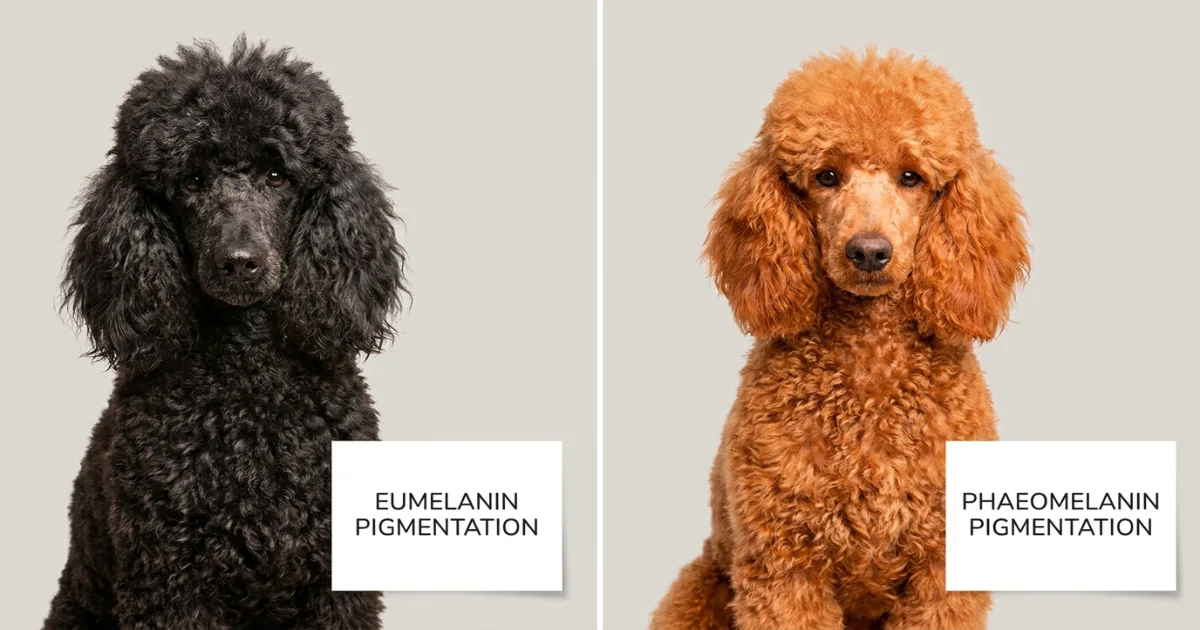
The two fundamental pigments at the core of all mammalian coat color are eumelanin (the black/brown pigment family) and phaeomelanin (the red/yellow pigment family). Every poodle color is a variation, dilution, restriction, or combination of these two. Nothing else. The question is always which genes are modifying them and how.
The Six Major Gene Loci in Poodle Color Genetics
Below is the core poodle color genetics chart framework—each locus, what it controls, and the alleles most relevant to poodle breeding:
| Locus | What It Controls | Key Alleles | Color Impact |
|---|---|---|---|
| B Locus | Black vs. brown eumelanin | B (black), b (brown/chocolate) | bb = brown/chocolate base; also affects nose, paw pad, and eye color |
| D Locus | Dilution of pigment intensity | D (full pigment), d (dilute) | dd dilutes black → blue/grey; dilutes brown → café au lait |
| E Locus | Whether eumelanin is expressed | E (normal), e (recessive red) | ee = only phaeomelanin expressed; produces red, apricot, cream |
| K Locus | Dominant black vs. patterned expression | KB (dominant black), ky (allows A locus expression) | KB– overrides most A locus patterns; kyky allows sable, phantom, etc. |
| A Locus | Agouti patterning (sable, phantom, tan points) | ay (sable), at (tan points/phantom), a (recessive black) | Only active when K locus allows; produces multi-tone patterning |
| S Locus | White spotting / parti pattern | S (solid), sp (parti/piebald) | spsp = classic parti poodle coloring (patches on white base) |
Color genetics testing through services like Embark or Paw Print Genetics can identify a dog’s genotype at each of these loci with high accuracy. Reputable breeders increasingly test parent dogs before breeding—not just for health clearances, but to predict color outcomes and avoid misrepresenting puppies as rare colors that their genotype can’t actually produce.
The Poodle Color Genetics Chart: Color by Color
Now that the loci framework is clear, here’s how the major poodle colors map to their underlying genetics. This is the section of the chart most buyers actually need.
Color Fading in Poodles: The Part Nobody Warns You About
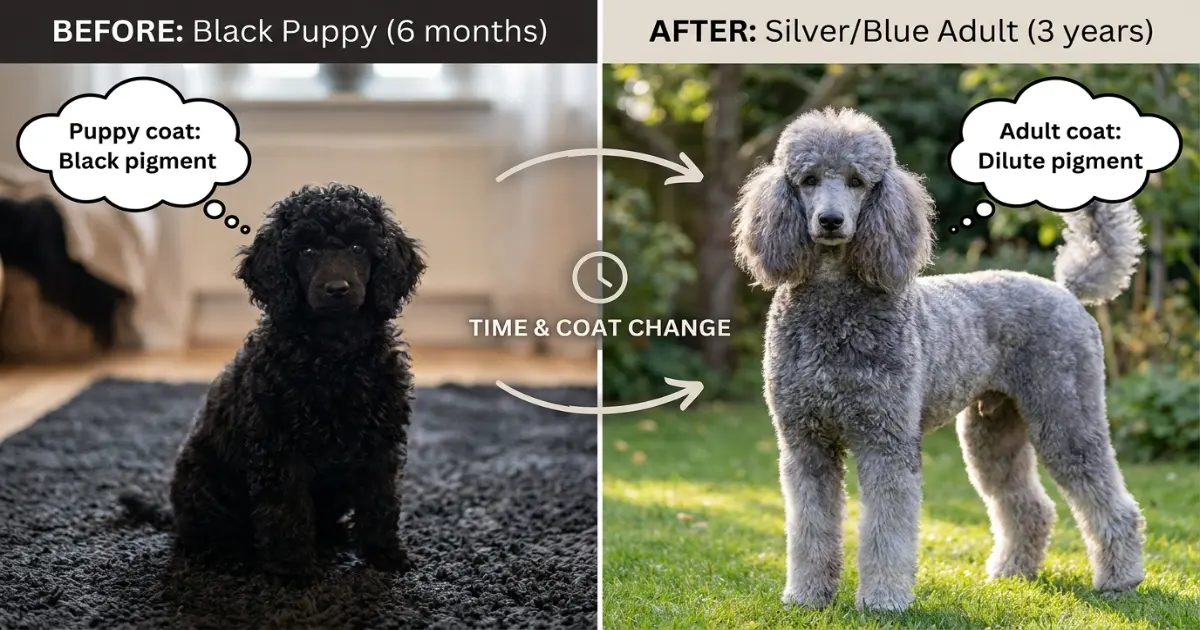
If there’s one aspect of poodle color genetics that catches owners off guard more than any other, it’s progressive color fading. The gene responsible is the Progressive Graying (G) gene—a dominant modifier that causes eumelanin-based pigment to fade over time. It doesn’t affect phaeomelanin-based colors (red, apricot, cream) in the same way, but for blacks, blues, browns, and silvers, it can dramatically change what a dog looks like by age two compared to at birth.
Black puppies with the G gene will often be born jet-black and clear progressively to blue or silver. Silver poodles are perhaps the most dramatic example—they begin clearing first around the face and paws, typically visible by 6 weeks old, and can look almost completely silver-white by 18 months. This early clearing is actually how experienced breeders identify silvers from blacks in a newborn litter.
The practical implication for buyers: if a breeder is selling a “rare dark silver” puppy that still looks entirely black at 8 weeks and shows no clearing at the face or paws, be skeptical. True silvers show their clearing early.
Poodle Color Genetics and the AKC: What’s “Official” and Why It Matters
The AKC recognizes 10 standard poodle colors: black, blue, brown, café au lait, cream, gray, silver, silver beige, white, and apricot—as well as red, which was formally added in 1980. Patterns like parti, phantom, and sable were not historically recognized for conformation showing, though AKC registration allows them.
This matters for buyers because some breeders market non-standard colors as “rare” and charge a premium for them—sometimes warranted, sometimes not. A parti poodle requires both parents to carry the sp allele, which does limit production. A phantom requires both parents to carry the at allele and kyky genotype. These aren’t trivial genetic coincidences. But “rare” in genetics doesn’t automatically mean “better in temperament or health.”
What Buyers Get Wrong About Poodle Color Genetics
Several persistent misconceptions circulate in online poodle communities. Here are the most consequential ones:
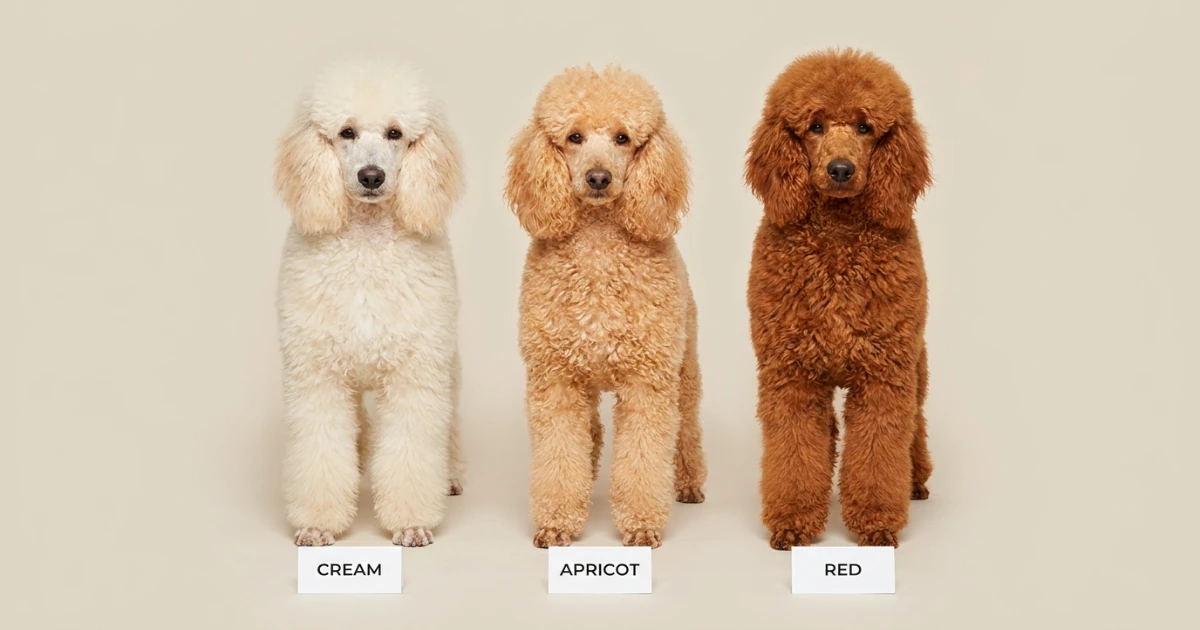
Apricot and red are the same color, just different shades. Genetically they’re the same pathway (ee), but the intensity difference is thought to be driven by additional modifier genes that aren’t fully mapped. In practice, they’re treated as distinct colors and graded separately in shows.
Blue poodles are a breed variation. They’re not. Blue is simply a black poodle with the dilution gene (dd). There is no “blue poodle line”—though breeders who prioritize blue coat outcomes do breed toward dd combinations intentionally.
A brown nose means a chocolate poodle. Not necessarily. Café au lait poodles also have brown noses. And some black poodles with winter nose (snow nose) temporarily lighten their pigment in cold months—that’s not genetics, that’s temperature affecting melanin production.
Parti is a health problem. Some historic prejudice around piebald patterns existed in multiple breeds (connecting white spotting to deafness, as in Dalmatians). In poodles, the S locus parti pattern has not been associated with increased deafness risk the way extreme white in some other breeds has. Parti poodles are generally healthy.
Silver and blue are the same color. Both are dilutions of black, but they’re distinct. Silver dilutes further and typically shows more pronounced face and paw clearing as puppies. Blues retain darker coat longer and clear more gradually.
Ask any poodle breeder selling a “rare” color whether the parents have been genetically tested at the relevant loci. A reputable breeder producing phantom or parti puppies intentionally should be able to show you parent genotypes—not just photos. If they can’t, the “rare” label may be marketing rather than science.
How Poodle Color Genetics Works in Practice: Predicting a Litter
Breeders who understand the poodle color genetics chart can make reasonably accurate predictions about litter color outcomes before a pairing ever happens. Here’s a simplified walk-through using the most commonly requested scenario: predicting whether two black poodles can produce a brown puppy.
Answer: yes—if both parents carry the recessive b allele. A black poodle that is genetically Bb (carrier) looks identical to one that is BB (non-carrier). Breed two Bb black poodles together and you have a 25% chance of producing bb (brown/chocolate) puppies. Without DNA testing, there’s no way to tell by looking at the parents.
This is why genetic testing has transformed ethical poodle breeding. It removes the guesswork that used to make color prediction feel like lottery odds. It also explains why reputable breeders who specifically produce chocolate, café au lait, or silver puppies aren’t just getting lucky—they’ve built breeding programs around verified genotypes.
2026 Poodle Color Pricing Guide
Color does meaningfully affect price in the poodle market, though it should never be the only factor. Here’s a realistic range based on current breeder pricing in 2026:
Black / White $1,500 – $2,500
Brown / Chocolate $1,800 – $3,000
Apricot / Cream $2,000 – $3,500
Red $2,500 – $4,000
Blue / Silver $2,000 – $3,500
Parti / Phantom $2,500 – $5,000+
Prices are for health-tested, well-bred puppies. Avoid breeders charging “rare color” premiums without supporting genetic testing documentation.
Phantom and Parti Poodles: A Closer Look at Patterned Genetics
Phantom and parti poodles have earned devoted followings, partly because of their striking appearance and partly because their genetics add a layer of complexity that enthusiast breeders find genuinely interesting.
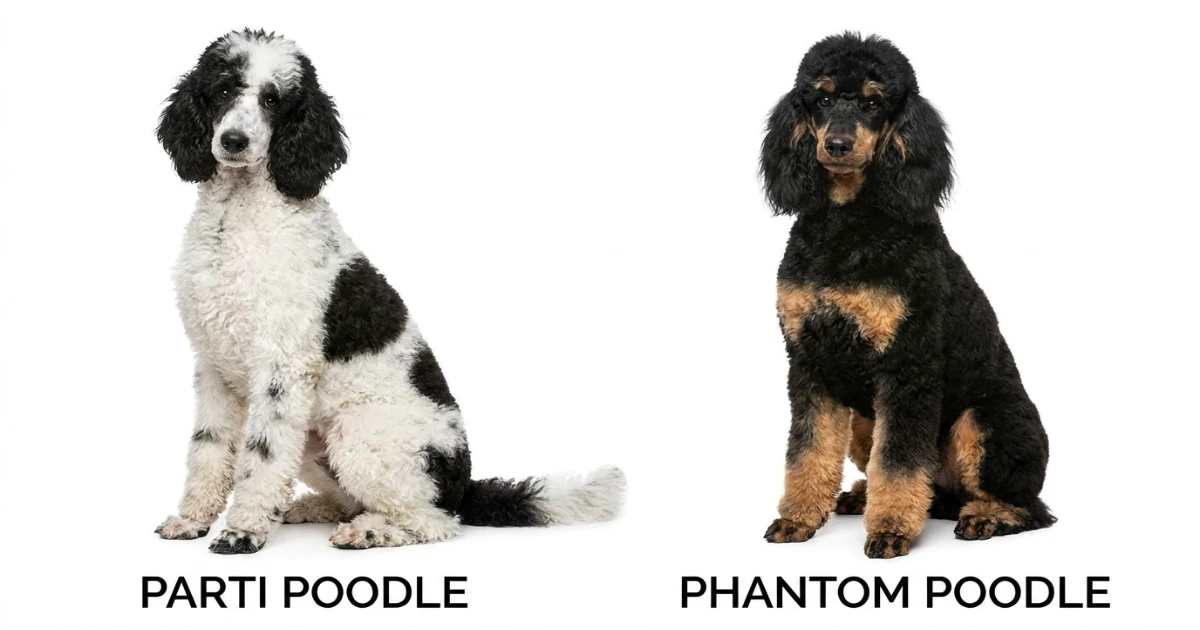
A phantom poodle is genetically similar to a Doberman or Manchester Terrier in pattern—a primary solid color with tan or lighter-colored points at specific locations (above the eyes, on the muzzle, chest, inside of legs, and under the tail). This requires the at allele to be expressed, which only happens when the K locus is kyky—meaning neither dominant black nor brindle is overriding the A locus. Phantom poodles exist in many base color combinations: black-and-apricot phantom, chocolate-and-apricot phantom, blue phantom, silver phantom, and more.
A parti poodle simply carries spsp at the S locus—two copies of the piebald allele. This produces at least 50% white coverage with patches of the dog’s base color distributed across the coat. Both parents must contribute an sp allele. A solid-colored poodle can carry one copy (Ssp) without showing any parti spotting—which is why two seemingly solid poodles can produce parti offspring if both are carriers.
Pro Tips for Buyers Prioritizing Color
- Request genetic testing documentation, not just verbal assurances, when a breeder advertises a specific rare color.
- View photos of the puppy’s parents at full adult age—not just as puppies—to understand where your pup’s coat is heading.
- Ask specifically about the Progressive Graying gene (G locus) if you’re hoping for a stable dark coat color into adulthood.
- A true silver poodle should show visible face-clearing by 6 weeks. If a breeder calls a fully dark puppy a “silver” at 8 weeks, ask for clarification.
- Color should be a secondary priority after health clearances, temperament lineage, and breeder transparency. The most gorgeous coat color on a dog from an untested litter is still a gamble.
Frequently Asked Questions
What is a poodle color genetics chart?
A poodle color genetics chart maps how alleles at six key gene loci (B, D, E, K, A, and S) combine to produce each coat color and pattern in poodles. It’s used by breeders to predict litter color outcomes and by buyers to understand why their poodle’s color may change with age.
Can two black poodles produce a brown puppy?
Yes—if both parents carry a recessive copy of the b allele (brown/chocolate). Two black poodles that are each Bb have a 25% chance of producing a bb (brown) puppy per birth. DNA testing confirms whether a black poodle is a brown carrier.
Why do poodle colors fade as they age?
Poodle color fading is caused by the Progressive Graying (G) gene, a dominant modifier that gradually reduces eumelanin pigment intensity over time. It most strongly affects black, brown, and blue poodles. Phaeomelanin-based colors (red, apricot, cream) fade less dramatically, though they can lighten as well.
What’s the difference between blue and silver poodles genetically?
Both are dilutions of black eumelanin via the dd genotype at the D locus. Silver poodles typically carry the Progressive Graying gene and begin showing face-and-paw clearing as early as 6 weeks. Blue poodles clear more slowly and maintain a darker, slate-blue tone into adulthood. They’re related but distinct in phenotype and timing.
Are parti poodles genetically healthy?
Yes, parti poodles are not associated with significant genetic health disadvantages. Unlike extreme white in some other breeds (e.g., double merle or extreme piebald in certain lines), the sp/sp genotype in poodles has not been linked to increased rates of deafness or other health concerns when bred responsibly.
What makes a poodle apricot versus cream?
Both apricot and cream poodles are ee at the E locus (recessive red). The difference is phaeomelanin intensity—cream has very low pigment expression while apricot has moderate expression. This intensity difference is influenced by additional modifier genes. All dogs in this spectrum are genetically classified as recessive red.
Can I predict my poodle puppy’s adult color?
Partially. Genetic testing of the parents reveals the genotype at each major locus, giving a probability-based prediction. However, modifier genes—especially those affecting color intensity and the G locus—can still cause surprises. Parent photos at adult age remain the most practical visual reference for buyers.
Is silver beige a separate genetic color from café au lait?
They’re closely related. Silver beige is considered a diluted version of café au lait—both involve bb (brown) at the B locus combined with dilution at the D locus. AKC registers them separately, and experienced breeders distinguish them by shade, but genetically the underlying pathways overlap significantly.
Summary: What the Poodle Color Genetics Chart Tells You
Poodle coat color is the product of six major gene loci—B, D, E, K, A, and S—each acting as a layer of modification over two base pigments. Understanding these interactions explains why the color a puppy is born with isn’t necessarily the color it will wear at age three. It also explains why parti puppies can come from solid-colored parents, why two black poodles can produce chocolate offspring, and why “blue” is a black poodle with a dilution gene rather than a separate variety.
For buyers, the poodle color genetics chart is most useful as a tool for evaluating breeder credibility. A breeder who understands and tests for the relevant loci is more likely to accurately represent their puppies—and less likely to charge a “rare color” premium for something that isn’t. For owners, it turns a confusing adolescent color shift from a frustration into something predictable and fascinating.
Color is one of the most joyful parts of choosing a poodle. It should also be one of the most informed.