Are Poodles Good With Strangers? What to Expect
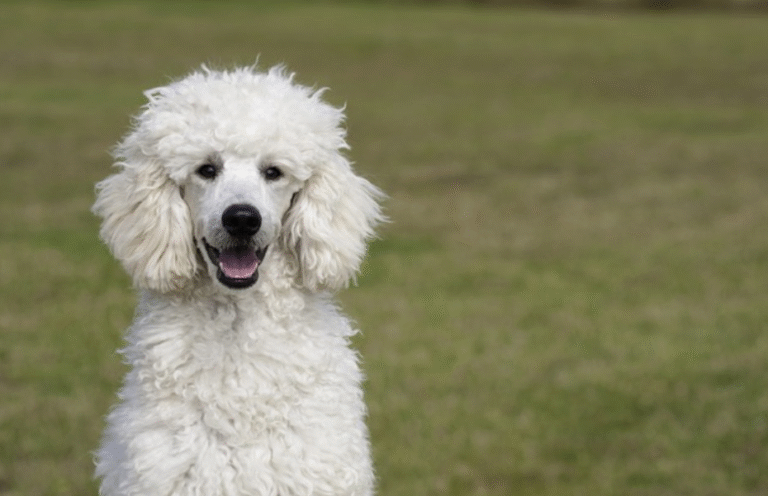
Poodles are rarely the dogs that leap joyfully onto every guest. But they’re also not typically the ones cowering in the corner. Understanding poodle behavior around strangers means reading the nuance between the breed’s natural reserve, high intelligence, and deep loyalty to their family.
Quick Answer
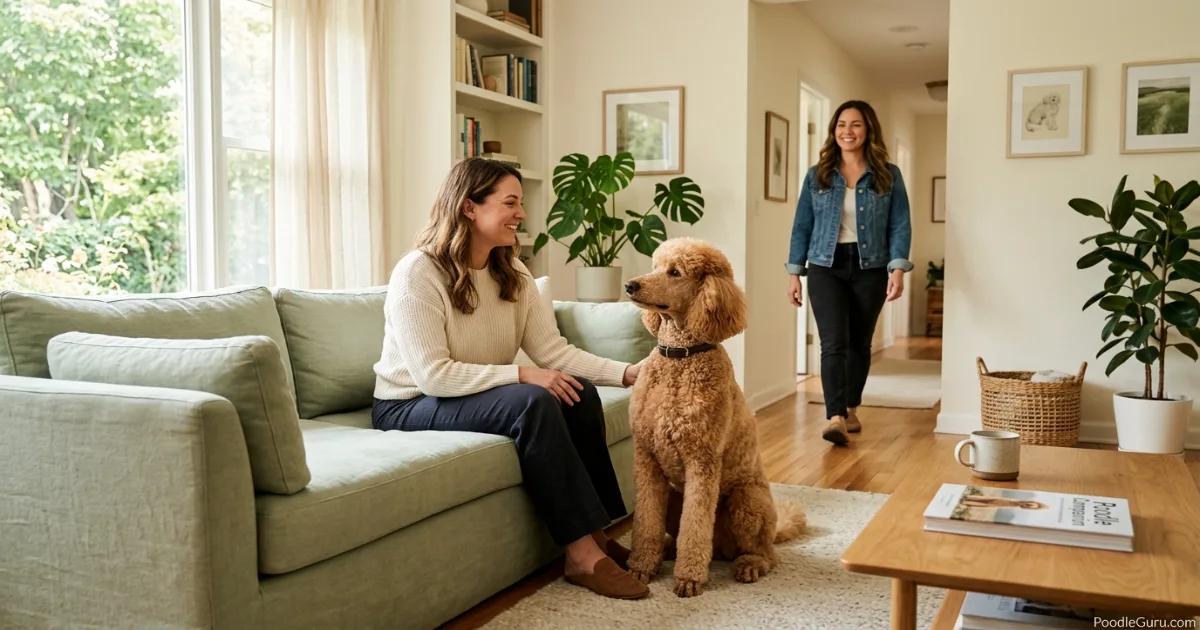
Poodles are generally reserved rather than immediately warm with strangers, but outright aggression or fear is not the breed norm. They tend to assess new people carefully before deciding whether to engage. With proper early socialization, most poodles become politely accepting of visitors and unfamiliar people in public. Without it, aloofness can tip into nervousness or protective barking. The key factor is almost always the dog’s individual socialization history, not the poodle breed itself.
Breed Standard Says
The AKC describes poodles as “very smart, active, and proud.” While not explicitly reserved, the breed standard implies a dog that carries itself with dignity rather than indiscriminate friendliness.
Intelligence Shapes Behavior
Poodles think before they react. A stranger isn’t automatically a friend — the poodle will watch, process, and decide. This can look like standoffishness but is simply thoughtful assessment.
Socialization Is Everything
A well-socialized poodle is typically unflappable. An under-socialized poodle may bark, retreat, or become anxious. The difference between the two is almost always early exposure.
The Typical Poodle Temperament: Aloof or Friendly?
Poodle temperament sits at an interesting intersection. These dogs were bred to work closely with humans — as water retrievers and later as circus performers and companions — so they’re not a breed that ignores people. But they’re also not a breed that lavishes affection on anyone who walks through the door. The breed’s characteristic dignity means many poodles hold back an initial, open-arms greeting in favor of observation.
For poodle owners, this means expecting a dog who is loyal and deeply bonded to their family but selective with outsiders. That selectivity is not a flaw. It’s the natural extension of a breed that was refined to be an attentive, intelligent partner. The most important thing to understand is that a poodle who doesn’t immediately fawn over strangers is not “unfriendly” — they’re simply displaying normal breed-typical reserve.
How Poodles React to Strangers: The Breed-Specific Pattern
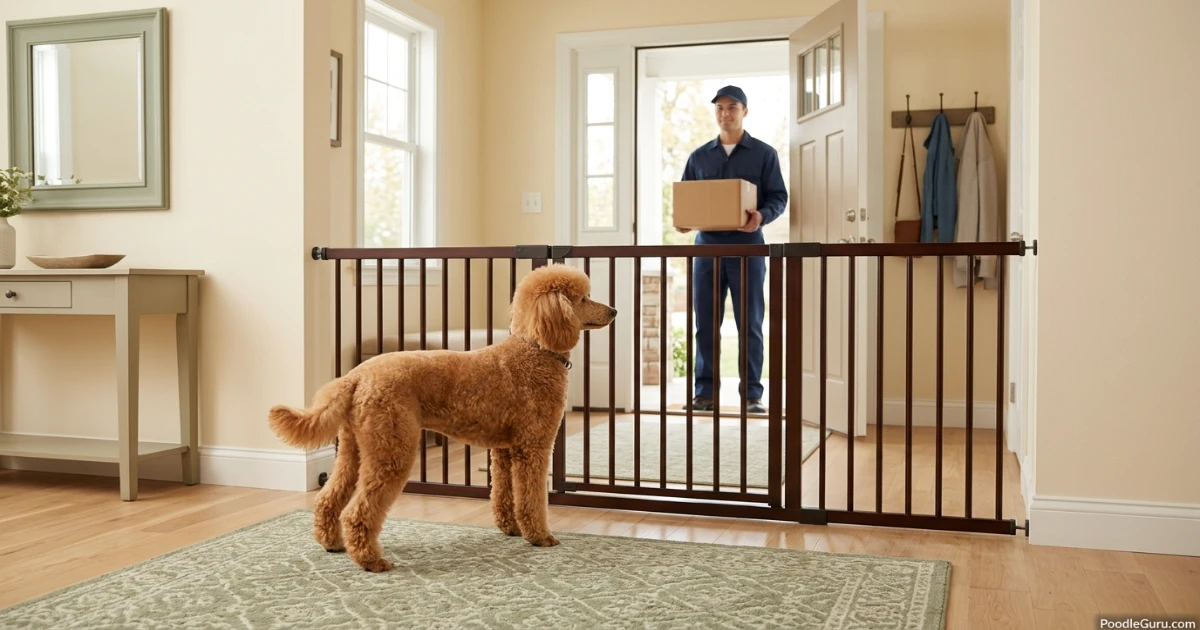
Most poodles follow a three-phase response to unfamiliar people. First comes the assessment phase: ears up, body still, eyes tracking. The dog is gathering information. Next is the decision phase: approach, retreat, or a neutral disengage. Finally, a relaxation phase if no threat is perceived. This sequence might take seconds, or it might stretch to an hour during a first visit. It’s not reactivity — it’s a thinking dog doing what thinking dogs do.
This pattern is what many owners describe as “my poodle ignores strangers at first but warms up.” In practice, a poodle may sit beside their owner and watch a guest for the first 20 minutes of a visit, then quietly approach for a sniff later. Forcing interaction before the poodle has finished assessing typically backfires. Letting the dog set the pace almost always results in a calmer outcome.
Poodle Behavior Around Strangers by Size
While all three poodle sizes share the breed’s core temperament, size sometimes influences how that temperament is expressed — and certainly how strangers react, which in turn shapes the dog’s response.
| Poodle Size | Typical Stranger Reaction | What’s Often Misread | Socialization Note |
|---|---|---|---|
| Toy Poodle (4–6 lbs) | May appear more nervous due to small size. Can bark as a distance-increasing strategy because everything looms large. | Fear barking is easily mistaken for aggression. It’s often just a tiny dog saying “please give me space.” | Carry your Toy in a bag for safe, controlled exposure to many people without being grabbed. |
| Miniature Poodle (10–15 lbs) | Often the most overtly alert of the three. Tends to be watchful and may vocalize from a fixed observation post. | Alert barking at the door is sometimes read as territorial when it’s simply announcement behavior. | Teaching a “place” cue early gives Miniatures a job to do when strangers arrive. |
| Standard Poodle (40–70 lbs) | Typically the most confident size with strangers, but also the most imposing. Many Standards stand between owner and stranger protectively. | A Standard’s silence while assessing can look like calm acceptance when it’s actually quiet watchfulness. | Early leash training prevents a protective posture from escalating to lunging if startled. |
Note: Individual personality overrides size generalizations every time. A shy Standard is not uncommon; a social-butterfly Toy is just as possible.
Regardless of size, the AKC Poodle breed standard points to a dog that is “exceptionally smart, active, and proud.” The standard doesn’t mandate a specific stranger response — which leaves owners free to shape the behavior they want through training and exposure.
Why Some Poodles Are Wary of New People
Reserve around strangers isn’t a defect. It’s often the result of a completely reasonable chain of causes. At PoodleGuru, we see five common reasons poodles develop wariness beyond the normal breed reserve:
1. Lack of Early Socialization
Poodle puppies have a critical socialization window between about 3 and 16 weeks. During this period, positive exposure to a wide variety of people — different ages, appearances, voices, and movements — teaches the puppy’s brain that unfamiliar humans are unremarkable and safe. Puppies who miss this window may grow into adults who react to novelty with suspicion. This is preventable, and the poodle puppy care guide explains how to do it safely.
2. A Single Scary Experience
One bad interaction — a stranger who grabs, a child who startles, a vet visit that hurts — can create a lasting negative association. Poodles remember. Their intelligence works against them here: they generalize from a single scary incident to other similar situations faster than less-cognitive breeds.
3. Protective Instincts
Poodles bond tightly to their people. A dog who perceives their owner as nervous or feels responsible for the home may step into a protective role. This can look like standing between owner and stranger, low growling, or alert barking when someone approaches. It’s not necessarily aggression — it’s a dog trying to manage a situation they view as uncertain.
4. Owner’s Own Anxiety
Dogs read human body language with extraordinary precision. An owner who tenses up, shortens the leash, or changes their breathing when a stranger approaches is communicating “this might be dangerous.” The poodle responds accordingly. Calm, matter-of-fact owner behavior is the single most underrated tool for improving poodle-stranger interactions.
5. Pain or Medical Discomfort
A poodle in pain — from dental disease, arthritis, or an ear infection — may become irritable and less tolerant of new people. If a previously social poodle suddenly starts avoiding or snapping at strangers, a veterinary check is in order before assuming a behavior problem.
Early Socialization: The Foundation for Confident Poodles
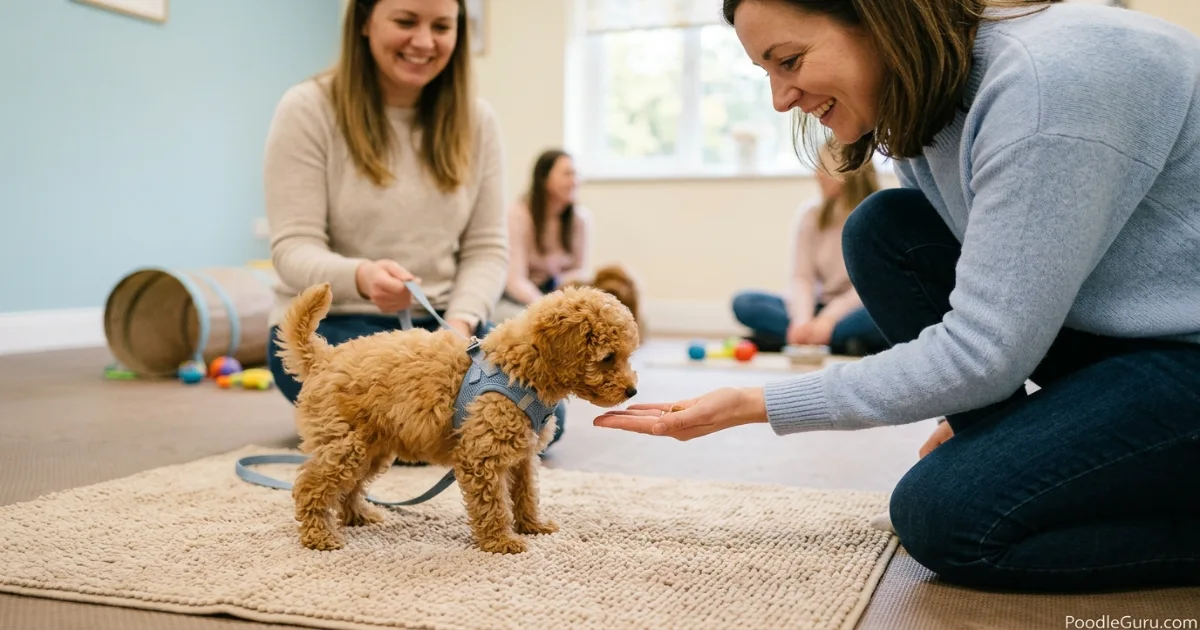
Socialization is not about forcing your poodle to accept handling from every passerby. It’s about creating enough positive or neutral experiences that the poodle’s default response to novelty shifts from suspicion to calm curiosity. The goal is a dog who can be in the presence of strangers without stress — not necessarily a dog who wants to be everyone’s best friend.
Effective socialization for poodles includes exposure to people of varying appearances, controlled distance so the dog isn’t overwhelmed, and consistent pairing of new people with high-value rewards. Short, positive sessions trump long, overwhelming ones. A five-minute meet-and-treat with a calm friend trumps a crowded dog park every time.
The PoodleGuru S.T.R.A.N.G.E.R. Framework
At PoodleGuru, we developed a structured way to evaluate your poodle’s response to unfamiliar people and design a targeted improvement plan. It’s called the S.T.R.A.N.G.E.R. Framework — eight letters that walk you from observation to confident management.
Scan the Reaction
When a stranger appears, what three things happen in sequence? Write down the exact behaviors: ear position, tail height, body movement, vocalization. Objectivity reveals patterns you might miss in the moment.
Track the Threshold
At what distance does your poodle first notice and react? Ten feet? Twenty? Right at the door? Knowing this threshold tells you where to start training — just outside the zone of reaction.
Rate the Intensity
On a scale of 1 to 5, how intense is the reaction? 1 is mild curiosity; 5 is full-on barking, lunging, or cowering. This gives you a benchmark to track progress — and flags when professional help is needed.
Assess Your Own Response
What do you do when your poodle reacts to a stranger? Tensing up, yanking the leash, or picking up a small dog all amplify the reaction. Honest self-assessment is part of the solution.
Name the Goal
Do you need your poodle to accept visitors in your home? Pass strangers calmly on walks? Politely ignore people at a café? Define the specific outcome — not just “be better with strangers.”
Graduate Exposure Slowly
Start below threshold: a stranger at a distance where your poodle notices but doesn’t react. Reward calmness. Gradually decrease distance over multiple sessions. Never push past the point of reaction.
Engage a Professional If Needed
If the intensity scale is a 4 or 5, or if you’ve tried gradual exposure for weeks without improvement, a certified positive-reinforcement trainer or veterinary behaviorist is the right next step.
Reinforce What Works
When your poodle gets it right — a calm glance, a relaxed body — reward generously. Poodles thrive on clear feedback. Every successful stranger interaction, no matter how small, builds the next one.
When Wariness Becomes a Problem
A certain level of reserve is normal. But poodle behavior around strangers crosses into problem territory when the dog can’t recover, can’t function, or poses a safety risk. This distinction matters.
Seek Professional Help If Your Poodle:
- Growls, snaps, or lunges at strangers — even if it only happens occasionally.
- Shuts down completely: trembling, hiding, refusing treats in the presence of new people.
- Urinates or defecates submissively when approached by strangers.
- Cannot be redirected from a reactive state with high-value food or a known cue.
- Has bitten or attempted to bite a person, regardless of circumstance.
A certified behavior consultant or veterinary behaviorist can assess whether fear, anxiety, or a medical issue is driving the reaction. Resources like ASPCA’s guidance on fear of strangers in dogs offer a helpful starting point. Early intervention prevents a manageable behavior from hardening into a dangerous one.
How to Introduce Your Poodle to New People: Step-by-Step
This sequence works for visitors in your home, guests at the park, or meeting a new pet sitter. Adjust the pace to your poodle’s comfort level.
Set Up the Environment
Choose a neutral space — not your poodle’s bed or a cramped doorway. For home visits, have your guest seated before the poodle enters the room. A standing, looming human is far more intimidating than one sitting calmly.
Let the Poodle Observe First
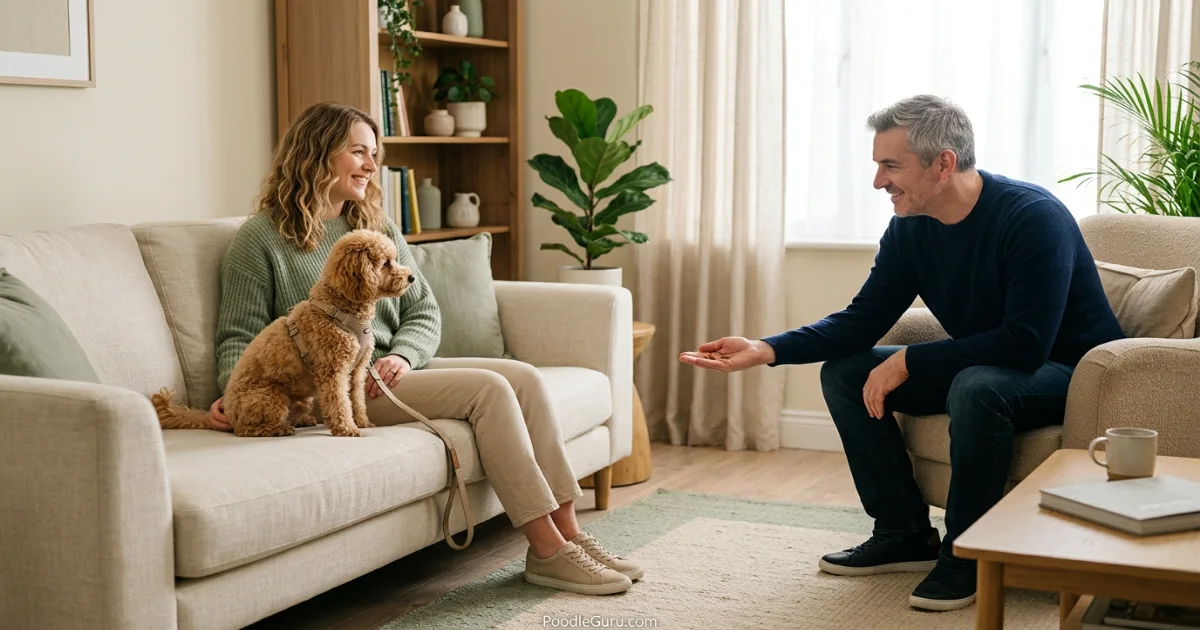
Bring your poodle into the room on a loose leash. Allow them to see the stranger from a distance. Don’t drag them closer. Let the dog process. This phase might last two minutes or twenty.
Have the Stranger Ignore the Dog
This feels counterintuitive, but it’s powerful. The stranger should avoid eye contact, keep hands still, and not lean toward the poodle. Let the dog initiate any interaction. Averted gaze and a relaxed posture signal non-threat.
Reward Any Voluntary Approach
If your poodle chooses to sniff the stranger, that’s a win. The stranger can gently offer a treat (from an open palm, not reaching over the dog’s head) but shouldn’t force petting. Treats build positive association; petting can come later.
Keep First Meetings Brief
A successful five-minute introduction beats a 30-minute session where the poodle eventually becomes overwhelmed. End on a positive note and allow your poodle to retreat to a safe space. Short, successful reps build confidence faster than long, draining ones.
Common Mistakes Owners Make with Stranger Introductions
Even well-meaning owners can accidentally make stranger interactions harder. Recognizing these patterns is half the fix.
Mistake vs. Better Approach
Mistake: Forcing your poodle to accept petting from a stranger because “they need to get used to it.”
Better: Let your poodle decide if and when they want contact. Forced petting breaks trust and can turn wariness into fear. A poodle who learns that strangers respect their space becomes more confident, not less.
Mistake: Picking up a small poodle every time a stranger approaches.
Better: Pick up only if the poodle is genuinely at risk. Frequent scooping teaches the dog that the ground-level world is dangerous and that their owner is a portable panic room. Let small poodles stand on their own four feet when safe, with you as a calm anchor.
Mistake: Punishing growling or barking at strangers.
Better: Listen to what the vocalization communicates. A growl is often a warning, not an act of aggression. Punishing a warning removes a critical communication layer and can lead to a dog who bites without warning. Address the underlying discomfort, not the symptom.
Mistake: Introducing your poodle to every stranger you encounter on a walk.
Better: Select the right strangers. A calm adult who listens to instructions is a far better socialization partner than an enthusiastic child who rushes forward. Quality of exposure matters infinitely more than quantity.
Frequently Asked Questions About Poodle Behavior Around Strangers
Are poodles naturally aggressive toward strangers?
No. Aggression is not a breed trait of poodles. However, any dog — regardless of breed — can develop aggressive behaviors if fearful, under-socialized, or in pain. A well-bred, well-socialized poodle is much more likely to be reserved or aloof than aggressive.
Why does my poodle bark at every person who walks by the house?
Alert barking is common in poodles. They’re watchful dogs and often appoint themselves as the household sentry. This is not necessarily stranger-directed aggression — it’s announcement behavior. Teaching a “quiet” cue and rewarding calm observation usually reduces the barking significantly.
Do Toy Poodles behave differently with strangers than Standard Poodles?
Sometimes. Toy Poodles may be more reactive to strangers simply because of their small size — everything seems bigger and potentially threatening. Standard Poodles tend to be more confident but also more protective. Miniature Poodles often fall somewhere in the middle. Individual personality outweighs size as a predictor.
Can an adult poodle learn to be comfortable with strangers?
Yes. While early socialization is ideal, adult poodles can absolutely learn new associations. The process takes longer and requires patience, but gradual positive exposure paired with high-value rewards can reshape a poodle’s emotional response to unfamiliar people at any age.
My poodle growls when a stranger enters my home. Should I scold them?
No. Growling is communication, not a moral failing. Scolding it suppresses the warning without fixing the underlying fear or discomfort. Instead, create distance, help your poodle feel safe, and work with a qualified trainer to address the root cause through desensitization.
How long does it take a poodle to warm up to a new person?
It varies dramatically. A well-socialized poodle might warm up in five minutes. A cautious or under-socialized poodle might need several sessions over multiple days. Poodles often warm up faster when the stranger ignores them initially and lets the dog set the pace.
Are poodles good with children who are strangers to them?
Poodles can be excellent with children, but both the dog and the child need guidance. A poodle who hasn’t been socialized to kids may find their unpredictable movements and high-pitched voices startling. Introductions should always be supervised, with the child instructed to be calm and gentle.
Key Takeaways: Poodles and Strangers
Your poodle’s reaction to strangers isn’t a fixed personality trait — it’s a reflection of genetics, socialization, environment, and your own handling. The good news is that all of those factors can be shaped. Here’s what to remember:
- Poodles are naturally reserved with strangers, not aggressively hostile. This aloofness is a breed characteristic, not a defect.
- A poodle who watches, waits, and warms up slowly is displaying normal breed-typical behavior; a poodle who trembles, hides, or snaps needs intervention.
- The PoodleGuru S.T.R.A.N.G.E.R. Framework helps owners move from worry to a clear, actionable plan for improving stranger encounters.
- Early socialization — positive, controlled exposure to diverse people — is the single strongest predictor of adult confidence with strangers.
- Forced interactions and punishment for warning signals damage trust and increase fear; letting the poodle set the pace builds lasting confidence.
- If your poodle’s behavior around strangers includes growling, lunging, or biting, seek help from a certified behavior consultant or veterinary behaviorist without delay.
Start by observing without judgment. Most poodles want to do the right thing — they just need clarity, safety, and a reason to trust that unfamiliar humans aren’t a threat.