Poodle vs Labradoodle: Which Dog Is Right for You?
Poodle vs Labradoodle is not a simple “purebred vs doodle” debate. One is a predictable purebred with centuries of refinement. The other is a popular crossbreed that may blend Poodle intelligence with Labrador friendliness — but coat, size, shedding, and temperament can vary far more than many buyers expect.
Quick Answer: Poodle vs Labradoodle
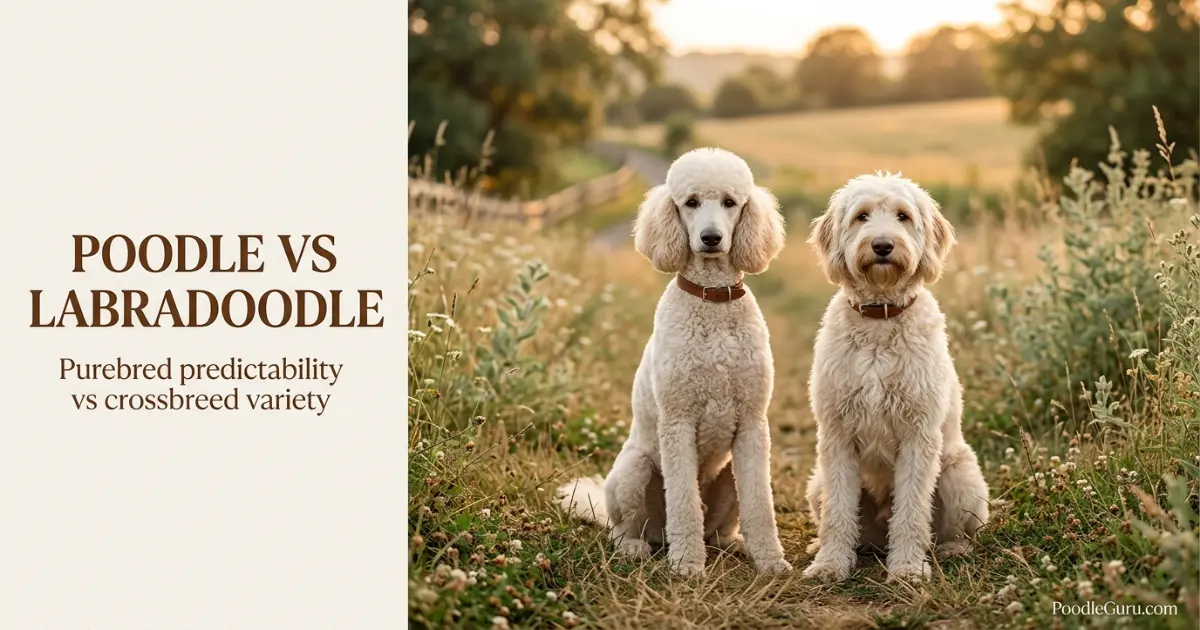
If you want a dog with predictable size, coat type, and temperament backed by a formal breed standard, choose a purebred Poodle. If you’re drawn to the Labradoodle’s retriever-influenced personality and can accept significant coat, size, and health variability between individual dogs, a Labradoodle may work — but only from an exceptional breeder who health-tests both parent breeds. The honest truth: there’s no universally “better” dog. There’s only the dog that better fits your tolerance for unpredictability, your grooming bandwidth, and your lifestyle.
In This Guide
- Quick Facts at a Glance
- What Is a Poodle?
- What Is a Labradoodle?
- The PoodleGuru Breed Match Method
- Head-to-Head Comparison Table
- Coat & Grooming: The Real Difference
- Temperament & Lifestyle Match
- Health & Longevity
- Size & Space Requirements
- Cost Comparison (2026)
- Common Buyer Mistakes & Red Flags
- Which Breed Fits Your Life?
- FAQs
- Final Summary & Key Takeaways
Quick Facts at a Glance
🐩 Poodle
Origin: Germany/France, recognized purebred with a long water-retriever history. Three recognized sizes: Toy, Miniature, Standard. AKC-recognized with a formal breed standard.
Coat: Single-coated, tightly curled or corded, low-shedding, and far more predictable than most doodle coats.
Lifespan: Often 10–18 years depending on size, care, and genetics; smaller Poodles commonly live longer than Standards.
🐕 Labradoodle
Origin: Australia, first intentionally bred in 1989 by Wally Conron. Not a recognized pure breed. A cross between a Labrador Retriever and a Poodle — with enormous variation between generations.
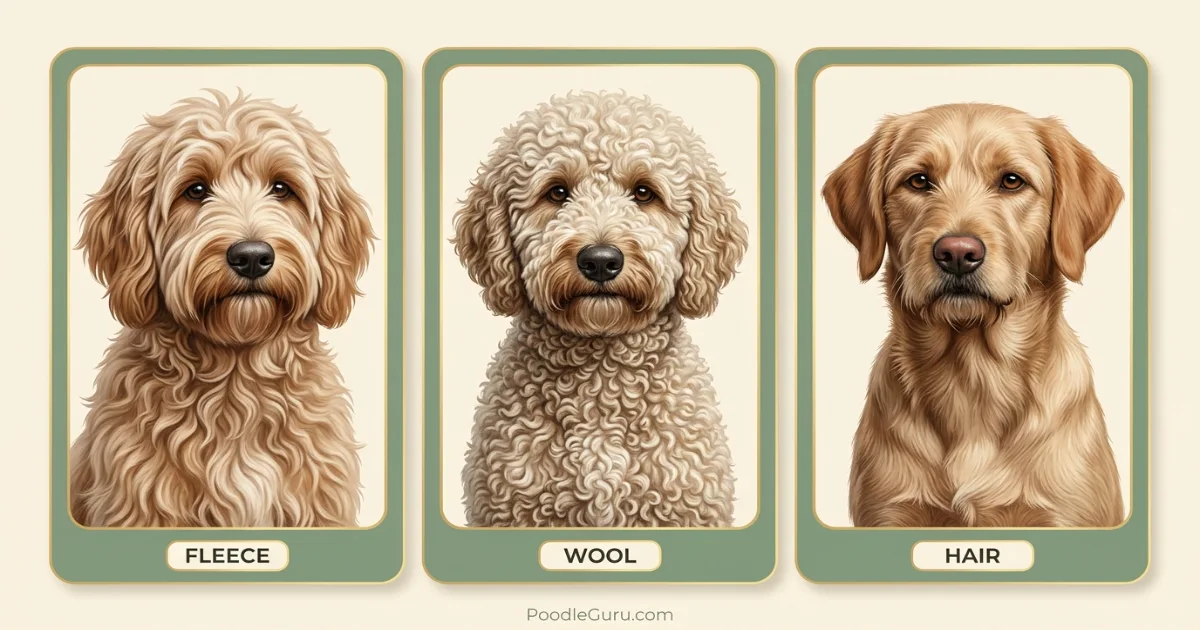
Coat: Can be fleece, wool, or hair — sometimes shedding, sometimes not. Unpredictable even within the same litter.
Lifespan: Often around 12–14 years, though long-term population data is less established than for recognized purebred Poodles.
⚡ The Core Trade-Off
With a Poodle, you get predictability. With a Labradoodle, you get possibility — a dog that might combine the Poodle’s intelligence with the Labrador’s easygoing nature, or might inherit the challenges of both breeds without the best of either. Your tolerance for that gamble is what this decision really hinges on.
What Is a Poodle?
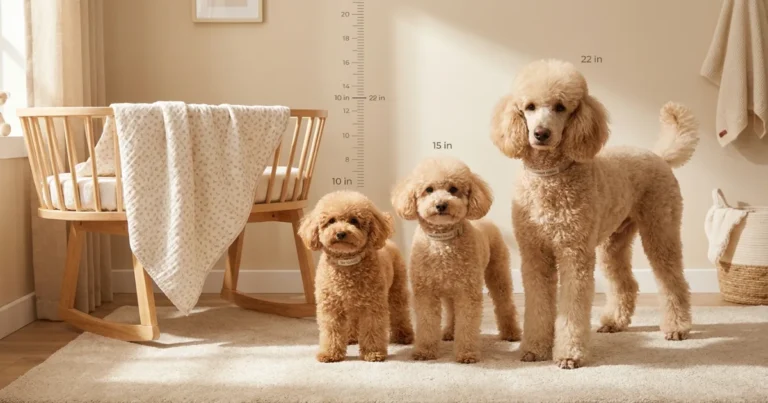
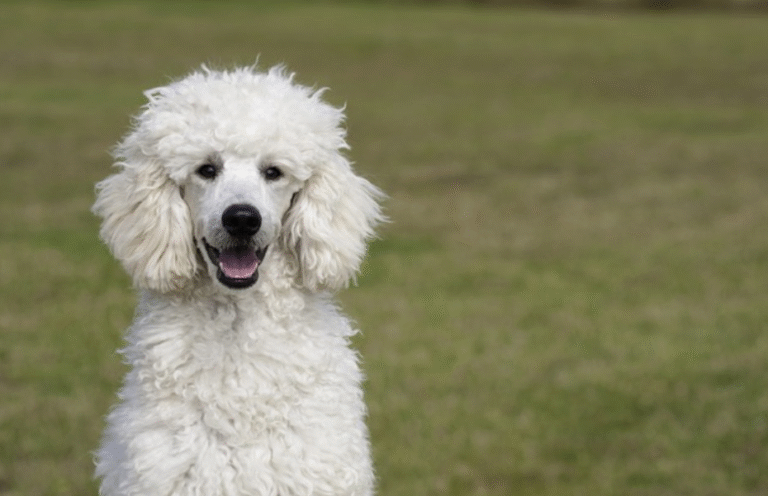
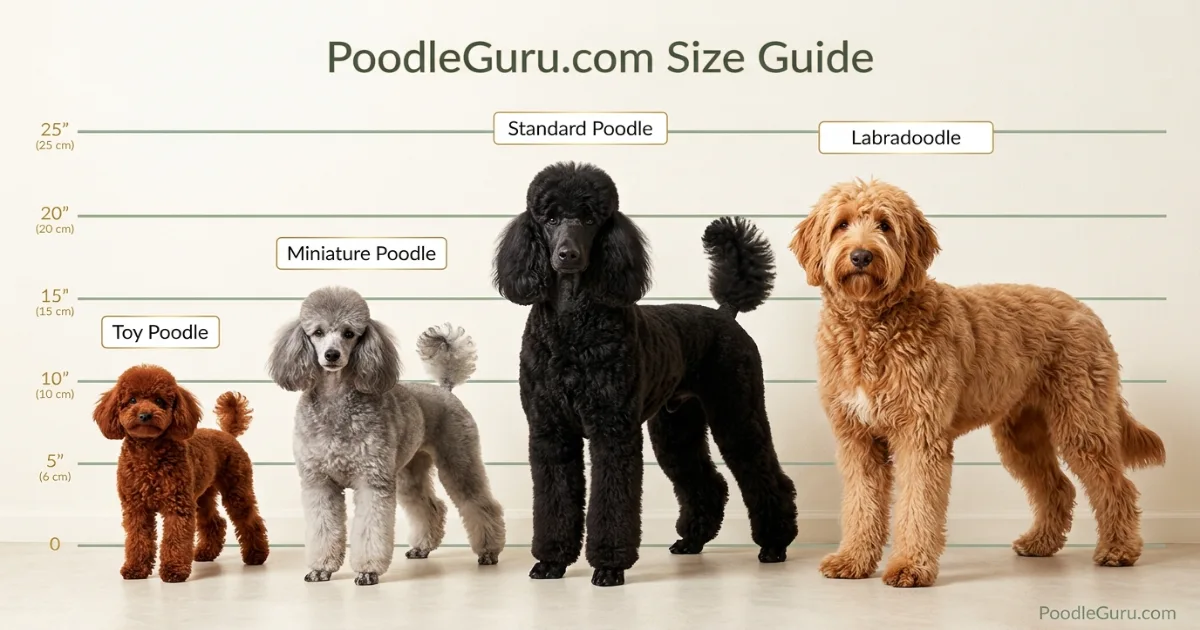
A Poodle is a purebred dog with a breed lineage that stretches back centuries — originally a water retriever, now one of the most versatile companion breeds in the world. The Poodle comes in three AKC-recognized sizes: Toy (under 10 inches), Miniature (10–15 inches), and Standard (over 15 inches). Some kennel clubs also recognize a fourth size, the Moyen, which sits between Miniature and Standard.
For owners, this means you can choose a Poodle that physically fits your living situation without sacrificing the breed’s core traits: high intelligence, a low-shedding single coat, and a generally alert, people-oriented temperament. The most important thing to understand is that Poodles are consistent. A well-bred Standard Poodle from one reputable breeder will closely resemble a well-bred Standard Poodle from another — in coat, structure, and behavioral tendencies. That consistency is what a breed standard guarantees.
The AKC Poodle breed profile and the Poodle Club of America breed standard outline the Poodle’s recognized size structure, coat expectations, and balanced square build, which means you can research the breed and trust that your dog will largely match what you’ve learned — provided you choose a responsible breeder. At PoodleGuru, our complete Poodle size chart walks through the exact differences between Toy, Miniature, Moyen, and Standard Poodles so you can match size to your home.
What Is a Labradoodle?
A Labradoodle is a crossbreed — specifically, a dog produced by breeding a Labrador Retriever with a Poodle. The modern Labradoodle story is commonly traced to Wally Conron’s 1989 guide-dog breeding project in Australia, but the reality decades later is far more complicated.
For owners, “Labradoodle” can mean dramatically different things depending on the generation. An F1 Labradoodle (first-generation, 50% Labrador / 50% Poodle) often has a loose, wavy coat that may still shed. An F1b (75% Poodle / 25% Labrador) is more likely to have a low-shedding curly coat. Multigenerational Australian Labradoodles are bred across several generations with additional breed infusions — and some lines are moving toward breed recognition, though none have achieved it yet. The most important thing to understand is that Labradoodles are not a breed in the traditional sense. They are a category of dog with enormous variation between individuals — even within the same litter.
That variation cuts both ways. Some Labradoodles are extraordinary dogs: smart, affectionate, low-shedding, and sturdy. Others inherit the Labrador’s heavy shedding, the Poodle’s sensitivity, or structural issues from poorly matched parents. The breeder you choose matters exponentially more with a Labradoodle than with a purebred Poodle — because without a breed standard, the breeder is the quality control.
The PoodleGuru Breed Match Method
At PoodleGuru, we evaluate breed suitability using a five-factor framework that cuts through marketing claims and focuses on what actually matters in daily life. This method helps you weigh the Poodle vs Labradoodle decision against your real circumstances — not Instagram photos or breeder promises.
Predictability Tolerance
How much variation can you genuinely live with? If the answer is “very little — I want to know exactly what I’m getting,” a purebred Poodle wins every time. If you’re comfortable rolling the dice on coat, size, and temperament in exchange for potentially unique traits, a Labradoodle enters the conversation.
Grooming Bandwidth
Both dogs need significant grooming. But a Poodle’s coat is consistent — you learn one routine. A Labradoodle’s coat might require completely different tools and techniques than another Labradoodle’s. Assess your willingness to adapt your grooming approach as the coat reveals itself over the first year.
Breeder Vetting Capacity
Finding a great Poodle breeder is straightforward: look for AKC registration, health testing per the Poodle Club of America guidelines, and transparency. Finding a great Labradoodle breeder is harder — because there’s no universal standard. You’ll need to verify health testing on both parent breeds independently. If you’re not willing to do that homework, choose a Poodle.
Activity & Engagement Style
Poodles are thinkers — they need mental work as much as physical exercise. Labradoodles often carry more of the Labrador’s “go anywhere, do anything” physical drive. If your ideal dog day involves training puzzles and focused skill work, lean Poodle. If it involves long unstructured romps and a dog who’s up for anything, the Labradoodle’s Labrador influence may appeal.
Long-Term Cost Realism
Both breeds carry real costs: grooming every 4–8 weeks, quality food, training, and healthcare. A Labradoodle is not a “cheaper Poodle.” In many cases, inconsistent coat genetics and less-established health baselines mean Labradoodles can cost more over a lifetime — especially if you end up treating conditions that reputable Poodle breeders actively screen against.
Expert Insight
This framework works because it forces you to evaluate your own capacity before evaluating the dog. Most buyer regret — in either direction — comes from choosing based on appearance or trend rather than lifestyle alignment. Work through these five factors honestly, and the right answer usually surfaces on its own.
Head-to-Head Comparison: Poodle vs Labradoodle
| Attribute | Purebred Poodle | Labradoodle |
|---|---|---|
| Breed Status | AKC-recognized purebred with formal breed standard | Crossbreed; not recognized by major kennel clubs |
| Size Predictability | High — three distinct size categories with clear height/weight ranges | Low to moderate — size depends on Poodle parent size and generation |
| Coat Type | Single coat, dense curls or cords, consistent texture | Variable: fleece, wool, or hair; shedding varies widely |
| Shedding Level | Very low — hair traps in the coat rather than falling | Unpredictable — some shed minimally, others shed like a Labrador |
| Grooming Frequency | Every 4–6 weeks professional grooming recommended | Every 4–8 weeks depending on coat type; mats quickly in fleece/wool coats |
| Temperament | Intelligent, alert, sensitive, people-oriented, can be reserved with strangers | Often outgoing, friendly, energetic; Labrador influence may increase sociability |
| Trainability | Exceptional — ranks among the most trainable breeds; thrives on mental challenges | High — but may show Labrador-style distractibility; responds well to positive reinforcement |
| Exercise Needs | Moderate to high; mental stimulation is as important as physical exercise | High; often needs more vigorous daily physical activity |
| Health Testing Baseline | Well-established; Poodle Club of America recommends specific genetic and orthopedic screenings | Inconsistent; quality breeders test both parent breeds, but many skip important screenings |
| Lifespan | 10–18 years (Toy: 12–18, Miniature: 12–15, Standard: 10–13) | 12–14 years average; less longitudinal data available |
| Puppy Price Range (2026) | $1,500–$4,000+ depending on size, color, lineage, and breeder reputation | $1,800–$5,000+ for well-bred puppies from health-tested parents; Australian Labradoodles often higher |
| Lifetime Cost Estimate | $25,000–$40,000 including grooming, food, veterinary care, training | $28,000–$45,000; coat unpredictability and variable health baselines can increase costs |
Use these costs as planning ranges, not fixed promises. Puppy prices, grooming fees, and veterinary costs vary by region, breeder quality, dog size, coat type, and individual health.
Coat & Grooming: Where the Differences Get Real
Coat care is where the Poodle vs Labradoodle conversation stops being theoretical. Both dogs need serious grooming — but the kind of grooming differs in ways that catch first-time owners off guard.
The Poodle Coat: Predictable and Demanding
Poodles have a single coat of dense, curly hair that grows continuously — similar to human hair. It doesn’t shed much because loose hairs tangle into the coat rather than falling onto your floor. That’s the good news. The trade-off: without consistent brushing (ideally every 1–3 days) and professional grooming every 4–6 weeks, Poodles mat painfully. Mats pull on the skin, trap moisture, and can lead to infections. Professional groomers commonly watch for hidden mats behind the ears, under the collar, and in the armpits — areas owners often miss.
Because the Poodle coat is standardized, you can learn one grooming system and use it for the dog’s entire life. Our complete Poodle grooming guide covers the exact tools, techniques, and schedules that work across all three Poodle sizes.
The Labradoodle Coat: Variable and Sometimes Harder
Labradoodle coats are commonly discussed in three broad categories: fleece (soft and wavy or loosely curling), wool (denser and more Poodle-like), and hair (straighter or shaggier and more likely to shed). The problem: you won’t know which coat your puppy will have until the adult coat comes in — usually between 9 and 18 months. A fleece-coated puppy might transition to a coat that mats if you look at it wrong. A wool-coated Labradoodle might need exactly the same grooming regimen as a Poodle. A hair-coated Labradoodle might shed enough to defeat the purpose of choosing a “hypoallergenic” crossbreed in the first place.
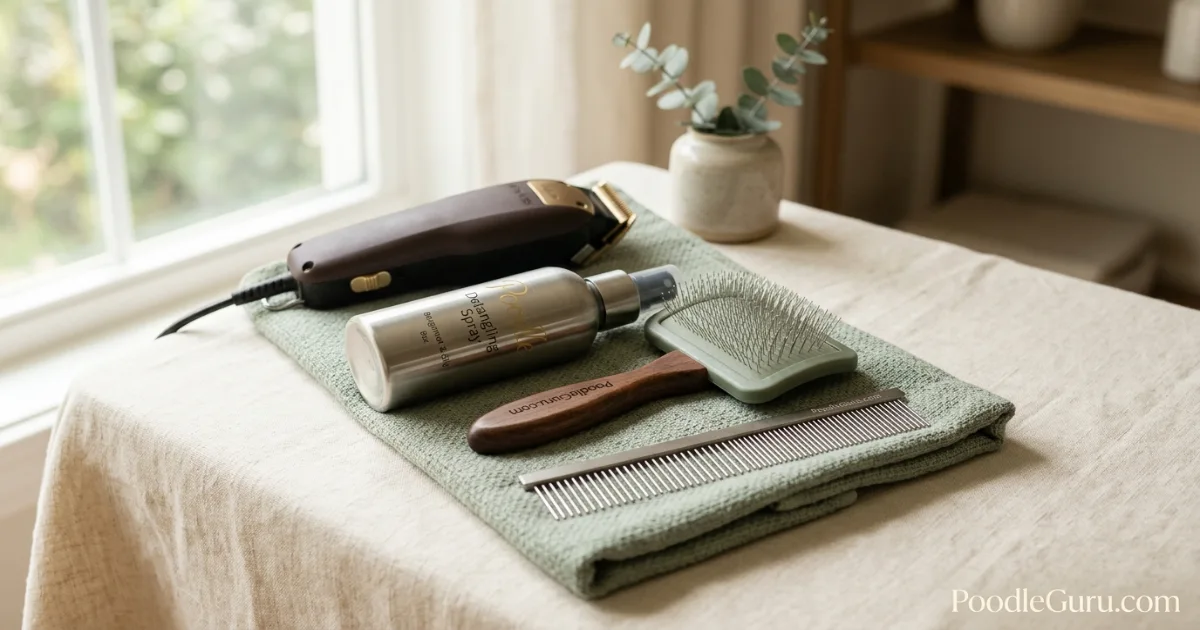
Veterinary guidance generally recommends that Labradoodle owners budget for professional grooming every 4–8 weeks and invest in a high-quality slicker brush, metal comb, and detangling spray — regardless of the puppy’s current coat. The coat will change, and you’ll need to adapt.
Grooming Reality Check
Neither dog is low-maintenance. The Poodle’s advantage is consistency: you know what you’re dealing with from day one. The Labradoodle’s wildcard coat means you may need to completely change your grooming toolkit and routine partway through the dog’s first two years. If that kind of unpredictability sounds stressful, the Poodle is the safer choice.
Temperament & Lifestyle Match
Temperament is where the Poodle vs Labradoodle decision gets personal. Both are intelligent, trainable dogs. But their default personalities differ in ways that matter deeply in daily life.
Poodle Temperament: The Thinking Companion
Poodles are problem-solvers. They watch you. They learn patterns. They notice when your routine changes and they’ll let you know. A well-socialized Poodle is devoted, eager to engage, and often described as “almost human” in their emotional attunement. They can also be sensitive — harsh corrections shut them down, and chaotic households can make them anxious. Owners often notice that Poodles pick one or two favorite people and bond deeply, sometimes appearing aloof with strangers until properly introduced.
This isn’t a flaw — it’s a feature of a breed that was developed to work closely with humans. The Poodle’s intelligence means they need a job: training sessions, puzzle toys, scent games, or structured activities. Without mental engagement, Poodles create their own entertainment — and a bored Poodle is a creative destruction machine.
Labradoodle Temperament: The Enthusiastic Mix
Labradoodles often inherit the Labrador’s “everyone is my friend” outlook. They tend to be more overtly social, quicker to greet strangers, and less likely to show the Poodle’s reserved side. This can make them wonderful family dogs — especially in homes with lots of visitors, children, or other pets. But the Labrador influence can also bring impulsivity, mouthiness, and a higher physical energy baseline that needs daily outlets.
The catch: because Labradoodles are a crossbreed without a stable temperament standard, two Labradoodle puppies from different litters can have radically different personalities. One might be calm and biddable. Another might be a high-drive whirlwind. This variability means you need to meet the specific puppy — and ideally the mother — before committing. Don’t assume all Labradoodles share a unified temperament.
Owner Tip: The Socialization Window
For both breeds, the critical socialization period (roughly 3–16 weeks) shapes adult temperament more than breed alone. A well-socialized Poodle can be warm and outgoing. An under-socialized Labradoodle can be fearful or reactive. Choose a breeder who raises puppies in a home environment with exposure to everyday sounds, surfaces, people, and handled by different humans — not isolated in a kennel or outbuilding.
Health & Longevity: What the Data Actually Shows
Health is the most misunderstood part of the Poodle vs Labradoodle decision — and unfortunately, the place where marketing claims do the most damage.
The Hybrid Vigor Myth
You’ll hear that Labradoodles are healthier than purebred Poodles because of “hybrid vigor.” This is a real biological concept — but it applies to unrelated genetic lines, not simply crossing two breeds. If both parent breeds carry genetic predispositions to the same conditions (hip dysplasia, for example, affects both Labrador Retrievers and Standard Poodles), crossing them doesn’t magically erase those risks. In practice, this means a Labradoodle from health-tested parents may be very healthy — but a Labradoodle from untested parents can inherit health problems from both breed pools simultaneously.
At PoodleGuru, we evaluate health based on what is verifiable: parent health testing, not breed labels. A Poodle from a breeder who follows Poodle Club of America health testing guidance offers more transparency than a Labradoodle from parents without documented screening — regardless of hybrid vigor claims.
Conditions to Know
Both breeds share risk for several conditions. In Standard Poodles and larger Labradoodles, hip dysplasia and bloat (gastric dilatation-volvulus) are primary concerns. Addison’s disease and sebaceous adenitis appear in Poodles and can pass to Labradoodle offspring. Labrador Retrievers contribute risks for elbow dysplasia, exercise-induced collapse, and certain eye conditions; the Labrador Retriever Club lists core health clearances responsible breeders should understand. A responsible breeder of either dog screens for these before breeding — and shows you the results.
For deeper guidance, veterinary resources like VCA Animal Hospitals provide detailed overviews of breed-associated conditions. If a breeder dismisses health questions or can’t produce OFA certification numbers, walk away — regardless of which dog you’re considering. Our guide to Poodle lifespan and long-term health covers what owners should monitor across all life stages.
When to Consult a Vet
This article discusses breed tendencies, not individual diagnosis. If you’re evaluating a specific puppy, ask your veterinarian to review the parents’ health testing results. A pre-purchase veterinary exam is worth every penny — for either breed. No amount of online research replaces a hands-on assessment from a qualified professional.
Size & Space: Matching the Dog to Your Doorframe
One underappreciated advantage of the purebred Poodle: size choice. With Toy, Miniature, Moyen (where recognized), and Standard Poodles, you can match the dog precisely to your living space. A Toy Poodle thrives in an apartment. A Standard Poodle needs room to stretch out — and a yard or dedicated exercise routine.
Labradoodles don’t offer that same granularity. Most Labradoodles are bred from Standard or Miniature Poodles, producing dogs that range from roughly 25 to 65+ pounds — but the exact adult size of any given puppy is harder to predict, especially in early generations. An F1 Labradoodle from a Standard Poodle parent could easily reach 60–70 pounds. One from a Miniature Poodle parent might stay under 30. If you have firm size constraints — landlord weight limits, a small car, young children who could be knocked over — a purebred Poodle gives you far more control over the outcome.
Cost Comparison: What You’ll Actually Pay in 2026
Purchase price is just the entry fee. The real cost story unfolds over 12–15 years. Here’s what to expect in the current market.
2026 Price Guide
Purebred Poodle puppy (well-bred, health-tested parents): $1,500–$4,000+. Toy Poodles from champion lines can reach $5,000+. Rare colors (red, silver, particolor) often command premium pricing. Standard Poodles typically sit at the lower end of this range; Toys at the higher end.
Labradoodle puppy (health-tested parents, reputable breeder): $1,800–$5,000+. Australian Labradoodles with multigenerational pedigrees regularly exceed $4,500. “Designer color” Labradoodles (merle, parti, rare shades) can reach $6,000+ — but be extremely cautious: merle is not a natural Labrador or Poodle color and indicates outcrossing that may bypass health testing.
What inflates price: Rare coat colors, “teacup” or “micro” size claims (red flag — these often signal unethical breeding), champion bloodlines, early training programs, and geographic demand in major metro areas.
What’s actually worth paying for: Documented health testing (OFA, genetic panels), puppy culture or early socialization programs, breeder transparency, and a contract that includes a health guarantee and return policy. These are worth far more than a rare color.
Beyond purchase price, both breeds need professional grooming at $60–$150+ per session (every 4–8 weeks), high-quality food, routine veterinary care, training, and supplies. A Labradoodle is not a budget Poodle — and cutting corners on grooming for either breed leads to matting, skin problems, and higher vet bills down the line.
Common Buyer Mistakes & Red Flags
Most Poodle vs Labradoodle buyer regret traces back to a handful of preventable mistakes. Here are the ones that surface repeatedly in owner communities — and how to avoid them.
| Mistake | Why It Happens | How to Avoid It |
|---|---|---|
| Assuming all Labradoodles are hypoallergenic | Marketing claims oversimplify coat genetics | Spend time with the specific puppy’s parents. Hair-coated Labradoodles can shed heavily. If allergies are a dealbreaker, a purebred Poodle is the safer bet. |
| Believing Labradoodles are “low-maintenance” | Comparison to Labrador Retrievers, which need less coat care | Budget for professional grooming every 4–8 weeks regardless of which dog you choose. Neither breed is wash-and-wear. |
| Choosing based on puppy photos alone | Emotional decision-making; all puppies are cute | Evaluate the breeder first, the parents second, and the individual puppy third. A beautiful puppy from unhealthy parents is a heartbreak waiting to happen. |
| Buying from the first available litter | Impatience; good breeders have waitlists | Expect to wait 3–12 months for a well-bred puppy from either breed. Immediate availability is often a red flag — reputable breeders don’t have surplus puppies sitting around. |
| Paying a premium for “rare” Labradoodle colors | Scarcity marketing; merle and exotic patterns | Merle Labradoodles are not naturally occurring — that color comes from outcrossing to other breeds, often without health testing continuity. Walk away from any breeder prioritizing color over health. |
Buyer Red-Flag Checklist
Walk away if the breeder: won’t show you health testing results, won’t let you meet the mother, has multiple litters available at all times, uses pressure sales tactics, can’t explain the genetic difference between F1 and F1b, or dismisses your questions. For either breed, a great breeder wants you to ask hard questions — because they have good answers.
Which Breed Actually Fits Your Life?
After everything we’ve covered, the decision usually crystallizes around a few clear patterns. Here’s how they map to real-life owner profiles.
Choose a Poodle If…
You want predictability in size, coat, and temperament. You have allergies and need a reliably low-shedding dog. You enjoy focused training and mental engagement with your dog. You want multiple size options to match your living situation precisely. You value a breed with a documented history and established health testing protocols. You’re willing to commit to a consistent grooming routine.
Choose a Labradoodle If…
You’re drawn to the Labrador’s outgoing personality blended with Poodle intelligence. You can accept uncertainty about adult coat type and shedding level. You have the bandwidth to vet breeders carefully across both parent breeds. You want a dog with high physical energy and a generally sociable disposition. You’re prepared for the possibility that your Labradoodle may need more grooming — or different grooming — than you initially expected.
Consider Waiting If…
You’re rushing the decision because a specific litter is available now. You’re choosing based on a viral video or a friend’s dog without researching independently. Your budget is tight and you haven’t priced out professional grooming. You’re hoping for a dog that doesn’t need much exercise or training — neither breed fits that description. A well-bred dog from either category is a 12–18 year commitment. There’s no prize for deciding fast.
Frequently Asked Questions
Which is better, a Poodle or a Labradoodle?
Neither breed is objectively better — the right choice depends on your tolerance for unpredictability. Purebred Poodles offer consistent size, coat type, and temperament backed by a formal breed standard. Labradoodles can be wonderful dogs but vary significantly between individuals. If predictability matters most, choose a Poodle. If you’re comfortable with variability and willing to vet breeders carefully, a Labradoodle may suit you.
Do Labradoodles shed more than Poodles?
Some do — significantly. Poodles have a single coat that traps loose hair, making them consistently low-shedding. Labradoodles can inherit a fleece, wool, or hair coat. Hair-coated Labradoodles may shed as heavily as a Labrador Retriever. Even within the same litter, shedding levels can vary dramatically. If minimal shedding is non-negotiable, a purebred Poodle is the more reliable choice.
Are Labradoodles healthier than purebred Poodles?
Not necessarily. Hybrid vigor can help when unrelated genetic lines reduce the chance of doubling up on some recessive risks, but it does not erase shared or polygenic conditions. Both Labrador Retrievers and Standard Poodles share risk for hip dysplasia, and Poodles carry additional breed-specific concerns like Addison’s disease. A Labradoodle from fully health-tested parents may be very healthy — but Labradoodles from untested parents can inherit problems from both breed pools.
Which costs more, a Poodle or a Labradoodle?
Purchase prices overlap significantly and vary by region, breeder reputation, health testing, training, size, and demand. Over a lifetime, Labradoodles may cost more if coat unpredictability requires more grooming work or if poorly tested parent lines create avoidable veterinary expenses. Neither breed is a budget dog.
Are Labradoodles good family dogs?
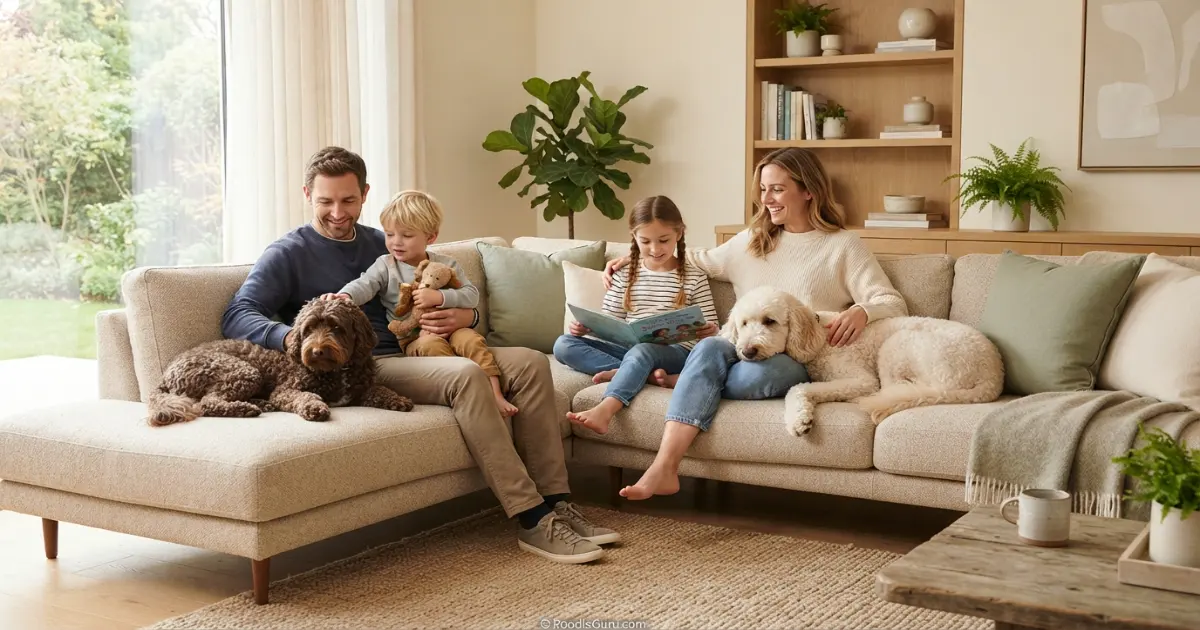
Many Labradoodles make excellent family dogs — especially those that inherit the Labrador’s outgoing, patient temperament. They tend to be sociable and energetic, which suits active households with children. However, temperament varies more in Labradoodles than in purebred Poodles, so meeting the specific puppy and its mother before committing is essential. A well-socialized Poodle can also be a wonderful family companion, particularly in calmer households.
Do Poodles or Labradoodles need more grooming?
Both need significant grooming — professional sessions every 4–8 weeks plus home brushing between appointments. The Poodle’s coat is consistent, so you learn one routine. A Labradoodle’s coat may require different tools and techniques as it matures, and some coat types mat more aggressively than a Poodle’s. Neither dog is low-maintenance in the grooming department.
What is the difference between an F1 and F1b Labradoodle?
An F1 Labradoodle is a first-generation cross: 50% Labrador Retriever and 50% Poodle. Coat type and shedding are highly unpredictable in F1s. An F1b Labradoodle is backcrossed to a Poodle: roughly 75% Poodle and 25% Labrador. F1b dogs are more likely to have low-shedding curly coats, making them a more reliable choice for allergy-conscious owners — but they’re also more Poodle-like in appearance and temperament.
Which is easier to train, a Poodle or a Labradoodle?
Both are highly trainable. Poodles rank among the most intelligent breeds and excel at focused, precision-based training — they thrive on mental challenges. Labradoodles often carry Labrador-influenced enthusiasm, which can make training fun but sometimes more distractible. Either dog responds well to positive reinforcement. The bigger variable is the individual dog’s temperament and the consistency of training, not the breed label.
Final Summary: Poodle vs Labradoodle
The Poodle vs Labradoodle decision isn’t about which dog is “better.” It’s about which dog fits your tolerance for unpredictability, your grooming commitment, and your lifestyle. A purebred Poodle gives you consistency: predictable size, coat, temperament, and established health testing protocols. A Labradoodle offers the possibility of a unique blend — but demands more diligence in breeder vetting and more flexibility as the dog matures.
Both breeds can be exceptional companions. The difference is in how much you’re willing to bet on an uncertain outcome. If you want the safer bet with less variability, choose a well-bred Poodle. If you’re drawn to the Labradoodle’s specific blend and you’re prepared to do the homework, find an exceptional breeder — and meet the parents in person.
Key Takeaways
- Purebred Poodles offer predictable size, coat type, and temperament across three distinct size categories recognized by the AKC.
- Labradoodles are a crossbreed with significant variation in coat (fleece, wool, or hair), shedding, and adult size — even within the same litter.
- Neither breed is low-maintenance: both require professional grooming every 4–8 weeks and consistent at-home coat care.
- Hybrid vigor does not guarantee better health — a Labradoodle from untested parents can inherit health conditions from both breed pools.
- Well-bred Poodles and Labradoodles both carry serious lifetime costs: purchase price, grooming, food, veterinary care, training, and supplies can easily add up across 12–15+ years.
- The single most important factor for either breed is the quality of the breeder — prioritize documented health testing and transparency above color, price, or availability.