Poodle Puppy Socialization Timeline: 7 Critical Windows Before Week 16
The poodle puppy socialization timeline has three non-negotiable critical windows: the 3–5 week period with littermates, the 5–8 week early human bonding phase, and the 8–16 week prime socialization window when a poodle puppy’s brain is most malleable.
By 14–16 weeks, the easiest socialization period narrows significantly, and new exposures usually require more careful, repeated positive conditioning. Poodles, being one of the most intelligent and emotionally sensitive breeds, need structured, positive exposure during these weeks far more than the average dog.
Missing these windows does not mean your poodle is ruined — but it does mean you will need to work harder, longer, and with more patience to achieve the same level of confidence and stability.
You brought home a poodle puppy — or you are about to — and someone mentioned “critical socialization windows.” Maybe a breeder said it. Maybe you stumbled across the phrase while googling at midnight, puppy asleep on your lap. Either way, you are now aware that the clock is ticking.
And unlike teaching “sit” or “stay,” you cannot simply circle back to socialization later. The architecture of your poodle’s adult temperament is being poured right now, in these early weeks, and the concrete sets fast.
The poodle puppy socialization timeline is not a loose suggestion. It is a neurologically grounded sequence of developmental stages that dictate how your dog will perceive the world — strangers, children, other dogs, car rides, vet visits, vacuum cleaners, thunder — for the rest of its life.
Poodles are uniquely wired: they are emotionally attuned, exceptionally intelligent, and startlingly good at pattern recognition. That means they soak up both good and bad experiences with equal intensity. A poorly socialized poodle does not simply become “shy.” It can become reactive, neurotic, or deeply anxious in ways that take years to unwind.
This guide walks you through every critical window, week by week, with the depth and specificity that poodle owners deserve. We will cover what the science says, what experienced breeders do, what new owners get wrong, and exactly how to execute a socialization plan that honors your poodle’s intelligence rather than overwhelming it.
Critical Window Opens
3 weeks of age — when eyes and ears open and the puppy begins processing the world beyond scent and touch.
Peak Sensitivity
8 to 12 weeks — the brain’s neuroplasticity is at its highest. Every exposure writes lasting neural pathways.
Window Closes
14 to 16 weeks — after this, socialization shifts from “imprinting” to “learning,” which is slower and harder.
Poodle-Specific Risk
High emotional sensitivity means bad experiences during the window cut deeper than in many other breeds.
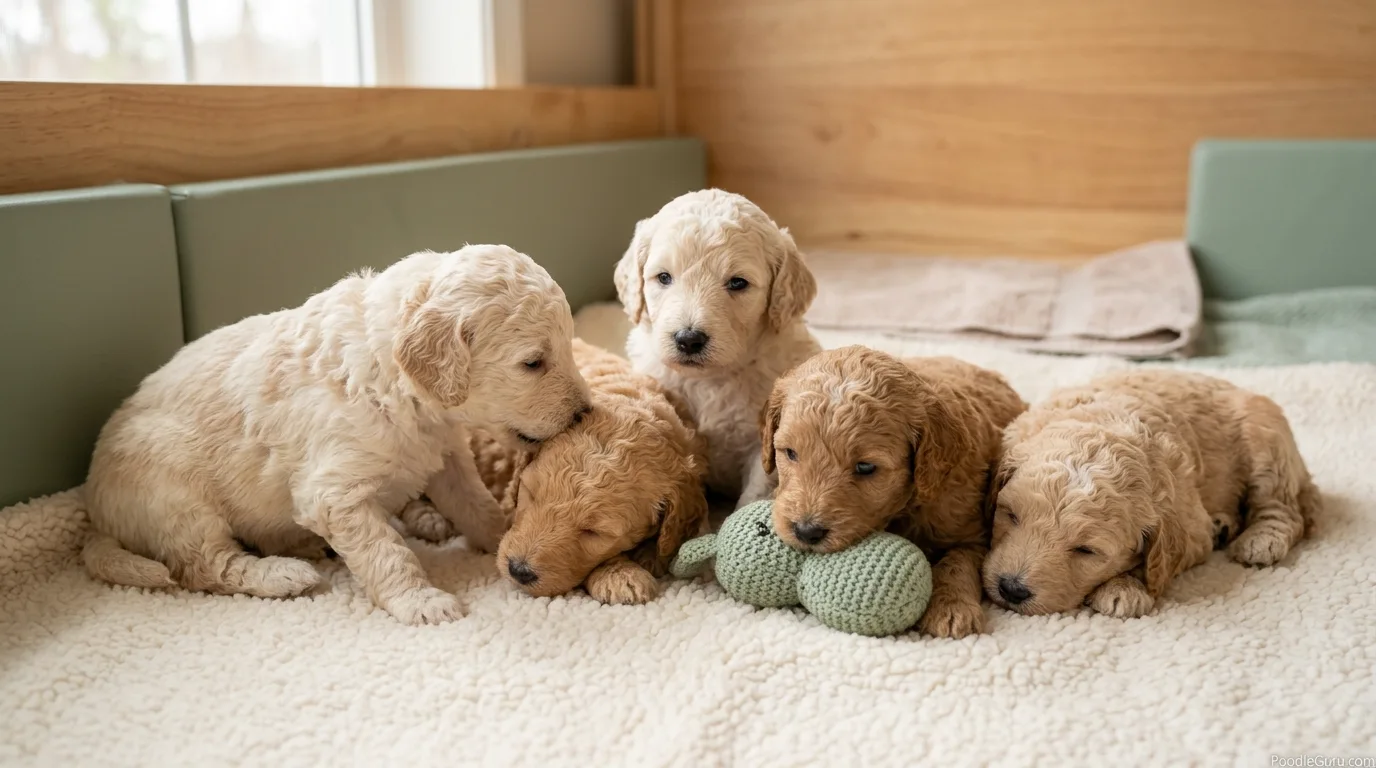
What the Poodle Puppy Socialization Timeline Actually Means
The poodle puppy socialization timeline is a controlled exposure plan, not a race to meet the most people or dogs.
Socialization is frequently reduced to “let your puppy meet lots of people and dogs.” That definition is dangerously incomplete.
Proper socialization means controlled, positive exposure to the full spectrum of stimuli a dog will encounter across a lifetime: surfaces, sounds, handling, restraint, solitude, movement, environments, and yes — people and animals of all shapes, ages, and energies. The goal is not quantity of encounters. It is quality of emotional response.
A single frightening event during a critical window can imprint more deeply than twenty neutral ones.
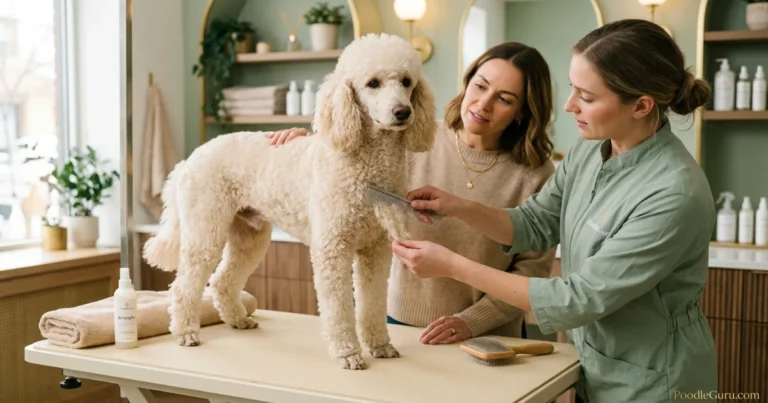
For poodles specifically, socialization also includes grooming desensitization. A poodle that has not been gently exposed to brushing, clippers, scissoring sounds, and standing on a grooming table during the critical window will likely become a nightmare at the groomer — and given that poodles require grooming every 4 to 6 weeks for life, that is a serious quality-of-life issue for both dog and owner.
Why the Poodle Puppy Socialization Timeline Needs a Deliberate Plan
A deliberate poodle puppy socialization timeline matters because this breed notices patterns, pressure, and emotional tone very quickly.
Poodles sit in the top tier of canine intelligence, alongside border collies and Belgian malinois. But intelligence in dogs is a double-edged gift. A smart dog does not simply learn faster — it also remembers fear faster, patterns anxiety more efficiently, and generalizes negative experiences with unnerving precision.
If a poodle puppy is startled by a tall man in a hat at 10 weeks, it may decide that all tall men, or all hats, or both, are threats. That is not paranoia. That is a highly intelligent brain doing exactly what it evolved to do: pattern-match for survival.
Add to this the breed’s emotional sensitivity. Poodles were developed as water retrievers and companion dogs — they were selected for attentiveness to human cues and responsiveness to mood. That same attunement means they absorb household stress, react to owner anxiety, and can become emotionally brittle if their early exposures are chaotic or frightening. Socialization for a poodle must be calm, curated, and confidence-building, not a flood of random experiences.
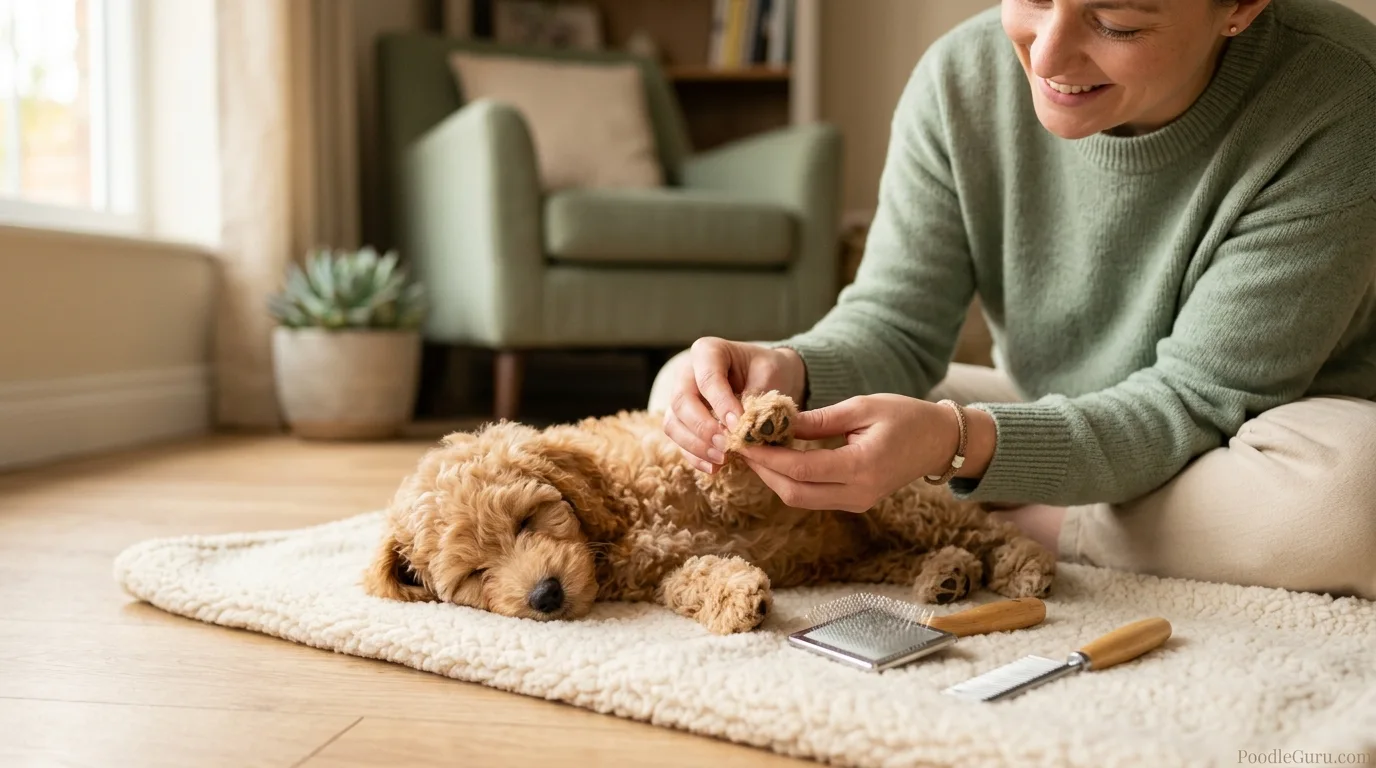
Poodle Puppy Socialization Timeline by Week: 3 to 16 Weeks
Below is the poodle puppy socialization timeline (critical windows) broken into the developmental stages that matter most. These are not arbitrary divisions — they reflect shifts in neurological development, fear sensitivity, and learning capacity that have been studied extensively in canine behavioral science.
| Age Window | Developmental Stage | What the Puppy Is Learning | Owner / Breeder Priority |
|---|---|---|---|
| 0–3 weeks | Neonatal | Touch, warmth, scent of mother and littermates. Eyes and ears closed. | Minimal handling. Ensure a calm, quiet whelping environment. No intentional socialization yet. |
| 3–5 weeks | Transitional / Early Socialization | Eyes open, ears open. First canine social signals — bite inhibition, body language, pack hierarchy. | Critical Window 1. Do not separate from littermates. Introduce varied surfaces in the whelping box. Breeder begins gentle daily handling. |
| 5–7 weeks | Early Human Bonding | Recognizes individual humans. Begins to explore beyond the nest. Startle response develops. | Critical Window 2. Multiple gentle handlers. Exposure to household sounds (vacuum, TV, dishes). First car ride in a safe carrier. |
| 7–9 weeks | First Fear Imprint Period | Brain is highly impressionable. Fearful experiences can imprint permanently. | Avoid shipping, harsh corrections, or overwhelming environments. Many breeders send puppies home at 8–9 weeks — ensure the transition is calm. |
| 8–12 weeks | Prime Socialization Window | Peak neuroplasticity. The puppy is a sponge for positive associations. Confidence builds rapidly. | Critical Window 3 — most important. Structured exposure to 50+ novel stimuli. Grooming desensitization. Positive vet visits. Controlled meetings with vaccinated dogs. |
| 12–14 weeks | Window Begins to Close | Brain starts pruning unused neural pathways. New experiences are processed with more caution. | Continue socialization but watch for signs of overwhelm. The puppy is becoming more discerning — novelty is less automatically accepted. |
| 14–16 weeks | Window Narrows Significantly | Socialization shifts from “imprinting” to “learning.” Fear of novelty becomes the default if not previously conditioned. | Last chance for easy, low-effort socialization gains. After 16 weeks, every new exposure requires more counter-conditioning work. |
| 16 weeks–6 months | Juvenile / Secondary Socialization | Still learning, but through active conditioning rather than passive imprinting. Fear periods may appear. | Maintain exposures. Do not stop. But expect slower progress. Fear periods around 4–5 months and again around 9–11 months are normal in poodles. |
Many poodle breeders keep puppies until 10 or even 12 weeks — and there is a good reason for that. Puppies placed at 8 weeks miss two full weeks of littermate learning inside the prime window. The trade-off is earlier bonding with the new owner.
Neither choice is universally “right,” but if your breeder keeps puppies longer, they should be executing a rigorous in-home socialization protocol during those extra weeks. Ask to see it. A breeder who keeps puppies until 12 weeks but does nothing beyond feeding and cleaning is doing those puppies a developmental disservice.
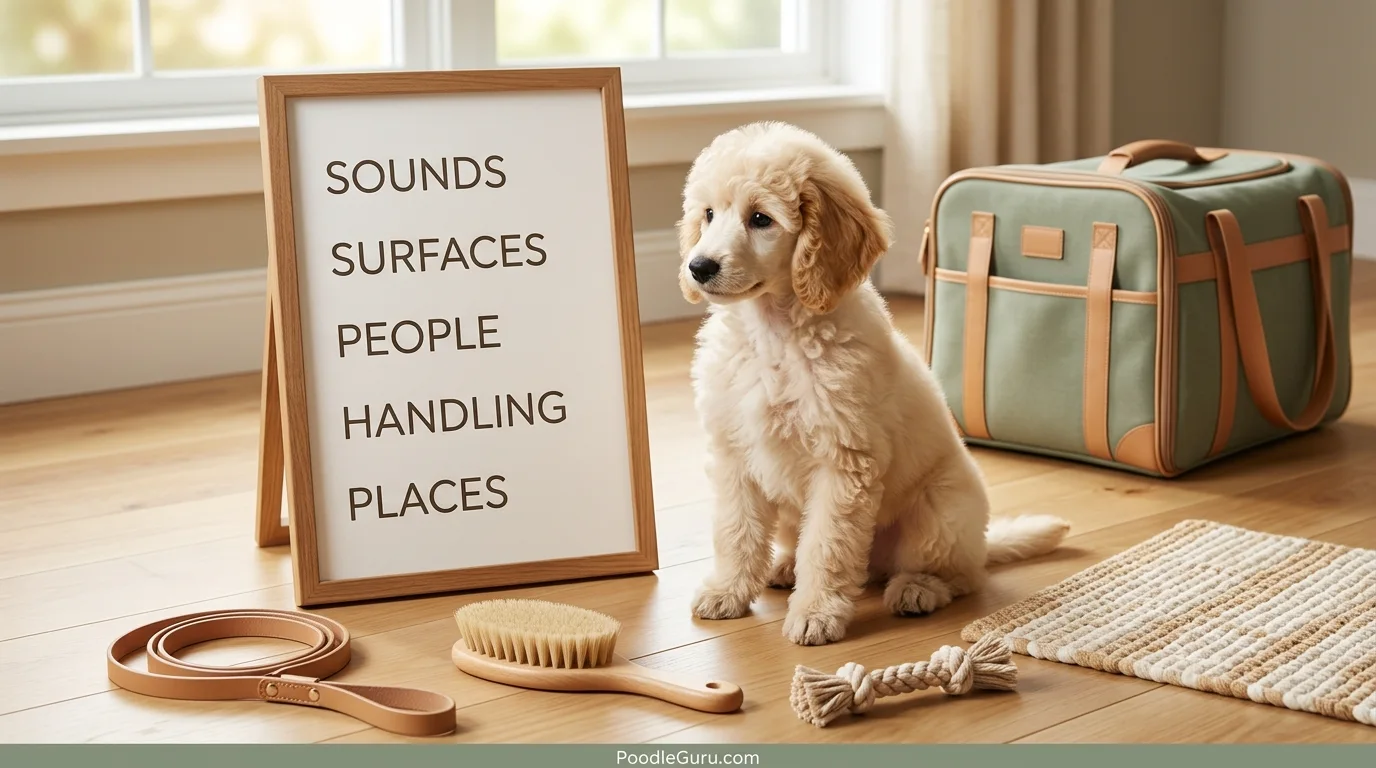
What Happens Inside the Poodle Puppy Socialization Timeline Windows
Inside the poodle puppy socialization timeline, each week shapes how your puppy classifies new sounds, surfaces, people, handling, and environments.
During the prime 8–12 week window, a poodle puppy’s brain is producing an abundance of neural connections — far more than it will keep. This is called experience-expectant neuroplasticity . The brain is primed to expect certain inputs: human touch, environmental variety, social signals from other dogs, novel sounds.
When those inputs arrive in a safe, manageable way, the brain wires them as “normal” and “safe.” When they do not arrive, or when they arrive paired with fear, the brain wires the absence — or the threat — as the baseline.
After 14–16 weeks, the brain shifts into a pruning phase. Unused neural pathways are dismantled. This is neurologically efficient — the brain does not want to maintain infrastructure it never uses — but it means that introducing new positive associations after this point requires building on thinner neural scaffolding. It can be done. It just takes more repetition, more treats, more time, and more emotional intelligence from the owner.
What Happens If You Miss the Poodle Puppy Socialization Timeline
Let us be honest without being alarmist. Missing the critical windows does not mean your poodle is broken. It means the road to a confident, stable adult dog becomes steeper.
Dogs socialized late often present with one or more of the following: stranger-directed fear or aggression, noise phobia, separation anxiety, leash reactivity, extreme submissive urination, or grooming intolerance . Sensitive, intelligent breeds like poodles may show anxiety more clearly when early socialization is lacking. The good news: poodles are also highly trainable.
With a qualified positive-reinforcement trainer or a veterinary behaviorist, you can make remarkable progress. But the work will be measured in months and years, not weeks — and some dogs will always carry a lower ceiling of confidence than they would have achieved with proper early exposure.
Poodle Socialization vs. Other Breeds: Why the Same Checklist Does Not Apply Equally
The poodle puppy socialization timeline should be calmer and more curated than a generic puppy checklist.
Generic puppy socialization checklists treat all breeds as interchangeable. They are not. A Labrador retriever puppy may bounce back from a startling event in minutes. A poodle puppy may carry that imprint for weeks or months. Here is how the socialization experience differs between poodles and a few other common breeds:
| Factor | Poodle (All Sizes) | Labrador Retriever | German Shepherd | Cavalier King Charles |
|---|---|---|---|---|
| Emotional Sensitivity | Very high — absorbs owner mood and environmental tension | Moderate — resilient, recovers quickly from mild stress | High — but channels sensitivity into vigilance rather than anxiety | Very high — similar to poodles, needs gentle handling |
| Fear Imprint Risk | High — single events can generalize broadly | Low to moderate — bounce-back is strong | Moderate — may develop suspicion if under-socialized | High — can become fearful with rough handling |
| Grooming Desensitization Need | Extreme — lifelong professional grooming required | Low — occasional brushing suffices | Moderate — heavy shedding but minimal professional grooming | Moderate — regular brushing needed but less intensive |
| Ideal Socialization Pace | Slow, curated, confidence-first | Faster, more robust to variety | Structured, calm, authority-building | Gentle, affectionate, low-pressure |
The takeaway is not that poodles are fragile. It is that they are discriminating. A poodle’s socialization plan must respect the breed’s cognitive and emotional depth. Rushing through a checklist to “get it done” before week 16 backfires more often with poodles than with almost any other breed.
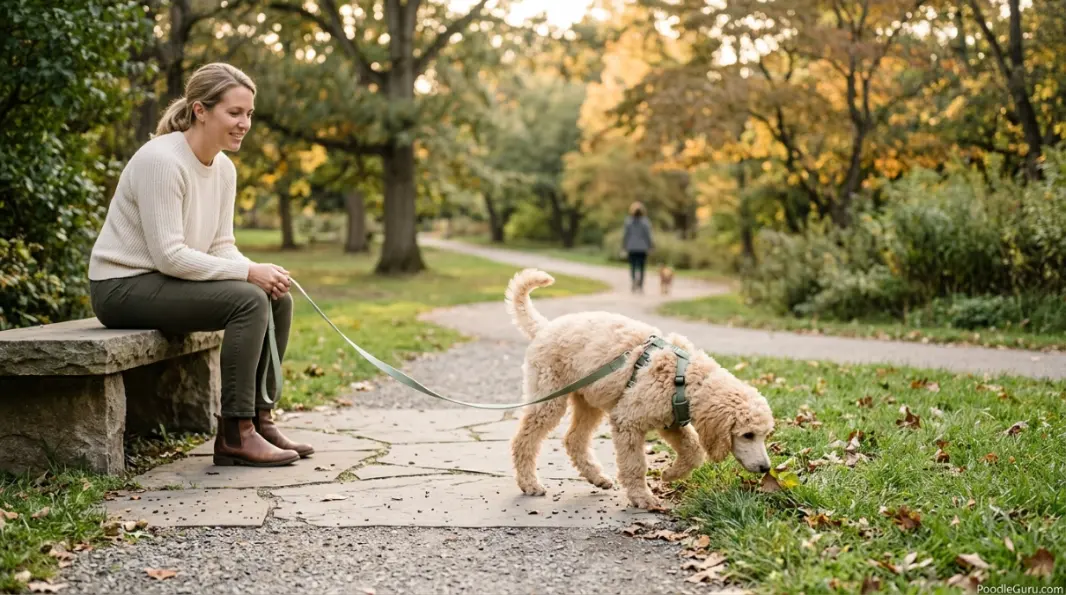
How to Use the Poodle Puppy Socialization Timeline: A Practical Roadmap
Use this poodle puppy socialization timeline as a flexible roadmap, then adjust the pace to your puppy’s confidence level.
This section assumes you are bringing your poodle puppy home around 8–10 weeks. If your puppy is younger and still with the breeder, forward this to them. If your puppy is older than 16 weeks, skip to the “What If the Window Has Already Closed?” section below — the approach changes.
Weeks 8–10: The Foundation Layer
Your puppy has just left its littermates. Everything is new. Your job in these two weeks is not to flood the puppy with experiences. It is to establish that your home is a safe base .
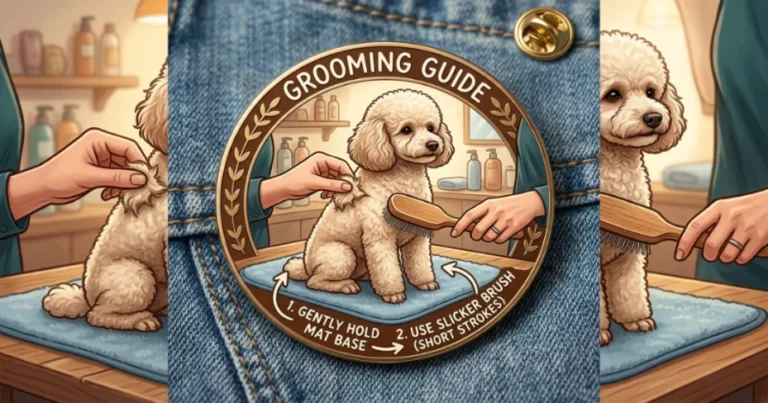
Focus on: gentle handling of paws, ears, and muzzle daily (30 seconds, heavily rewarded); exposure to 3–5 household sounds at low volume; meeting 2–3 calm, dog-savvy adults who will not overwhelm the puppy; one short car ride in a crate to somewhere pleasant; and the first gentle introduction to a slicker brush — no actual grooming, just letting the brush touch the coat while treats flow.
Weeks 10–12: The Expansion Layer
Now you widen the circle. Carry your puppy (or use a stroller or sling if not fully vaccinated) to observe the world from a safe perch: a park bench, a quiet café patio, the sidewalk outside a school at dismissal. The puppy does not need to interact — observation is socialization .
Introduce 10–15 new surfaces: grass, concrete, gravel, wood decking, carpet, tile, a wobble board. Continue grooming desensitization, now with short sessions that include the sound of clippers (off, then on at a distance). Schedule a “happy vet visit” — just a weigh-in and treats from the staff, no procedures.
Weeks 12–14: The Deepening Layer
The window is still open but beginning to narrow. Now introduce more complex scenarios: people in uniforms, people with hats or sunglasses, children (supervised and calm), polite vaccinated adult dogs one at a time. If your poodle shows hesitation, do not push. Let the puppy choose the pace.
A poodle that learns it can opt out of a scary situation and be protected by its owner builds more confidence than a poodle that is forced to “face its fear.”
Weeks 14–16: The Consolidation Layer
Repeat the best exposures. Deepen the positive associations. If your puppy has been calm about the groomer’s clippers, book an actual introductory grooming session — just a bath and tidy, nothing overwhelming. If your puppy has done well with car rides, take a slightly longer trip that ends in a fun walk.
This is also the time to introduce brief, positive alone-time to prevent separation anxiety: 5 minutes, then 10, never letting the puppy cross into panic.
1. Use the “three-second rule” for new stimuli. Introduce something new for three seconds, then remove it and reward. Repeat. This prevents overwhelm and builds curiosity. 2. Never end a socialization session on a scared note. If your puppy spooks, dial back to something easy and end there. The last emotion lingers. 3.
Grooming desensitization cannot wait. By 12 weeks, your poodle should be comfortable with the grooming table, brush, and the sound of clippers. Book a puppy intro at a poodle-experienced groomer by 14 weeks. 4. Socialization is not socialization if the puppy is terrified.
A puppy cowering in a busy dog park is not being socialized — it is being sensitized to fear. Read your dog.
What Owners Get Wrong About the Poodle Puppy Socialization Timeline
After years of working with poodle owners, several patterns of misunderstanding surface repeatedly. First: waiting until vaccinations are complete . The critical window closes around 16 weeks, which is roughly when the final puppy shots are given. If you wait until full vaccination to begin socialization outside the home, you have missed the window.
The solution is not to skip vaccinations — it is to socialize safely: carry the puppy, use a sling, avoid high-dog-traffic areas, and arrange playdates with known vaccinated dogs in clean environments. The American Veterinary Society of Animal Behavior explicitly states that the risk of under-socialization outweighs the risk of disease when reasonable precautions are taken.
Second: confusing exposure with overwhelm . Taking a 10-week-old poodle to a loud farmers market for two hours is not socialization — it is a stress bath. Poodles need dosed exposure. Short, positive, repeated. Third: neglecting solitude training . Poodles are velcro dogs by nature.
If you spend every moment of the critical window with your puppy, you are socializing it to expect constant companionship — and that becomes separation anxiety later. Alone-time training must be part of the plan from week 10 onward.
The Breeder’s Role in the Poodle Puppy Socialization Timeline
The poodle puppy socialization timeline begins before the puppy comes home, so breeder work during weeks 3–8 matters deeply.
A significant portion of the critical socialization timeline happens before you ever meet your puppy. The 3–8 week period takes place entirely in the breeder’s care.
A responsible poodle breeder will have a documented early socialization protocol that includes: daily handling by multiple people, exposure to household sounds, introduction to a crate, early grooming desensitization, varied surfaces in the whelping area, and age-appropriate problem-solving challenges (like simple food puzzles).
If a breeder cannot articulate what they do during weeks 3–8 beyond “the puppies are in our living room,” that is a red flag. The best breeders can send you videos, checklists, and detailed notes about each puppy’s early experiences and temperament observations.
When evaluating a poodle breeder, ask: “Can you walk me through your socialization protocol from week 3 to when the puppy comes home?” A quality breeder will light up at this question. A poor breeder will give a vague answer about “lots of love.” Love is not a protocol.
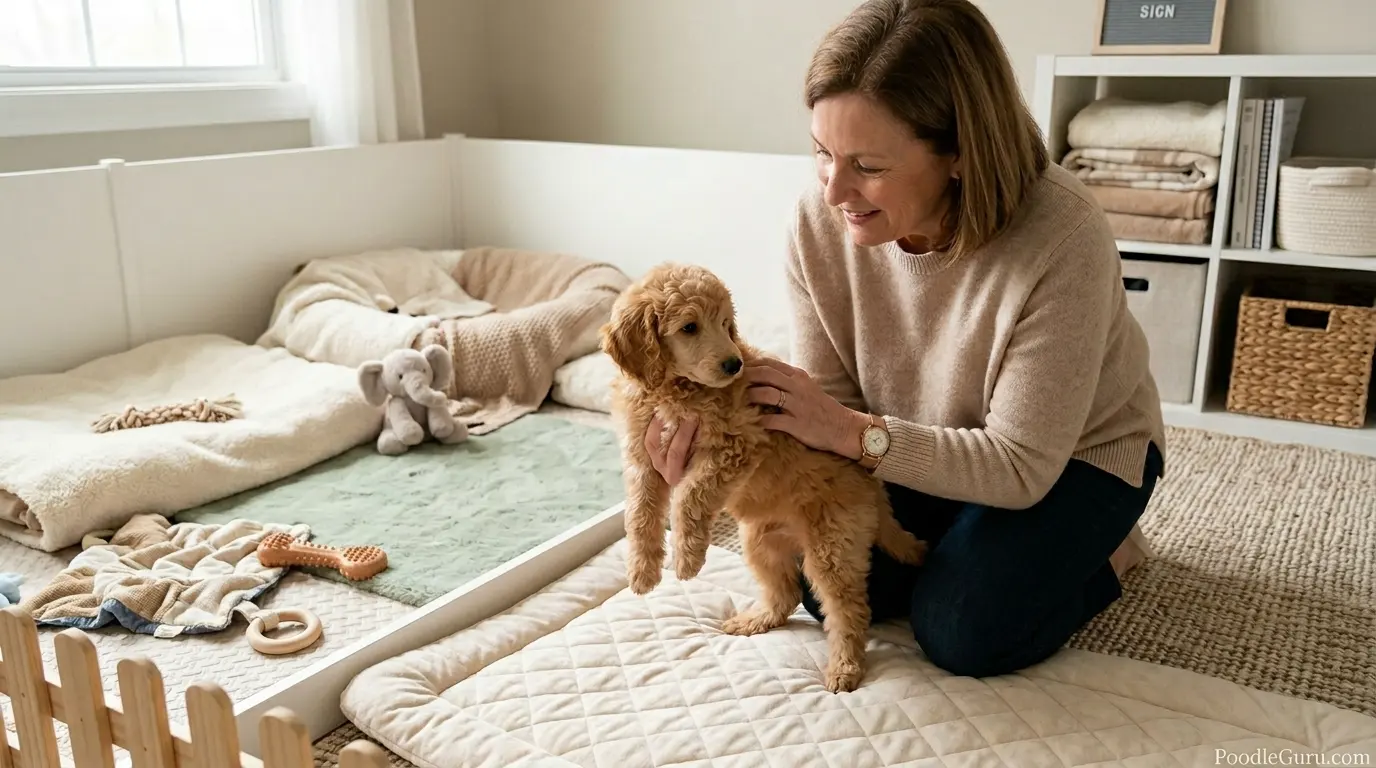
Signs Your Poodle Puppy May Have Missed Key Socialization Milestones
When the poodle puppy socialization timeline is incomplete, the signs often show up as fear, shutdown, grooming panic, or poor recovery after stress.
Not every anxious puppy is poorly socialized, and not every confident puppy was perfectly socialized — genetics play a role too.
But certain behaviors strongly suggest socialization gaps: excessive startle response to everyday sounds (a dropping pan, a doorbell); extreme fear of strangers that does not improve with gentle exposure over several sessions; shutting down or trembling in new environments even when nothing threatening is present; aggressive panic during grooming despite weeks of desensitization attempts; and inability to recover from mild stress within a few minutes.
If you see these patterns in a poodle under 6 months, do not wait. Engage a positive-reinforcement trainer who has specific experience with sensitive breeds. Early intervention during the juvenile period can still shift the trajectory significantly.
What to Do If the Poodle Puppy Socialization Timeline Window Has Closed
If the poodle puppy socialization timeline window has passed, you can still help your dog with slower counter-conditioning and patient repetition.
Maybe you adopted an older poodle puppy. Maybe you only learned about the critical windows after week 16 had come and gone. Maybe life circumstances — illness, a move, a family crisis — meant socialization took a back seat. Here is what matters now: the window closing does not mean the door is locked .
It means you now need a different approach. Counter-conditioning and desensitization (CC/DS) become your primary tools. This means pairing every new or feared stimulus with something the dog loves — high-value food, a favorite toy — at a distance and intensity where the dog remains under threshold.
You inch closer over many sessions, never pushing past the point of fear.
With poodles, this works better than with many breeds because their intelligence allows them to form new associations when the training is precise and patient. But expect the timeline to stretch. What might have taken 3 days during the critical window may take 3 weeks — or 3 months — after it. That is not failure. That is reality. Work with a professional, keep sessions short, and celebrate small wins.
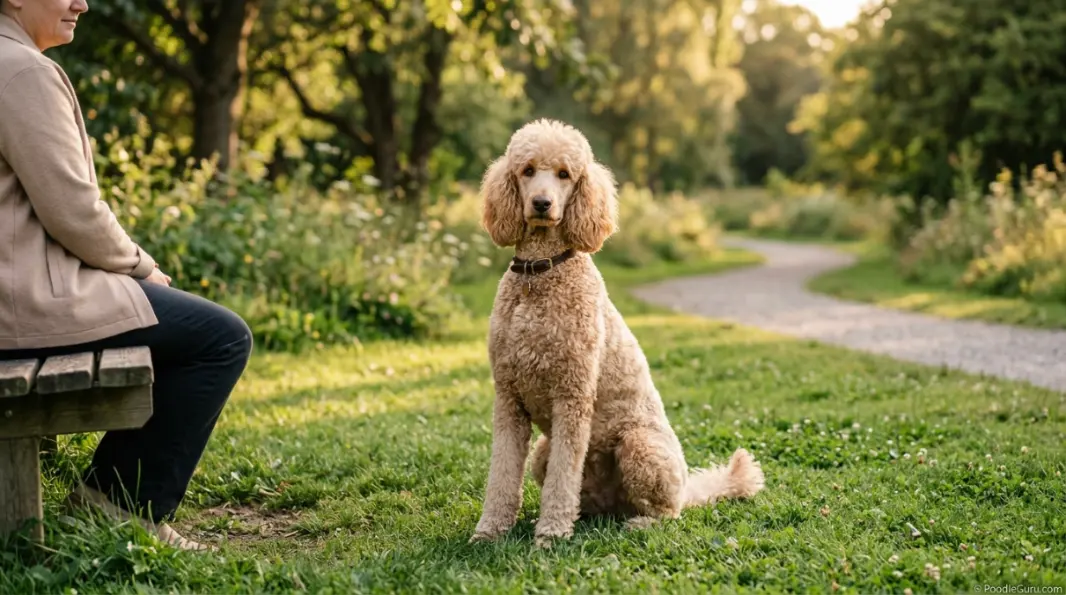
Poodle Puppy Socialization Timeline FAQs
Can I socialize my poodle puppy before vaccinations are complete?
Use safe methods: carry your puppy in public, use a stroller or sling, avoid areas with unknown dog traffic, and arrange playdates with fully vaccinated, healthy adult dogs in clean, private spaces. The behavioral risk of missing the socialization window is statistically greater than the disease risk when sensible precautions are taken.
What if my poodle puppy is already showing fear at 10 weeks?
If fear persists or worsens across multiple sessions, consult a positive-reinforcement trainer now rather than waiting. Early fear that is handled gently often resolves. Early fear that is pushed through can become permanent.
How many new experiences should my poodle puppy have per day during the prime window?
Does socialization look different for toy poodles versus standard poodles?
Standard poodles need more work on leash manners and not jumping up, simply because their adult size makes these behaviors higher-stakes. The underlying emotional principles — calm, positive, curated exposure — remain identical across sizes.
When should I start grooming desensitization with my poodle puppy?
Book a “puppy intro” grooming appointment (bath and light tidying only, no full clip) by 14 weeks. Poodles that miss early grooming desensitization often require sedation for grooming as adults — a stressful, expensive, and avoidable outcome.
Can an adult poodle be socialized if it missed the critical window as a puppy?
That said, poodles’ intelligence and human-attunement make them more responsive to late socialization efforts than many other breeds. Work with a qualified professional for the best outcome.
Should I avoid all stressful situations during the critical windows?
A puppy that is never challenged learns fragility. The art of socialization is exposing your poodle to manageable challenges that build confidence, not overwhelming events that shatter it.
Poodle Puppy Socialization Timeline: The Window Is Short, But the Impact Is Lifelong
The poodle puppy socialization timeline (critical windows) is not one more thing to feel guilty about. It is a map. The 3–5 week window with littermates plants the seeds of canine communication. The 5–8 week window with the breeder waters those seeds with human gentleness.
And the 8–16 week window — the one you control most directly — shapes the adult dog who will share your home for the next 12 to 18 years. Poodles are extraordinary dogs: brilliant, emotionally present, deeply bonded to their people. They deserve a start in life that matches what they are capable of becoming.
A few weeks of intentional, calm, well-structured socialization is one of the highest-return investments you will ever make in your dog’s quality of life — and your own.
Start where you are. Use the timeline. Respect your puppy’s pace. And when the window feels short, remember: every positive experience you offer during these weeks echoes forward for years. That is not pressure. That is power — used wisely.