Poodle Puppy Biting: How to Stop It Fast (Without Breaking Your Bond)
Poodle puppy biting is completely normal and peaks between 10 and 16 weeks. The fastest way to stop it is a combination of consistent bite-inhibition training, immediate redirection to appropriate chew toys, enforced naps when the puppy is overtired, and making sure every family member responds the same way. Most poodle puppies improve dramatically by 5 to 6 months once adult teeth come in, but the habits you build in the first few weeks shape whether mouthing fades or lingers into adolescence.
You brought home a whip-smart, velvety-soft poodle puppy. And then the teeth found your fingers. And your ankles. And the hem of your favorite sweater. Suddenly you are googling poodle puppy biting at 10 p.m. with a Band-Aid on your thumb, wondering if you missed a red flag at the breeder’s house.
You didn’t. Poodle puppies bite. A lot. What separates owners who sail through this phase from those who struggle for months is not luck — it is understanding why the biting happens, knowing what makes poodles slightly different from other breeds, and applying a clear, humane strategy that works with your puppy’s brain rather than against it. This guide covers all of that, and nothing here is theoretical. It’s drawn from real owner experience, veterinary behavior insight, and the pattern recognition that comes from watching dozens of poodle litters grow up.
At a Glance: Poodle Puppy Biting Facts
Why Do Poodle Puppies Bite So Much?
Biting is not a sign of a bad temperament. It is not dominance. It is not your puppy being stubborn or difficult. For poodle puppies especially, biting sits at the intersection of three powerful developmental forces. Miss any one of them in your training approach and you will feel stuck.
Teething Pain Is Real — and Relentless
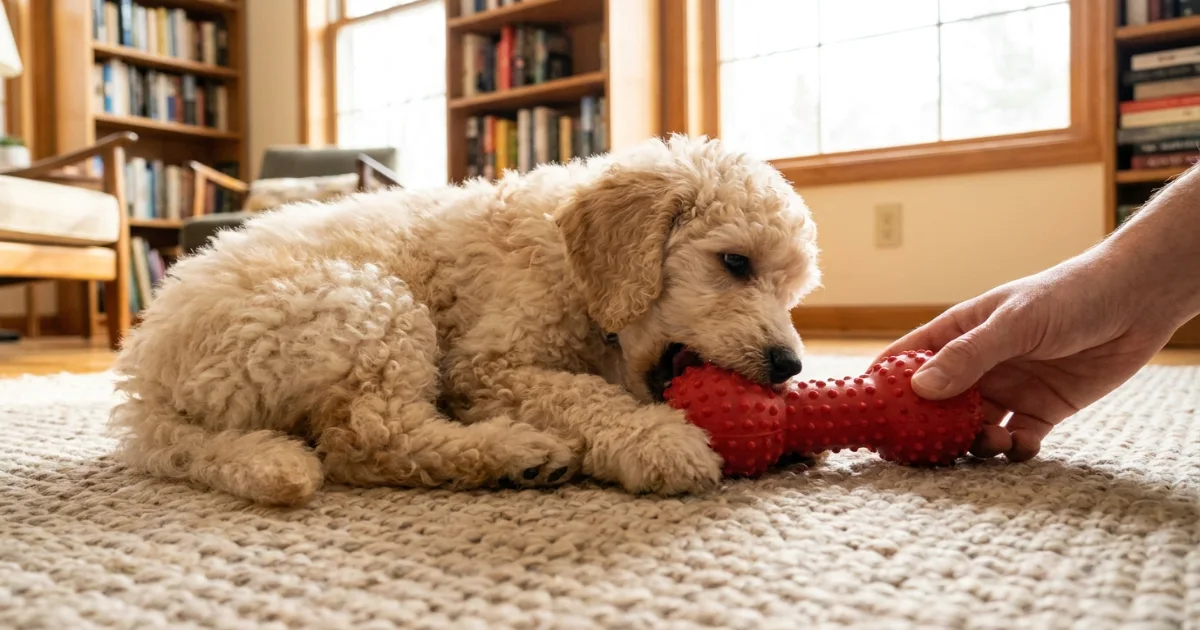
Between roughly 12 weeks and 6 months, your poodle puppy’s baby teeth fall out and adult teeth push through the gums. This hurts. Chewing and mouthing provide genuine relief. A puppy who was relatively gentle at 9 weeks can turn into a land shark at 14 weeks simply because her mouth is throbbing. Cold chew toys, frozen washcloths, and textured rubber surfaces become your best tools during this stretch. If you only correct the biting without offering relief alternatives, you are fighting biology — and biology usually wins.
Mouth-First Exploration
Dogs lack hands. A poodle puppy’s primary way to investigate texture, density, movement, and reaction is through the mouth. When your puppy mouths your hand, part of what is happening is genuine curiosity: What does this feel like? Does it move? Does it make a sound? This is not aggression. It is data collection. The goal is not to eliminate mouthing entirely at first — it is to shape it down to gentleness, then phase it out.
The Intelligence Factor Nobody Talks About
Poodles are brilliant. That is a double-edged sword during the biting phase. A less intelligent puppy might try something three times and give up. A poodle puppy will run the experiment thirty times, varying the pressure, the context, the family member, and the time of day. If your response changes — if you let mouthing slide when you are tired but correct it sharply when you are fresh — your poodle notices the pattern faster than you do. Consistency is not optional with this breed; it is the entire game.
What Makes Poodle Puppy Biting Different From Other Breeds
Anyone who has raised both a poodle and, say, a Labrador or a terrier will tell you: the biting feels different. Lab puppies tend to be mouthy but often softer-mouthed by instinct (retrieving heritage). Terrier puppies bite with a harder, more determined grip. Poodle puppies fall somewhere in the middle — but the real difference is the persistence and the targeting.
Poodles are highly attuned to human movement. They notice hands, sleeves, flowing fabric, ankles in motion. Their herding-adjacent ancestry (yes, poodles have working roots beyond water retrieving) means motion triggers engagement. A poodle puppy is more likely to chase and nip moving children than a sedentary adult. This is not prey drive in the dangerous sense — it is arousal and the instinct to interact with motion. Understanding this lets you predict when biting is most likely and manage the environment instead of reacting after the fact.
Because poodles are so human-focused, they often bite more when they want attention. A poodle puppy who learns that mouthing gets a big reaction — even a negative one — may escalate the behavior simply because any engagement counts as a win. This is why calm, boring responses to biting work better than loud corrections with this breed.
Bite Inhibition: The Timeline Every Poodle Owner Should Know
Bite inhibition — the ability to control the force of a bite — is the single most important skill your puppy will learn. A dog with good bite inhibition may still mouth softly in excitement, but will not break skin even if startled or hurt. The window for teaching this is finite, and it closes faster than most owners realize.
| Age Range | What Is Happening | Your Focus |
|---|---|---|
| 6–9 weeks | Puppy learns bite pressure from littermates. Squeals from siblings teach “too hard.” | Ideally still with the litter. If already home, prioritize gentle mouth acceptance before phasing out. |
| 10–14 weeks | Peak mouthing intensity. Teething begins. Exploration through mouth is constant. | Consistent yelp-and-freeze or redirect. Do not punish mouthing; shape it down. Introduce “gentle” cue. |
| 14–20 weeks | Adult teeth erupting. Pain drives increased chewing and biting. | Heavy emphasis on appropriate chew outlets. Cold/frozen items. Enforced naps for overtired biting. |
| 5–7 months | Adult teeth fully in. Mouthing should be tapering significantly. | Zero tolerance for hard mouthing. Redirect soft mouthing. If no improvement, consult a trainer. |
| 8+ months | Mouthing should be rare and exceptionally soft if present at all. | Any persistent hard biting needs professional behavioral assessment — not just more YouTube tutorials. |
How to Stop Poodle Puppy Biting Fast: 7 Proven Strategies
Here is the core of this guide. These seven strategies work together as a system. Using just one or two will help. Using all seven consistently will transform your daily experience within two to three weeks. The order matters — start with the first three immediately.
1. The Yelp-and-Freeze Method
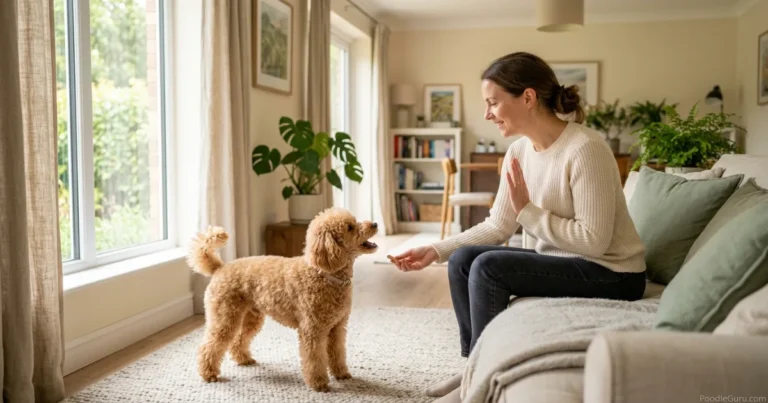
When teeth touch skin at an uncomfortable pressure, let out a sharp, high-pitched “ouch!” — not angry, just startling — and immediately freeze. Stop moving your hand. Stop engaging. Count to five. If the puppy backs off, calmly praise and offer a toy. If the puppy persists, calmly stand up and walk away for 15 seconds. The message: Hard mouthing ends all fun, instantly, every time. This mimics how littermates communicate and works with your puppy’s social instincts, not against them.
2. Redirect With Intention, Not Distraction
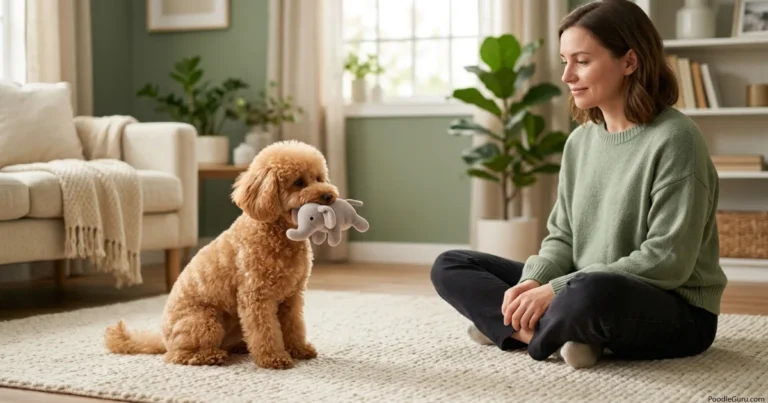
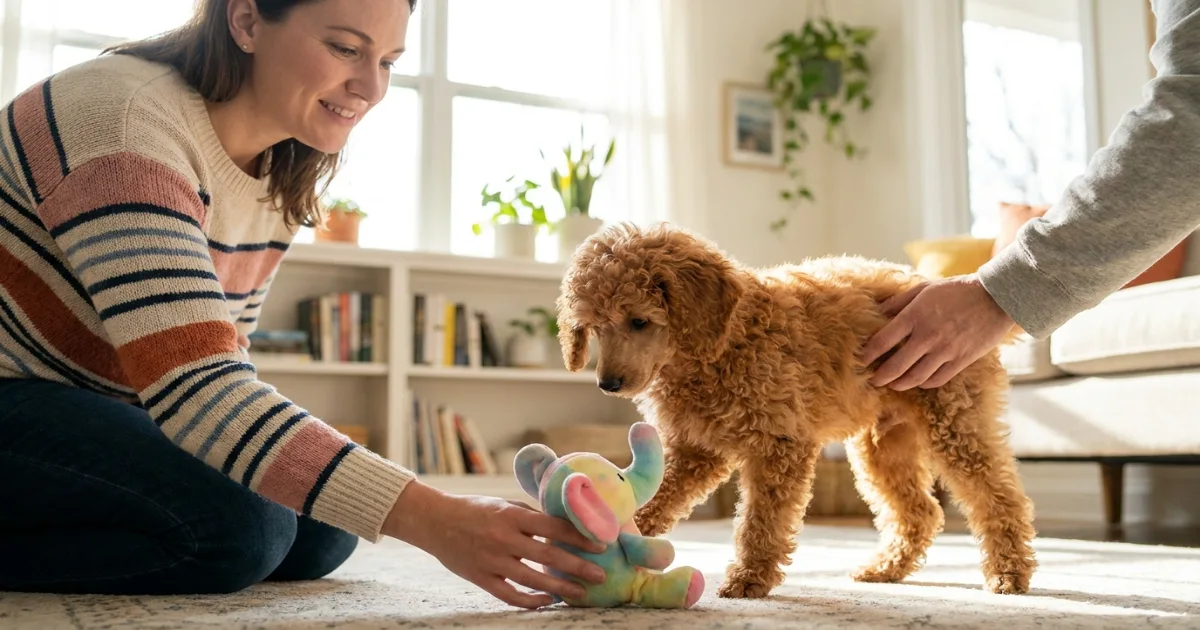
There is a difference between mindlessly shoving a toy into a biting puppy’s face and teaching the puppy that toys are more rewarding than hands. When you redirect, make the toy interesting — wiggle it, drag it, make it come alive. Your hands become boring and still; the toy becomes the exciting option. Over dozens of repetitions, your poodle’s clever brain rewires to seek the toy when arousal spikes, because the toy has a history of engagement and your hands have a history of going dead.
3. Manage the Environment Proactively
If your poodle puppy predictably bites ankles every morning when the kids run through the kitchen, the solution is not to yell “no biting” twelve times. It is to gate off the kitchen during high-energy moments, or to have the puppy on a light drag leash so you can calmly redirect before the chase instinct kicks in. Environmental management is not an admission of defeat. It is the mark of an experienced owner who understands that preventing rehearsal of unwanted behavior is more effective than correcting it after the fact.
4. Teach “Gentle” as a Command
Pick a calm moment when the puppy is not over-aroused. Hold a treat between two fingers with your thumb covering most of it. Offer it near the puppy’s nose. If the puppy lunges or grabs hard, close your fist. The instant the puppy uses a soft mouth — even a lick or a gentle nuzzle — say “gentle” in a warm voice and release the treat. Over a week or two, your poodle learns that a soft mouth earns rewards. This generalizes beyond treat-taking into all mouth contact.
5. Enforced Naps Are Not Cruel
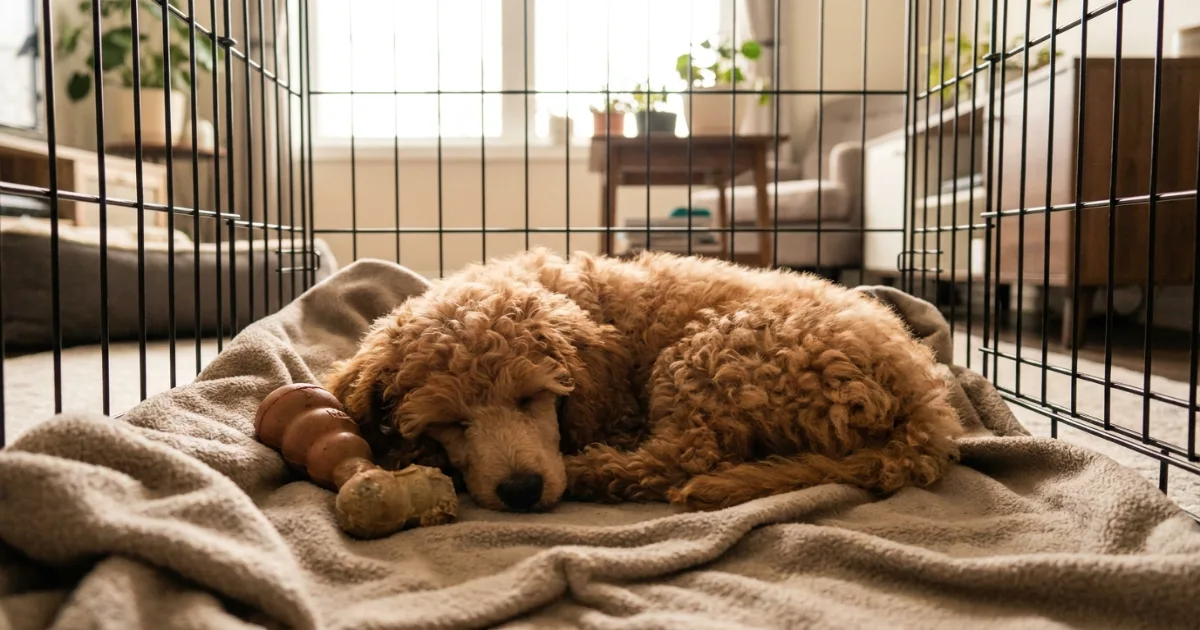
Poodle puppies, like toddlers, become bitey nightmares when overtired. A puppy who has been awake for 90 minutes and is spiraling into frantic ankle-chasing is not being bad — she is exhausted and lacks the off-switch to put herself to sleep. Place her in a crate or a quiet pen with a chew toy. Most puppies conk out within five minutes and wake up noticeably gentler. A well-rested poodle puppy is a dramatically less bitey poodle puppy.
A rough schedule for a young poodle puppy: 45 to 60 minutes awake, then 90 to 120 minutes of nap. If biting escalates suddenly, check the clock — odds are the puppy has been up too long. Enforce the nap before the biting spiral starts, and you prevent the problem rather than reacting to it.
6. Socialization With Other Vaccinated Dogs
Adult dogs who are known to be gentle and vaccinated are the best bite-inhibition teachers on the planet. A well-socialized adult dog will correct a rude puppy with a quick growl or a freeze — far more effectively than any human can. A few supervised play sessions with a patient older dog can accelerate your poodle puppy’s understanding of appropriate mouth pressure by weeks. Just make sure the adult dog has a tolerant temperament and that all interactions are supervised.
7. Never Play With Your Hands
This rule sounds simple, and it is, but most families break it within the first week. Roughhousing with hands, letting the puppy chase wiggling fingers, playing “got your nose” — every instance teaches the puppy that human hands are play objects. Use toys for play. Keep hands for petting, grooming, and calm affection. If you have children, this is the rule that requires the most coaching. A single family member who plays with hands can undo days of consistent training from everyone else.
Comparing Popular Bite-Stopping Methods
Not every method works equally well for poodles. Some widely recommended techniques backfire with highly intelligent, sensitive dogs. Here is an honest look at what tends to work and what tends to make things worse.
| Method | How It Works | Effectiveness for Poodles | Risk / Note |
|---|---|---|---|
| Yelp and Freeze | High-pitched sound, then stillness | ✅ High — mimics littermate feedback | Low risk; may not work if puppy is over-aroused |
| Toy Redirection | Swap hand for toy, make toy exciting | ✅ High — channels mouthing appropriately | Low risk; essential for all puppies |
| Time-Out (Brief Isolation) | Remove yourself or puppy for 15–30 seconds | ✅ Moderate-High — very effective if timed right | Must happen within 2 seconds of the bite |
| Holding the Muzzle Shut | Physically close the puppy’s mouth | ❌ Low — often escalates frustration | Can damage trust; especially risky with sensitive poodles |
| Loud “No!” or Yelling | Startle the puppy verbally | ❌ Low — poodles may find it arousing or frightening | Can increase anxiety-based mouthing over time |
| Bitter Spray on Hands | Deterrent taste on skin | ⚠️ Mixed — some puppies avoid, others ignore | Does not teach bite inhibition; purely aversive |
The Biggest Mistakes Owners Make With Poodle Puppy Biting
Most mistakes come from good intentions paired with incomplete information. Here are the errors that keep showing up in poodle owner forums, training consultations, and frustrated late-night texts to breeders.
- Inconsistent responses across family members. If one person allows mouthing because “it doesn’t hurt” and another corrects it sharply, the puppy learns nothing except that humans are unpredictable. Poodles track inconsistency with unsettling precision.
- Punishing instead of teaching. Yelling, smacking, grabbing the scruff — these suppress behavior momentarily but do not teach what should happen instead. A suppressed poodle is an anxious poodle, and anxiety often expresses itself through more mouthing later.
- Waiting too long to start. Owners sometimes assume the puppy will “grow out of it” without intervention. While mouthing does naturally decrease with age, unshaped mouthing often hardens into a habit that is significantly harder to undo after 6 months.
- Over-tiring the puppy. Long play sessions, too much excitement, not enough sleep — and then the biting explodes. The owner blames the puppy. The puppy is just exhausted.
- Using hands as toys from day one. This is the hardest habit for families to break and the most consequential. Once hands are coded as play objects, every interaction becomes a potential biting opportunity.
What Prospective Buyers Usually Get Wrong
If you are reading this before bringing a poodle puppy home, you are already ahead of most. Here is what catches new owners off guard — and what breeders sometimes forget to mention.
Myth: “Poodles are refined dogs. They won’t be as mouthy as a Lab or a Golden.”
Reality: Poodle puppies are every bit as mouthy as any sporting breed, and in some cases more persistent. Their refinement shows up in adulthood, not in the teething phase.
Myth: “A good breeder produces puppies that don’t bite.”
Reality: Biting is developmental, not temperamental. A well-bred poodle puppy from champion lines will still bite during teething. What a good breeder does provide is a puppy who has had early exposure to gentle handling and has started learning bite pressure from littermates — which gives you a head start, not a free pass.
Myth: “If the biting is bad, the puppy must be aggressive.”
Reality: True aggression in poodle puppies under 6 months is extremely rare. What looks like aggression is almost always over-arousal, teething pain, exhaustion, or attention-seeking behavior amplified by inconsistent handling.
Some owners mistake normal poodle puppy biting for a deeper behavioral problem and either panic or, worse, resort to harsh correction methods that damage the puppy’s trust. Others dismiss genuinely concerning biting — hard, unprovoked bites with growling and stiff body language — as “just puppy stuff” for too long. The difference matters. Normal puppy biting is exploratory and occurs during play or excitement. Concerning biting looks more targeted, happens in contexts that don’t obviously invite it, and doesn’t soften even when the “victim” freezes or yelps. If you are unsure, video a few incidents and share them with a qualified positive-reinforcement trainer who has poodle experience.
When Should You Worry About Poodle Puppy Biting?
For the vast majority of poodle puppies, biting fades on the timeline described above with consistent training. But there are moments when professional help is warranted sooner rather than later:
- Biting that breaks skin regularly past 16 weeks despite consistent training
- Biting accompanied by a hard stare, stiff body, or growling with no playful context
- Biting that escalates when the person freezes or backs away (rather than de-escalating)
- Resource-guarding bites around food, toys, or resting spots
- Any bite that feels significantly different from the normal mouthing pattern — trust your gut
In these cases, a veterinary behaviorist or a certified positive-reinforcement trainer with puppy specialization is your best next step. Do not wait and hope it resolves on its own. Early intervention is easier, cheaper, and more effective than rehabilitating an adult dog with an established biting habit.
Practical Owner Insights: What the First 8 Weeks Really Look Like
Here is an honest, unvarnished look at what to expect week by week when you bring a poodle puppy home. This is not from a textbook. It is the composite experience of dozens of poodle owners who have been exactly where you are.
Week 1–2 (8–10 weeks old): The puppy is sweet, sleepy, and a little overwhelmed. Biting is present but usually gentle. You think, “Maybe we got lucky.” You didn’t. Enjoy this honeymoon while it lasts.
Week 3–5 (11–14 weeks old): The biting ramps up noticeably. Teething begins. The puppy tests boundaries with everyone in the household. This is when most owners panic and start Googling. This is also when consistency matters most — the habits you set now shape the next several months.
Week 6–10 (15–20 weeks old): Peak teething. Adult teeth are pushing through. The puppy’s mouth is genuinely uncomfortable, and biting reflects that. This is the hardest stretch. Frozen toys, plenty of naps, and unwavering calm redirection get you through. You will see glimmers of the adult dog emerging between the difficult moments.
Week 11–16 (21–26 weeks / 5–6 months old): Adult teeth are mostly in. Mouthing should be tapering clearly. If it is not — if the biting is still hard and frequent — this is the moment to bring in a professional. Do not keep trying the same strategies and expecting different results.
Does Your Poodle Puppy Need More Chew Options?
Sometimes biting persists simply because the puppy does not have enough appropriate, satisfying things to chew. Poodle puppies can be particular — they often prefer texture variety. If you only offer one type of toy, your puppy may ignore it in favor of your hands simply because the toy is boring. Try rotating through a few categories:
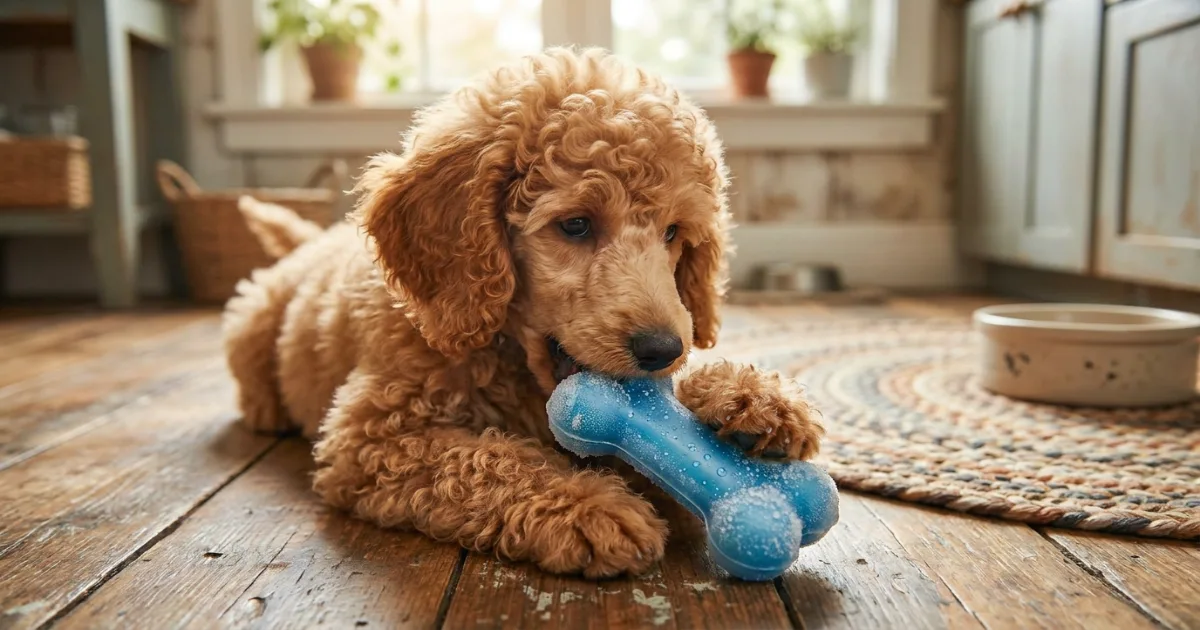
- Rubber toys with some give (Kong-style, ideally stuffable and freezable)
- Textured nylon chews for the molar-eruption phase (supervised only)
- Plush toys with crinkle or squeak for gentle mouthing sessions
- Rope toys (under supervision — frayed strands can be ingested)
- Frozen carrots or frozen damp washcloths for teething pain relief
Poodles often prefer toys they can “solve.” Puzzle toys that dispense treats, toys with hidden squeakers, or stuffed Kongs that require work to empty engage the poodle brain in a way that passive chewing does not. A mentally stimulated poodle is less likely to seek stimulation through mouthing people.
Frequently Asked Questions About Poodle Puppy Biting
At what age do poodle puppies stop biting?
Most poodle puppies show dramatic improvement between 5 and 6 months once adult teeth are fully in. Soft mouthing may linger until 7 or 8 months, but hard, frequent biting should be largely resolved by the half-year mark with consistent training. Some individuals take a bit longer — that doesn’t necessarily signal a problem if the trajectory is steadily improving.
Why does my poodle puppy bite me but not my partner?
This is remarkably common and usually comes down to three factors: how each person responds to the biting, how each person moves and sounds, and who the puppy sees as more “exciting.” If you react with high-pitched sounds, quick hand movements, or inconsistent corrections while your partner stays calm and boring, the puppy may target you because you are simply more stimulating. It is rarely about preference — it’s about arousal patterns.
Is my poodle puppy biting a sign of aggression?
In puppies under 6 months, true aggression is rare. Normal poodle puppy biting happens during play, excitement, or teething moments and softens when the person freezes. Aggressive biting tends to be harder, accompanied by stiff body language, and may not de-escalate when the interaction stops. If you see a hard stare, lifted lips, deep growling, and sustained intensity, consult a professional — but most puppy biting does not look like that at all.
How do I stop my poodle puppy from biting my children?
Start by managing the environment: use gates or pens to create calm zones, and never leave young children and a mouthy puppy unsupervised. Teach children to stand still like a tree when the puppy bites — movement fuels the behavior. Coach kids to use toys for play and to avoid squealing or running, which can trigger chase-biting. The adult should intervene calmly rather than expecting the child to handle the training. Over time, supervised practice builds mutual trust.
Can teething toys really stop poodle puppy biting?
Teething toys alone will not stop biting — but they are a critical piece of the puzzle. They provide pain relief, appropriate chewing outlets, and a redirection target. Without them, you are asking a puppy in genuine discomfort to ignore the one thing that soothes her gums. Combine teething toys with consistent training, and you address both the physical and behavioral sides of the problem.
Should I hold my poodle puppy’s mouth shut when they bite?
No. This technique is outdated and can backfire badly, especially with sensitive, intelligent breeds like poodles. Holding the muzzle shut can escalate frustration, damage trust, and in some cases trigger a defensive response. It also teaches nothing — the puppy learns to fear your hands, not to moderate mouth pressure. The yelp-and-freeze method or brief time-outs are safer and more effective alternatives.
How long does the puppy biting phase last in poodles?
The acute biting phase typically spans from roughly 10 weeks to 5 or 6 months, with the worst intensity concentrated between 14 and 20 weeks during peak teething. Soft mouthing may continue on and off until 7 to 9 months. If you are doing everything right and still seeing frequent hard biting past 7 months, it’s time to bring in a professional trainer for an assessment — not because something is necessarily wrong, but because an outside eye can spot dynamics you might miss in the daily routine.
Poodle puppy biting is a normal, temporary developmental phase — not a character flaw, not a sign of a bad breeder, and not a predictor of adult temperament. The puppies who stop biting fastest are the ones raised with calm consistency, appropriate chew outlets, enough sleep, and family members who all respond the same way every time. Poodles are too smart to be trained by accident; they need clarity, and they reward it.
Focus on teaching bite inhibition before expecting zero mouthing. Use the yelp-and-freeze method. Redirect relentlessly with engaging toys. Enforce naps before the overtired biting spiral begins. Never play with hands. And if the biting feels off — harder than expected, accompanied by concerning body language, or not improving by 6 to 7 months — reach out to a qualified professional without shame. Early help is a sign of a responsible owner, not a failed one.
Your poodle puppy will almost certainly grow into the elegant, gentle companion you imagined. The biting phase is just that — a phase. How you navigate it shapes the trust between you for years to come.