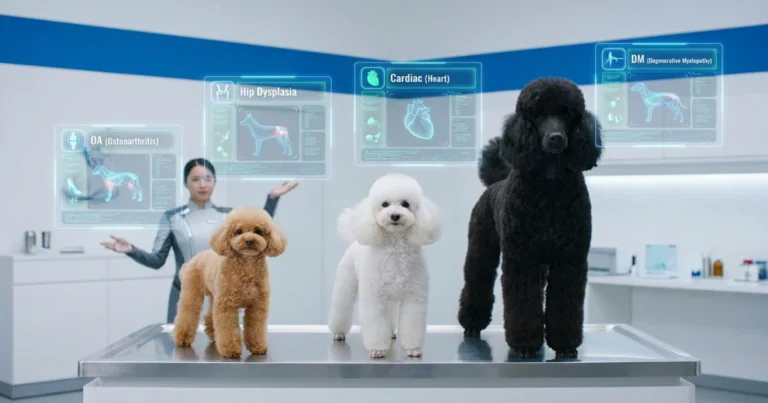
The Complete Poodle Puppy Growth Chart (Toy, Mini, Standard): What to Expect from 8 Weeks to Full Maturity

Quick Answer: A Poodle puppy growth chart (toy, mini, standard) maps how each size variety develops from weaning through physical maturity. Toy Poodles typically reach adult weight by 10–12 months, Miniatures by 12–14 months, and Standards anywhere from 18–24 months. At 8 weeks, a Toy weighs roughly 1.5–2.5 lbs, a Mini 3–5 lbs, and a Standard 10–15 lbs. Adult weights land around 4–7 lbs for Toys, 10–17 lbs for Minis, and 40–70 lbs for Standards — but the path between those numbers is anything but linear. Growth spurts, teething, appetite shifts, and breeder practices all shape the curve. Use this guide as a benchmark, not a rigid rulebook.

No two Poodle puppies grow exactly alike. Even within the same litter, you will see one pup that seems to double in size overnight and another that tiptoes toward adulthood at a slower, steadier pace. That variability is normal — but it also creates anxiety for new owners staring at a scale and wondering if their puppy is on track. A Poodle puppy growth chart (toy, mini, standard) exists to replace that anxiety with informed context. It tells you what to expect, when to worry, and — just as importantly — when to stop worrying and let genetics do its quiet, unhurried work.

This page is built for owners who want the full picture: weekly and monthly benchmarks, side-by-side size comparisons, the biology behind the numbers, the mistakes buyers make, and the practical care decisions that influence healthy growth across every Poodle variety.

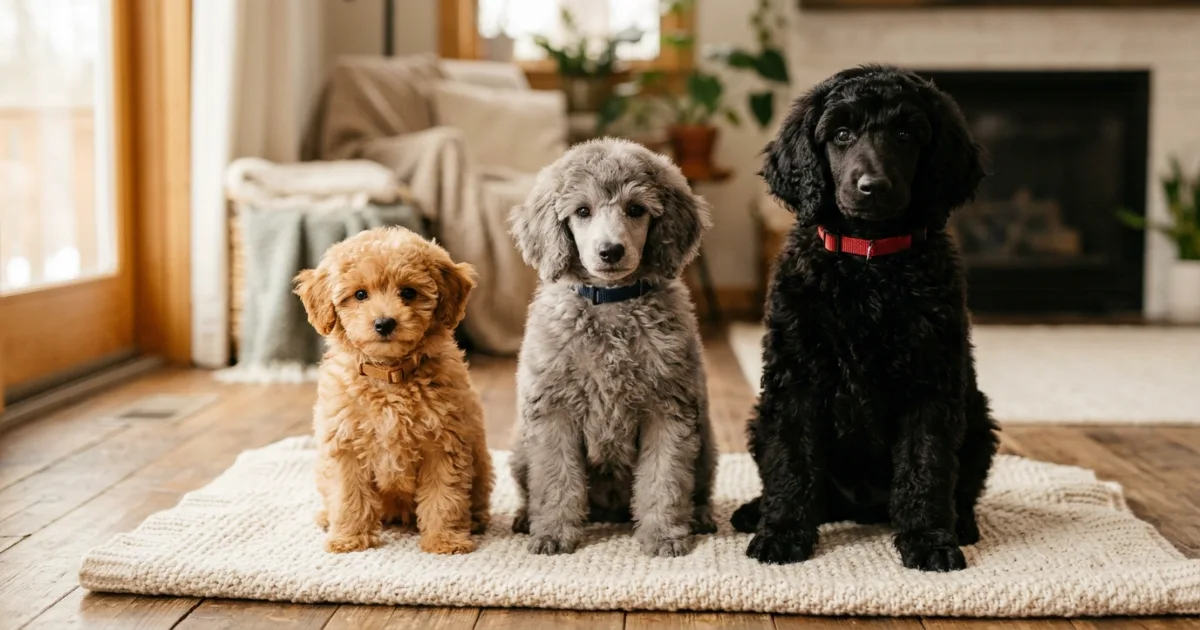
Poodle puppy growth chart showing toy miniature and standard size comparison at different ages
The three Poodle size varieties follow dramatically different growth trajectories — what looks like a fully grown Mini at 16 weeks is still a baby Standard.
Toy Poodle Adult: 4–7 lbs
Full size by 10–12 months
8-week weight: ~1.5–2.5 lbs
Miniature Poodle Adult: 10–17 lbs
Full size by 12–14 months
8-week weight: ~3–5 lbs
Standard Poodle Adult: 40–70 lbs
Full size by 18–24 months
8-week weight: ~10–15 lbs

Why a Poodle Puppy Growth Chart Matters More Than You Think

Most new Poodle owners check a growth chart because they want reassurance. That is a perfectly good reason. But a well-constructed chart does more than soothe nerves — it helps you catch early deviations that might signal nutritional gaps, parasite loads, or underlying health issues before they become visible to the naked eye.

Poodles, as a breed group, share a common ancestry and body type, but the three size varieties are functionally different dogs when it comes to metabolic rate, bone development timelines, and caloric needs per pound of body weight. A Toy Poodle puppy burns through energy stores faster than a Standard puppy relative to its size. That means feeding strategies that work beautifully for one variety can leave another underweight or overweight. A growth chart tuned to your specific variety gives you a reference point that generic “puppy weight calculators” simply cannot match.

There is also the breeder factor. Responsible breeders track growth curves across generations. When you buy from someone who can show you weight records for the dam, sire, and previous litters, you are not just buying a puppy — you are buying predictability. A Poodle puppy growth chart (toy, mini, standard) becomes far more useful when you know whether your pup comes from a line that trends toward the upper or lower end of the breed standard.

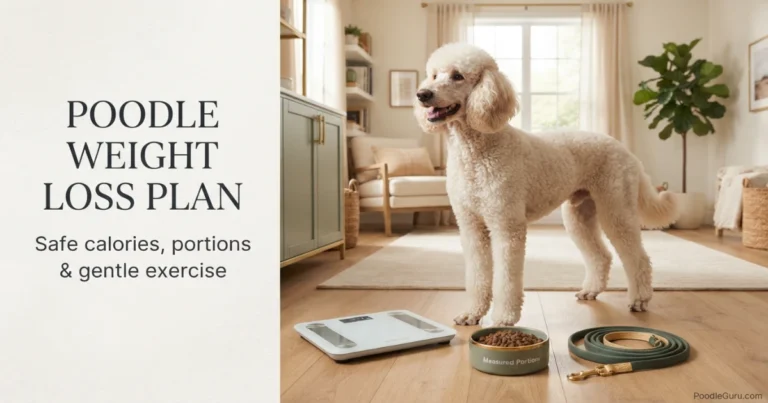
🐩 Expert Insight: “I tell all my puppy buyers to weigh their Poodle weekly for the first six months — same scale, same time of day, before feeding. One or two flat weeks are normal. Three consecutive weeks with no gain in a puppy under 6 months? That warrants a vet visit. Growth charts only work if you actually use them.” — Dr. Lena Hartwick, DVM, small-breed reproduction specialist

Toy Poodle Puppy Growth Chart: Small Dog, Fast Finish

Toy Poodles are the sprinters of the Poodle world. Their growth arc is short, steep, and finished before many Standard Poodles have even hit their adolescent lanky phase. Because Toy Poodles mature so quickly, owners sometimes miss the window for critical interventions if something is off.

AgeExpected Weight RangeDevelopmental Notes
8 weeks1.5 – 2.5 lbsWeaning complete; rapid neuromuscular development
12 weeks2.5 – 4 lbsGrowth rate peaks; vaccine series underway
16 weeks3.5 – 5 lbsTeething begins; appetite may dip temporarily
6 months4 – 6 lbsNear adult height; filling out continues
9 months4.5 – 6.5 lbsGrowth plates closing; spay/neuter considerations
12 months5 – 7 lbsPhysically mature; weight may shift ±0.5 lb through age 2

Toy Poodles frequently hit 80–90% of their adult weight by 7 or 8 months. The last few ounces fill in slowly, and some individuals will continue subtle muscle development through 14 months. Do not panic if your 9-month-old Toy Poodle plateaus at 5.2 lbs for a few weeks — that is often the body consolidating before the final small push.

One thing buyers consistently underestimate: a Toy Poodle advertised as “teacup” is often just an undersized Toy, and those dogs follow erratic growth patterns because they are bred away from the breed standard. If your puppy came from a breeder emphasizing “micro” or “teacup” sizing, a standard growth chart may not apply cleanly. Those dogs are outliers, and their curves deserve veterinary guidance, not guesswork.

Miniature Poodle Puppy Growth Chart: The Middle Child Nobody Fully Explains

Miniature Poodles occupy an awkward information gap in most online growth resources. They are not small enough to be treated like Toys, nor large enough to share the Standard’s extended adolescence. Their growth curve is moderate, and that very moderation is what trips people up — it is easy to assume everything is fine when weight gain looks “steady enough.”

AgeExpected Weight RangeDevelopmental Notes
8 weeks3 – 5 lbsEarly socialization critical; rapid brain development
12 weeks5 – 8 lbsCoordination improving; appetite robust
16 weeks7 – 10 lbsTeething; may show temporary weight plateau
6 months9 – 13 lbsAdult proportions emerging; energy levels high
9 months11 – 15 lbsGrowth slowing; muscle definition increasing
12–14 months10 – 17 lbsPhysical maturity; final weight settles here

The 10–17 lb adult range for Miniatures is wider than most charts acknowledge. A 10.5-lb Mini is not “too small,” and a 16.8-lb Mini is not overweight by default — both can be perfectly correct within the breed standard, provided the dog is proportionate in height and bone. What matters is the trajectory. A puppy tracking along the 15th percentile consistently is fine; a puppy that drops from the 70th percentile to the 30th in six weeks is not.

Miniature Poodle puppy being weighed on a digital scale during growth tracking
Weekly weigh-ins on a consistent digital scale give you the most reliable growth data for your Miniature Poodle puppy.

⚠️ Buyer Beware: Some breeders market “Royal Miniature” or “Large Mini” Poodles that blur the line between Mini and Standard. These dogs may exceed 18 lbs and technically fall into an unregistered middle ground. If you want a true Mini, ask to see the parents’ weights and registration. A growth chart cannot fix a misidentified size variety.

Standard Poodle Puppy Growth Chart: The Long Game

Standard Poodles take their time. Where a Toy finishes growing before its first birthday, a Standard Poodle at 12 months is often still gangly, still filling out, still very much a work in progress. This extended growth window means Standard owners must stay vigilant about nutrition and joint health for nearly two full years.

AgeExpected Weight RangeDevelopmental Notes
8 weeks10 – 15 lbsRapid skeletal growth begins; high-quality puppy food essential
12 weeks18 – 25 lbsMay appear leggy; coordination catching up
16 weeks25 – 35 lbsTeething; ears may seem disproportionately large
6 months35 – 45 lbsHeight approaching 75% of adult; lanky adolescent phase
9 months40 – 55 lbsGrowth rate slowing; muscle development accelerating
12 months45 – 60 lbsNear adult height; chest broadening continues
18 months50 – 65 lbsFilling out; growth plates largely closed
24 months40 – 70 lbsFull physical maturity reached

The 40–70 lb adult range for Standards is startlingly broad — a 45-lb female and a 68-lb male can both be perfectly healthy and breed-correct. Males typically outsize females by 10–15 lbs. What trips up new owners is the “ugly duckling” phase between roughly 7 and 13 months, when Standards look leggy, ribby, and awkward no matter how well you feed them. That phase is normal. Do not overfeed to “fill them out” faster, because excess weight during rapid growth puts stress on developing joints — and Standard Poodles are already predisposed to hip dysplasia and bloat.

Standard Poodle puppy growth progression from 8 weeks through 18 months showing size changes
Standard Poodles go through a pronounced leggy adolescent stage — resist the urge to overcompensate with extra calories.

Side-by-Side Comparison: Toy vs. Mini vs. Standard Growth at Key Ages

Placing all three varieties next to each other reveals just how differently these dogs develop. The table below uses approximate midpoints for each variety at shared age milestones.

AgeToy Poodle (lbs)Miniature Poodle (lbs)Standard Poodle (lbs)
8 weeks~2~4~12
16 weeks~4~8.5~30
6 months~5~11~40
12 months~6 (mature)~14 (near mature)~52 (still filling)
18 months~6~15 (mature)~58
24 months~6~15~62 (mature)

Notice the chasm at 16 weeks: a 4-lb Toy and a 30-lb Standard are the same species, the same breed, separated only by generations of selective breeding for size. That genetic divergence is exactly why one-size-fits-all puppy advice fails Poodles so badly. A Poodle puppy growth chart (toy, mini, standard) that lumps them together is worse than useless — it is misleading.

What Buyers Usually Get Wrong About Poodle Puppy Growth

After a decade of advising Poodle owners, certain patterns emerge. Here are the misunderstandings that surface again and again:

1. “The breeder said he’d be 5 pounds, but he’s already 4.5 at 10 weeks — he’s going to be huge.” No. Early growth is not linear. Many Toy Poodles hit a fast burst between 8 and 14 weeks and then dramatically slow down. A 10-week weight is a snapshot, not a forecast.

2. “My Standard is 45 pounds at 8 months — is he done growing?” Almost certainly not. Standards gain height first, mass later. That 45-lb 8-month-old may add another 10–15 lbs of muscle and bone density between months 12 and 20.

3. “If I feed more, he’ll grow bigger.” You will get a fatter dog, not a taller one. Adult size is overwhelmingly genetic. Overfeeding a puppy in hopes of boosting its adult stature leads to obesity, orthopedic stress, and a shortened lifespan — not a bigger frame.

4. “Growth charts are guarantees.” They are not. They are population averages derived from healthy, well-bred dogs. Your individual puppy may sit at the 10th or 90th percentile and still be perfectly normal. Trends matter more than single data points.

🧬 Genetics in Plain Terms: Adult size in Poodles is polygenic — meaning dozens of genes contribute, not just one or two. Size-influencing genes interact with nutrition, maternal health, litter size, and early environment. Even two 6-lb Toy Poodle parents can produce a 7.5-lb offspring if recessive size alleles line up. That puppy is not “wrong” — it is expressing the full genetic potential that was always present in the line.

How Poodle Sizes Are Often Misidentified or Misunderstood

Online marketplaces and social media have created a parallel universe of Poodle size labels that do not correspond to anything recognized by the American Kennel Club, the United Kennel Club, or the Fédération Cynologique Internationale. Terms like “teacup,” “micro,” “toy-mini,” “moyen,” and “royal standard” circulate freely, and buyers absorb them as if they represent real, distinct categories.

In North America, the AKC recognizes only three size varieties: Toy (up to 10 inches at the shoulder), Miniature (over 10 inches up to 15 inches), and Standard (over 15 inches). Weight is not directly specified in the standard — height is the defining measurement. This creates a disconnect: buyers shop by weight, but the breed is defined by height. A dog that is 11 inches tall and 9 pounds may be a small Miniature, not a large Toy, even if the seller labeled it a “teacup toy.”

The “Moyen” or “Klein” Poodle — popular in Europe and increasingly marketed in the U.S. — falls between Mini and Standard, roughly 15–20 inches and 18–30 lbs. It is recognized by the FCI as a fourth size but is not an AKC-recognized variety. If you are buying a “Moyen” in the United States, you are buying from a breeder operating outside the AKC size framework. That does not automatically make the dog unhealthy or misrepresented, but it does mean standard growth charts may need adjustment.

Height comparison of Toy Miniature and Standard Poodle varieties side by side
Poodle size is defined by height at the shoulder, not weight — a distinction that matters when interpreting any growth chart.

Factors That Influence Your Poodle Puppy’s Growth Curve

A growth chart gives you a reference range. What pushes your puppy toward the upper or lower end of that range includes:

Genetics and lineage. This is the dominant factor. Ask your breeder for adult weights of the dam, sire, and any available data from previous litters. Those numbers are your best predictor.

Litter size. Puppies from large litters tend to be smaller at birth and may take longer to catch up. A Toy Poodle singleton often outweighs a littermate from a litter of five by 15–20% at 8 weeks, even with identical genetics.

Nutrition quality. Not just quantity — quality. Puppies fed a well-formulated, AAFCO-compliant growth diet appropriate for their projected adult size build muscle and bone more efficiently. Toy and Mini puppies need calorie-dense, small-kibble formulas; Standards benefit from large-breed puppy formulas that moderate calcium and phosphorus ratios to protect developing joints.

Parasite load. Even a mild roundworm or giardia infection can stall growth for weeks. A puppy that suddenly flatlines on the growth chart should have a fecal test, no questions asked.

Early spay/neuter timing. Growing evidence suggests that early gonad removal alters growth plate closure timing, particularly in Standards. Discuss timing with your veterinarian rather than defaulting to the 6-month mark.

Feeding Through the Growth Phases: Practical Guidance by Size

🍽️ Feeding Guidelines Across Growth Stages

  • Toy Poodles (8–16 weeks): 3–4 small meals per day. Food should be calorie-dense. Watch for hypoglycemia — Toys can crash if they go more than 5–6 hours without eating during rapid growth.
  • Miniature Poodles (8–16 weeks): 3 meals per day. Moderate calorie density. Appetite is usually robust; do not free-feed — Minis can overeat.
  • Standard Poodles (8–16 weeks): 3 meals per day. Use a large-breed puppy formula with controlled calcium (1.0–1.5% on a dry matter basis). Avoid calcium supplements unless prescribed.
  • All sizes (4–8 months): Transition to 2–3 meals. Teething may cause appetite dips. Soften kibble with warm water if needed.
  • Standards (8–18 months): Stay on large-breed puppy food until growth plates close. Switching to adult food too early may shortchange bone development.

Health Considerations During the Growth Period

Growth is not just about numbers on a scale. It is a physiological process that stresses multiple body systems. Know what to watch for:

Patellar luxation appears more frequently in Toys and Minis and may first become noticeable during growth spurts when the musculoskeletal system is temporarily out of sync. A puppy that occasionally skips or holds up a hind leg warrants a veterinary exam, not a “wait and see” approach.

Hip dysplasia in Standards is influenced by growth rate. Pushing a Standard puppy to gain weight too quickly — whether through overfeeding or high-calorie supplementation — is a known risk factor. Let the dog grow at its genetically programmed pace.

Panosteitis — “growing pains” — can affect young Standards, causing shifting leg lameness between 5 and 14 months. It is self-limiting but painful, and it often correlates with rapid growth phases. Rest and pain management are the standard protocols; it resolves without long-term damage in most cases.

2026 Price Guide: What Each Poodle Size Costs and Why

💰 Realistic Poodle Puppy Prices (2026, U.S. Market)

Toy Poodle: $1,800 – $3,500 from a reputable breeder. Show-quality or rare color lines can push to $4,500+. “Teacup” marketed dogs often carry inflated prices with no health benefit.

Miniature Poodle: $1,500 – $3,200. Generally the most affordable of the three, though champion-bloodline Minis can rival Toy prices.

Standard Poodle: $1,800 – $4,000+. Large litters help keep per-puppy costs moderate, but health-tested parents, titling, and early socialization programs raise the price floor. Parti-colored and phantom Standards often command premiums.

What inflates price: Coat color rarity, AKC champion lineage, OFA/PennHIP health clearances on both parents, ENS/ESI early neurological stimulation programs, and geographic demand.

Red flag pricing: Anything under $1,200 for a well-bred Poodle of any size in 2026 likely cuts corners on health testing. The savings evaporate the first time you pay for a preventable genetic condition.

Pro Tips for Buyers and New Owners

🐩 Six Things Experienced Poodle Owners Wish They’d Known

  • Weigh weekly, not daily. Daily fluctuations from water, food, and waste mask the real trend. Once a week, same conditions, is the gold standard.
  • Ask for the dam’s adult weight. A breeder who cannot tell you what the mother weighs fully grown is either inexperienced or evasive. Walk away.
  • Do not compare your puppy to Instagram Poodles. Social media distorts size perception. A Toy Poodle photographed close-up can look like a Mini. Trust your scale and your vet, not photos.
  • Growth spurts are real and they are dramatic. A Toy Poodle might gain 0.4 lbs in one week and nothing the next two — that is not a problem, that is biology.
  • Height tells you the size category, not weight. Measure your puppy’s shoulder height monthly. If your “Toy” is 11.5 inches at 8 months, you likely have a small Mini.
  • Keep a simple spreadsheet. Date, weight, and a one-line note (e.g., “teething hard, ate less this week”) creates a record that is genuinely useful to your vet and invaluable if health issues arise later.
Poodle puppy on a digital scale with growth tracking notebook and chart beside it
A simple weekly weigh-in habit produces better growth data than any generic online calculator ever will.

Frequently Asked Questions

How fast do Toy Poodle puppies grow compared to Standards?

Toy Poodles complete roughly 90% of their growth by 8–9 months, whereas Standard Poodles at the same age may only be at 70–75% of their adult mass. The Toy’s accelerated timeline means nutritional missteps have a tighter window for correction — things move fast, and there is less margin for error. A Toy Poodle that is significantly underweight at 5 months needs immediate attention, while a Standard at the same age has more runway to catch up.

At what age is a Miniature Poodle considered fully grown?

Most Miniature Poodles reach their adult height by 10–12 months and their final adult weight by 12–14 months. Subtle muscle development and chest broadening can continue through roughly 16 months. If your Mini is still gaining weight noticeably after 16 months, evaluate the diet — it is likely fat accumulation, not growth.

How much should a Standard Poodle puppy weigh at 6 months?

A healthy Standard Poodle at 6 months typically weighs between 35 and 45 pounds, with females trending toward the lower half and males toward the upper half of that range. Some lines run larger or smaller — what matters more than the absolute number is whether the puppy has followed a consistent curve from 8 weeks onward. A 6-month weight of 32 lbs is not alarming if the puppy has always tracked on the leaner side.

What if my Poodle puppy is not gaining weight according to the growth chart?

First, check your method — different scales, different times of day, and weighing after versus before meals can create apparent stalls that are not real. If the stall is confirmed across three or more weekly weigh-ins in a puppy under 6 months, have your veterinarian run a fecal exam and a basic blood panel. Parasites, protein-losing enteropathy, or congenital liver shunts can all flatten a growth curve, and early detection changes outcomes dramatically.

Can a Toy Poodle end up larger than the growth chart predicts?

Yes, and it is more common than most buyers expect. A Toy Poodle whose parents were both at the upper limit of the breed standard (or slightly over) may reach 8 or even 9 pounds as an adult — technically outside the Toy specification but genetically consistent. This is not a sign of poor breeding unless the breeder guaranteed a specific adult weight without disclosing the possibility of overshoot. Honest breeders acknowledge that biology does not respect exact poundage.

How can I tell if my Poodle puppy is a true Toy, Mini, or Standard?

Measure height at the withers (shoulder blades) once the puppy is standing squarely on a flat surface. At adulthood: Toys are 10 inches and under, Miniatures are over 10 up to 15 inches, and Standards are over 15 inches. If your puppy is still growing, parental heights are your best guide. A puppy whose dam is 14.5 inches and sire is 15.5 inches is almost certainly a Miniature, regardless of what the seller’s listing called it.

What is the best food for a Poodle puppy during the rapid growth phase?

The best food is a high-quality, AAFCO-compliant puppy formula matched to your Poodle’s size trajectory. For Toys and Minis, choose a small-breed puppy food with higher calorie density per cup. For Standards, a large-breed puppy formula with appropriate calcium-to-phosphorus ratios (ideally around 1.2:1) supports controlled skeletal growth. Avoid grain-free boutique brands unless prescribed for a diagnosed allergy — the FDA’s ongoing investigation into diet-associated dilated cardiomyopathy (DCM) has made grain-inclusive formulations the safer default for most Poodles.

Why does my Standard Poodle look so skinny during adolescence?

The “adolescent lankiness” phase — typically between 7 and 14 months — is a normal developmental stage in Standards. Vertical growth outpaces muscle and fat deposition, creating a ribby, narrow appearance that alarms owners who are not expecting it. As long as the puppy is eating well, energetic, and gaining weight (even slowly), this phase resolves on its own. Overfeeding during this window creates a predisposition to obesity once the growth plates close and the metabolism shifts. Patience is the correct intervention.

📋 Summary: A Poodle puppy growth chart (toy, mini, standard) is not a crystal ball — it is a compass. Toy Poodles finish the race by roughly 12 months at 4–7 lbs. Miniatures cross the line around 14 months at 10–17 lbs. Standards take the scenic route, reaching full maturity at 18–24 months and 40–70 lbs. What links all three is the principle that trend matters more than any single weigh-in. Track weekly, feed appropriately for the size variety, ignore marketing labels like “teacup” that have no breed-standard meaning, and build a relationship with a veterinarian who understands the developmental nuances of Poodles specifically. The growth chart is a tool. Your attentiveness is what makes it work.

Similar Posts

Leave a Reply

Your email address will not be published. Required fields are marked *