Poodle Leash Reactivity: Causes, Fix Methods, and a Calmer Walk Ahead
Poodle leash reactivity is an exaggerated emotional response to triggers—like other dogs, people, or moving objects—while restrained by a leash. It looks like barking, lunging, spinning, or frantic pulling, but it almost never starts as true aggression. In poodles, reactivity usually stems from frustration at being unable to greet, fear-based anxiety, or over-arousal. The good news: with a training method that combines trigger distance management, pattern games, and calm reconditioning, poodle leash reactivity can be dramatically reduced—and often fully resolved—without harsh corrections.
If you’ve felt your heart sink as your poodle spots another dog a block away and begins to shriek, lunge, or spin like a whirling dervish, you’re not alone—and you’re not failing. Poodle leash reactivity catches many devoted owners off guard. Poodles carry a reputation for elegance and intelligence, so when they unravel on leash, the gap between expectation and reality can feel crushing. But here’s what seasoned trainers know: poodles are exquisitely sensitive, environmentally aware dogs. That same alertness that makes them brilliant companions also makes them prime candidates for leash frustration when their choices are suddenly limited by a six-foot strap.
This article walks you through exactly why poodle leash reactivity happens, what fuels it, how to stop making the common mistakes that accidentally reinforce it, and—most important—how to build a step-by-step fix that respects your poodle’s big emotions while giving you back peaceful walks.
What Is Poodle Leash Reactivity, Really?
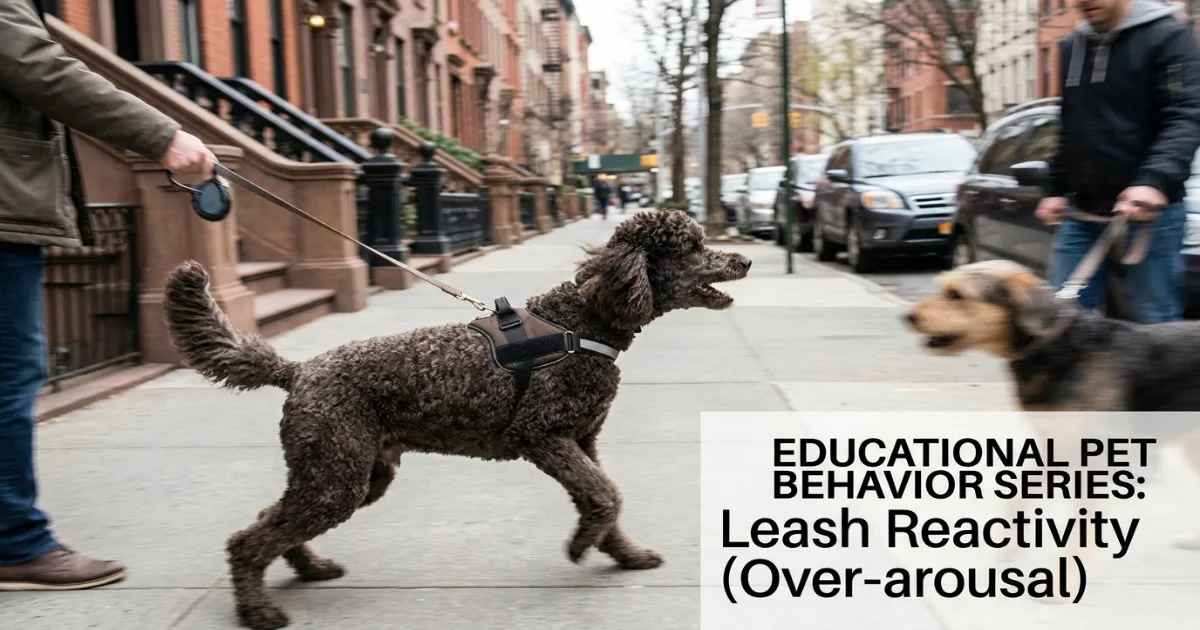
Leash reactivity is not a diagnosis. It’s a label for a cluster of outward behaviors—barking, lunging, growling, spinning, fixating—that happen when a dog is on leash and sees or hears a trigger. The trigger might be another dog, a runner, a bicycle, a child, or even a plastic bag skittering across the street. The leash prevents the dog from moving toward or away from the trigger naturally, and that physical restraint creates an emotional pressure cooker.
In poodles, this often looks more dramatic than dangerous. A poodle who barks and spins at the sight of another dog is usually saying one of two things: “I desperately want to meet that dog and this leash is stopping me” (frustration) or “That dog makes me nervous and I can’t escape” (fear). Sometimes both emotions mix together. The barking and lunging are simply the poodle’s attempt to make the situation change—and because poodles are operant learners, if the trigger eventually moves away (which it almost always does), the reactive behavior gets reinforced.

Why Poodles Are Especially Prone to Leash Reactivity
Poodle owners didn’t pick a laid-back breed. They picked a thinking, noticing, responding breed. That’s a gift in training, but it’s a vulnerability on leash. A poodle’s brain constantly scans the environment, and when something interesting or concerning appears, their reaction is swift and full-bodied. Restrict that with a leash, and the poodle’s frustration tolerance—which was never bred to be high in a dog designed to work closely and freely with people—can crash quickly.
Additionally, many poodles are socially motivated to an extreme degree. They love people and other dogs, and the restraint of a leash creates what behaviorists call “barrier frustration.” The dog learns that the presence of another dog predicts the inability to interact freely, and over time that anticipation alone can trigger a reactive outburst. A smaller subset of poodles develops fear-based reactivity, often after a negative experience or during a sensitive fear period in adolescence. In either case, the leash is the common denominator.
Leash Reactivity vs. Aggression: A Comparison That Matters
One of the most damaging misunderstandings in the dog world is the conflation of reactivity with aggression. They overlap in appearance but differ in motivation—and that difference determines the entire training approach.
| Characteristic | Leash Reactivity | True Aggression |
|---|---|---|
| Emotional root | Frustration, fear, over-arousal | Intent to harm or drive away |
| Off-leash behavior | Often social and appropriate with other dogs | May still show offensive postures, attacks |
| Body language | High, tight tail; ears forward or pinned; may play-bow after trigger leaves | Stiff, low posture; hard stare; deliberate stillness before escalation |
| Response to trigger distance | Decreases dramatically when trigger is far enough away | May remain vigilant or aggressive even at distance |
| Primary fix | Counterconditioning, impulse control, pattern games | Desensitization, careful management, possible medication |
Most poodles presented for “aggression” are actually experiencing leash reactivity. A qualified behavior professional can distinguish the two, but the information above should give you a starting framework. Reactivity that is purely frustration-based has an excellent prognosis with training.
What Buyers and New Owners Consistently Get Wrong About Poodle Leash Reactivity
If you’re researching poodles before bringing one home, you might stumble across online forums warning that poodles are “neurotic” or “reactive by nature.” Neither is accurate, but certain misunderstandings keep circulating—and they cause real harm.
Misunderstanding 1: Reactivity means the dog wasn’t socialized enough. In truth, many reactive poodles were heavily socialized—but socialization without teaching emotional regulation can backfire. A puppy who was allowed to greet every dog on leash for months may develop intense frustration when greetings stop, leading to reactivity. Quality of socialization matters far more than quantity.
Misunderstanding 2: A reactive poodle is a bad or dangerous dog. This belief leads some owners to rehome or suppress behavior with punishment. Most reactive poodles are emotionally soft underneath the display; harsh corrections can deepen the anxiety and make the behavior worse over time.
Misunderstanding 3: Fixing it means the dog must “suck it up” and learn to walk past triggers. Flooding—forcing a dog to endure triggers at close range—is the fastest way to turn frustration into fear-based reactivity. Real progress happens when the dog stays under threshold.
Misunderstanding 4: Once reactive, always reactive. Not true. Many poodles graduate from leash reactivity to calm, attentive walking when given the right protocol. The brain pathways can change; neuroscience supports this.

How Leash Reactivity Gets Misidentified in Poodles
Because poodles are expressive, their reactive displays are hard to ignore. But the same expressiveness also leads to frequent mislabeling. A poodle who spins and vocalizes at the sight of a dog might be called “aggressive” by a neighbor or “untrained” by a family member. Meanwhile, the real emotion—desperation to greet—goes completely unrecognized.
Another common misidentification happens with excitement urination or submissive posturing combined with barking. An adolescent poodle who barks and then rolls over when a dog approaches may look conflicted, but this is often social anxiety mixed with barrier frustration, not a “dominance” issue. Treating it as defiance leads owners down the wrong path.
Finally, poodle leash reactivity can be mistaken for a medical problem. A dog who suddenly becomes reactive on leash might be experiencing pain—hip discomfort, a pulled muscle, or dental pain can lower a dog’s threshold for emotional outbursts. Before assuming it’s purely behavioral, a veterinary check is wise, especially if the reactivity appears abruptly in an adult dog.
The Fix Method: A Step-by-Step Training Plan for Poodle Leash Reactivity
1. Build a Foundation of Trigger Distance Management
You cannot train a dog who is over threshold. The first week—or longer—is solely about preventing reactions. Walk at times and in places where triggers are minimal. Cross the street, duck behind a car, or turn around the moment you spot a trigger. This isn’t avoidance forever; it’s setting the stage for learning. Your poodle must experience walks without the adrenaline flood of a reaction.
2. Teach a Pattern Game: “1-2-3 Treat”
Pattern games create predictable sequences that soothe anxious brains. At home first, say “one-two-three” in a calm voice and deliver a high-value treat on “three.” Practice until your poodle snaps their attention to you when they hear “one.” Then take it outside in low-distraction environments. Eventually, you’ll use this game the moment a trigger appears at a distance—the pattern interrupts the fixation before the reaction can start.
3. Install a “Look at That” (LAT) Cue
LAT, developed by Leslie McDevitt, teaches the dog to glance at the trigger and then immediately reorient to you for a reward. Mark the instant your poodle looks at the trigger with a clicker or verbal marker like “yes,” then deliver a treat by your knee. Over time, the trigger becomes a cue to check in with you rather than an invitation to erupt. Start with stationary triggers at a distance, then gradually decrease distance.
4. Reinforce the “Engage-Disengage” Sequence
Similar to LAT but with a built-in disengage step: your poodle looks at the trigger (engage), you mark, and then they turn away from the trigger on their own to take the treat (disengage). This sequence teaches voluntary disengagement, which is more powerful than being cued every time. Practice with neutral objects first, then work up to easier triggers.
5. Decompression Walks on a Long Line
Several times a week, give your poodle freedom to move at their own pace on a 15–30-foot long line in a quiet, open area. These walks allow natural sniffing, trotting, and environmental processing without the constant pressure of a short leash. Decompression walks lower baseline stress and reduce the cumulative tension that fuels reactivity on neighborhood walks.
Pro Tips for Fixing Poodle Leash Reactivity
- Always use a front-clip harness, not a back-clip harness or flat collar, during training. It reduces pulling without causing discomfort and gives you gentle steering control.
- Keep high-value treats (freeze-dried liver, cheese, real chicken) reserved solely for reactivity training—these must be better than anything else in the environment.
- Track progress with a simple journal: date, trigger, distance, and reaction intensity (1–10). Seeing improvements written down prevents discouragement.
- If your poodle reacts, don’t scold. Create distance quickly, let the adrenaline subside for 5–10 minutes, and try a pattern game to reset before continuing.
- Avoid on-leash greetings with unknown dogs entirely during the fix phase. Every on-leash greeting risks reinforcing the idea that pulling and barking lead to access.
- Consider working with a certified fear-free or positive reinforcement trainer if you feel stuck—especially one experienced with poodles.

Practical Owner Insight: Tools, Timing, and Realistic Timelines
Leash reactivity doesn’t resolve in a weekend seminar. Expect a timeline of weeks to months, not days. Most owners see a noticeable reduction in outbursts within 4–8 weeks of consistent, daily practice. Setbacks happen—adolescent fear periods, a surprise off-leash dog, or illness can temporarily regress progress. Regression isn’t failure; it’s information.
Equipment matters more than many admit. A well-fitted front-clip harness (like the Balance Harness or Perfect Fit) gives you control without choking. Head halters can be useful for strong pullers but require careful conditioning. Avoid retractable leashes entirely—they teach inconsistent tension and make trigger management impossible.
If your poodle’s reactivity is fear-based and severe, a veterinary behaviorist can discuss short-term anti-anxiety medication. Medication doesn’t sedate a dog into oblivion; it lowers the baseline anxiety enough that training can actually take hold. This is a legitimate and often life-changing option.

When Leash Reactivity Might Indicate Something More
While most poodle leash reactivity is behavioral, there are times when an underlying medical, neurological, or pain condition is the true driver. If your poodle’s reactivity appears suddenly after a period of normal behavior, if it’s paired with sensitivity to touch on the neck, back, or hips, or if it happens unpredictably without clear triggers, schedule a veterinary exam. Conditions like hip dysplasia, spinal discomfort, thyroid imbalances, or even chronic ear infections can lower the threshold for reactive outbursts.
Additionally, if your poodle’s reactivity is accompanied by signs of generalized anxiety—panting, pacing, inability to settle at home, hypervigilance—a consultation with a veterinary behaviorist can help tease apart learned behavior from an anxiety disorder that needs multimodal treatment.
Frequently Asked Questions About Poodle Leash Reactivity
Can poodle leash reactivity be cured completely?
Many poodles can reach a point where they notice triggers without reacting—what trainers call “sub-threshold neutrality.” For some, this becomes their new normal. Others may always need a bit of management in high-density trigger environments. Complete resolution is possible, especially when reactivity is frustration-based and addressed early, but even partial improvement makes walks enjoyable again.
Is a head halter a good idea for a leash-reactive poodle?
Head halters can provide effective steering control, but they must be conditioned slowly so the poodle doesn’t find the facial pressure aversive. Some poodles become more reactive if the halter is introduced abruptly or used to force head turns. If you choose a head halter, spend at least a week pairing it with treats before using it on walks.
Will neutering or spaying fix leash reactivity?
Neutering is not a reliable fix for leash reactivity. While it may reduce some hormone-driven behaviors, frustration and fear-based reactions are learned and emotional, not hormonal. In some cases, early neutering has been associated with increased fearfulness, so this is not a decision to make solely for behavior modification. Consult a veterinary behaviorist for guidance.
Can a reactive poodle ever go to dog parks or off-leash areas?
It depends on the individual dog. A poodle who is solely leash-frustrated and plays well with other dogs off-leash may do fine in off-leash settings. However, off-leash encounters with unknown dogs always carry risk. Ensure your poodle has a solid recall and that you can read canine body language fluently before considering off-leash freedom. Never use off-leash play as a primary “cure” for leash reactivity.
How do I stop my poodle from reacting to the doorbell or leash picking sounds?
This is a form of trigger stacking. Desensitize the sounds separately: record the doorbell or leash jingle, play it at a low volume while scattering treats, and gradually increase the volume over days. Pair the actual leash pick-up with a calm pattern game. Over time, the sounds lose their predictive power for excitement or frustration.
Can poodle leash reactivity be a sign of pain?
Absolutely. Sudden onset of reactivity, especially in an adult poodle with no previous history, warrants a veterinary exam. Pain from hip dysplasia, neck strain, dental issues, or even gastrointestinal discomfort can lower a dog’s tolerance for environmental stressors and manifest as reactivity. Ruling out pain should be an early step in any reactivity case.
Why does my poodle react to some dogs but not others?
Dogs are discriminative. A poodle might react to large, bouncy dogs but not small, calm ones; to intact males but not females; to dogs that stare versus those that look away. The common denominator is usually the specific energy, size, or body language that triggers the strongest emotional response. Keep notes to identify patterns—this helps you predict triggers and set up training scenarios.
What should I do if an off-leash dog approaches my reactive poodle?
Your priority is safety. Move your poodle behind you, toss high-value treats on the ground away from the approaching dog to buy time, and calmly but firmly ask the other owner to call their dog. Do not pick up your poodle unless it’s a toy or miniature and absolutely necessary—picking up can escalate prey drive in the approaching dog. Practice an emergency scatter cue (“find it!”) so it’s automatic in these situations.
Final Summary: A Calmer Walk Is Absolutely Possible
Poodle leash reactivity is a loaded topic—frustrating for owners, emotionally taxing for dogs, and often misunderstood by everyone watching from the sidewalk. But beneath the barking and lunging is a poodle who needs a different way to handle big feelings while restrained. That way exists. It’s built on distance management, pattern predictability, counterconditioning, and a deep respect for what your poodle is experiencing.
Start small. Prioritize calm over exposure. Celebrate tiny wins—a glance at a trigger followed by a voluntary check-in is a monumental neurological shift. With consistent, compassionate training, the same poodle who once threw a fit at the sight of a squirrel can learn to walk past with a soft eye and a loose leash. You didn’t get a poodle for a boring, quiet life; you got one for the connection. Leash reactivity is just a chapter—not the whole story.