Poodle Limping Causes: Why Your Poodle Limps & When To See A Vet
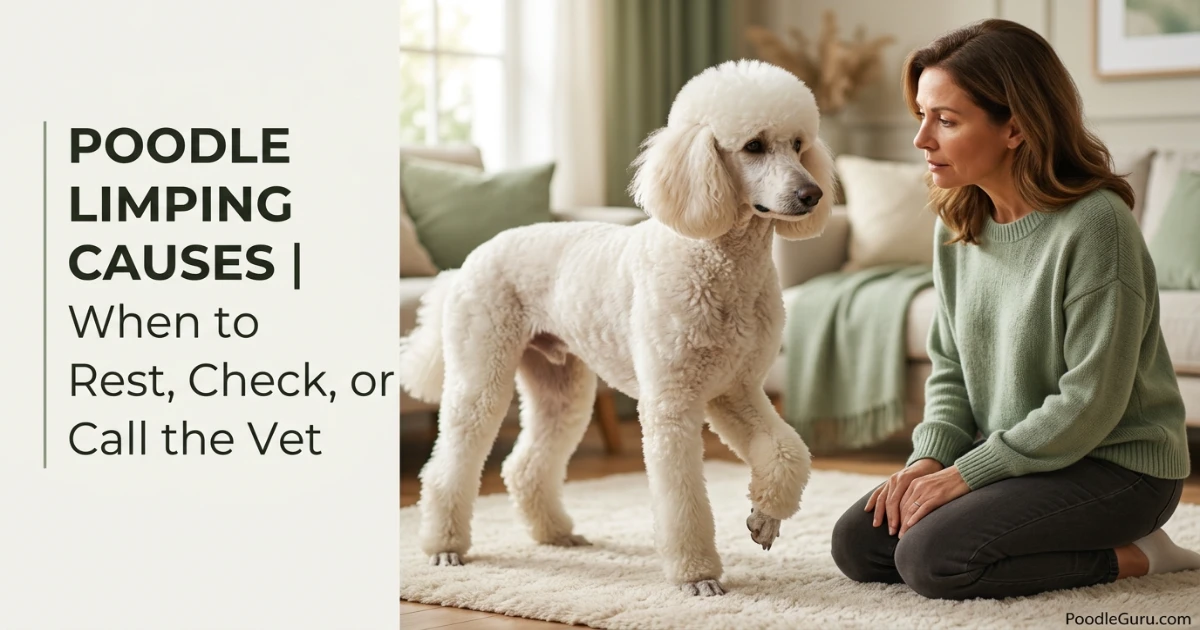
You watch your poodle take a step and immediately notice that something’s off: a slight hitch, a held-up paw, a head bob, or a visible wince. Poodle limping causes range from a simple stone between paw pads to joint disease, ligament injury, infection, or trauma that needs prompt veterinary care. This guide helps you observe the signs safely and decide when rest is reasonable and when a vet call should not wait.
Quick Answer
A poodle limping can result from many causes—soft tissue strain, patellar luxation, hip dysplasia, ligament injury, paw pad wounds, tick-borne illness, or trauma. If the limp is mild, your poodle is still eating normally, and there is no swelling, bleeding, fever, or obvious pain, strict leash-rest for 24 hours may be reasonable. But a non-weight-bearing limp, worsening lameness, swelling, a dangling limb, or pain at rest means you should call your veterinarian right away.
Not All Limping Is Pain
Poodles may limp from a tingling sensation or a foreign object, not just pain. Check paws first.
Size Dictates Risk
Toy poodles are prone to kneecap issues; Standard poodles are more likely to have hip or ligament problems.
Rest Is a Valid First Step
For a mild limp with no red flags, 24 hours of strict leash-rest can help you see whether it improves.
Why Do Poodles Limp? Understanding the Signal
Lameness is any abnormal gait caused by discomfort, weakness, or structural change in a limb. For poodle owners, this means a dog who shifts weight off a leg, takes shorter strides, or avoids putting a paw down entirely. The most important thing to understand is that limping is never normal; it’s always a message.
Poodles are athletic, intelligent dogs, and they’re often stoic—meaning some dogs keep moving even when they are uncomfortable. Because poodles stand high on their legs, any issue in the paw, ankle, knee, or hip becomes exaggerated in their elegant stride.
According to the AKC poodle breed standard, all three varieties should move with a light, springy gait. If you see stiffness or a head bob while walking, something is interfering with that natural motion.
Common Poodle Limping Causes
We’ve organized the most frequent reasons a poodle limps into a scannable table, with each cause mapped to the typical poodle size affected and the urgency level. This isn’t a diagnosis tool—it’s a way to give your observations structure before you call the vet.
| Cause | Typical Poodle Size | Classic Signs | Urgency |
|---|---|---|---|
| Patellar Luxation | Toy & Miniature | Skip-hop gait, suddenly holding leg up, then using it again | Moderate – vet exam needed |
| Hip Dysplasia | Standard | Bunny-hopping run, difficulty rising, reluctance to jump | High – progressive joint damage |
| Cruciate Ligament Tear | Standard (most), Miniature | Sudden non-weight-bearing lameness, swollen knee | Urgent – vet exam needed; surgery or medical management may be recommended |
| Soft Tissue Sprain | All sizes | Mild limp after rough play or a misstep; improves with rest | Low – monitor at home |
| Paw Pad Injury | All sizes | Licking at paw, visible cut or thorn, bleeding | Low to Moderate – clean and check |
| Lyme Disease | All sizes, especially tick-exposed | Shifting leg lameness, fever, lethargy | Moderate – antibiotics needed |
| Bone Tumor (Osteosarcoma) | Standard (most common) | Persistent, worsening limp; swelling on limb; pain at rest | Urgent – prompt vet visit |
Poodle limping causes rarely exist in isolation. A dog with early hip dysplasia may also strain a muscle compensating for the pain. Always consider the big picture.
Front-Leg vs Back-Leg Limping in Poodles
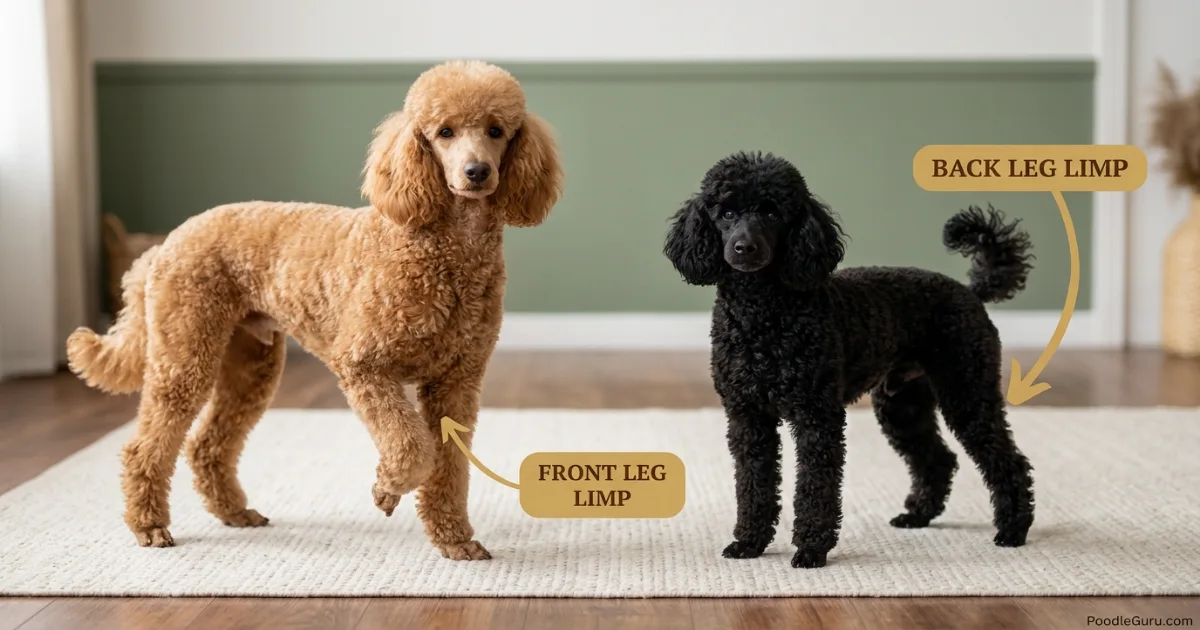
Before you assume the cause, try to identify whether the limp is coming from the front leg or the back leg. Front-leg limping often shows as a head bob: the head rises when the sore leg touches the ground and drops when the sound leg lands. Back-leg limping may look like a hip hike, shorter stride, bunny-hop run, or a rear paw that touches the floor only lightly.
Front-Leg Limping
Common sources include paw pad cuts, torn nails, shoulder strain, elbow discomfort, wrist sprains, or a foreign object stuck between toes. Check the paw and nails first.
Back-Leg Limping
Common sources include patellar luxation, hip dysplasia, cruciate ligament injury, muscle strain, or lower-back pain. Watch for skipping, bunny-hopping, stiffness after rest, or trouble rising.
Shifting Limp
If the limp moves from one leg to another, mention tick exposure, fever, tiredness, or appetite changes to your vet. Shifting lameness can point to inflammation or infection.
Size Matters: Limping by Poodle Size
Poodles aren’t just one dog in three sizes. Each variety carries its own orthopedic tendencies. At PoodleGuru, we evaluate limping by first understanding which joint issues the dog’s size predisposes it to.
Toy Poodles (4–6 lbs)
- High risk for patellar luxation (kneecap slips out of groove)
- Legg-Calvé-Perthes disease (hip joint degeneration) possible
- Fragile bones—even a small jump off a couch can cause a fracture
- Check for luxating patella if you see intermittent skipping
Miniature Poodles (10–15 lbs)
- Patellar luxation still common, though less frequent than in Toys
- May develop cruciate ligament injuries, especially if overweight
- Hip dysplasia occurs but less often than in Standards
Standard Poodles (40–70 lbs)
- Hip dysplasia and elbow dysplasia are primary concerns
- Cruciate ligament tears are common athletic injuries
- Osteosarcoma (bone cancer) appears more frequently in large breeds
- Bloat—though not orthopedic—can mimic a hunched, painful stance that looks like limping
Knowing your poodle’s size-related risks helps you and your vet move faster toward the right diagnosis.
When Limping Is an Emergency: Red-Flag Checklist
Not every limp requires an emergency run, but these signs demand immediate veterinary attention. If you check any of these boxes, don’t wait until tomorrow:
- Complete non-weight-bearing lameness—the leg dangles or your poodle won’t put any weight on it at all.
- Visible fracture or a limb that hangs at an abnormal angle.
- Severe swelling or a joint that feels hot to the touch.
- Limb dragging or knuckling (paw flipped under), which could indicate nerve damage.
- Screaming or whimpering when the area is touched, or panting and trembling at rest.
- Limping paired with lethargy, vomiting, or fever—possible infection or systemic illness.
- Sudden hind-leg weakness, dragging, knuckling, or collapse—possible nerve, spinal, or severe orthopedic injury that needs emergency care.
Even if the limp seems mild, if it’s getting worse day by day instead of improving, that’s a clear call to schedule an appointment.
The PoodleGuru Limping Assessment Framework
This step-by-step method helps you gather meaningful information for your vet while avoiding actions that could make things worse. Use it the moment you notice your poodle limping.
Visual Inspection of the Paw
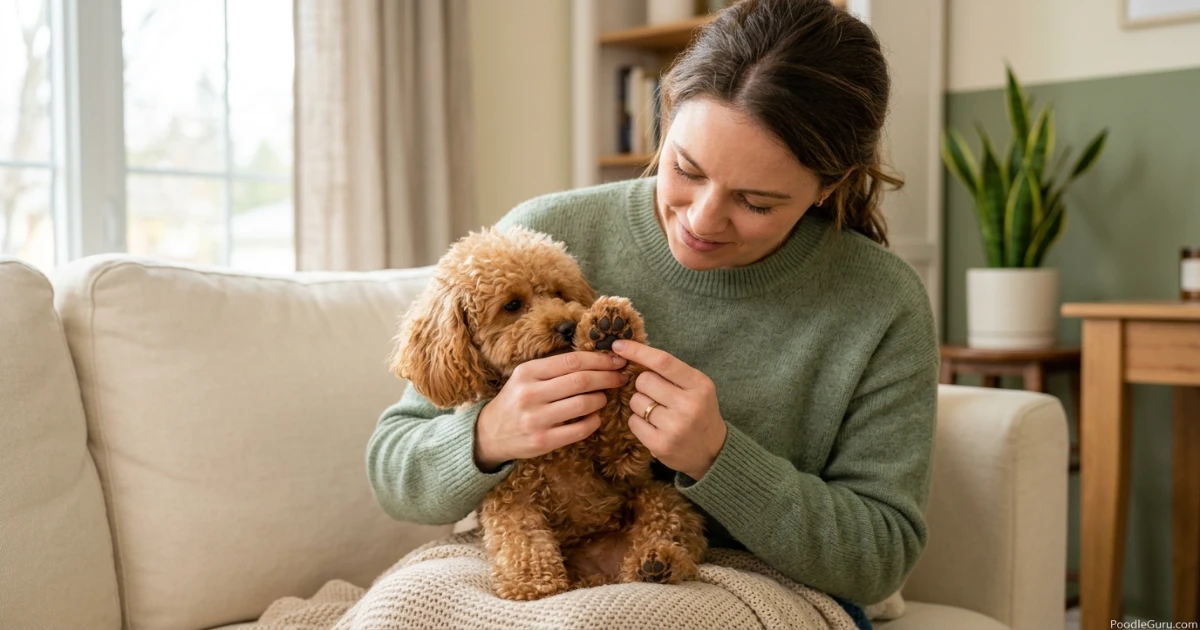
Gently examine the paw pads, between toes, and around the nails. Look for foxtails, cuts, swellings, or torn nails. Remove any visible debris with clean tweezers. If it’s deeply embedded, leave it for the vet.
Gently Palpate the Leg
Starting at the toes and moving upward, softly run your fingers along the limb, feeling for heat, swelling, or a pain reaction. Don’t squeeze—just press lightly. Compare the joints to the other leg for symmetry.
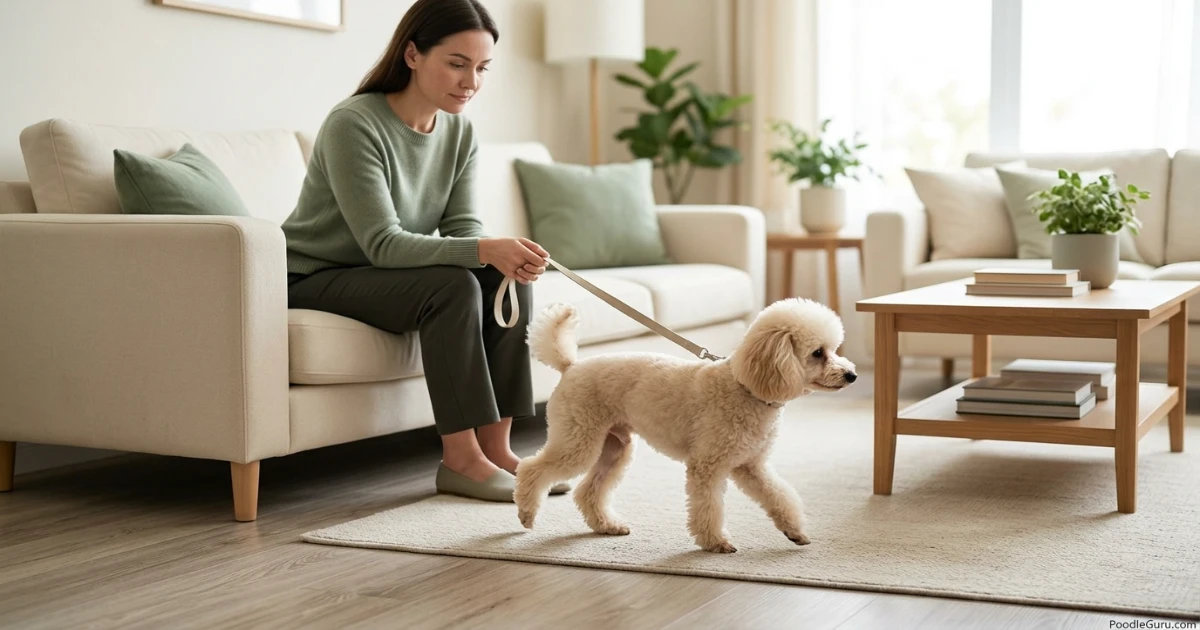
Observe the Gait on a Short Leash
Walk your poodle on a flat surface. Watch for a head bob (front leg limp) or a hip hike (rear leg limp). Video it on your phone—slow-motion footage often reveals subtle lameness you’ll miss with the naked eye.
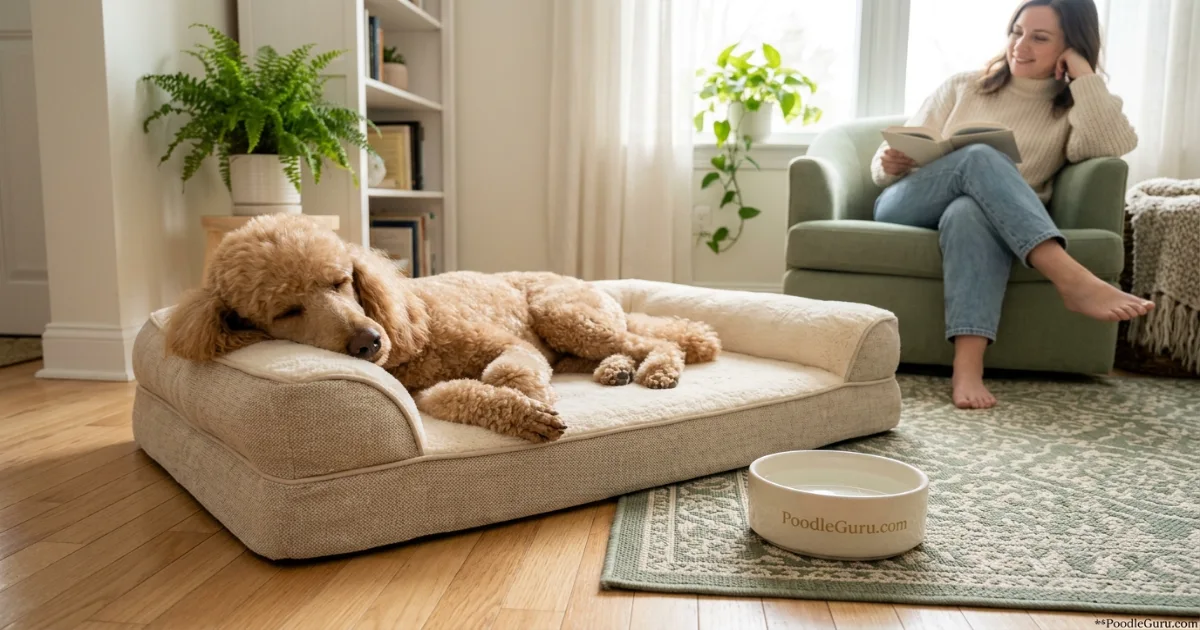
Apply Rest and Time
For mild limps without red-flag symptoms, restrict activity for 24 hours: no jumping, no stairs, short leash walks only. If the limp disappears, it was likely a soft tissue strain. If it persists or worsens, call your vet with your observations ready.
This framework isn’t a substitute for veterinary diagnostics like X-rays or joint taps. It’s a structured way to decide when those tools are needed.
Safe Home Care and Mistakes to Avoid
When your poodle is limping, your first instinct might be to soothe and help. Some approaches are genuinely useful for mild, improving soreness; others can turn a small problem into a serious one.
What You Can Do Safely
- Ice the area (wrapped in a thin cloth, never directly) for 10 minutes at a time if you see mild swelling, provided your poodle tolerates it and there is no open wound.
- Provide a non-slip surface. Yoga mats or rugs on hardwood floors prevent further strain.
- Use a supportive harness and keep bathroom trips short, slow, and on leash.
- Keep your poodle at a healthy weight. Extra weight increases stress on small joints, knees, hips, and ligaments.
What to Avoid
- Never give human pain medication. Ibuprofen, naproxen, and acetaminophen can be dangerous or toxic to dogs. Only use pain relief prescribed or approved by your veterinarian.
- Don’t force exercise. A poodle who doesn’t want to walk is protecting an injury. Rest is medicine.
- Don’t apply heat to a fresh injury—it increases swelling. Use cold first; heat may be recommended later for chronic conditions.
- Avoid “wait and see” if the limp is non-weight-bearing. A fully lifted leg rarely self-resolves and can lead to muscle wasting quickly.
Practical Owner Insight
The VCA guide to lameness in dogs emphasizes that a thorough history—when the limp started, which leg, whether it comes and goes—is more valuable to your veterinarian than you might think. Write it down.
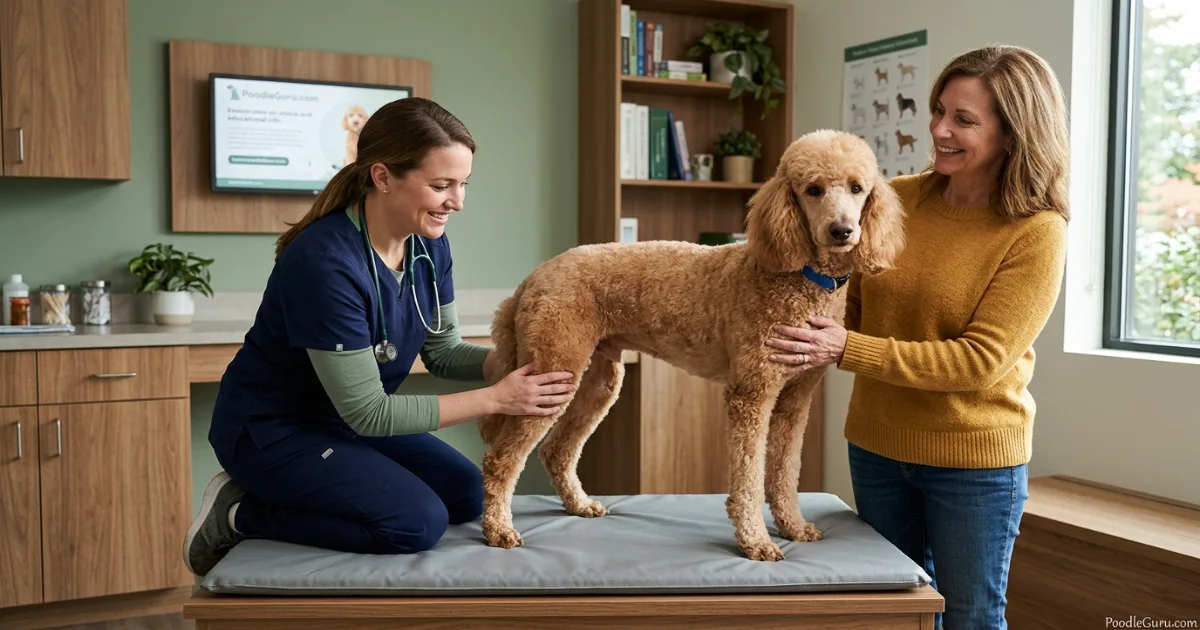
What Your Vet May Check During a Limping Exam
If the limp continues, worsens, or returns repeatedly, a veterinary exam is the safest next step. Your vet may start by watching your poodle walk and trot, then compare both sides of the body for swelling, heat, muscle loss, range of motion, and pain response.
The exam may include a paw and nail check, knee stability tests, hip extension, spine palpation, temperature check, tick-history questions, and X-rays when a fracture, hip dysplasia, arthritis, or ligament injury is suspected. Treatment may involve rest, anti-inflammatory medication made for dogs, weight management, physical therapy, joint support, or surgery depending on the diagnosis.
Helpful Tip Before the Appointment
Record a 20–30 second video of your poodle walking away from you, toward you, and from the side. Limping can temporarily disappear at the clinic because of adrenaline, so a clear video often helps your vet see the real pattern.
Frequently Asked Questions About Poodle Limping
Why is my poodle limping on and off?
Intermittent limping, especially in Toy and Miniature Poodles, often points to a luxating patella—the kneecap slips out and then pops back. If the limp comes and goes without pain, it’s still worth a vet evaluation because the joint wears down over time.
Can a poodle limp from a tick bite?
Yes. Lyme disease, spread by deer ticks, can cause shifting-leg lameness—a poodle may limp on one leg one day and another the next. If you’ve found ticks or live in a high-risk area, mention it to your vet; a blood test can confirm.
My poodle is limping but doesn’t seem to be in pain. Should I still worry?
Yes, because poodles often mask pain. A limp that appears painless could still be a mechanical issue like a partial ligament tear or early hip dysplasia. Any limp that lasts more than 48 hours warrants a vet check.
How can I tell if my poodle’s limp is from a paw injury or a joint problem?
Paw injuries usually cause licking and a visible wound. Joint issues often create stiffness after rest that improves with movement. If your poodle limps more after lying down, think joint. If they’re fixated on licking one spot, check the paw.
Is limping a sign of hip dysplasia in Standard Poodles?
It can be. Hip dysplasia often shows as a bunny-hopping gait when running, difficulty rising, and reluctance to jump. It may appear as early as 5–6 months. X-rays are the only way to confirm, so early screening is wise.
Should I wrap my poodle’s leg if they are limping?
Don’t wrap a leg without veterinary instruction. An improperly applied bandage can cut off circulation or cause a pressure sore. If you need to protect a paw pad, a clean sock or a properly fitted dog bootie is safer while you travel to the vet.
Key Takeaways: Poodle Limping Causes
- Poodle limping causes range from paw pad foreign bodies and soft tissue sprains to serious orthopedic conditions like patellar luxation, hip dysplasia, and cruciate ligament tears.
- A Toy or Miniature Poodle that skips or hops intermittently is often showing a luxating patella, while a Standard Poodle with hind-end stiffness and a bunny-hopping gait may have hip dysplasia.
- The PoodleGuru Limping Assessment Framework—inspect the paw, palpate the leg, observe the gait, and apply rest—gives owners a safe, structured way to gather information before calling the vet.
- Non-weight-bearing lameness, severe swelling, or a dangling limb are emergencies that require immediate veterinary care—don’t wait 24 hours.
- Home care like ice, rest, and a non-slip environment can help mild injuries heal, but never give human pain medications and never wrap a leg without vet approval.
When in doubt, trust your instincts. You know your poodle’s walk better than anyone.