Poodle Potty Training: The Mistakes Even Smart Owners Make (And Fast Fixes That Work)
Quick Answer: Poodle potty training fails most often not because the dog is stubborn, but because the owner misunderstands the Poodle’s sensitivity and intelligence. Common mistakes include punishing accidents, inconsistent schedules, over-reliance on pee pads, and expecting a genius puppy to “get it” in days. The fix always comes back to calm consistency, high-value rewards, and accepting that a Poodle’s emotional world is as important as the lesson itself.
Poodles might be one of the most intelligent breeds in the world, but that does not mean they arrive knowing where to pee. Poodle potty training trips up a surprising number of devoted owners — not because the dog is difficult, but because traditional “discipline” backfires spectacularly on a breed this perceptive. A Poodle reads your frustration in milliseconds. If you use the wrong tools at the wrong time, you do not just slow housebreaking; you can damage the trust that makes this breed so extraordinary to live with.
If you are reading this with a half-cleaned puddle somewhere behind you, take a breath. Almost every single potty training mistake is fixable. The goal here is not to give you a generic “take the puppy out every two hours” list. You can find that anywhere. We are going to talk about the nuanced, Poodle-specific missteps that set people back weeks or months, and how to reset the process with confidence.
Why Poodle Potty Training Challenges Even Experienced Owners
There is a quiet curse that comes with owning a highly intelligent dog: we assume speed. When a Poodle learns a trick in three repetitions, owners unconsciously apply that expectation to bladder control. But physical development does not speed up alongside cognitive gifts. A twelve-week-old Toy Poodle has a bladder the size of a walnut and zero reason to care about your clean floors until you teach her why it matters — gently.
The other layer is emotional. Poodles are sensitive to tone and tension. A loud, exasperated sigh after you discover an accident can make a Poodle puppy feel unsafe. That does not teach “do not potty inside”; it teaches “human is unpredictable and scary when there is a mess.” The puppy may start hiding to pee — behind the sofa, in the guest room — and you lose the chance to catch and redirect.
The 7 Most Common Poodle Potty Training Mistakes (And What Actually Works)
Mistake 1: Punishing After the Fact
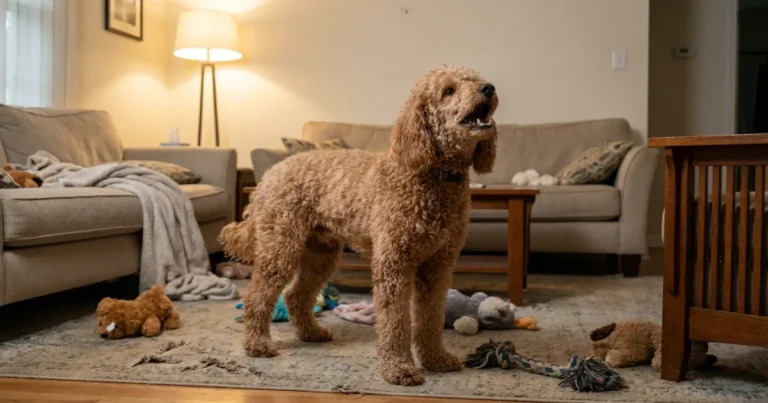
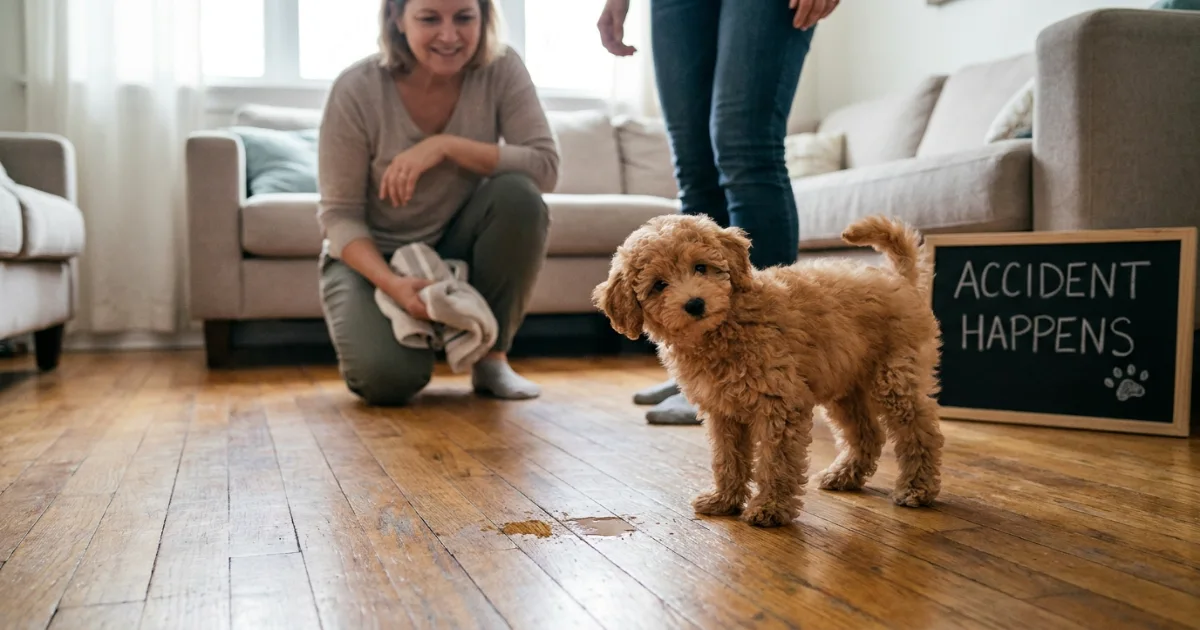
You walk into the room, see the wet spot, and the Poodle is already across the house with a toy. If you drag her back to the scene and scold her, she does not connect your anger to the act of peeing ten minutes ago. She connects it to you arriving and the spot being there. Fix: Clean it up without a word. Increase supervision so accidents are caught during the act, then interrupt gently with a cheerful “Outside!” and immediately reward the finish outdoors.
Mistake 2: An Unpredictable Routine
Poodles thrive on pattern. If potty outings happen at 7 a.m. one day, 9 a.m. the next, and sometimes after a long phone call, the puppy never learns a bodily rhythm. Fix: Set alarm-based reminders. For the first month, a consistent schedule — after waking, after eating, after play, before crating — builds the internal clock. Yes, it is boring. Yes, it works.
Mistake 3: Overusing Indoor Pee Pads
Pads can be a lifesaver for high-rise dwellers or tiny Toy Poodle bladders, but they create a confusing rule: sometimes it is okay to go indoors on that square, but not on the rug that looks similar. Many Poodles generalize poorly here. Fix: Use pads only as a temporary bridge. Move the pad incrementally closer to the exit door, then outside, then eliminate it. If your goal is fully outdoor training, transition off pads by week 16.
Mistake 4: Too Much Freedom, Too Soon
If a four-month-old Poodle has unsupervised access to the entire living room, accidents will happen. Poodles are smart enough to roam and find private corners. Fix: Use gates, a long lead indoors, or close doors to limit the puppy to one room where you can see her. Freedom expands as the number of accident-free weeks grows.
Mistake 5: Rushing Out of the Crate
A crate that is too large, or giving up on it because the puppy cried, robs you of the most powerful potty training tool. Poodles generally do not like to soil their sleeping area. Fix: Make the crate cozy and just big enough to stand, turn, and lie down. Use it for short, positive periods. Take the puppy outside immediately upon release. That moment is a guaranteed success opportunity.
Mistake 6: Expecting Adult Control Before Physical Readiness
This matters enormously for the smaller Poodle varieties. A Toy Poodle under six months literally cannot hold it all day. Expecting her to is not training — it is setting her up to fail. Fix: Hire a midday visitor if you work long hours, or offer a properly confined area with an approved pad surface. Lower your timeline expectations and trust biology.
Mistake 7: Skipping the “Reward Outdoors” Moment
You take the puppy out, she pees, you bring her in without a word. That is a missed paycheck. Fix: Carry amazing treats on every potty trip. The instant she finishes, celebrate like she just won Westminster. A Poodle who feels praised will repeat the act. The treat must be delivered within one second of completion, or the connection weakens.
| The Mistake | Why It Backfires With Poodles | Swift Fix |
|---|---|---|
| Punishing past accidents | Creates anxiety; puppy hides future pees | Neutral cleanup, more supervision, interrupt mid-act gently |
| Inconsistent schedule | Body clock never forms; cognitive confusion | Alarms and a 30-day written log |
| Pads forever | Blurs “inside OK” vs. “outside only” | Transition outdoors by 4–5 months |
| Full house access early | Smart Poodle finds hidden corners | Single-room supervision with gates |
| Large, empty crate | Eliminates den instinct to hold | Proper sizing and crate covers |
| Demanding all-day holds | Physically impossible for toy puppies | Midday break or safe indoor spot |
| No reward outside | No positive marker; “outside” is meaningless | Party with treats within one second |
When a Previously Trained Poodle Regresses
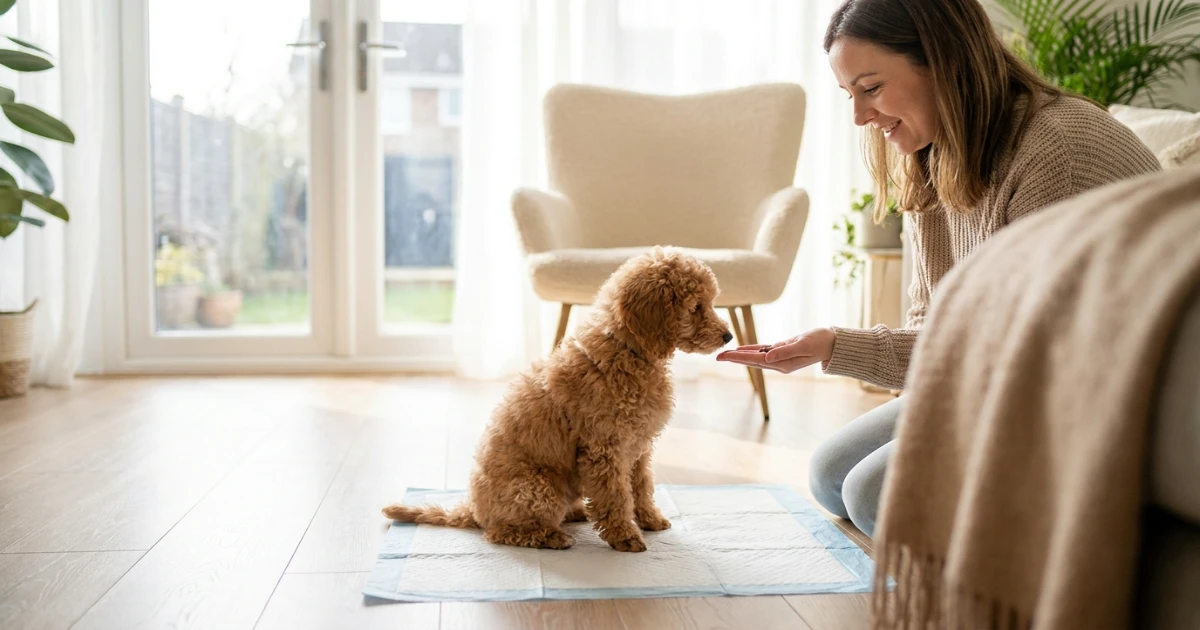
Regression can feel more demoralizing than the initial training. You did everything “right” and now your six-month-old or even two-year-old Poodle is suddenly leaving puddles. Before you reboot any training heavy-handedly, consider the Poodle-specific triggers.
A urinary tract infection is the most common medical culprit, especially in female Poodles. Stress or schedule changes — a new baby, a house move, a departing family member — can cause temporary regression because Poodles absorb household emotions deeply. And in some cases, adolescence brings a brief testing phase where the dog who knew the rules suddenly “forgets” them to see if the boundary still holds. The fix is a calm, no-drama return to the puppy schedule for seven to ten days, as if restarting from scratch, coupled with a vet check.
What Buyers and First-Time Owners Usually Get Wrong
Here is where we need blunt honesty. Many people choose a Poodle because of the “hypoallergenic” coat and the stellar intelligence ranking. They then convince themselves that potty training will be a two-week endeavor. When it is not, something curdles — sometimes resentment toward the dog, but more often self-doubt. “If my Poodle is so smart, why is this so hard? Am I failing?”
You are not failing. The intelligence is not a shortcut through biology. Puppies have immature sphincters. Period. What that intelligence does mean is that a Poodle remembers what worked — or what scared her — far longer than other breeds. That same brain that will later retrieve your slippers can also hold a vivid memory of you shouting over a puddle for months. The mistake buyers make is wielding a sledgehammer of correction on a mind that only needs a consistent nudge.
Another buyer mistake: believing that breeders send home puppies that are already “housebroken.” A responsible breeder will have started introducing a potty area, but at eight to ten weeks, no puppy is reliable. Expect to be the one who finishes the story.
Indoor Pads vs. Outdoor-Only: A Real-World Comparison for Poodle Homes
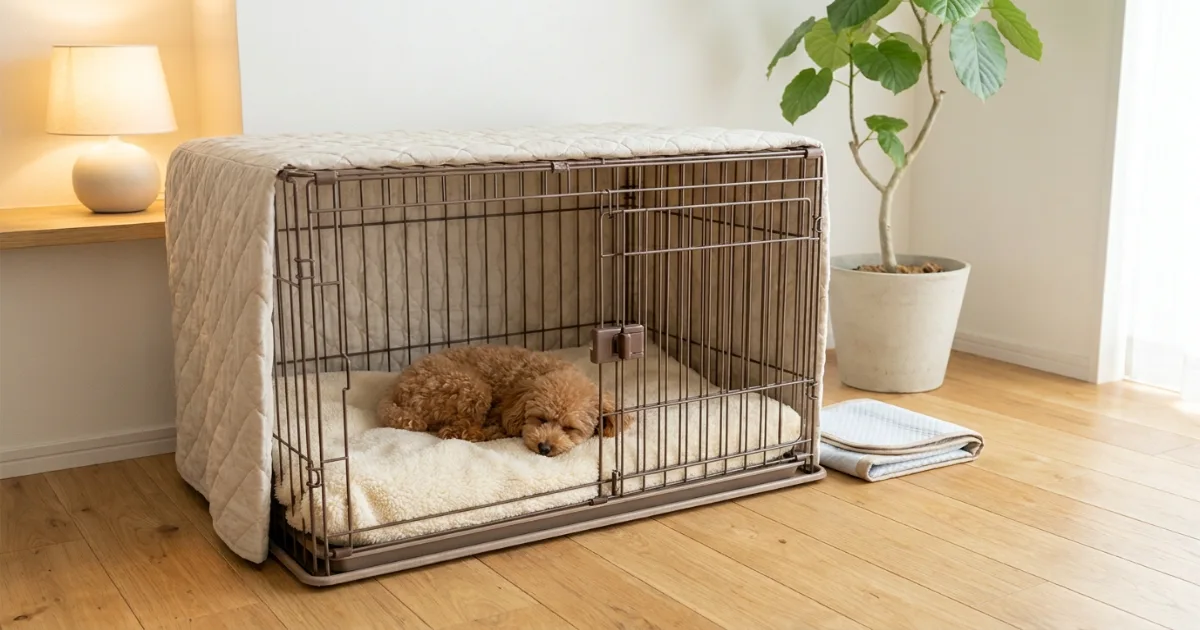
No single solution fits every household, but the choice must be made intentionally. Many Poodle owners in apartments with Toy or Miniature dogs choose a pad or artificial grass system permanently. That can absolutely work, but it requires a distinct surface texture that never resembles your bath mat.
| Factor | Indoor Pad System | Outdoor-Only |
|---|---|---|
| Best for | High-rise, no private yard, tiny bladders | House with immediate outdoor access |
| Poodle-specific risk | Confusion between pad and similar soft surfaces (rugs, towels) | Reluctance to go out in rain or cold; Poodles can be drama queens about wet grass |
| Transition complexity | Harder to phase out later if target is outdoors | None; consistent expectation from day one |
| Odor and maintenance | Daily pad changes required; odor noticeable | Yard cleaning, mud management on curly paws |
| Long-term feasibility | Viable forever for toy dogs if managed | Standard for most homes |
Pro Tips That Actually Move the Needle
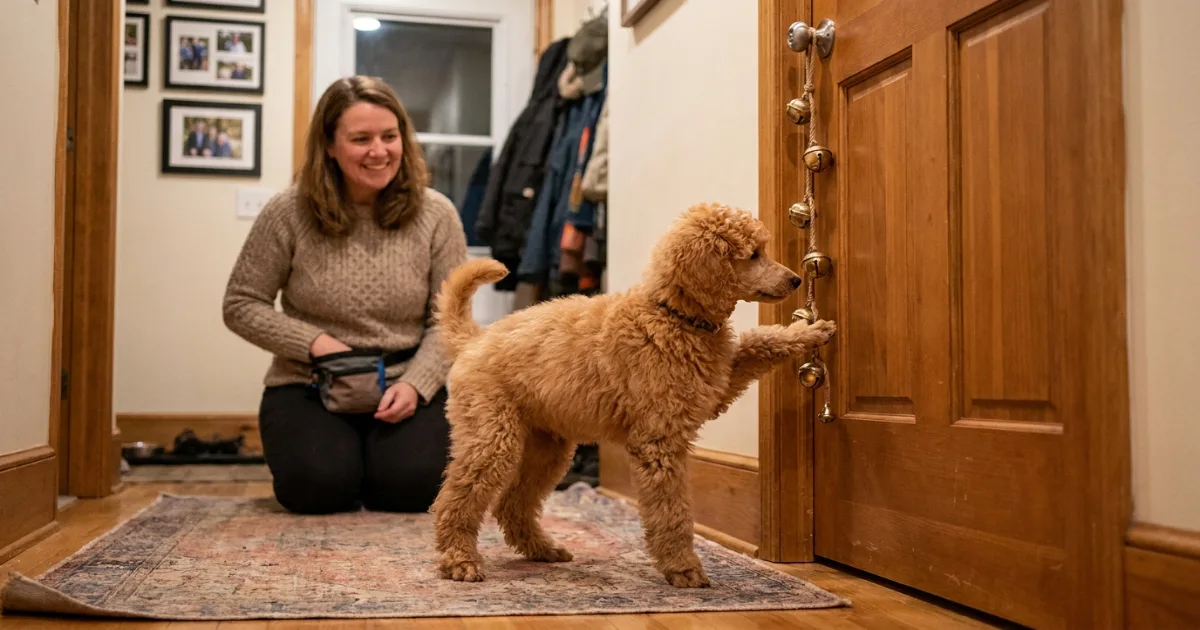
- Hang bells on the door from day one. Touch them each time you go out. Within a few weeks, most Poodles will nudge them to signal. Do not ignore the first bell — even if you think it is a false alarm.
- Leash your Poodle for potty breaks even in a fenced yard. It keeps her on task instead of chasing leaves, and it positions you perfectly to reward the moment.
- Use a specific phrase (“Go potty” or “Do your business”) every time, and only when you see the pre-potty sniffing. Over time, the cue becomes a trigger.
- Keep a log for the first thirty days. It reveals patterns you would otherwise miss — like a consistent accident thirty minutes after dinner. Adjust the schedule based on data, not frustration.
- Never punish a submissive urination event, which is common in young Poodles. That small squat when you reach down is not a training failure; it is an appeasement gesture. Calm, low greetings fix it.
FAQs About Poodle Potty Training
- How long does it take to fully potty train a Toy Poodle?
- Consistently accident-free by 6 to 9 months is typical for Toy Poodles. Their tiny bladders extend the timeline compared to Standards. Look for four consecutive weeks without an accident before declaring victory. Regression during adolescence is normal; treat it like a quick refresh.
- Should I use puppy pads for my Miniature Poodle?
- Puppy pads can be useful temporarily if outdoor access is delayed, but they often cause surface confusion in Poodles. If you must use them, select a texture unlike any carpet or rug, and have a clear transition plan to outdoor elimination by 16–20 weeks.
- My Poodle pees every time someone greets her. How do I stop it?
- This is likely submissive or excitement urination, not a housebreaking problem. Do not scold. Ignore the accident, keep greetings low-key and quiet, crouch sideways rather than bending over the dog, and reward her when she stays dry. It usually decreases with confidence and age.
- Can an adult rescue Poodle be potty trained if they’ve lived in a kennel?
- Yes. Adult Poodles can learn new potty habits with a crate and frequent outdoor breaks. They may not have a strong den instinct if they were forced to eliminate in their sleeping area, so expect to use tether supervision and enzymatic cleaners more intensively for the first month.
- What time should the last potty break be for a Poodle puppy?
- Take water away one hour before bedtime, and offer a final potty trip just before you turn in — usually 10:30 or 11 p.m. For young puppies under 16 weeks, a 3 a.m. or 4 a.m. potty call is often unavoidable. They outgrow it on a predictable curve as bladder capacity increases.
- Why does my Poodle only have accidents when I’m not watching?
- That usually indicates the puppy has learned that eliminating in front of you leads to a negative reaction. She hides to avoid your reaction. Reset with zero punishment, constant calm supervision, and reward party when she goes in the correct place.
- Is outdoor potty training impossible during harsh winter weather?
- No, but Poodles — especially smaller ones — may rebel against cold and snow. Create a covered potty area right outside the door, use a coat, and keep trips extremely short. Return inside immediately after elimination to prevent bad weather from becoming a training disruption.
Summary: Patience Managed, Poodle Understood
Poodle potty training is not a battle of wills. It is a dance of timing, emotional literacy, and unshakeable routine. The most common mistakes — punishment, inconsistency, unrealistic expectations — all share a single root: forgetting that this bright, sensitive animal is still a baby learning a very human rule. When you remove fear and replace it with joyful clarity, a Poodle doesn’t just get housebroken. She learns to trust you, and that trust makes everything else in your life together easier.
No more scrubbing in frustration. Reset the schedule, load your pocket with treats, and watch the dog you always knew was brilliant finally show you what she can do.