Poodle Hip Dysplasia in Standard Poodles: A Complete Owner’s Guide
Poodle hip dysplasia in standard poodles is a developmental orthopedic condition where the hip joint doesn’t fit together properly, causing the femoral head to rub and grind against the acetabulum instead of gliding smoothly. This leads to progressive joint deterioration, pain, and reduced mobility. While large-breed dogs are most commonly affected, standard poodles carry a meaningful genetic risk—one that reputable breeders actively screen for using OFA or PennHIP evaluations. Early detection, weight management, and a range of treatment options from joint supplements to total hip replacement mean many affected poodles live full, comfortable lives.
If you’re reading this, chances are you’ve either just heard the words “hip dysplasia” from your veterinarian, or you’re doing your homework before bringing a standard poodle into your life. Either way, you’re in the right place. The phrase poodle hip dysplasia in standard poodles stirs up a lot of anxiety—and for good reason. Standard poodles are agile, athletic dogs. The thought of them struggling to rise from a bed or limping after a walk feels deeply unfair.
But here’s what most articles won’t tell you plainly: hip dysplasia is not a death sentence. It’s not even necessarily a sentence to a life of pain. What it is, is a manageable condition—one that demands informed owners, honest breeders, and a willingness to act early. This article walks you through everything that matters: what the condition actually is, why standard poodles are vulnerable, how to spot it before it spirals, what treatment really costs, and what responsible ownership looks like day to day.
What Is Poodle Hip Dysplasia in Standard Poodles?
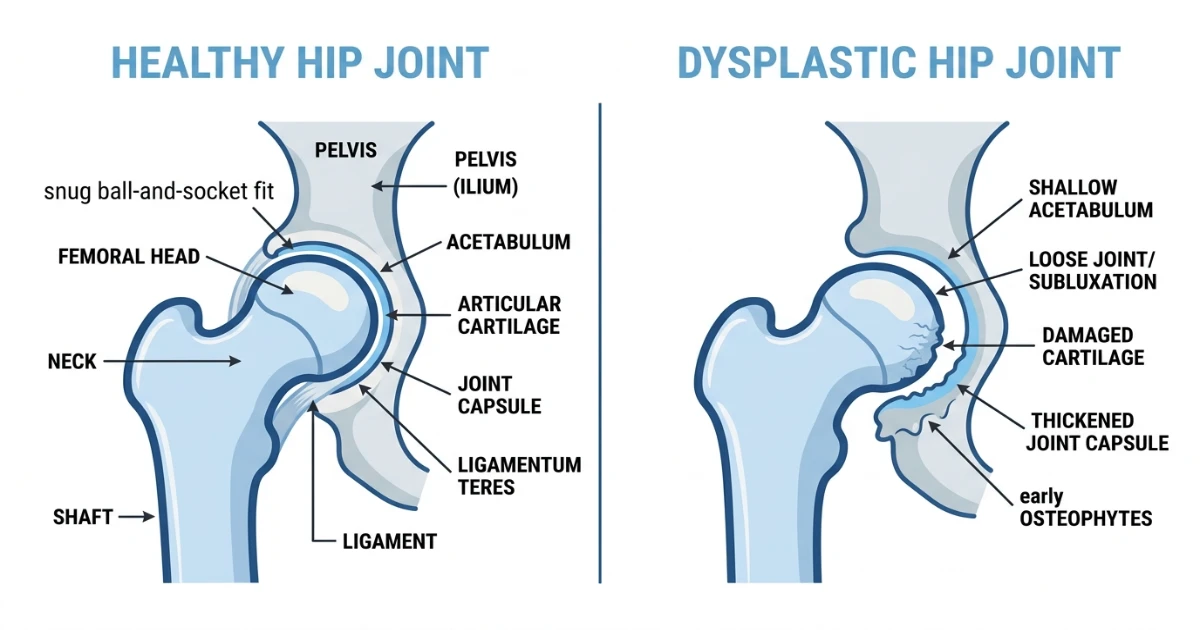
At its simplest, hip dysplasia is a mismatch between the ball of the femur and the socket of the pelvis. In a healthy hip, the femoral head sits snugly inside the acetabulum, rotating without friction. In a dysplastic hip, the socket is too shallow, the femoral head is misshapen, or the ligaments holding everything together are too loose. The result is joint laxity—a wobble that, over months and years, grinds down cartilage, inflames the joint capsule, and eventually leads to osteoarthritis.
What makes poodle hip dysplasia in standard poodles particularly worth understanding is that standards sit in an awkward middle zone. They aren’t giant-breed dogs like Great Danes, where dysplasia is almost expected. But they’re large enough—typically 40 to 70 pounds—that their hips carry real biomechanical load. A standard poodle sprinting across a field, leaping into a car, or navigating stairs places repetitive stress on joints that may have been imperfect from the start.
The condition isn’t something that suddenly appears at age five. It’s developmental. Puppies are born with anatomically normal hips, but in genetically predisposed individuals, the joint fails to develop proper congruence during the rapid growth phase between 3 and 12 months. By the time an owner notices a subtle hitch in their poodle’s gait, structural changes may already be well underway.
Why Hip Dysplasia Matters So Much for Standard Poodle Owners
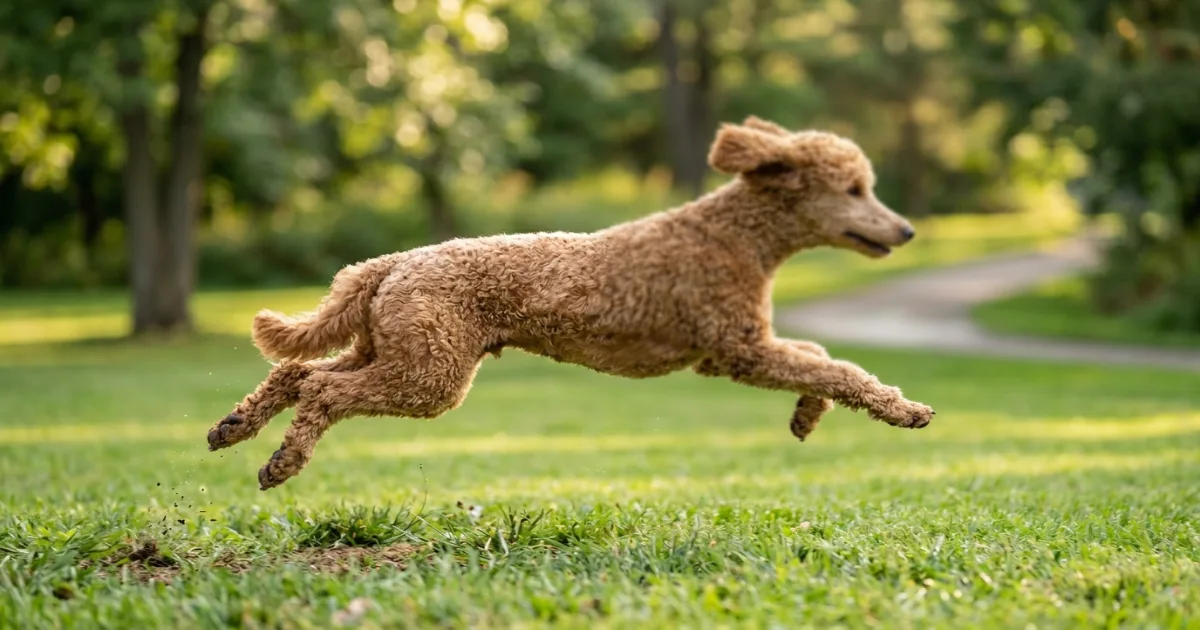
Standard poodles aren’t couch ornaments. They’re meant to move—to swim, to run, to compete in agility, to hike alongside their people. When hip dysplasia enters the picture, it doesn’t just affect a joint. It affects the entire rhythm of a dog’s life and, by extension, the owner’s life too.
There’s an emotional layer here that clinical articles tend to skip. You watch your poodle hesitate before jumping onto the bed they used to bound onto. You notice they sit differently, shifting weight off one hip. You start calculating whether that limp is worse in the morning or after exercise. These observations accumulate quietly, and they weigh on owners who only want the best for their dog.
Financially, the stakes are real. Managing hip dysplasia can range from a few hundred dollars a year for supplements and occasional anti-inflammatories to upwards of $10,000 for bilateral total hip replacement. Insurance may or may not cover it, depending on when the policy started and whether the condition is deemed pre-existing. These aren’t small decisions.
The Genetic Architecture Behind the Condition
Hip dysplasia is polygenic, meaning multiple genes contribute to the risk, and no single gene is solely responsible. This complicates breeding decisions enormously. Two parents with excellent hips can still produce a dysplastic puppy, while two parents with fair hips might—rarely—produce an excellent-hipped offspring. The heritability of hip dysplasia in standard poodles is estimated to be moderate, around 0.25 to 0.40, which means selective breeding can move the needle, but it cannot eliminate the condition entirely.
What Breeders Should Be Doing
Reputable standard poodle breeders screen every breeding dog through the Orthopedic Foundation for Animals (OFA) or PennHIP. OFA requires dogs to be at least 24 months old for a final hip rating. Breeders should be able to produce certificates showing ratings of Excellent, Good, or Fair for both parents. A breeder who waves off hip screening with “my lines don’t have that problem” is not someone you should trust with your money or your future companion.
Even better, look for breeders who track hip scores across generations—grandparents, aunts, uncles, and siblings of previous litters. Vertical pedigree analysis gives a far more honest picture than a single OFA certificate.
Signs and Symptoms That Owners Routinely Overlook
Hip dysplasia doesn’t always announce itself with an obvious limp. In standard poodles, early signs can be maddeningly subtle. Here’s what experienced owners and veterinarians learn to watch for:
- Bunny-hopping gait: Instead of moving hind legs independently at a run, the dog moves both legs together. This compensates for reduced hip extension.
- Difficulty rising after rest: A poodle who’s been lying down for an hour and struggles to stand smoothly may be dealing with early joint stiffness.
- Seductive sitting: Dogs with hip pain often sit with one leg splayed out to the side rather than sitting squarely.
- Reluctance to jump or climb stairs: This one’s easy to dismiss as “slowing down with age,” but in a dog under five, it warrants investigation.
- Audible clicking or popping from the hips: Not always present, but when it is, it’s a strong indicator of joint incongruity.
- Muscle atrophy in the hindquarters: Over time, reduced use of the hind legs leads to visible thinning of the thigh muscles.
How Hip Dysplasia Is Diagnosed
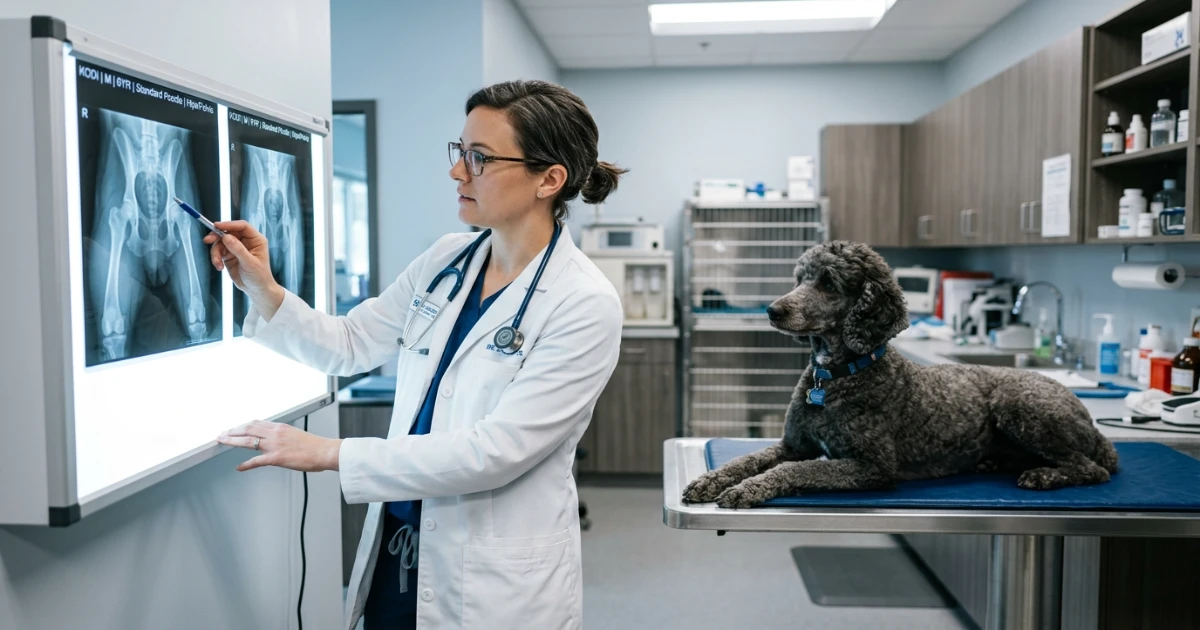
Diagnosis typically follows a three-step path. First, the veterinarian performs a hands-on orthopedic exam, manipulating the hips through their range of motion, checking for the Ortolani sign (a palpable clunk as the femoral head slides in and out of the socket), and assessing for pain on extension. Second, radiographs are taken under sedation or light anesthesia—this is critical because conscious muscle tension can mask the true degree of joint laxity. Third, the films are evaluated using either the OFA 7-point scale or the PennHIP distraction index.
PennHIP can be performed as early as 16 weeks and provides a quantitative distraction index that predicts the likelihood of developing osteoarthritis. OFA requires 24 months for a final certification but remains the more widely recognized standard in the breeding community. Neither test is perfect, but together they give the most complete picture.
Hip Dysplasia vs. Other Joint Conditions: A Comparison
Standard poodles can develop several joint issues, and they’re often confused with one another. Here’s how hip dysplasia stacks up against conditions that mimic or overlap with it:
| Condition | What It Is | Typical Age of Onset | Key Distinguishing Feature |
|---|---|---|---|
| Hip Dysplasia | Developmental joint incongruity | 4–12 months (early signs); osteoarthritis later | Laxity on palpation; radiographic changes in both femoral head and acetabulum |
| Legg-Calvé-Perthes Disease | Avascular necrosis of the femoral head | 4–12 months | Usually unilateral; small-breed dogs more common but can occur in standards |
| Cruciate Ligament Tear | Ligament rupture in the knee | Any age; more common in middle-aged dogs | Acute lameness; positive cranial drawer test; hip radiographs normal |
| Lumbosacral Stenosis | Narrowing of the spinal canal at the lower back | Middle-aged to senior | Pain over the lower spine; neurological signs; hip manipulation often pain-free |
| Panosteitis | Inflammatory bone condition (“growing pains”) | 5–18 months | Shifting leg lameness; pain on bone palpation; resolves spontaneously |
Treatment Pathways: From Conservative to Surgical
Treatment for poodle hip dysplasia in standard poodles falls along a spectrum, and the right choice depends on the dog’s age, severity of symptoms, radiographic findings, and the owner’s resources. No single approach works for every dog.
| Treatment | Best For | Approximate Cost (2026) | What to Expect |
|---|---|---|---|
| Weight management + controlled exercise | All dogs, especially mild cases | $0–$100/month (food adjustments) | Reduced joint load; slower disease progression |
| Joint supplements (glucosamine, chondroitin, omega-3s) | Mild to moderate dysplasia | $30–$80/month | Variable efficacy; best started early |
| NSAIDs and pain medications | Moderate to severe pain episodes | $40–$120/month | Effective for inflammation; requires monitoring for organ effects |
| Adequan injections | Moderate dysplasia with cartilage damage | $50–$90 per injection (series of 8) | Disease-modifying potential; given intramuscularly |
| Platelet-rich plasma (PRP) or stem cell therapy | Moderate dysplasia; younger dogs | $1,200–$3,500 per treatment | Emerging evidence; not universally available |
| Femoral Head Ostectomy (FHO) | Dogs under 40–50 lbs; salvage procedure | $1,800–$4,000 per hip | Removes femoral head; relies on scar tissue for a “false joint” |
| Total Hip Replacement (THR) | Severe dysplasia; large active dogs | $5,500–$9,500 per hip | Gold standard; excellent long-term outcomes; requires specialist surgeon |
| Juvenile Pubic Symphysiodesis (JPS) | Puppies 12–20 weeks identified early | $1,200–$2,500 | Minimally invasive; alters pelvic growth to improve socket coverage |
What Buyers Usually Get Wrong About Hip Dysplasia
After years of speaking with standard poodle buyers and breeders, several patterns of misunderstanding emerge consistently. These aren’t minor confusions—they lead people to buy puppies from the wrong sources, miss early warning signs, or make treatment decisions based on bad information.
Mistake 1: Assuming OFA “Good” parents guarantee healthy puppies. OFA ratings reflect phenotype, not genotype. Two Good-rated parents reduce risk significantly but do not eliminate it. The breeding that produced those parents matters just as much as the parents themselves.
Mistake 2: Thinking a puppy who runs and plays can’t have hip dysplasia. Young dogs are remarkably good at compensating. A puppy with mild hip laxity may show no overt lameness until secondary osteoarthritis sets in years later. Pain tolerance in dogs is high, and their drive to play often overrides discomfort.
Mistake 3: Believing hip dysplasia is always bilateral and symmetrical. It can affect one hip far more than the other. A dog who always sits with the same leg splayed out may have unilateral disease that’s easy to miss if you’re looking for a “typical” presentation.
Mistake 4: Over-relying on supplements while ignoring weight. Even the best joint supplement cannot compensate for a standard poodle carrying 10 to 15 extra pounds. Weight control is the single most impactful non-surgical intervention, and it’s entirely in the owner’s hands.
How Hip Dysplasia Gets Misidentified in Standard Poodles
Standard poodles have a particular gait and conformation that can muddy the diagnostic waters. Their naturally springy, light-footed movement sometimes masks early stiffness. Additionally, their deep chest and relatively narrow hindquarters can make muscle atrophy less obvious than in stockier breeds.
A common scenario: a standard poodle starts sitting oddly or hesitating on stairs. The owner Googles the symptoms, lands on a generic article, and assumes it’s arthritis from aging. The dog is only four years old. By the time radiographs are finally taken, significant joint remodeling has occurred. This delay happens far more often than it should, and it’s almost always driven by the assumption that hip dysplasia is a “puppy disease” that would have been caught earlier.
Another misidentification trap: attributing hind-end weakness to hip dysplasia when the real issue is lumbosacral disease or even a partial cruciate tear. This is why a thorough veterinary workup—not just a visual gait assessment—is non-negotiable.
Living with a Standard Poodle with Hip Dysplasia: Practical Daily Guidance
If your poodle has been diagnosed, the daily routine shifts in manageable but meaningful ways. The goal isn’t to wrap the dog in bubble wrap—it’s to make smart choices that preserve joint health while keeping the dog mentally and physically fulfilled.
- Flooring matters enormously. Hardwood and tile are the enemy of dysplastic hips. Runners, yoga mats, and non-slip rugs in high-traffic areas reduce micro-slipping that aggravates joint pain.
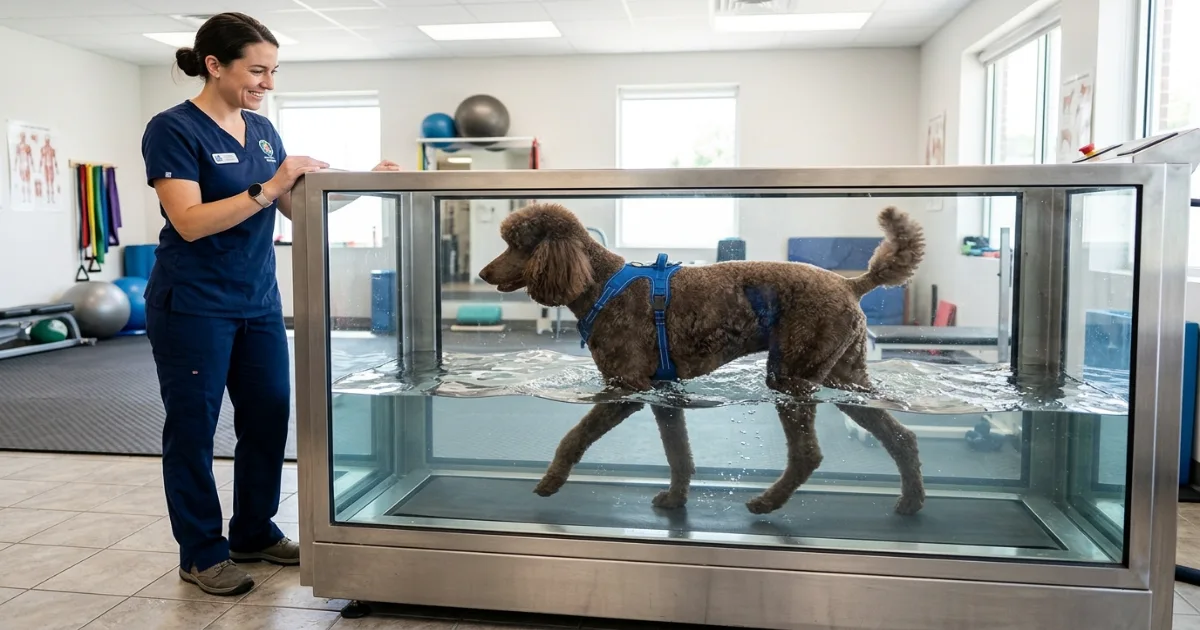
- Exercise should be frequent but moderate. Three 15-minute walks are better than one 45-minute walk. Swimming is ideal—zero-impact resistance that builds hip-supporting muscle.
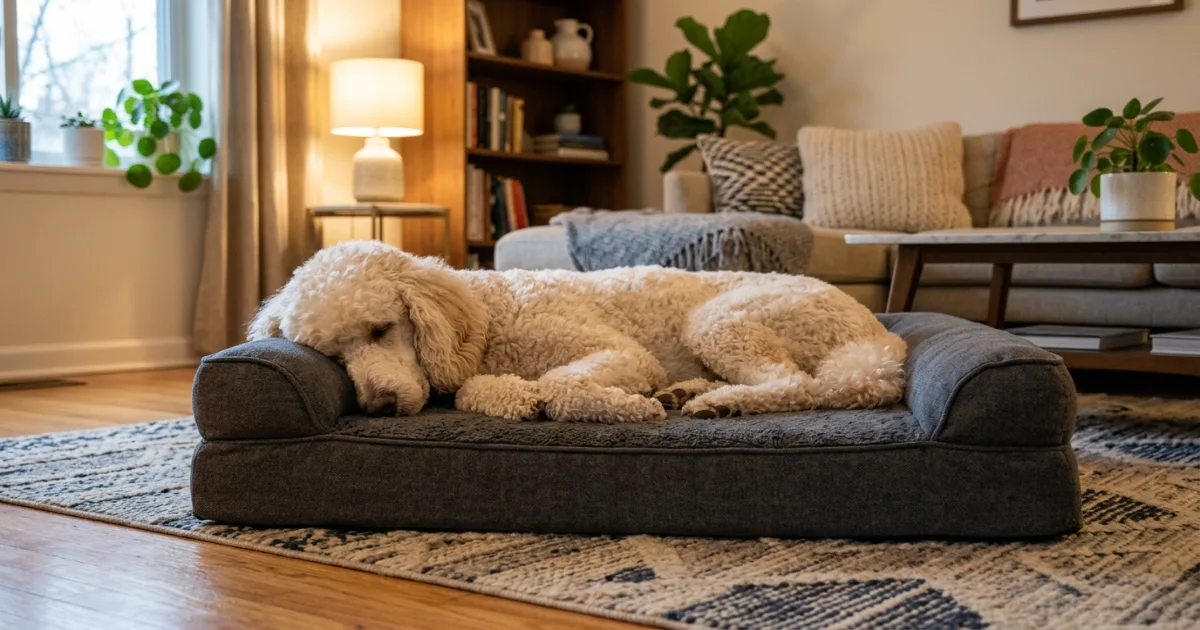
- Bedding isn’t a luxury. A high-quality orthopedic bed with memory foam makes a measurable difference in morning stiffness. Heated beds can help during colder months.
- Nail trims are medical, not cosmetic. Long nails alter foot placement and gait mechanics, transmitting abnormal forces up into the hips. Keep nails short, always.
- Ramps for vehicles and furniture prevent the jarring impact of jumping down, which can be more damaging than jumping up.
Pro Tips for Buyers and Current Owners
- Ask breeders for three-generation hip clearance documentation, not just sire and dam.
- If buying a puppy, request PennHIP evaluations at 16–20 weeks if you want the earliest possible risk assessment.
- Keep puppy growth slow and steady—rapid growth in the first year is a known environmental risk factor for dysplasia expression.
- Start joint supplements proactively in at-risk puppies by 6–8 months, not after symptoms appear.
- Build a relationship with a veterinary orthopedic specialist before you need one. Having a baseline exam and radiographs on file is invaluable.
- Do not breed a standard poodle with less than OFA Fair hips, regardless of how wonderful their temperament or coat may be.
The Financial Side: What Hip Dysplasia Really Costs
2026 Cost Outlook for Managing Hip Dysplasia
Annual conservative management (supplements, occasional NSAIDs, weight-management food): $600–$1,800
FHO surgery (one hip, including aftercare and rehab): $2,500–$5,500
Total hip replacement (one hip, board-certified surgeon): $6,000–$10,000
Bilateral THR (both hips, often staged months apart): $11,000–$18,000
What inflates the cost: geographic location, specialist availability, whether rehabilitation is included, and whether complications arise. What reduces it: pet insurance purchased before any symptoms appear, veterinary teaching hospitals, and some non-profit assistance programs for qualifying owners.
Is it worth it? For THR, the success rate exceeds 90%, and most dogs return to full athletic function. For many owners, the answer is a clear yes—but it’s a deeply personal financial decision, and no one should feel guilt for choosing a well-managed conservative path.
Frequently Asked Questions About Poodle Hip Dysplasia in Standard Poodles
Can a standard poodle puppy be screened for hip dysplasia before going home?
Yes, partially. PennHIP radiographs can be performed as early as 16 weeks and provide a distraction index that predicts the likelihood of future osteoarthritis. This is the earliest reliable screening method. Standard OFA radiographs require the dog to be 24 months old for a final certification. Reputable breeders may offer PennHIP results on puppies, especially from lines with any hip concerns in the pedigree.
Is hip dysplasia in standard poodles always painful?
Not always perceptibly so, especially in early stages. Many dogs with mild hip laxity show no overt pain signs until secondary osteoarthritis develops, which can take years. The absence of limping or whining does not rule out the condition. Subtle changes in gait, sitting posture, or willingness to jump often precede obvious pain.
Do standard poodles with hip dysplasia need to avoid stairs completely?
Not necessarily, but stairs should be managed thoughtfully. Occasional, slow stair use on carpeted steps is generally fine for dogs with mild dysplasia. For dogs with moderate to severe dysplasia, limiting stairs and providing a ramp or carrying assistance reduces repetitive impact. The key is minimizing the jarring descent, which places more stress on the hips than climbing up.
Can a standard poodle with hip dysplasia still do agility or run?
It depends on severity. Dogs with mild dysplasia who maintain excellent muscle conditioning may continue low-impact agility work with modifications—no high jumps, no tight turns at speed. Dogs with moderate to severe dysplasia should avoid high-impact activities. Swimming and controlled leash walks become the preferred outlets. Always consult a veterinary orthopedic specialist before continuing any sport with a diagnosed dog.
Does pet insurance cover hip dysplasia treatment in standard poodles?
Coverage depends entirely on the policy and timing. Most insurers will cover hip dysplasia treatment if the policy was purchased before any symptoms or diagnosis appeared and after any applicable waiting period (often 6–12 months for orthopedic conditions). If the condition is deemed pre-existing, it will not be covered. Always read the orthopedic waiting period and hereditary condition clauses before purchasing a policy.
Are male or female standard poodles more prone to hip dysplasia?
Research does not consistently show a strong sex-based difference in hip dysplasia prevalence in standard poodles. Some large-scale studies across breeds suggest a slight male predisposition, but the difference is small. Genetics, growth rate, nutrition, and body condition are far more influential than sex alone.
Can diet really prevent hip dysplasia in a genetically predisposed puppy?
Diet cannot change genetics, but it can powerfully influence whether genetic susceptibility translates into clinical disease. Controlled growth through measured feeding—not free-feeding—during the first year is one of the best-supported preventive strategies. Puppies that grow too quickly place excessive strain on developing joints. A balanced calcium-to-phosphorus ratio and appropriate calorie intake for a slow, steady growth curve are critical.
How long can a standard poodle live comfortably with hip dysplasia?
With proper management, many standard poodles with hip dysplasia live full lifespans of 12–15 years with good comfort levels. The key variables are early detection, weight control, appropriate exercise, and timely intervention when symptoms worsen. Dogs who receive total hip replacements often return to completely normal activity and life expectancy. Even dogs managed conservatively can enjoy many quality years with attentive care.
Final Summary: What Every Standard Poodle Owner Should Remember
Poodle hip dysplasia in standard poodles is a real concern, but it is not an unmanageable one. The condition develops from a combination of genetic predisposition and environmental factors during growth, which means both breeders and owners hold meaningful power to influence outcomes. Breeders who screen thoroughly across generations, and owners who prioritize slow growth, lean body condition, and early veterinary assessment, stack the odds in their poodle’s favor.
If your standard poodle is already diagnosed, you have options—from supplements and weight management to advanced surgical interventions with excellent success rates. The worst thing you can do is wait and hope symptoms resolve on their own. They rarely do. The best thing you can do is act early, stay informed, and build a care team that includes a veterinarian you trust and, when needed, a board-certified orthopedic specialist.
Standard poodles give us their intelligence, loyalty, and boundless spirit. Protecting their hips is one of the most tangible ways we can give something back.