Poodle Pet Insurance: Is It Worth It? 2026 Cost Guide
Quick Answer: Poodle pet insurance is almost always worth it for standard, miniature, and toy Poodles because their breed-specific hereditary conditions — Addison’s disease, hip dysplasia, bloat, progressive retinal atrophy — can lead to staggering vet bills. In 2026, a robust accident-and-illness plan costs $38–$68 per month, while a single bloat surgery with complications easily exceeds $7,500. The right policy transforms a terrifying emergency into a manageable expense, but the wrong policy is a waste of money. The key is matching coverage to real Poodle health risks.
Walk into any poodle-focused forum or Facebook group and you’ll see the same question posed by both first-time puppy buyers and seasoned owners: Is poodle pet insurance actually worth it, or am I just paying for peace of mind I’ll never use?
It’s a fair question, and one that deserves a lot more nuance than a simple yes or no. The answer changes depending on the size of your Poodle, whether you bought from a health-tested lineage, how you feel about surprise $4,800 emergency bills, and — crucially — which policy you pick.
We’ve built this guide to cut through the marketing promises and the forum horror stories. It’s written specifically for Poodle people, because poodles are not generic dogs. They have a distinct health profile, a long lifespan, and a price tag that makes gut-wrenching vet decisions feel personal. By the end, you’ll know exactly what Poodle pet insurance should cover, what it realistically costs in 2026, and whether it’s a smart buy for your situation.
$38–$68 for accident & illness (varies by size, age, location)
Gastric dilatation-volvulus (bloat) surgery: $5,500–$8,200
12–15 years; late-onset issues make early enrollment worthwhile
Pre-existing conditions & some hereditary caps on low-tier plans
What Poodle Pet Insurance Actually Covers (And Where It Gets Tricky)
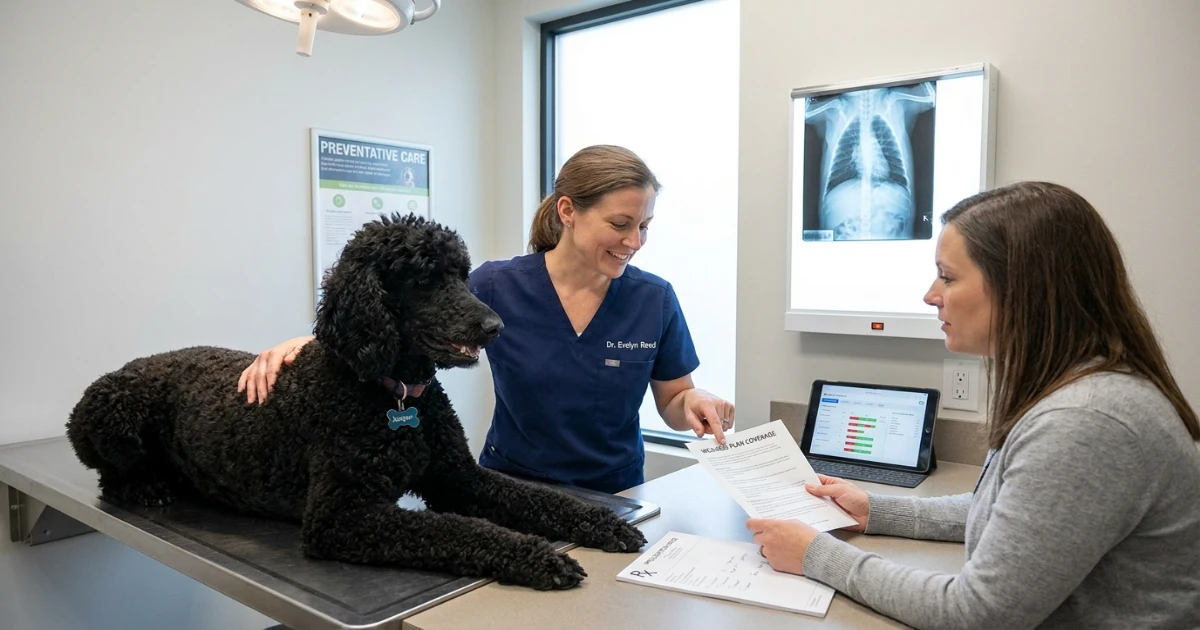
Before you even glance at a premium table, you have to understand what a policy does in the real world. Poodle pet insurance is not a wellness plan. It isn’t going to pay for your dog’s annual checkup, heartworm test, or grooming bill — and that confuses many first-time buyers.
Most comprehensive accident-and-illness policies cover: emergency surgery, hospitalization, diagnostics (MRI, ultrasound, blood panels), prescription medications, specialist visits, cancer treatments, hereditary and congenital conditions, and sometimes alternative therapies like acupuncture. The critical phrase for Poodles is hereditary and congenital. If your plan excludes or caps those, you’re essentially uninsured for the very things a Poodle is likely to develop.
What is almost never covered: pre-existing conditions, elective procedures, breeding costs, cosmetic dentistry, and the exam fee for a non-claim visit. If your Poodle already has a hip dysplasia diagnosis before the policy starts, that joint is permanently excluded. That’s why every breeder-worth-their-salt tells you to enroll the moment the puppy comes home.
Why Poodle Health Needs Make Insurance a Different Conversation
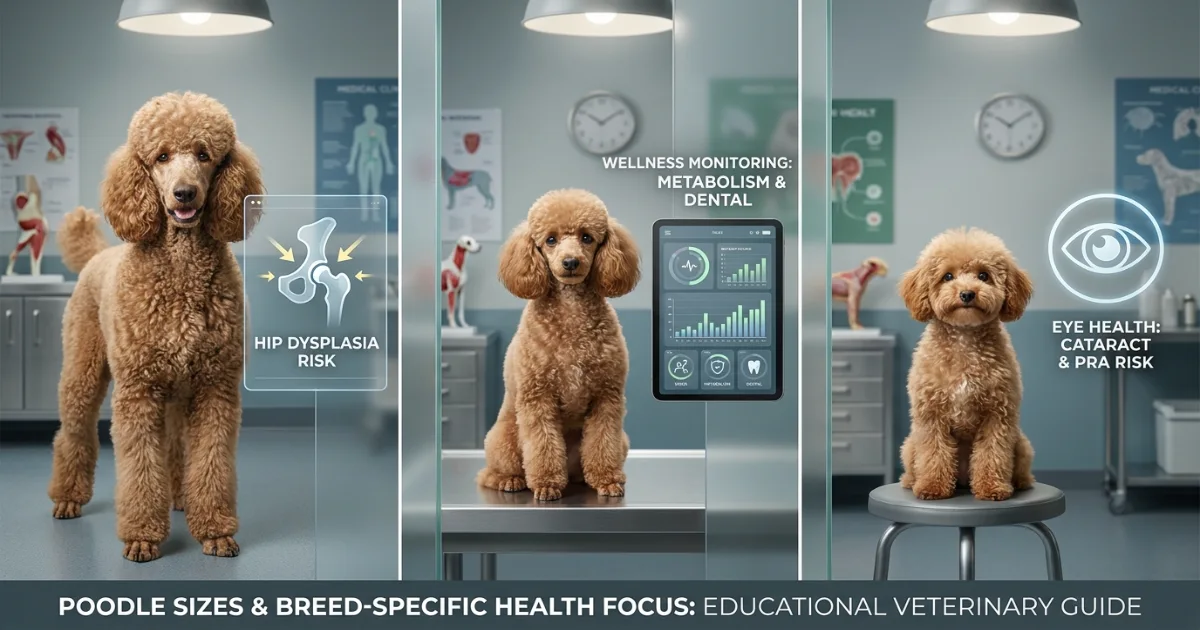
Generic dog insurance guides treat a Poodle like any other breed. That’s a mistake. A standard Poodle is built differently, both structurally and genetically. The deep chest predisposes to bloat. The large, active joints are vulnerable to dysplasia. The gene pool that gives us that magnificent coat can also carry Addison’s disease, sebaceous adenitis, and thyroid disorders. Miniature and toy Poodles have their own risks, including collapsing trachea and luxating patellas.
What does that mean financially? A single Addisonian crisis — where the dog collapses, needs IV fluids, and requires lifelong medication — can run $2,500–$4,500 just for the initial stabilization. Sebaceous adenitis treatment is chronic and cumulative. Cataract surgery for a toy Poodle: $2,800–$4,200 per eye. These aren’t freak accidents; they’re documented breed predispositions. The right Poodle pet insurance policy treats them as covered conditions from day one, not as surprises.
Expert Insight: “Poodles are not a fragile breed, but they are a deep-chested, long-lived breed with a list of manageable — yet expensive — hereditary conditions. I’ve seen too many owners choose a cheap policy that caps hereditary coverage at $1,500, and then face a $6,000 bloat surgery. Read the policy’s definition of hereditary coverage before you enroll.” — Dr. Lena Hartmann, DVM, small animal practitioner and Poodle owner.
Real Cost of Poodle Vet Care Without Insurance (Why the Sticker Shock Is Real)
To evaluate whether Poodle pet insurance is worth it, you have to look at the alternative: paying out of pocket. Below are average 2026 U.S. veterinary cost ranges for procedures Poodles most commonly face, sourced from multiple clinics and pet insurance claims data.
| Procedure / Condition | Estimated Cost Without Insurance (2026) | Poodle Size Affected |
|---|---|---|
| GDV (bloat) surgery with gastropexy | $5,500 – $8,200 | Standard |
| Hip dysplasia (unilateral TPO or THR) | $5,000 – $7,500 per hip | Standard, Miniature |
| Addison’s crisis & initial management | $2,500 – $4,500 | All sizes |
| Sebaceous adenitis (lifetime management) | $800 – $1,800 per year | Standard |
| Cataract surgery (one eye) | $2,800 – $4,200 | Toy, Miniature |
| Luxating patella repair | $1,800 – $3,200 | Toy, Miniature |
| Cancer treatment (chemotherapy protocol) | $4,000 – $9,000+ | All sizes |
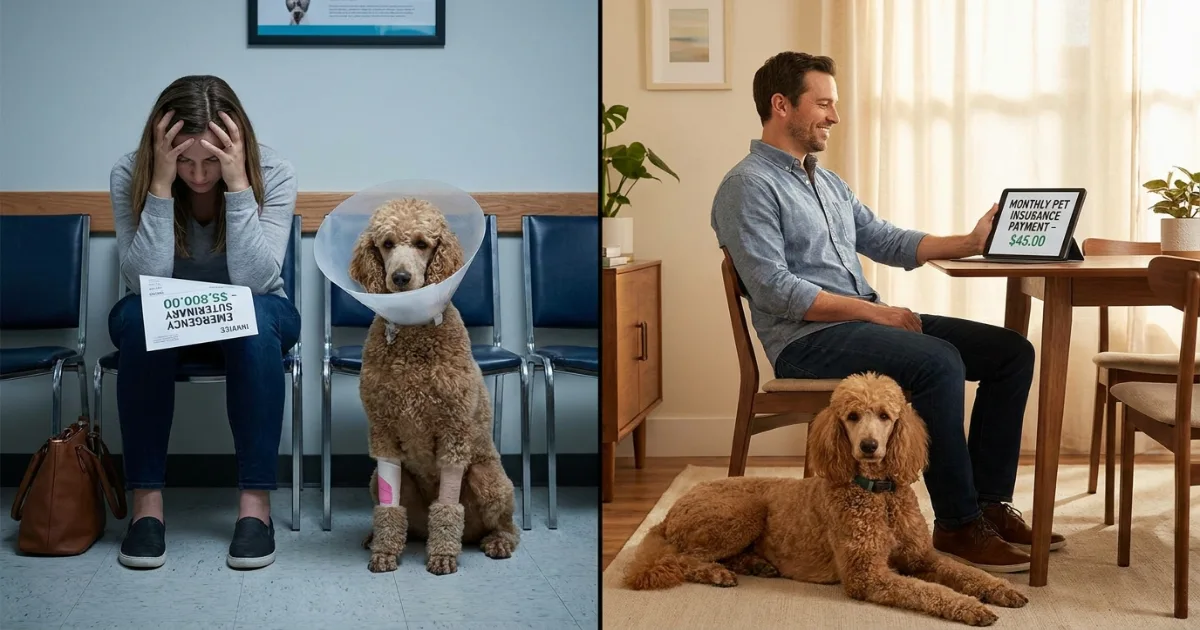
When you are staring at a $6,000 estimate at 2 a.m., a $48 monthly premium suddenly looks like the cheapest safety net you’ve ever bought.
2026 Poodle Pet Insurance Cost Breakdown
Quoting insurance can feel like a black box. In reality, premiums are built on a few transparent factors: your dog’s age, breed, location, the annual coverage limit, the reimbursement percentage, and the deductible you choose. For a Poodle in 2026, here’s what the landscape looks like.
Real-World Monthly Premium Ranges (Accident & Illness Plans)
Toy Poodle puppy (under 1 year): $32 – $48
Miniature Poodle puppy: $35 – $52
Standard Poodle puppy: $42 – $68
Adult Standard Poodle (5 years): $55 – $85
Senior Poodle (9+ years): $80 – $135+ (if accepted)
These ranges assume an 80% reimbursement, $500 annual deductible, and $10,000–unlimited annual limit. Plans with lower deductibles or 90% reimbursement raise the premium by 15–25%.
What Actually Inflates a Poodle’s Premium
Poodles are often priced higher than mixed breeds but lower than bulldogs or Bernese mountain dogs. The premium bump comes from that hereditary condition list. Companies that underwrite based on breed-specific risk algorithms know that a standard Poodle is more likely to claim for bloat and Addison’s than a Labrador. If your quote seems high, check whether the provider has a “hereditary condition cap” — some cheap policies lower the premium by severely limiting coverage for exactly those conditions, which defeats the purpose for a Poodle.
Location also matters a lot. In urban areas like New York City or San Francisco, vet costs — and therefore premiums — run 20–35% higher than in rural Kansas. A standard Poodle puppy in Manhattan might cost $74/month, while the same plan in Des Moines is $49. That’s not a gimmick; that’s the actuarial reality of what vet clinics charge.
Comparison: What to Look For Beyond the Monthly Price
Most comparison websites only show the monthly premium and leave you to discover the gaps later. For Poodle owners, the decision matrix must include these four rarely-discussed factors:
Some insurers exclude or limit bilateral conditions (e.g., if one hip has dysplasia, the other might not be covered). Run from those.
Many plans have a 14-day illness wait, but hereditary issues can have a 6–12 month exclusion window. Know it.
That $125 emergency exam fee each visit adds up. Top plans include it; others don’t.
Some pay based on “usual and customary” fees, others on actual vet invoice. Actual-invoice models protect you far better.

Is Poodle Pet Insurance Worth It? The Math That Changes the Conversation
Let’s put aside emotion and run a realistic 10-year scenario for a standard Poodle:
If you pay a $58 average monthly premium for 12 years, you’ll spend about $8,352 in premiums. During those same 12 years, the likelihood of at least one major hereditary claim (bloat, Addison’s, hip dysplasia, or sebaceous adenitis) is, based on claims data, around 35–45%. One bloat surgery at $6,500 plus follow-up medications already puts you near break-even. Add a second event — say, a mast cell tumor removal at $2,400 — and you’re thousands ahead.
The value proposition is even stronger for owners who would never put a price on their Poodle’s life but know they’d face a terrible emotional decision if they couldn’t afford treatment. Insurance removes that impossible calculation from the emergency room.
Pro Tip: If you’re on the fence, get a high-deductible plan with a 90% reimbursement rate and an unlimited annual cap. The monthly cost stays manageable (often $35–$50 for a young Poodle), and you’re protected against catastrophic events. You still pay for routine stuff out of pocket, but the financial abyss is covered.
7 Mistakes Poodle Buyers Make With Pet Insurance (And How to Avoid Them)
After years of talking to Poodle owners and seeing claims data, the same errors surface again and again. Avoid these:
1. Waiting until the first health scare. The moment you notice a limp or a funny blood panel, it’s too late. Pre-existing conditions lock out coverage. Enroll within the first week of bringing your Poodle home, while the vet record is clean.
2. Assuming all hereditary conditions are fully covered. This is the single biggest misunderstanding. Some low-cost plans have a $2,000 lifetime cap on hereditary issues — useless for a Poodle. Always ask, “Is there a per-condition or lifetime limit on hereditary or congenital disorders?”
3. Choosing a low annual limit to save $8/month. A $2,500 annual limit won’t cover a single bloat surgery. With Poodles, a $10,000 minimum annual limit is the safe baseline, and unlimited is ideal for peace of mind.
4. Not understanding bilateral exclusions. If your policy excludes “bilateral conditions,” a cruciate tear in one knee means the other knee is also excluded. Poodles, especially standards and minis, can be prone to CCL tears. This fine print matters enormously.
5. Overlooking the waiting period for hip dysplasia. Some insurers have a 12-month exclusion for hip dysplasia. If your 8-month-old standard Poodle puppy develops signs at 10 months, you’re paying premiums for nothing. Seek 14-day or 30-day waiting periods for hip issues if possible.
6. Relying on the breeder’s health guarantee instead. A typical breeder guarantee covers severe congenital defects for up to 2 years, often requiring the dog to be returned. It does not cover treatment costs, and it rarely covers conditions that appear later in life. Insurance fills that enormous gap.
7. Cancelling the policy when the dog seems healthy. Poodles often sail through ages 2 to 6 with few problems. The danger is that many serious conditions — Addison’s, hip dysplasia with gradual onset, cancer — show up later. Cancel, and you’ll have to re-enroll an older dog with possible pre-existing issues and a much higher premium.
How to Choose the Best Poodle Pet Insurance Plan: A Step-by-Step Approach
There’s no single “best” provider for every Poodle. The right choice depends on your dog’s size, age, your location, and your financial comfort zone. Follow this process:
Step 1 — List the conditions that scare you most. For a standard Poodle, bloat and Addison’s top the list. For toys, it might be collapsing trachea and patella issues. Write them down. Then call the insurer and ask point-blank: “How are these covered under your accident-and-illness policy? Any caps?” Record the answer.
Step 2 — Get three quotes with identical parameters. Use an 80% reimbursement, $500 deductible, and unlimited annual limit if possible. Compare apples to apples. A plan that’s $12 cheaper but has a $5,000 hereditary cap isn’t a better deal; it’s a different product entirely.
Step 3 — Read the hereditary and congenital section of the sample policy. Yes, actually read it. Search for “bilateral,” “pre-existing,” “hereditary limit,” “waiting period.” Anything that sounds ambiguous will be interpreted against you later.
Step 4 — Factor in the Poodle’s age. If your dog is over 7, many insurers stop offering new accident-and-illness policies. You may need an accident-only plan plus a dedicated savings account. That’s still better than nothing.
Alternatives to Poodle Pet Insurance (And Why They Often Fall Short)
Some Poodle owners choose to self-insure by putting $60 a month into a high-yield savings account. After five years, that’s $3,600 — enough for many issues but not for a catastrophic bloat surgery with complications plus rehabilitation. The math breaks if the emergency happens in year one, when the fund has $720. For a puppy from a line with unknown health history, the risk is real.
Another alternative: CareCredit or scratchpay. These are financing tools, not insurance. They help you pay the bill over time, but you still pay the full amount plus interest. They are a backup, not a replacement for coverage.
Owner Reality Check: Many Poodle owners who initially skipped insurance later told us they enrolled after hearing a friend’s story of a $7,000 emergency. Don’t let your hindsight be that expensive.

Frequently Asked Questions About Poodle Pet Insurance
- Is pet insurance for a Poodle really worth the monthly cost?
- Yes, for most Poodle owners. The breed’s elevated risk for costly conditions like bloat, Addison’s, and hip dysplasia makes a comprehensive plan financially sensible. Even one major claim often exceeds years of premiums.
- How much does Poodle pet insurance cost per month in 2026?
- Expect to pay $38–$68 for a puppy, with Standard Poodles at the higher end. Adult and senior dogs will see rates from $55 to over $135, depending on the deductible, reimbursement level, and location.
- Does Poodle pet insurance cover hereditary conditions like Addison’s disease?
- It can, but not all plans do. You must verify that the policy explicitly covers hereditary and congenital conditions without low lifetime caps. Avoid plans that exclude or severely limit these.
- Can I get insurance for my older Poodle?
- It’s possible up to a certain age, often 10–14 years depending on the insurer, but new accident-and-illness enrollment is usually restricted for seniors. Accident-only plans remain an option, and some wellness add-ons help.
- What is the best pet insurance for Poodles?
- There is no universal “best,” but the right plan will cover hereditary conditions at a high annual limit with no bilateral exclusions, a short waiting period for hip dysplasia, and reimbursement based on actual vet invoices.
- What doesn’t Poodle pet insurance cover?
- Pre-existing conditions, grooming, routine wellness (unless a rider is added), elective procedures, breeding costs, and often prescription food. Exam fees are excluded by some providers, so check that detail.
- When should I buy Poodle pet insurance — as a puppy or later?
- As a puppy, ideally within the first week of bringing them home. This locks in lower rates and ensures no pre-existing conditions are on record. Waiting even a few months can lead to exclusions.
- Are there alternatives to pet insurance for Poodle owners?
- Self-insuring with a dedicated savings account is an alternative, but it leaves you vulnerable to early emergencies. Financing like CareCredit helps with payment but doesn’t reduce the total bill. Insurance remains the strongest safety net.
The bottom line: Poodle pet insurance is a strategic tool, not an impulse buy. With this breed’s long lifespan and specific hereditary vulnerabilities, a well-chosen accident-and-illness plan shifts the most terrifying financial scenarios from crippling to manageable. Enroll early, demand transparent hereditary coverage, ignore the cheapest plans that cap what Poodles actually need, and you’ll have made one of the smartest decisions for your dog’s future. In 2026, the question isn’t “can I afford the premium?” — it’s “can I afford to face a $6,800 emergency room bill without it?”