Why Do Poodles Bark So Much? Causes and Training Solutions
A complete breakdown of poodle barking problems — what triggers them, why they happen, and exactly how to address each one.
If you share your home with a poodle, you already know the soundtrack: a sharp bark at the mail carrier, non-stop yapping when you leave the room, frantic noise every time a squirrel dares cross the yard. Poodle barking problems are one of the most common frustrations owners raise in training classes, veterinary offices, and dog behavior forums. The good news? Excessive barking is rarely random. Every bark your poodle throws at the world has a reason behind it — and once you understand that reason, you can address it directly.
This guide breaks down the five most common causes of poodle barking problems, explains the psychology behind each one, and gives you a practical, trainer-approved toolkit for quieting things down — without squashing your poodle’s vibrant personality.
Alert Barking: “There Is Something You Need to Know About”
Alert barking is the most natural and deeply wired form of vocalization in poodles. Originally bred in Germany as waterfowl retrievers and versatile working dogs, poodles were selected for high intelligence and attentiveness. Telling the hunter that something moved in the reeds was literally their job. That instinct has not gone anywhere.
In a modern home, alert barking is triggered by anything perceived as out-of-the-ordinary: a knock at the door, a stranger walking past the window, a delivery truck, another dog visible from the yard, or an unusual sound on television. The bark is communicative — your poodle is not misbehaving. It is doing exactly what it was bred to do.
The problem is that most household poodles exist in sensory-rich environments where alerts are essentially constant. Without guidance on when to stand down, alert barking quickly escalates from a useful heads-up into a relentless noise problem.
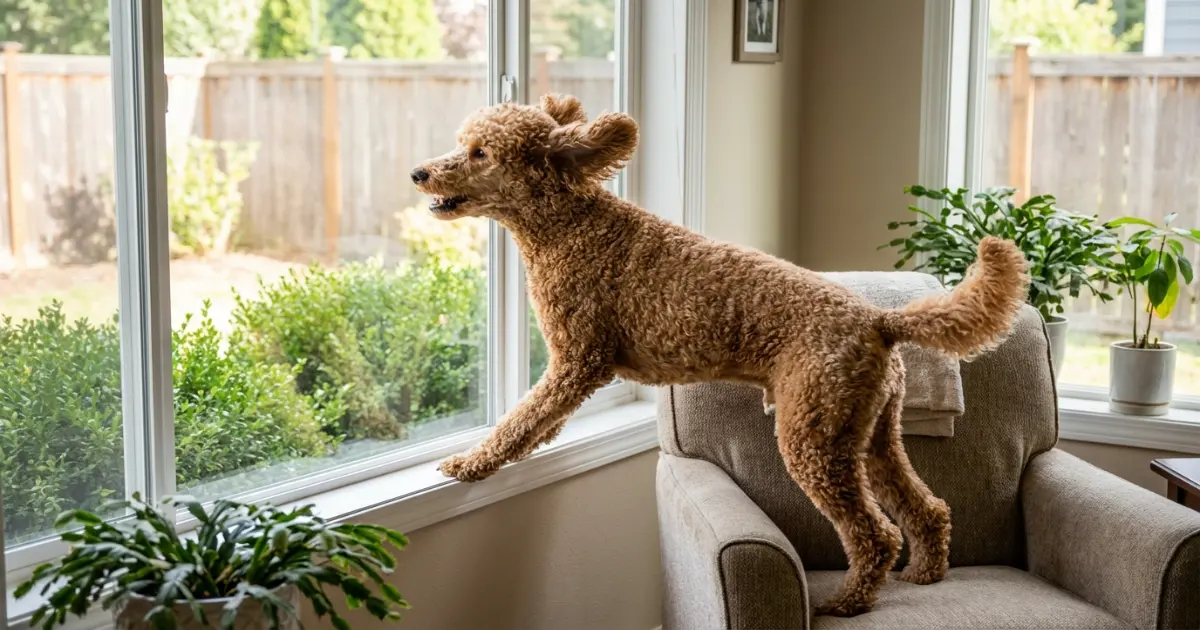
How to Identify Alert Barking
- Barking begins suddenly in direct response to a specific, identifiable trigger.
- Your poodle is physically oriented toward a door, window, or the source of a sound.
- The barking stops — or at least pauses — once the trigger disappears.
- The dog may also display raised hackles, a stiff posture, or intense staring.
The “Thank You, Enough” Protocol
Trying to eliminate alert barking entirely is both unrealistic and unfair. A more effective approach is to acknowledge the bark and then give a clear “stand down” signal. When your poodle alerts, walk calmly to its location, observe what it is reacting to, and say “thank you” in a neutral tone. Then deliver a firm, quiet “enough” or “quiet” cue. The instant the dog pauses — even for two seconds — deliver a high-value treat immediately.
Repeated consistently over days and weeks, your poodle learns that one or two barks is the expected limit. You can also limit access to high-trigger zones — such as a front window with a busy street view — while training is in progress, to prevent endless rehearsal of the unwanted behavior.
Boredom Barking: “I Have Nothing to Do and I Am Losing My Mind”
Poodles are routinely ranked among the top two or three most intelligent dog breeds in the world. That intelligence is a tremendous gift — until it becomes a liability. A bored poodle is a problem poodle. These dogs need their minds engaged, and when they are not, they invent their own entertainment. Barking, destructive chewing, pacing, and digging are all classic symptoms of a poodle that is mentally understimulated.
Boredom barking is especially common in poodles left alone for extended periods, or in households where daily exercise is inconsistent. A 20-minute walk is simply not enough for many poodles — particularly younger dogs and the energetic Miniature variety.
How to Identify Boredom Barking
- Barking occurs even when there is no obvious external trigger prompting it.
- The bark is repetitive and monotone — more of a complaint than a reaction.
- Your poodle also shows other restless or destructive behaviors throughout the day.
- The barking is worst during predictable low-activity windows — mid-morning or mid-afternoon.
Tire the Brain, Not Just the Body
Physical exercise matters, but mental stimulation is often the missing piece for poodles with boredom-related barking. Puzzle feeders, sniff mats, food-dispensing toys, nose-work games, and short daily training sessions (5–10 minutes each) give the poodle’s brain something constructive to work through. Rotate toys weekly to prevent habituation.
Predictable daily structure also reduces anxiety during idle time. If you are unsure how much professional training support you may need, the Poodle Training Cost Estimator can help you plan a realistic budget for classes or private sessions.
Attention Barking: “Look at Me. Look at Me Right Now.”
Attention barking is a learned behavior — which makes it one of the most correctable forms of poodle barking problems, but also one of the trickiest, because it was almost certainly trained accidentally by the owner. Here is how the cycle forms: your poodle barks, you glance up. Your poodle barks again, you tell it to stop. Your poodle barks louder, you get up. In the dog’s mind, the formula is crystal clear: barking produces a human response. The behavior is reinforced, and it escalates.
Poodles are extraordinarily people-oriented dogs. They crave interaction, eye contact, and engagement. Attention barking is the product of a dog that has discovered barking is the fastest path to what it wants most.

How to Identify Attention Barking
- Your poodle barks directly at you while maintaining steady eye contact.
- The barking stops the moment you engage — even a negative response satisfies it.
- It occurs when you are present but focused on something else: work, cooking, or television.
- The dog may also paw at you, nudge, or bring a toy to prompt play.
“Every person in the household must respond identically — the one family member who still reacts will sustain the behavior for everyone.”
Extinction and Reinforcing Calm Behavior
The cardinal rule for attention barking: do not reward it with any response whatsoever. No eye contact, no verbal correction, no physical touch. Turn your back completely and wait for silence. The very moment your poodle is quiet — even for two seconds — calmly praise and reward. Teach an incompatible behavior such as “go to your place” and reinforce it generously throughout the day.
Consistency across all family members is non-negotiable. If one person still responds to attention barking, the behavior will persist. Intermittent reinforcement actually strengthens the barking pattern — not weakens it.
Separation Anxiety: “Please Do Not Leave Me”
Poodles bond deeply — sometimes too deeply — with their primary caregivers. This sensitivity is part of what makes them exceptional therapy and companion dogs, but it also fuels a significant poodle barking problem: separation anxiety. Dogs suffering from separation anxiety are not being dramatic. They are experiencing something closer to a genuine panic response when left alone, and vocalizing is one of the few coping mechanisms available to them.
Separation anxiety-related barking is distinct from ordinary boredom barking. It tends to begin within the first 30 minutes of the owner leaving, is frequently accompanied by whining, pacing, destructive behavior, or elimination accidents, and represents a state of real psychological distress.

How to Identify Separation Anxiety
- Barking and visible distress begin as soon as you prepare to leave — keys, shoes, coat.
- Neighbors or a home camera confirm your poodle continues vocalizing for a prolonged period.
- Destructive behavior, panting, or accidents occur specifically when you are gone.
- Your poodle is excessively clingy and shadow-follows you throughout the home.
Systematic Desensitization — Slow and Steady
Separation anxiety requires a structured, gradual approach. Begin with absences of just 10–30 seconds, rewarding calm behavior upon your return. Advance incrementally — never beyond the threshold where the dog becomes distressed. Use a consistent pre-departure routine and provide a long-lasting chew or food-stuffed toy immediately before leaving.
For moderate to severe cases, professional guidance from a certified applied animal behaviorist is strongly recommended. Veterinarian-prescribed anti-anxiety support can complement behavior modification in serious cases. Use the Poodle Training Cost Estimator to plan what professional support may cost.
Territorial Barking: “This Is Mine, and You Are Too Close”
Territorial barking is triggered when something or someone approaches a space your poodle has claimed — the house, yard, car, or even your personal space. The dog’s goal is to warn the intruder and assert ownership. Territorial barking is typically louder, more sustained, and more aggressive in tone than alert barking, and the poodle often positions itself directly between you and the perceived threat.
While some territorial behavior is natural in all breeds, it tips into a genuine poodle barking problem when the dog treats every visitor, delivery driver, or neighborhood dog as an existential threat. Under-socialized poodles and those who spend significant time guarding a perimeter through a fence or large window are most prone to this pattern.
How to Identify Territorial Barking
- Barking intensifies as the person or animal gets closer to the property boundary.
- Your poodle may lunge, growl, or display hard staring alongside the barking.
- The behavior is notably worse with strangers than with familiar people or animals.
- Removing visual access to the trigger — closing a gate, drawing curtains — reduces intensity significantly.
Counter-Conditioning and Controlled Socialization
Counter-conditioning changes your poodle’s underlying emotional response to territorial triggers. Every time a person or dog approaches your property, feed your poodle high-value treats in a calm, upbeat manner. The goal is a reliable new association: stranger approaching = wonderful things happen. Repeat consistently until the response shifts.
Simultaneously, build a reliable “look at me” or “leave it” cue that you can use to redirect attention before barking escalates. For puppies, broad positive socialization from an early age is the most powerful preventive measure available. For adult poodles, progress is slower — but entirely achievable with consistent, patient work.
Core Training Principles for Poodle Barking Problems
Regardless of the type of barking your poodle exhibits, these universal principles underpin the success of any specific technique you apply.
Never Punish the Bark
Yelling, spray bottles, or shock collars punish the symptom without addressing the emotion driving it. Punishment often worsens anxiety-rooted barking and erodes trust. Always train toward a behavior you want.
Consistency Is Everything
Poodles are fast learners — which cuts both ways. Inconsistent responses teach the dog that persistence pays off. Every family member must follow the same rules, every single time.
Manage the Environment
Reduce opportunities for the unwanted behavior to be rehearsed. Block window access, use baby gates to manage space, and build daily structure so your poodle knows what is coming next.
Invest in Real Skills
A poodle with solid foundational obedience — sit, stay, quiet, leave it — can respond rather than react. Use the Training Cost Estimator to plan your investment wisely.
Rule Out Medical Causes
A sudden increase in barking in a previously calm poodle can indicate pain or cognitive decline. When behavioral changes are abrupt or unexplained, always start with a veterinary check-up first.

Frequently Asked Questions About Poodle Barking Problems
Poodles are moderately vocal dogs by nature. They were originally bred as working retrievers and watchdogs, so alerting their owners through barking is hardwired into their instincts. However, excessive poodle barking problems are usually the result of environmental triggers, insufficient training, or unmet emotional needs — not pure genetics.
Most poodle owners notice the onset of problem barking between 6 and 18 months of age, as the dog enters adolescence and becomes more reactive to its environment. However, rescue poodles or those who experienced early trauma may exhibit barking issues at any age.
Toy and Miniature Poodles tend to bark more frequently than Standard Poodles. Smaller dogs often compensate for their size with louder vocal behavior, and Toy Poodles in particular are prone to alert and attention barking. Standard Poodles are calmer overall, though they still bark when anxious or bored.
Spaying or neutering can reduce hormone-driven territorial behavior and reactivity in some dogs, which may lower barking frequency. However, it is not a guaranteed fix for poodle barking problems rooted in anxiety, boredom, or learned habits. Behavioral training remains the most effective long-term solution.
Results vary depending on the dog’s age, the underlying cause, and training consistency. Most owners see meaningful improvement within 4–8 weeks of consistent positive reinforcement work. Deeply ingrained habits or anxiety-related barking may take 3–6 months and benefit from working with a certified trainer or behaviorist.
Bark collars — including shock, citronella, and ultrasonic types — are generally not recommended by professional trainers for poodles. These devices suppress the symptom without addressing the root cause and can increase anxiety, which often worsens barking over time. Positive reinforcement-based training is a safer and more lasting approach.
Every Bark Has a Solution
Poodle barking problems are not a personality flaw, and they are not a life sentence. Whether your poodle is patrolling the property line, demanding your attention like a tiny executive, or spiraling with separation anxiety — there is a targeted, humane, and effective training approach for each situation. Start by identifying which type of barking is most present, apply the matching strategy consistently, and keep sessions short, positive, and free of punishment. A poodle smart enough to learn excessive barking is absolutely smart enough to learn when to stop.
Estimate Your Training Costs →