Why Do Poodles Tilt Their Head? Cute Behavior Explained
Few things in life are as instantly heart-melting as a poodle cocking its head to one side, ears perked, eyes wide and locked onto yours. It is one of the most universally adored dog behaviors, and poodle owners witness it almost daily. But what is actually happening behind that adorable pose? Is your poodle confused, curious, or is something far more sophisticated going on inside that impressively intelligent brain?
The short answer is: quite a lot. The head tilt is not simply a reflex or a random quirk. It is a purposeful, multi-layered behavior rooted in how dogs process sound, read human emotions, and interact with the world around them. Understanding why poodles tilt their head gives you a fascinating window into canine cognition — and a whole new appreciation for that sideways glance your poodle gives you every morning.
In this post, we will break down every reason behind the head tilt, from sensory biology to emotional bonding, and we will also cover when a persistent tilt might signal something worth a trip to the vet.
Sound Detection: Fine-Tuning the Internal Antenna
The most well-supported scientific explanation for the head tilt has everything to do with hearing. Dogs rely on sound far more acutely than humans do, and their ears are sophisticated directional instruments. When a poodle tilts its head, it is physically repositioning its ears and ear canals to better triangulate the source, distance, and nuance of a sound.
Dogs locate sounds by measuring the tiny difference in time it takes for a sound wave to reach each ear. By tilting the head, a dog effectively shifts one ear slightly forward and one slightly back, creating a wider temporal gap between the two signals. This gives the auditory system more data to work with and allows for a more precise read on where a sound is coming from and what it contains.
Poodles, despite having floppy ears that partially cover the ear canal, are remarkably sharp listeners. The head tilt compensates for any acoustic dampening caused by their ear shape. Think of it as your poodle manually adjusting its own audio settings in real time.
Research in animal cognition has also shown that poodles and other highly intelligent dogs tilt their heads more frequently when they hear words they recognize. In effect, the tilt is a sign that the brain is working hard — cross-referencing incoming audio against a stored vocabulary.
Communication: Reading Your Face More Clearly
Sound is only part of the story. A significant contributor to the head tilt is visual — specifically, your poodle’s effort to get a better look at your face.
Dogs are uniquely attuned to human facial expressions. Over thousands of years of co-evolution, they have developed a remarkable ability to read the subtle movements of human eyes, mouths, and brows. Studies confirm that dogs preferentially look at the left side of a human face — the side humans most strongly express emotion. This behavior is shared with humans and great apes, speaking volumes about how deeply dogs have adapted to reading us.
Here is where the head tilt becomes a practical tool: poodles have a muzzle that can block a portion of their lower visual field when looking straight ahead. By tilting the head to one side, a poodle can shift its muzzle out of the sightline and get a cleaner, fuller view of your facial expression — particularly the lower half of your face, where smiles, frowns, and lip movements live.
A poodle’s eyes and visual system are positioned slightly more to the sides of the head than in humans, meaning that looking directly at a face requires adjustment. The tilt compensates for this, centering the face in the most information-rich part of the visual field.
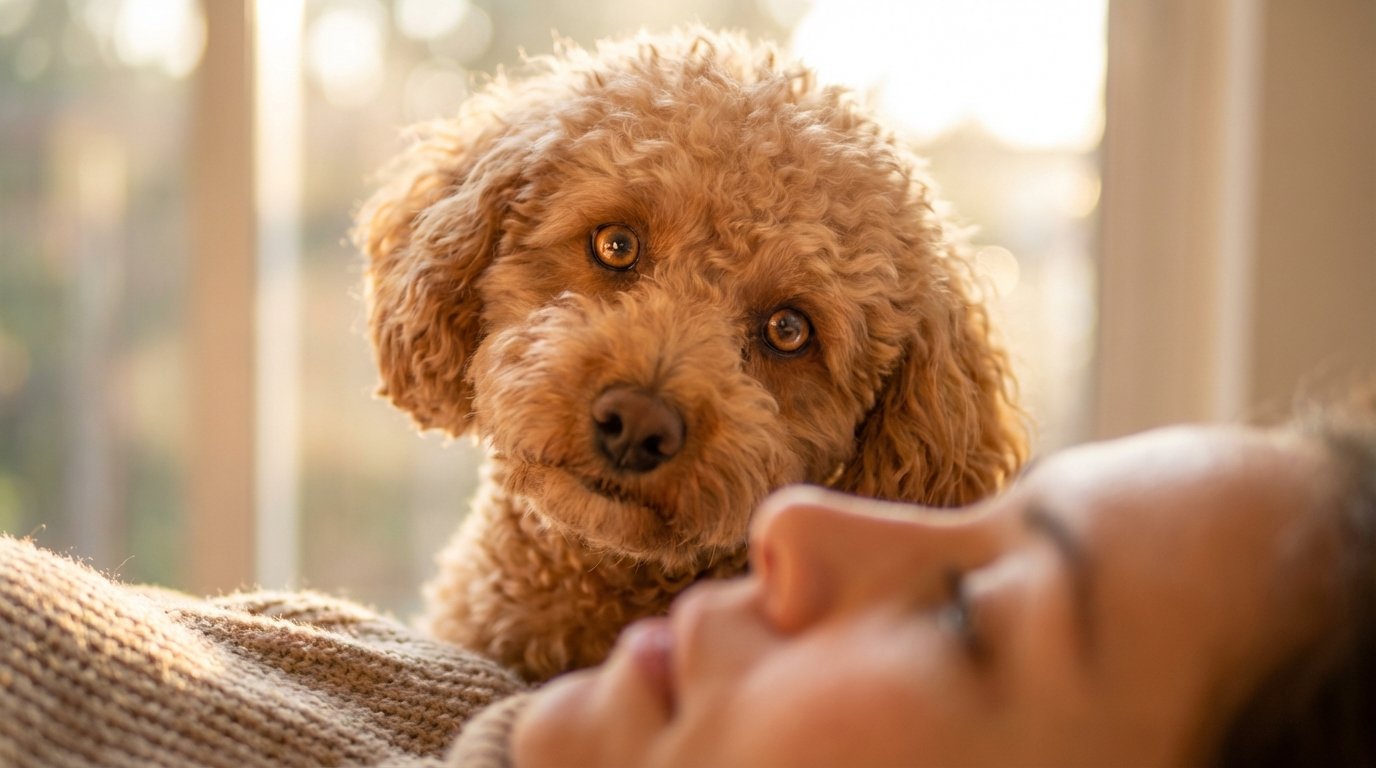
Emotional Response: Empathy in Action
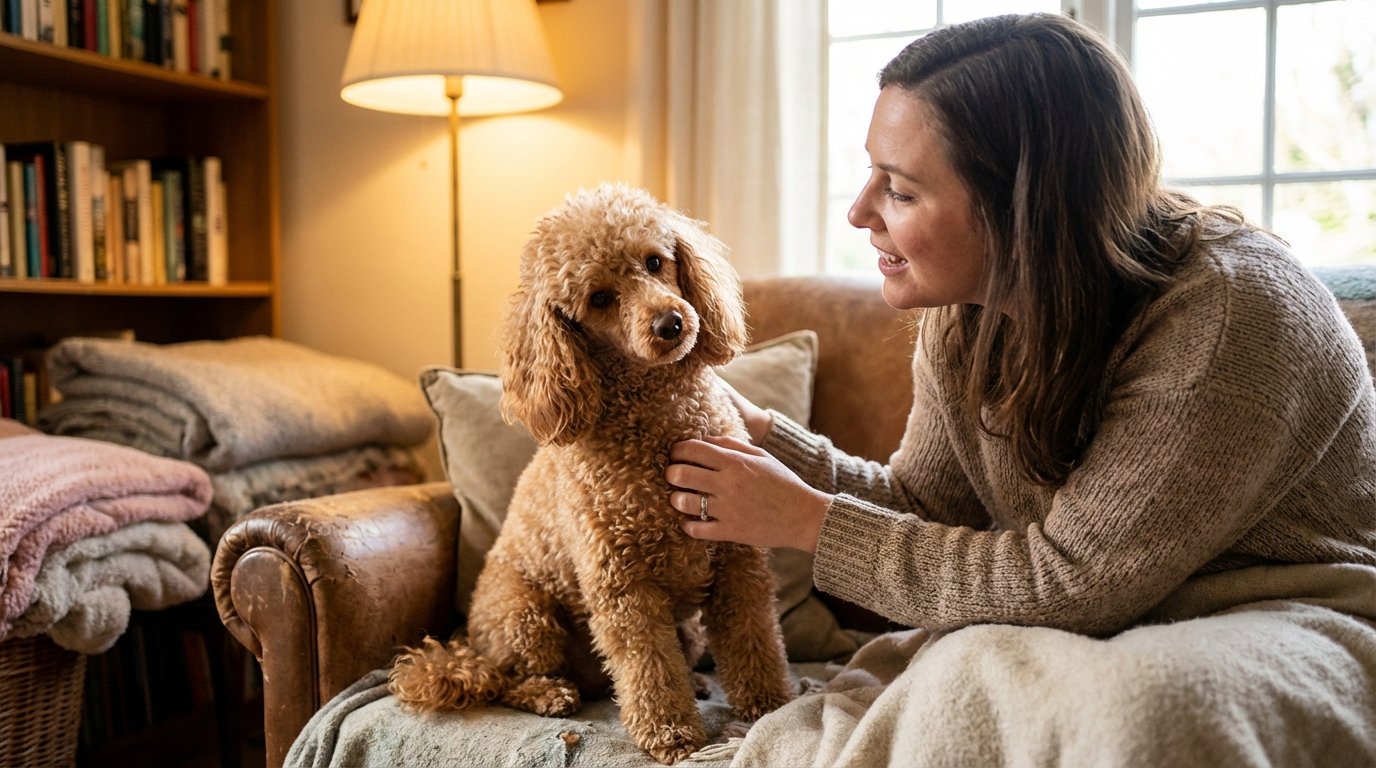
Poodles are one of the most emotionally intelligent dog breeds on the planet. They are famously sensitive to the moods of the people around them, which is precisely why they excel as therapy dogs, emotional support animals, and devoted family companions. The head tilt is a direct expression of that emotional attunement.
When your poodle tilts its head in response to your tone of voice — especially when you sound sad, excited, or anxious — it is processing your emotional state and demonstrating empathic engagement. This is not anthropomorphization; it is observable behavior backed by neurological research. Dogs have the same basic limbic brain structures that govern emotion in humans, and they respond to emotional cues in ways that closely parallel human empathy.
Poodles that have a strong bond with their owner tend to tilt their heads more frequently than those with weaker social attachments. The behavior is reinforced over time because humans almost universally respond with positive attention and affection — which makes the poodle more likely to repeat it. In this way, the tilt becomes a learned social behavior layered on top of its instinctive origins.
Vision Angles: Adjusting the Camera Lens
Beyond reading facial expressions, there are general visual geometry reasons why a dog might tilt its head. Dogs do not perceive depth and spatial relationships exactly as humans do. Their eyes are positioned to give them a wider peripheral field of view — excellent for detecting movement — but their binocular vision zone is narrower than ours.
When something in the environment is particularly interesting — a new object, an unusual movement, or a face at an unfamiliar angle — a poodle may tilt its head to shift its visual field and get a sharper, more three-dimensional read on what it is looking at. It is the equivalent of a person leaning in and squinting to focus on something across the room.
This is especially common when a poodle encounters something novel: a new toy, a person wearing a hat or sunglasses, or a screen showing animals. The tilt helps the brain build a more complete spatial picture of the unfamiliar object.
Curiosity: The Tilt as a Sign of an Active Mind
Sometimes a head tilt is simply what it looks like: curiosity. Poodles are intensely curious dogs with a deep need for mental stimulation. When something captures their interest — a new smell drifting through the window, a sound they cannot quite place, or a word they almost recognize — the head tilt is the physical manifestation of their brain spinning up to full processing power.
Think of the tilt as your poodle’s loading screen. The head goes sideways, the ears adjust, the eyes sharpen, and for a moment the whole dog becomes one focused instrument of perception. It is a beautiful illustration of why poodles are ranked the second most intelligent dog breed in the world, just behind the border collie.
Encouraging this curiosity — through enrichment toys, new environments, varied training challenges, and regular conversation — will keep your poodle mentally healthy and emotionally satisfied. And yes, it will give you more of those delightful sideways looks.
When Head Tilting Indicates Health Issues
While the head tilt is almost always a perfectly normal and healthy behavior, there are circumstances where it becomes a medical symptom rather than an expression of curiosity or communication. The key distinction is context and persistence. A poodle that tilts its head in response to sounds or conversation is doing something natural. A poodle that holds its head at a persistent, involuntary tilt — especially when accompanied by other symptoms — may be telling you something is wrong.
Ear Infections
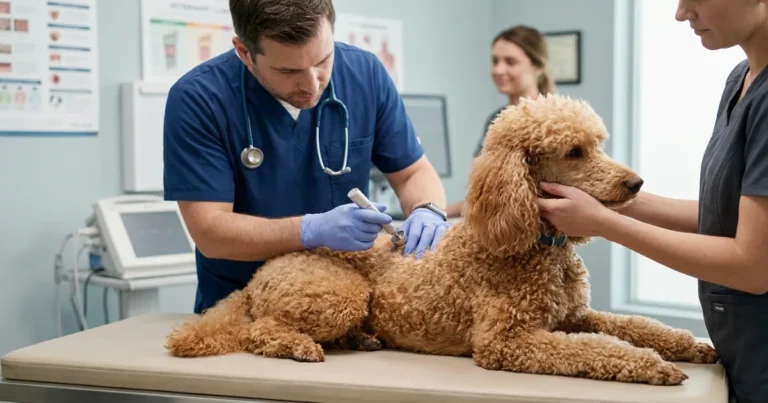
Poodles are unfortunately prone to ear infections, largely because of their floppy ears and the dense, curly hair that grows inside the ear canal. This combination restricts airflow, traps moisture, and creates a warm, humid environment where bacteria and yeast can thrive.
When a poodle develops an ear infection, one of the most common early signs is a persistent head tilt toward the affected ear. Watch out for these accompanying symptoms:
- Scratching at the ear
- Frequent head shaking
- Foul or yeasty odor
- Redness or swelling
- Dark waxy discharge
- Flinching when touched
Left untreated, ear infections can progress from the outer ear (otitis externa) to the middle and inner ear, where they become far more serious and can affect balance, hearing, and the vestibular system. Routine ear cleaning and keeping ear hair trimmed are the best preventive measures for poodle owners.

Neurological Problems
A head tilt that appears suddenly, is sustained, and does not vary with environmental stimuli is a potential red flag for a neurological issue. The most common neurological cause in dogs is idiopathic vestibular disease, also called “old dog vestibular syndrome” in senior dogs. It typically presents as a sudden, dramatic head tilt, loss of balance, falling to one side, rapid involuntary eye movement (nystagmus), and nausea.
While vestibular disease often resolves on its own within a few weeks, it requires a veterinary diagnosis to rule out more serious causes such as brain tumors, strokes, or inflammatory brain disease. Poodles — particularly toy and miniature varieties — can also be susceptible to hereditary neurological conditions. Any sudden change in head posture or balance should be evaluated promptly, as early diagnosis significantly improves outcomes for most neurological conditions.
Final Thoughts
The next time your poodle fixes you with that sideways gaze — head cocked, ears adjusting, eyes bright and focused — you can now see it for what it truly is: a sophisticated, multi-sensory act of communication. Your poodle is calibrating its hearing, clearing its sightline, reading your emotions, and processing your words all at the same time. It is intelligence and affection wrapped up in one irresistibly cute gesture.
Talk to your dog. Use their name. Give them things to be curious about. The more you engage with your poodle as the emotionally intelligent, socially attuned creature it is, the richer your bond will be — and the more of those wonderful head tilts you will get in return.
Just stay alert to the distinction between a behavioral tilt and a medical one. When in doubt, a quick check with your vet is always the right call. 🐾
Frequently Asked Questions
Why does my poodle tilt its head when I talk to it?
Your poodle tilts its head when you talk because it is actively working to hear and understand you better. The tilt helps it pinpoint your voice direction, pick up on emotional tone, and get a clearer view of your facial expressions — all at once. It is a sign of high engagement and social attentiveness, and one of the reasons poodles make such exceptional companion dogs.
Is head tilting in poodles a sign of intelligence?
Absolutely. Frequent and contextually appropriate head tilting is strongly associated with canine intelligence and social awareness. Poodles are the second most intelligent dog breed in the world, and their habitual head tilting reflects their drive to process human language, emotional tone, and body language. Studies have found that dogs with larger working vocabularies tilt their heads more in response to familiar words.
When should I be concerned about my poodle tilting its head?
Be concerned if the tilt is constant, involuntary, or does not change depending on what is happening around your dog. Warning signs that warrant a vet visit include loss of balance, stumbling or falling, rapid eye movements (nystagmus), nausea, circling, or a sudden onset of the tilt with no obvious trigger. These can indicate an ear infection, vestibular disease, or a neurological condition.
Do all dog breeds tilt their heads, or is it specific to poodles?
All dog breeds can tilt their heads, but how often they do it varies. Poodles tend to do it more frequently for two reasons: their floppy ears slightly muffle sounds, making the tilt a useful acoustic adjustment, and their high intelligence makes them more attentive to human communication. Breeds that are highly social and cognitively engaged with humans generally show the behavior more than more independent breeds.
Can I train my poodle to tilt its head on command?
Yes, and poodles are excellent candidates for this trick given their trainability. The easiest method is to identify a sound or word that naturally triggers a tilt, then immediately mark and reward the behavior with a treat and enthusiastic praise. Over several short sessions, introduce a verbal cue like “tilt” or a hand signal. Most poodles pick this up within a week of consistent short practice sessions.