Are Poodles Hypoallergenic? The Truth About Their Coat
The short answer is nuanced — and the long answer could change whether you bring a poodle home. Here is everything you need to know.
Few questions in the dog world generate as much confident misinformation as the question of whether poodles are hypoallergenic. Some breeders market them as completely safe for allergy sufferers. Some skeptics dismiss the idea entirely. The truth, as usual, lives somewhere in between — and it is grounded in immunology, canine biology, and a clear-eyed look at what the word “hypoallergenic” actually means.
This guide covers everything: what are poodles hypoallergenic really means from a scientific perspective, the structure of the poodle coat and why it matters, how much poodles actually shed, the most persistent myths around poodle allergies, and what you can realistically do — through grooming and management — to minimize allergen exposure in your home.
What “Hypoallergenic” Actually Means
The word “hypoallergenic” was coined in the cosmetics industry in the 1950s. It means “below normal” or “slightly allergenic” — not allergy-proof, not allergy-free. When applied to dogs, it has no regulatory definition, no scientific standard, and no enforcement mechanism. Any breeder can use it on their website without consequence.
That said, it is not a meaningless term. Some dog breeds genuinely produce or disperse lower levels of allergens than others. Poodles are among those breeds — and there is solid science to explain why. But to understand the nuance, you first need to understand what people are actually allergic to when they react to dogs.
The Real Culprit: Can f 1
Contrary to popular belief, most people are not allergic to dog fur itself. The primary dog allergen is a protein called Canis familiaris allergen 1, or Can f 1. It is produced primarily in the salivary glands, but also in the skin, urine, and to a lesser extent in hair follicles. When a dog grooms itself, Can f 1 from saliva is transferred onto the coat. From there it dries, flakes off as dander, and becomes airborne.
A secondary allergen, Can f 2, is also present in dog secretions and can trigger reactions in sensitive individuals. Both proteins are sticky, lightweight, and can remain airborne for hours and cling to surfaces — including walls, furniture, and clothing — for months.
This is an important distinction: every dog produces Can f 1. No breed is allergen-free. What varies between breeds — and where poodles genuinely outperform most — is how much of that allergen gets dispersed into the home environment. And that is almost entirely determined by the coat.
Poodle Coat Structure — Why It Is Different
To understand why poodles rank so highly among hypoallergenic dog breeds, you need to look closely at what makes their coat biologically unusual. The differences are significant enough to create a measurably different allergy experience compared to most other breeds.
Single-Layer Coat
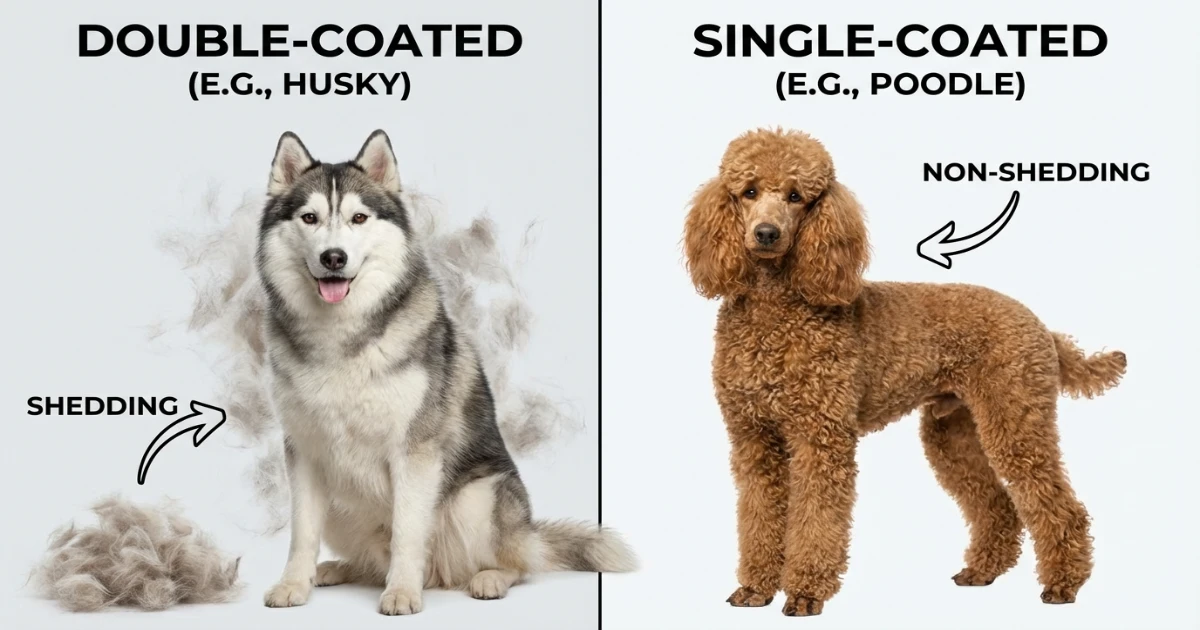
The vast majority of dog breeds have a double coat — a dense, insulating undercoat beneath a longer outer coat. This undercoat sheds heavily, particularly during seasonal changes, releasing enormous quantities of loose hair and attached dander into the environment. Poodles have a single-layer coat with no undercoat at all. There is no mass seasonal shed, no tumbleweeds of fur rolling across your floor, and dramatically less loose hair circulating in the air.
Tight Curl Pattern
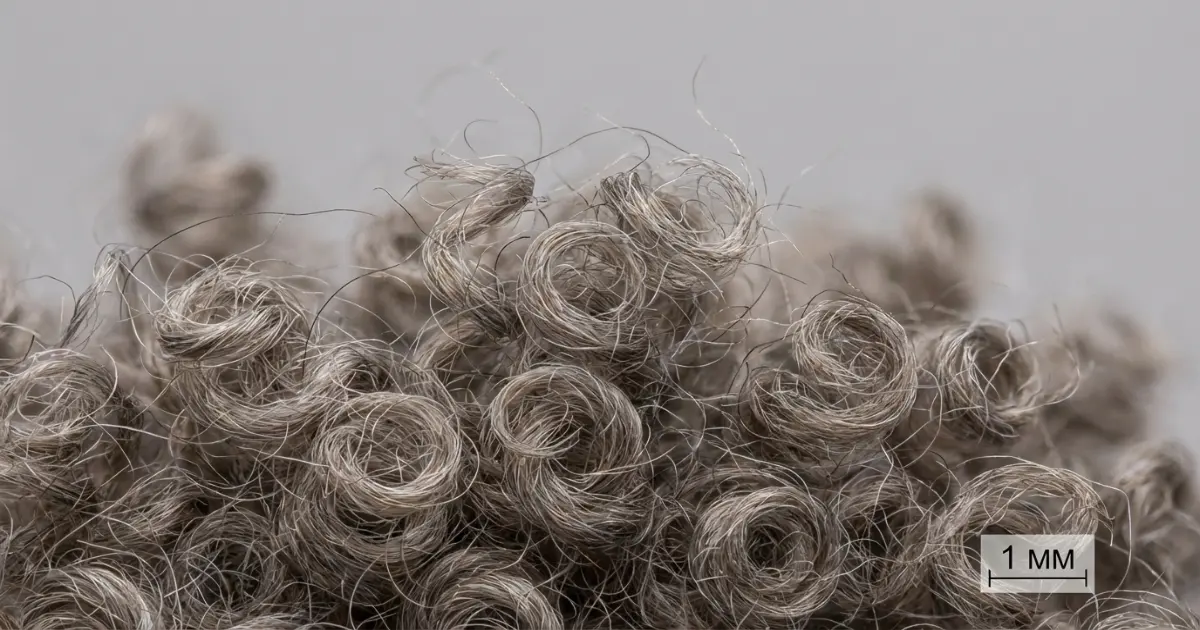
The poodle’s coat grows in dense, tight curls — sometimes described as a “fleece” texture in younger dogs and a tighter, woolier texture as the dog matures. When the coat does shed individual hairs (which it does at a very low rate), those hairs do not fall freely to the floor. Instead, they become trapped within the curl structure of surrounding hairs. This means shed hair — and the dander clinging to it — stays within the coat rather than floating into the air or settling on upholstery.
Continuous Growth, Not Seasonal Cycles
Unlike double-coated breeds that follow boom-and-bust shedding cycles tied to daylight hours, the poodle’s coat grows continuously — somewhat like human hair. It does not naturally fall out in large quantities but instead requires regular clipping to manage length. This continuous-growth model means there is no “allergy season” with poodles where dander output spikes dramatically.
Typical Double-Coat Breed
Two layers, heavy undercoat. Sheds constantly, surges seasonally. Loose hair disperses freely into air, furniture, and clothing, carrying dander throughout the home.
Poodle Coat
Single layer, no undercoat. Minimal shedding. Loose hairs trapped in curls. No seasonal surge. Dander largely contained within the coat until removed by grooming.
The Result for Allergy Sufferers
Far less airborne dander, far less hair on surfaces, and a significantly lower allergen burden throughout the home — especially with consistent, regular grooming.
It is also worth noting that poodle coat type varies somewhat with age. Puppies typically have a softer, less tightly curled coat that may shed slightly more than the mature adult coat. The characteristic dense, curly fleece fully establishes itself around 12 to 18 months of age.
Do Poodles Shed? The Real Answer
This is one of the most googled questions about the breed — and the answer surprises many prospective owners. Yes, poodles do shed — but the quantity and mechanism are so different from most other dogs that the word “shed” barely applies in the same way.
All mammals shed hair as part of normal follicle cycling. A poodle loses hair too, but at a rate that is a fraction of most other breeds, and without the airborne dispersal that makes dog hair such a problem for allergy sufferers. For a thorough breakdown of the shedding specifics, including how shedding differs across the Toy, Miniature, and Standard varieties, see the dedicated guide on whether poodles shed — it covers the topic in much greater depth than this article can accommodate.
Shedding at a Glance
On a standard canine shedding scale from 1 (none) to 5 (heavy), poodles consistently score a 1 or low 2 — comparable to the Bichon Frisé, Maltese, and Portuguese Water Dog. For context, a Labrador Retriever typically scores a 4, and a Husky or German Shepherd scores a consistent 5.
The practical difference in a home environment is substantial: poodle owners typically report finding virtually no visible hair on furniture, bedding, or clothing — a stark contrast to life with a high-shedding breed.
The key caveat is that “trapped in the coat” does not mean “eliminated.” Shed hair that accumulates in the curls, combined with dried saliva, skin oils, and environmental debris, creates a buildup that must be managed through regular grooming. Left ungroomed, this accumulation can actually worsen allergen concentration in the coat over time — which is why the grooming section of this article is so important for allergy sufferers specifically.
5 Poodle Allergy Myths — Debunked
The gap between what people believe about poodle allergies and what the science actually says is wide. Here are the five most persistent myths — and the reality behind each one.
No dog is 100% allergy-safe. Poodles produce Can f 1 in their saliva and skin like every other breed. Individuals with severe dog allergies may still react, particularly to direct contact or being licked. The correct framing is that poodles are lower-allergen, not allergen-free.
Fur itself is not the allergen — the Can f 1 protein is. Poodle fur does reduce allergen dispersal by trapping dander, but it does not eliminate the protein at its source. Allergy sufferers can still react to poodle saliva, urine, and skin cells regardless of shed volume. The poodle shedding guide explores this distinction in more detail.
Poodle mix coat types vary significantly based on which parent’s genetics are expressed. A Labradoodle may inherit the poodle’s curly fleece — or the Labrador’s dense double coat. There is no genetic guarantee. Allergy sufferers considering a mixed breed should spend time with the specific dog before committing, and should not assume poodle-mix status equals low shedding.
This is occasionally true but unreliable as a strategy. Some individuals develop mild tolerance to a specific animal’s allergens with repeated low-level exposure. However, many allergy sufferers find their symptoms worsen with prolonged exposure, particularly if allergen buildup in the home goes unmanaged. Do not count on desensitization as a plan.
This one holds up. Studies measuring airborne Can f 1 levels in homes with different dog breeds consistently find lower concentrations in homes with low-shedding, single-coat breeds like poodles. Less shed hair in the environment means less surface area carrying dried allergen into the air — which translates to a genuinely reduced allergen exposure for residents.
“The question is not whether poodles produce allergens — they do. The question is whether their coat architecture disperses those allergens into your home — and here, poodles are genuinely exceptional.”
How Grooming Affects Allergen Levels
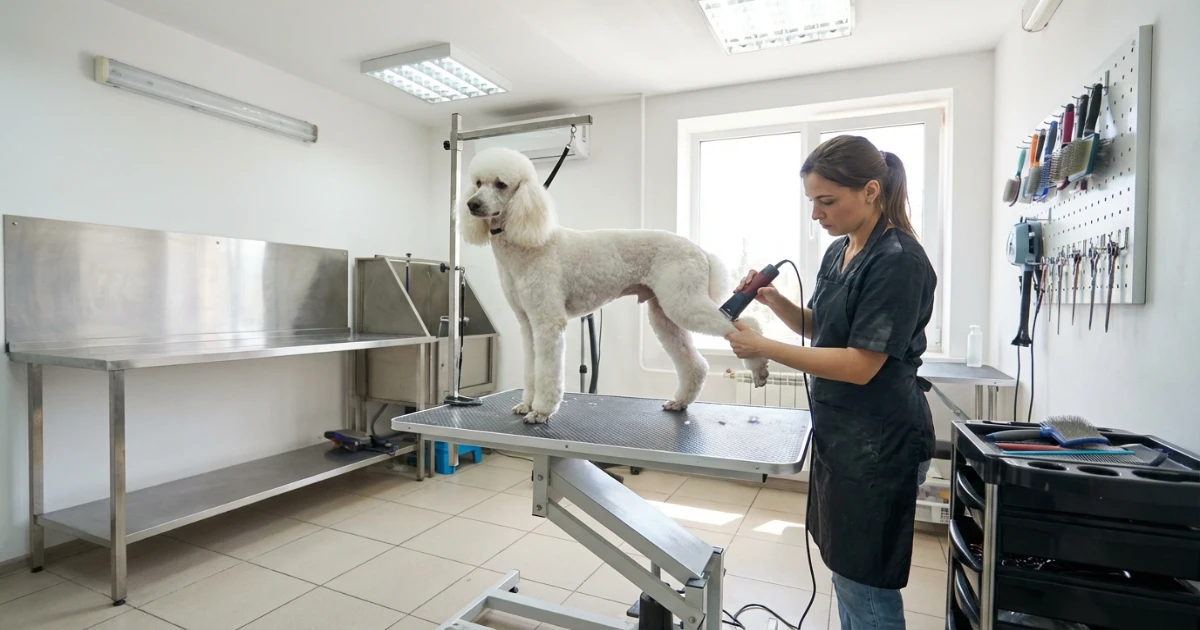
For allergy sufferers considering a poodle, grooming is not cosmetic — it is a medical intervention. The poodle’s coat, precisely because it traps shed hair and dander so effectively, becomes a reservoir of allergens if left unmanaged. How you groom, how often, and who does it makes a measurable difference to how much Can f 1 circulates in your home.
| Grooming Task | Frequency | Allergy Benefit |
|---|---|---|
| Professional clip / trim | Every 6–8 weeks | Removes accumulated dander, dried saliva, and debris from the coat; reduces coat volume that traps allergens |
| Bathing with dog shampoo | Every 3–4 weeks (or up to weekly for allergy households) | Washes Can f 1 off the coat surface; studies suggest frequent bathing reduces airborne allergens by up to 84% |
| Brushing / combing | Several times per week | Removes loose trapped hairs before they accumulate; prevents matting that harbors dander |
| Ear cleaning | Monthly (or as needed) | Poodle ear canals accumulate hair and moisture; cleaning reduces bacterial growth that can worsen skin inflammation and dander production |
| Face wipe after eating / drinking | Daily | Reduces saliva allergen transfer to surfaces the dog touches; particularly helpful for households with severe allergy sufferers |
Important: Who Grooms Matters Too
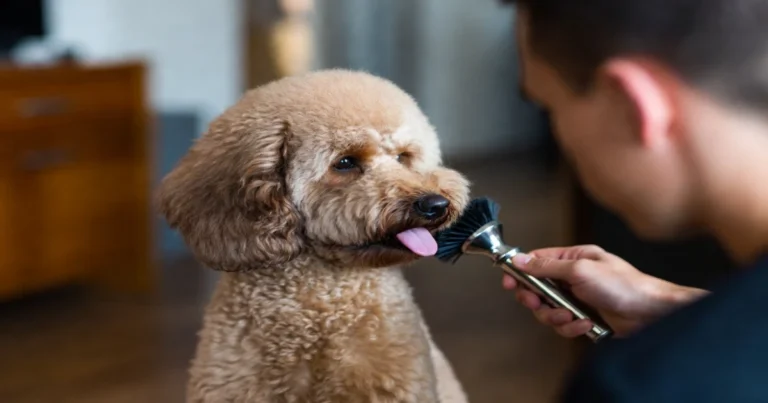
For allergy sufferers, having someone else groom the dog — or visiting a professional groomer — is significantly better than self-grooming. The act of brushing, clipping, or bathing releases a concentrated burst of dander and dried allergen into the immediate vicinity. If you must groom the dog yourself, do it outdoors, wear a mask, and shower immediately afterward.
A note on coat length: shorter clips reduce the total surface area of coat available to trap allergens, which is why many allergy-conscious poodle owners opt for shorter trims such as the “puppy clip” or “sporting clip” rather than the longer show-style coats. A dog with a dense, long coat is carrying significantly more accumulated dander than one kept in a close trim — particularly if brushing and bathing intervals are imperfect.
Living with a Poodle When You Have Allergies
If you have mild to moderate dog allergies and are seriously considering a poodle, there is genuine reason for optimism. Many people who thought dog ownership was impossible have successfully and comfortably shared their homes with poodles for years. The key is treating allergen management as a system — not a single solution.
-
1Spend time with a specific poodle before adopting. All poodles produce Can f 1, but individual dogs vary in how much allergen they produce. Spending an hour or two with a dog in an enclosed space is the only reliable way to gauge your personal reaction. Ask the breeder or rescue if you can visit more than once before committing.
-
2Establish a grooming schedule from day one. Build the bathing and brushing routine into your calendar before the dog even arrives home. Consistent grooming from puppyhood also socializes the dog to accept grooming calmly as an adult, making the process far easier long-term.
-
3Use HEPA air purifiers in key rooms. High-efficiency particulate air (HEPA) filtration captures airborne particles as small as 0.3 microns — well within the range of dried dander particles. Place a unit in the bedroom and the main living area for maximum impact.
-
4Keep the bedroom a dog-free zone. You spend a third of your life in the bedroom. Keeping the dog out and running a HEPA purifier overnight dramatically reduces the allergen load during the hours when your immune system is most vulnerable to sensitization.
-
5Wash pet bedding and soft furnishings weekly. Dog bedding, blankets, and fabric furniture accumulate Can f 1 rapidly. Washing at 60°C (140°F) or higher kills allergens; regular vacuuming with a HEPA-filtered vacuum cleaner removes surface accumulation between washes.
-
6Consider allergy immunotherapy. For individuals with confirmed dog allergy who are committed to poodle ownership, subcutaneous or sublingual allergy immunotherapy (allergy shots or drops) can meaningfully reduce sensitivity over time. Discuss this with an allergist alongside any lifestyle modifications.
-
7Opt for hard floors over carpet where possible. Carpet is a major allergen reservoir — it traps Can f 1 particles deep within its fibers and is extremely difficult to fully clean. Hard floors (wood, tile, laminate) can be mopped rather than vacuumed and accumulate dramatically less allergen over time.

What the Research Says
A 2011 study published in the American Journal of Rhinology & Allergy tested Can f 1 levels in homes with 60 different dog breeds and found no breed that was truly allergen-free. However, they did confirm significant variation in allergen levels between breeds and between individual dogs within the same breed — with smaller, lower-shedding breeds consistently producing lower home allergen burdens.
A separate study found that bathing dogs twice weekly reduced the amount of Can f 1 shed from the coat by up to 84% compared to unbathed dogs — the single most impactful management step available to allergy-sensitive owners.
Finally, if you have not yet had formal allergy testing, it is worth doing before committing to any dog. An allergist can identify exactly which proteins you are reacting to, the severity of your sensitivity, and whether allergen-specific immunotherapy might make poodle ownership viable even if your initial test visit produces a reaction. Knowledge is the most useful tool here.
Frequently Asked Questions
No dog breed is 100% hypoallergenic. Poodles are considered low-allergen dogs because their curly, low-shedding coat traps dander close to the skin rather than dispersing it into the air. However, they still produce the Canis familiaris allergen 1 (Can f 1) protein in their saliva, urine, and skin cells, which can trigger reactions in sensitive individuals.
Poodles do shed, but at a far lower rate than most other breeds. Their single-layer, tightly curled coat holds shed hairs within the curl structure rather than releasing them into the environment. This dramatically reduces airborne dander and loose hair in the home, making poodles one of the most allergy-friendly choices available. For a full breakdown, read the complete poodle shedding guide.
All three poodle sizes — Toy, Miniature, and Standard — share the same low-shedding coat type, so there is no meaningful allergy difference based on size alone. Toy Poodles have less total body surface area and therefore produce less dander in absolute terms, which some allergy sufferers find beneficial.
Many people with mild to moderate dog allergies successfully live with poodles. The key factors are consistent grooming (every 6–8 weeks), regular bathing (every 3–4 weeks), HEPA air filtration, washing pet bedding frequently, and keeping the dog out of the bedroom. Spending time with a specific poodle before adopting is the most reliable way to gauge personal tolerance.
Yes. The primary dog allergen — Can f 1 — is found in saliva, not fur. When a poodle licks itself, allergens are transferred to the coat and then to surfaces the dog touches. Allergy sufferers should avoid face licking, wash hands after petting, and bathe the dog regularly to reduce the allergen load on the coat.
Yes, grooming significantly reduces the allergen burden associated with poodles. Professional clipping removes accumulated dander, dried saliva, and environmental debris from the coat. Studies suggest bathing a dog as frequently as twice a week can reduce airborne allergen levels by up to 84%. Regular grooming is one of the highest-impact steps an allergy-sensitive poodle owner can take.
Not reliably. Poodle mixes inherit a range of coat types depending on which parent’s genetics dominate. A Labradoodle or Goldendoodle may inherit the poodle’s curly low-shed coat — or the heavy shedding double coat of the retriever parent. Individual variation is significant, and allergy sufferers should not assume a doodle breed will be as low-allergen as a purebred poodle.
The Bottom Line on Poodles and Allergies
Poodles are genuinely among the best choices available for allergy-sensitive dog lovers — but they are not a magic solution. Their unique single-layer coat, minimal shedding, and trapped-dander architecture give them a real, scientifically supported edge over most other breeds. Pair that advantage with consistent grooming, smart home management, and a personal allergy assessment, and poodle ownership is achievable for many people who thought dogs were out of reach.
Read the Full Poodle Shedding Guide →