Poodle vs Cockapoo: 7 Crucial Differences
Poodle vs Cockapoo is one of the most common choices for families who want a smart, affectionate, curly-coated companion. One gives you predictable purebred traits; the other blends Poodle and Cocker Spaniel qualities in a less predictable but often charming hybrid. Here’s the full side-by-side breakdown to help you decide with your eyes wide open.

Quick Answer
In the Poodle vs Cockapoo decision, the purebred Poodle is the safer choice if you want a known coat type, highly trainable mind, and clear size options. A Cockapoo can be a delightful family companion, but you inherit more variability — in coat, shedding, adult size, and sometimes health — because it’s a hybrid. The real question isn’t which one is “better,” but whether you prefer a known quantity or are willing to embrace a wider range of possible outcomes.
In This Guide
- Quick Answer
- Quick Facts at a Glance
- What Is a Cockapoo, Exactly?
- Size & Appearance
- Coat & Grooming: The PoodleGuru Hybrid Coat Evaluation Method
- Temperament & Trainability
- Health & Longevity
- The PoodleGuru Hybrid Decision Method
- Price & What Affects It (2026)
- Buyer Red Flags & Common Mistakes
- Related Reading on PoodleGuru
- FAQs
- Final Summary & Key Takeaways
Poodle vs Cockapoo Quick Facts at a Glance
Poodle (Toy / Miniature)
- Size: 4–15 lbs (Toy), 10–15 lbs (Miniature)
- Coat: Curly, single coat, virtually non-shedding
- Lifespan: 12–15 years
- Trainability: Exceptionally high
- Breed status: Purebred, recognized by AKC
Cockapoo
- Size: 12–24 lbs typically (varies widely)
- Coat: Can be curly, wavy, or straight; may shed lightly
- Lifespan: 13–16 years
- Trainability: High, but with independent streaks
- Breed status: Hybrid (not recognized by AKC)
Key Difference in One Sentence
A Poodle’s traits are the result of centuries of selective breeding for consistency; a Cockapoo blends two breed blueprints, so every puppy is a unique genetic shuffle.
What Is a Cockapoo, Exactly?
A Cockapoo is a hybrid cross between a Cocker Spaniel and a Poodle, typically a Miniature or Toy Poodle, that inherits traits from both parent breeds. For poodle owners, this means the dog may or may not have a true low-shedding coat and may vary significantly in temperament. The most important thing to understand is that no two Cockapoos are exactly alike — even littermates can differ in coat type, size, and energy level, because first-generation hybrids lack the genetic uniformity of a pure breed.
Many people think a Cockapoo is just a curly‑coated, smaller Poodle with floppy ears. In reality, the Cocker Spaniel influence brings a double coat, a more rounded skull, and a sometimes more strong‑willed personality into the mix. The result can be wonderful — or it can surprise you. Knowing what you might get is the key to avoiding disappointment.
Breed Origins & Why the Hybrid Exists
The Poodle’s history as a water retriever gave it sharp intelligence and a coat that resists matting when wet. The AKC recognizes three Poodle sizes, each with a consistent standard that breeders have worked to preserve for decades.
The Cockapoo first appeared in the 1960s, part of the early “designer dog” movement. The goal was to blend the Poodle’s low-shed coat and cleverness with the Cocker Spaniel’s gentle, affectionate nature. While the intent was solid, the outcome isn’t guaranteed because first-generation crosses don’t breed true. You might get the best of both worlds; you might get the worst of one. The Cocker Spaniel, one parent of the Cockapoo, is known for a merry temperament but also brings potential for ear infections, a heavier shedding undercoat, and a shorter muzzle that can affect breathing.
Poodle vs Cockapoo Size & Appearance
Purebred Poodles come in clearly defined size categories. When someone compares “poodle vs cockapoo,” they’re usually picturing a Toy or Miniature Poodle against a similarly sized Cockapoo. The table below shows typical ranges, but Cockapoos can fall outside these norms.
| Trait | Toy Poodle | Miniature Poodle | Cockapoo (typical) |
|---|---|---|---|
| Weight | 4–6 lbs | 10–15 lbs | 12–24 lbs |
| Height at shoulder | ≤10 inches | 10–15 inches | 10–15 inches |
| Body shape | Square, elegant, fine‑boned | Square, sturdy, athletic | Variable: often slightly longer, sturdy |
| Muzzle | Long, straight | Long, straight | Medium length; may inherit shorter Cocker muzzle |
| Coat predictability | Always curly, single coat | Always curly, single coat | Curly, wavy, or straight; can be double or single |
Cockapoo size varies partly because the Poodle parent may be Toy or Miniature. If the breeder uses a Toy Poodle, the pups often stay under 15 pounds; a Miniature pairing can push them toward 20 pounds or more. Even within the same litter, some may be leggy like a Poodle, others more compact like a Cocker Spaniel.

Coat & Grooming: The PoodleGuru Hybrid Coat Evaluation Method
Coat surprises are the number one source of owner frustration with Cockapoos. Because hybrids can inherit either parent’s coat type, you can’t assume you’ll get the Poodle’s signature curls. Our method gives you a systematic way to assess what you’re likely taking on.
The PoodleGuru Hybrid Coat Evaluation Method
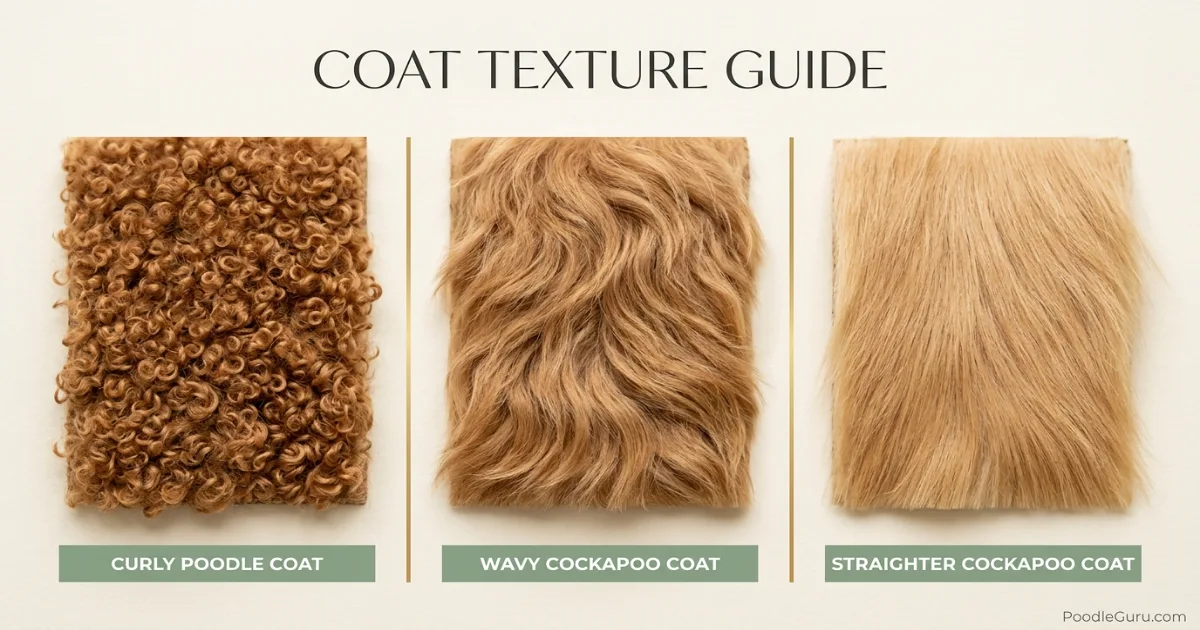
Identify the coat type. Pure Poodles have a single, tightly curled coat that traps shed hair. A Cockapoo’s coat falls into three categories: curly (closer to Poodle, low-shed), wavy (often a mix, light shedding possible), or straight (closer to Cocker Spaniel, noticeably more shedding).
Assess matting risk. Curly Cockapoo coats tangle similarly to a Poodle’s and need brushing every 2–3 days. Wavy coats mat faster, sometimes daily brushing is needed. Straight coats shed more but mat less. A purebred Poodle’s single coat, kept in a short clip, is the easiest to maintain once you understand the routine.
Plan for professional grooming. Both dogs need appointments every 4–6 weeks. A purebred Poodle’s coat responds predictably to clipping. A Cockapoo with a mixed coat may require a groomer who understands how to blend textures — sometimes the coat grows unevenly, leading to extra shaping work and potentially higher cost.
Coat Reality Check
Many first‑time Cockapoo buyers are told the dog is “hypoallergenic.” While many individuals are low-shed, it’s not a guarantee. A straight‑coated Cockapoo can shed enough to trigger allergies. With a Poodle, you know exactly what you’re getting. When coat dependability matters, the purebred wins.
Temperament & Trainability
Poodles are famously keen to work with you. They read your body language, anticipate routines, and thrive on positive training. A bored Poodle can become anxious or barky, but mental engagement — puzzle toys, short training sessions — keeps them content. This is a dog that often feels like a clever partner.
A Cockapoo’s personality lives somewhere between the Poodle’s eagerness and the Cocker Spaniel’s gentle, sometimes stubborn, people‑pleasing. Many Cockapoos are affectionate, cheerful, and trainable, but you may see more independence. They’re less likely to need a “job” and more likely to be satisfied with cuddles. However, if the Cocker Spaniel’s stubborn streak comes through, housetraining can take longer, and recall may be less reliable off‑leash than with a Poodle.
Both breeds do well with children when socialized early. Toy Poodles are delicate, so they suit families with older, gentle kids. Cockapoos often fall into a sturdier size bracket, which can feel like an advantage if you have younger children — but supervise play regardless.
Health & Longevity
The average Poodle lifespan is 12–15 years. Cockapoos often live 13–16 years, partly due to hybrid vigor — but that’s not a health guarantee. Purebred Poodles can face patellar luxation, progressive retinal atrophy, Addison’s disease, and hip dysplasia in larger sizes. Responsible breeders screen for these.
Cockapoos may inherit health issues from either parent. The Cocker Spaniel side brings risks of ear infections (those floppy ears trap moisture), eye problems including glaucoma, and heart disease. The Poodle side can pass on the same conditions listed above. Without careful health testing across both parent lines, you’re doubling the pool of potential inherited disorders.
When to Call a Vet
For any dog — purebred or hybrid — seek veterinary attention if you notice sudden lameness, eye redness or cloudiness, persistent head shaking, changes in appetite or thirst, or labored breathing. This article is educational; always defer to your veterinarian’s advice. For breed‑specific health information on Cockapoos, PetMD’s Cockapoo breed profile is a useful reference.
The PoodleGuru Hybrid Decision Method
At PoodleGuru, we guide readers through a clear, step‑by‑step evaluation to decide between a purebred Poodle and a Cockapoo. This method prioritizes your real‑life tolerance for unpredictability.
Rate your need for predictability. If you’d feel uneasy not knowing whether your dog will shed, how large it will grow, or how its coat will behave, a purebred Poodle is the stronger choice. Consistency is the purebred’s superpower.
Examine the specific Cockapoo’s parentage. An F1 Cockapoo (first-generation cross) has the most variable traits. An F1b (backcross to Poodle) often has a curlier coat and more Poodle‑like temperament, but still not guaranteed. Ask the breeder exactly which generation the puppy is and what coat types previous litters produced.
Assess health clearances, not just promises. For a Poodle, ask to see OFA patella, eye, and — if Miniature or Standard — hip clearances. For a Cockapoo, demand the same clearances on both the Cocker Spaniel and Poodle parents. A breeder who can’t produce them isn’t doing their job.
Meet adult dogs, not just puppies. An adult Poodle’s energy and coat are what you’ll live with for years. An adult Cockapoo from the same breeder (or a similar cross) shows you the range of possible outcomes. If you can’t meet an adult, you’re taking a bigger gamble.
Honestly list your must‑haves. If “low shedding” is non‑negotiable, go Poodle or a confirmed curly‑coated Cockapoo from a backcross line. If “gentle, lower‑intensity companion” tops your list, a well-bred Cockapoo might fit beautifully. Write down three deal‑breakers and see which dog clears them.
Poodle vs Cockapoo Price & What Affects It (2026)
Well‑bred Toy or Miniature Poodles typically cost $1,500–$3,000, with champion lines or rare colors trending higher. Cockapoo prices often sit in a similar range — $1,800–$3,500 — partly because the “designer” label inflates demand. But a higher price doesn’t automatically mean healthier.
What Inflates Price — and What’s Actually Worth Paying For
“Rare” coat colors, tiny “teacup” claims, or trendy marketing can push Cockapoo prices above $4,000. Those markups aren’t health guarantees. Worthwhile costs include comprehensive genetic testing on both parents, early socialization programs, and a breeder who provides a multi‑year health guarantee. If a seller can’t produce verifiable health clearances, the price isn’t justified — no matter how cute the puppy looks online.
Buyer Red Flags & Common Mistakes
Some mistakes show up repeatedly, whether you’re shopping for a Poodle or a Cockapoo. Here are the warning signs and the right move.
| Red Flag | Why It Matters | What to Do Instead |
|---|---|---|
| “Hypoallergenic guarantee” on a Cockapoo | No hybrid can guarantee coat type without a backcross and even then it’s not 100%. | Request a coat forecast from the breeder and meet adult siblings. |
| Breeder won’t show health clearances | Increases risk of inherited joint, eye, or cardiac conditions. | Only buy from breeders who share OFA or equivalent documentation. |
| Puppy sold before 8 weeks | Interferes with crucial socialization and bite inhibition. | Wait until at least 8 weeks; 10–12 weeks is better for some hybrids. |
| “Teacup” or “micro” sizing claims | Often a sign of undernourished runts or unethical breeding for extreme small size. | Choose a Toy Poodle from a breeder who prioritizes health over tiny size. |
Frequently Asked Questions
Which is better for allergies, a Poodle or a Cockapoo?
A purebred Poodle is the safer choice. Its single curly coat traps dander and shed hair extremely effectively. Cockapoos can range from low-shed to moderate shedding, so allergy sufferers may react to a straight‑coated individual.
Are Cockapoos healthier than purebred Poodles?
Not necessarily. Hybrid vigor can reduce some recessive disorders, but Cockapoos can inherit health problems from both parent breeds. A well-bred Poodle from health‑tested lines often has a more predictable health outlook than a poorly bred Cockapoo.
Do Cockapoos bark a lot?
It varies. Poodles can be alert barkers; Cockapoos may be quieter if they inherit the Cocker Spaniel’s mellower nature. But any dog without enough mental stimulation can develop nuisance barking. Early training shapes this behavior more than breed alone.
Poodle vs Cockapoo: which is easier to groom?
A Poodle kept in a short clip is easier to maintain predictably. Cockapoo coats range from easy-care to high‑maintenance. You won’t know which you have until the adult coat comes in, usually by 12–18 months.
Can Cockapoos compete in dog sports like Poodles?
Poodles excel in obedience, agility, and rally. Cockapoos can participate, but because they’re not a recognized breed, they compete in mixed‑breed or performance events. Training ability depends on the individual, but Poodles have a proven competitive edge.
Is a Cockapoo just a mixed‑breed dog with a fancy name?
Yes — a Cockapoo is a deliberate crossbreed, not a pure breed. The name reflects the intent to blend specific traits, but it’s not recognized by major kennel clubs. That doesn’t make it a lesser dog, but it does mean no breed standard protects its traits.
How much does a Cockapoo cost vs a Poodle?
Both typically range $1,500–$3,500. Cockapoos sometimes command higher prices due to “designer” demand, but that doesn’t mean you’re getting a healthier or better-tempered dog. Health testing matters more than the sticker price.
Final Summary & Key Takeaways
Poodle vs Cockapoo: you’re not choosing between a good dog and a bad one. You’re choosing between a dog whose every feature has been shaped by generations of careful breeding, and a hybrid whose charm lies in its one‑of‑a‑kind blend. Your decision should hinge on how much variability you can welcome.
- A purebred Poodle gives you consistent coat type, size, and temperament — ideal if predictability matters.
- A Cockapoo’s coat can be curly, wavy, or straight; shedding and grooming needs can’t be guaranteed in a first-generation cross.
- Health testing on both parent breeds is non‑negotiable, whether you choose a purebred Poodle or a Cockapoo.
- Both dogs need professional grooming every 4–6 weeks and an owner committed to regular brushing.
- Cockapoos often cost as much as — or more than — a well-bred Poodle; price does not equal quality.
- Use the PoodleGuru Hybrid Decision Method to evaluate your own tolerance for unpredictability before you commit.
Ready to build a rock‑solid care routine? Start with our Complete Poodle Grooming Guide — it’s the next essential read for anyone bringing home a curly‑coated companion.