Poodle Clicker Training: How It Works (A Beginner Guide That Actually Makes Sense)
Quick Answer: Poodle clicker training works by using a small handheld device that makes a distinct “click” sound to mark the exact instant your dog performs the behavior you want. The click is immediately followed by a high-value treat. Because Poodles are exceptionally quick at forming associations, the click becomes a powerful communication bridge — it tells the dog, “That precise thing you just did earns a reward.” This clarity accelerates learning, deepens focus, and eliminates the frustration of poorly timed praise.
Some training methods ask a Poodle to guess what you want. Poodle clicker training, by contrast, hands the dog a clear, consistent signal that cuts through confusion. If you have ever watched a Poodle tilt her head in that famously perceptive way, you already know she is waiting for a conversation, not a command. The clicker becomes the precise word in that conversation, and once the system clicks — literally — the speed of learning feels almost magical.
This guide does not assume you have ever held a clicker before. It will walk you through exactly how the method works, why Poodles in particular thrive on it, what mistakes trip up newcomers, and how to start tomorrow morning with nothing more than a cheap plastic box and a handful of treats.
What Is Clicker Training, and Why Is It Uniquely Suited to Poodles?
Clicker training is a form of operant conditioning where a neutral stimulus — the click — becomes a conditioned reinforcer. There is nothing mystical here. The clicker does not mean “good dog” in some universal language; it means food is coming. But unlike a voice cue, the click is fast, identical every time, and completely free of emotional baggage. Your Poodle never hears disappointment in a click. She never hears impatience. She hears a crisp, split-second marker that captures the exact leg lift, nose touch, or quiet pause you want to grow.
Poodles are a breed that notices micro-details. They are hypersensitive to tone and timing. A verbal “good” that arrives half a second late can muddy the lesson. A click, delivered right on the behavior, eliminates that noise. For a dog who already processes information at a dizzying speed, the clicker is like finally giving her the right file format.
How Poodle Clicker Training Actually Works: The Communication Bridge
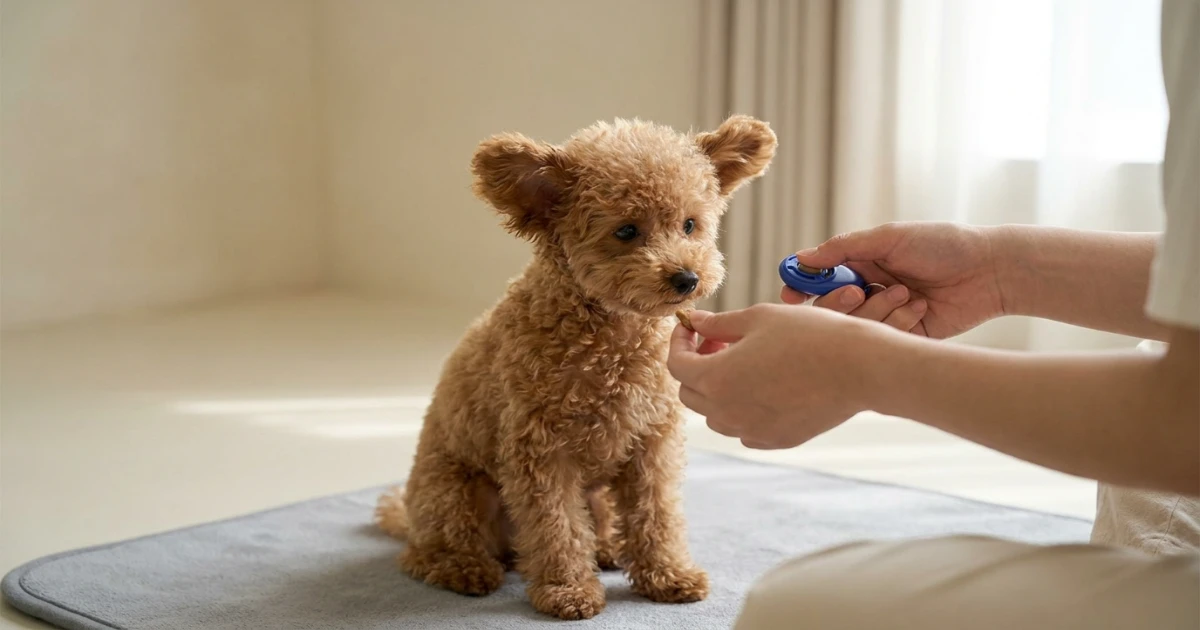
Imagine you are teaching a child to play a note on a piano. If you wait until the end of the piece to say “good job,” the child does not know which note earned the praise. If you instead mark the exact moment her finger strikes the correct key, learning accelerates. That is what the clicker does for your Poodle. It bridges the gap between the behavior and the treat delivery, which might come a second or two later. The click says, “That right there — store that.”
Here is the sequence: the Poodle does a behavior (a sit, a paw lift, eye contact). The instant the behavior occurs, you click. Then you reach for the treat and give it. The order is non-negotiable: behavior → click → treat. Never click after the treat has already been offered. Never click to get the dog’s attention. The click is a photograph of a moment.
What You Need to Start (Hardware and Heartware)
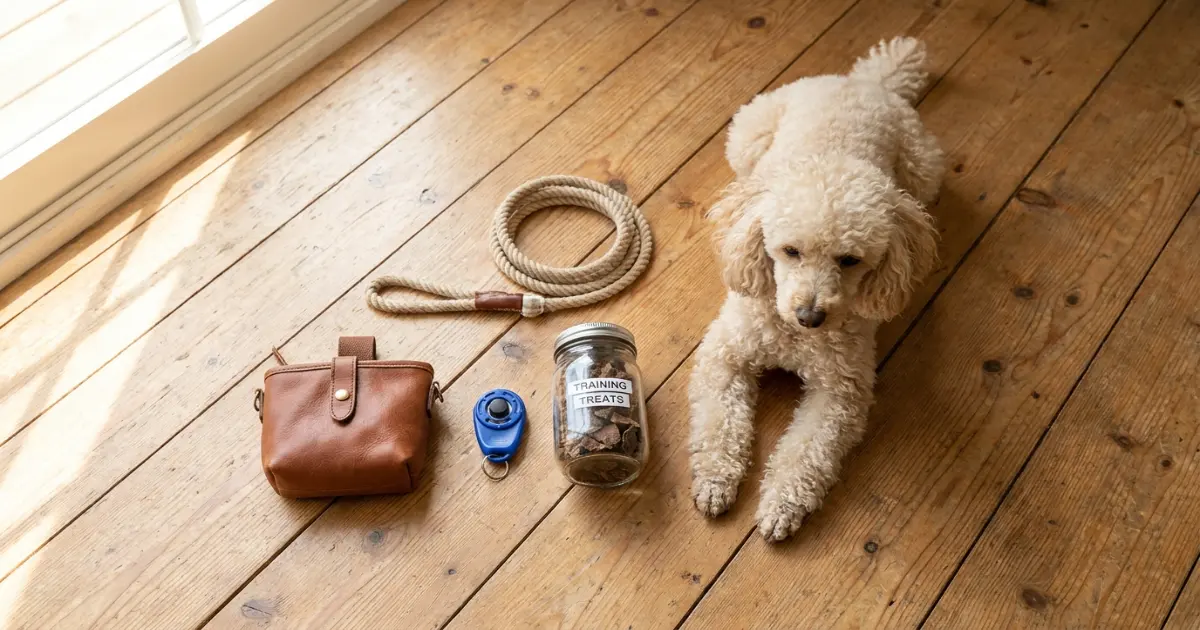
The equipment list is laughably short: a box clicker (or a clicker app on your phone, but a physical clicker provides more consistent sound), a treat pouch that keeps rewards accessible in under two seconds, and a calm training space without competing distractions. You also need something no store sells — patience that outlasts your own frustration. A Poodle will sometimes get the game instantly. Other times she will stare at you as if you have lost your mind. Both reactions are normal.
Beyond the physical items, you need a clear idea of what you want to mark. “Being calm” is too vague. “Four paws on the floor for two seconds” is specific. The clearer you are about the goal, the cleaner your clicks will be.
Step-by-Step: How to Introduce the Clicker to Your Poodle
Step 1: Charge the Clicker
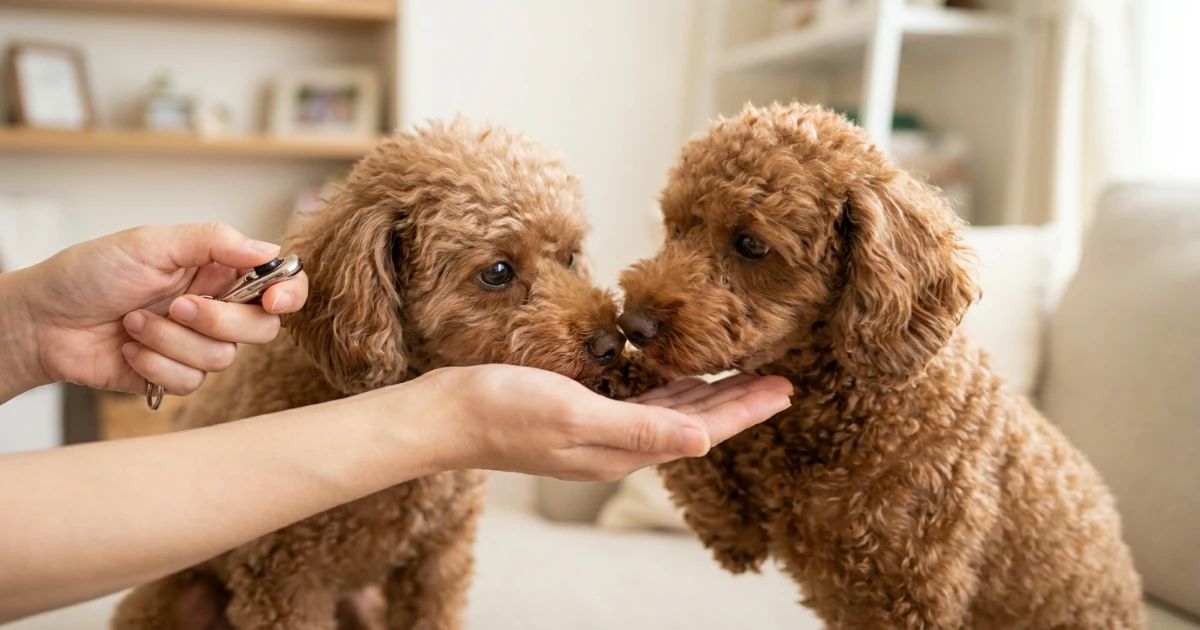
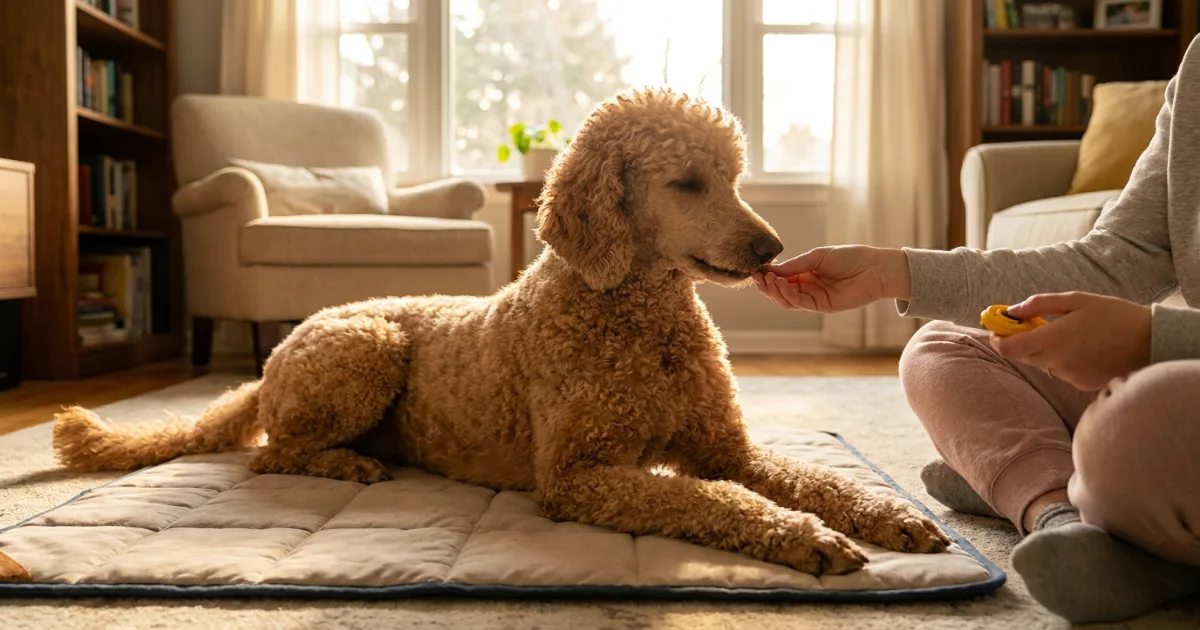
Sit with your Poodle in a quiet room. Without asking for any behavior, click once and immediately give a treat. Do this ten to fifteen times. Your dog does not have to do anything — she just needs to learn that the click predicts food. Within minutes, you will see her ears perk at the sound. That is the moment the clicker becomes meaningful. Do not rush past this step. A clicker that has not been charged is just background noise.
Step 2: Capture a Simple Behavior
Wait for your Poodle to do something naturally — a sit, a glance at your face, even just standing still for a breath. The instant it happens, click and treat. If she sits again, click-treat again. She will quickly realize her actions cause the click, and the click triggers the prize. At this stage, you are not giving any verbal cues. The dog learns to offer behaviors to “make you click.”
Step 3: Shape, Don’t Lure Too Much
Shaping means rewarding small steps toward a final goal. If you want a target touch with a nose to your palm, you might click for a slight head turn toward your hand, then for a step closer, then for an actual touch. Poodles adore this problem-solving process. Luring with a treat in your hand is fine to get started, but many Poodles become so focused on the treat that they stop thinking. Fade the lure quickly and let the clicker mark the dog’s own decisions.
Step 4: Add a Verbal Cue Later
Once the behavior is offered reliably — say, the Poodle sits three times without you saying a word — you can start saying “sit” just as she begins the motion. Click and treat. Soon she will connect the word to the action. The golden rule: name it only when you are willing to bet money she is about to do it anyway.
Common Beginner Mistakes That Slow Poodle Clicker Training
Even motivated owners slip up, and Poodles, being acute observers, can get confused quickly if the signal is scrambled. The most pervasive error is mistimed clicking. A click that arrives while the dog is already standing up after a sit rewards the rising, not the sit. The result? A Poodle who learns to sit and pop right back up. Film yourself. Most people click half a second late without realizing it.
Another mistake: holding the clicker like a remote control pointed at the dog. The sound comes from the device, not your hand direction, but your body language matters. A Poodle who sees you thrust the clicker toward her may become wary. Keep the clicker by your side or behind your back until the moment you click.
Neglecting to vary the reward placement also stalls progress. If you toss the treat to reset the position after every rep, the Poodle learns to expect the toss and might move before the click. Sometimes deliver the treat to her mouth while she holds position. Sometimes toss it to the side so she has to return. Variation keeps the lesson crisp.
| Mistake | How It Confuses a Poodle | Quick Fix |
|---|---|---|
| Late click | Marks the wrong behavior; Poodle memorizes error | Practice timing without the dog; click as a friend drops a ball |
| Clicking without treating | Devalues the click; Poodle stops responding | Every single click gets a treat, forever |
| Luring too long | Dog depends on treat in face, not thinking | Fade lure after 3–5 successes |
| Training sessions too long | Mental fatigue; Poodle shuts down or gets zoomies | 3–5 minutes, 2–3 times a day |
| Adding verbal cue too early | Poodle associates word with wrong action | Wait until behavior is predictable |
Clicker Training vs. Lure-Only Training for Poodles
Many owners rely entirely on a treat held in front of the nose to guide the dog into position — a lure. It works, but it has limits. A Poodle trained primarily with lures often tracks the treat, not the cue. Remove the visible treat, and the behavior falls apart. Clicker-trained Poodles learn that the invisible reward is what matters, and the click marks the action even when treats are out of sight.
Both methods overlap. The clicker is not anti-lure; it is just a more precise consequence marker. Even if you use a lure to get the sit, click exactly when the rear touches the floor. That separates the lure from the permanent lesson.
| Factor | Clicker Training | Lure-Only Training |
|---|---|---|
| Timing precision | Extremely precise marker | Marker is verbal “good” often late |
| Dog’s problem-solving | Encouraged; dog offers behaviors | Dog follows food; less active thinking |
| Fading the lure | Easier; reward not visible initially | Harder; dog depends on visible treat |
| Emotional tone | Neutral and consistent | Varies with owner’s voice mood |
| Best for complex tricks | Ideal for shaping chains | Limited beyond basic positions |
What Buyers and New Owners Commonly Misunderstand
Clicker training is not a “gadget fix” for a Poodle who is being stubborn. People sometimes purchase a clicker thinking the sound itself hypnotizes the dog into obedience. It does not. The magic lies entirely in the timing and the consistency of the human behind the tool. A clicker used carelessly is worse than useless — it installs wrong lessons at high speed.
Another false belief: that once a Poodle knows a behavior, the clicker should continue forever. Experienced trainers “bank” behaviors and move the clicker onto new challenges. The click is a teaching tool, not a permanent remote control. Eventually, everyday life rewards — a tossed ball, a door opening, a belly rub — replace the click and treat for known behaviors.
Also, some buyers think they need a professional-grade plan from day one. The truth is simpler: three minutes of charging the clicker, then clicking for random offered attention, is enough to start. The Poodle will teach you the rhythm if you let her.
Practical Owner Insight: Making the Clicker a Natural Part of Poodle Life
- Keep a clicker in multiple rooms. You never want to miss a spontaneous moment of brilliance — like the puppy sitting politely at the door instead of jumping.
- If you mess up a click, do not try to “undo” it. Just feed the treat and move on. The Poodle will not hold a grudge over a sloppy click; she will simply try again.
- Use the clicker to build calmness, not just action. Click for a deep breath, a soft eye blink, a relaxed down. Poodles need help learning that stillness earns good things.
- Introduce the clicker to Poodle puppies as early as eight weeks, but adult rescue Poodles respond just as brightly. Age is no barrier to the clicker game.
- If your Poodle barks at the clicker in excitement, you are not failing. Wait for a second of quiet, then click-treat. Congratulations — you just started training quiet.
Beyond Basics: What Clicker Training Unlocks in Poodles
Once the clicker is charged and your Poodle understands the game, the possibilities stretch far past sit and down. Poodles consistently rank among the top trick-performing breeds, and clicker training is the secret passage to behaviors that seem impossibly clever. You can shape a retrieve sequence, a “back up” through a narrow space, a nose-target to close a cabinet door, or a quiet chin rest on your lap for cooperative grooming.
For poodle sports — agility, rally, obedience — the clicker is practically standard equipment. It lets you mark a perfect contact zone hit or a precise front position without your voice betraying excitement that might break the dog’s concentration. The click is a cold, clean data point, and in the heat of a competition run, that precision counts.
Even everyday life improves. A Poodle who knows that a click marks polite greetings at the front door learns to control her impulses faster than one who is merely scolded for jumping. The clicker builds a dog who thinks, rather than one who simply reacts.
FAQs About Poodle Clicker Training: How It Works
- Do I have to use a clicker forever, or can I phase it out?
- You can phase it out once a behavior is fluent and on a verbal cue. The clicker is a teaching tool, not a life sentence. Once your Poodle performs the behavior reliably in different environments without the click, you simply stop clicking for that skill and reward intermittently with praise, play, or life rewards.
- Can I use the same clicker for multiple Poodles?
- Yes, but each dog must be trained separately at first. A click in a group session marks the behavior of only one dog at a time, which can confuse others if they are not highly experienced. Start individually, then later you can use the clicker with all dogs present once each understands the game.
- My Poodle is afraid of the clicker sound. What should I do?
- Muffle the clicker by wrapping it in a cloth or putting it in your pocket. Click with the device behind your back. Alternatively, use a ballpoint pen click or a soft “snap” of a clicker designed for sound-sensitive dogs. The key is to pair the quieter sound with an extraordinary treat until apprehension fades.
- Can clicker training help with a Poodle that pulls on the leash?
- Absolutely. Click and treat the moment the leash goes slack. Use a high rate of reinforcement — every single step with a loose leash earns a click-treat at first. Poodles quickly learn that slack lead equals reward, and tension earns nothing. The precise timing of the clicker makes this far more effective than verbal corrections.
- How long does it take for a Poodle to understand the clicker?
- Most Poodles understand the clicker means “treat incoming” within 10–15 repetitions of charging. The deeper game — offering behaviors to earn clicks — may emerge in the first session or take a few days. Every dog’s timeline differs, but the breed’s problem-solving nature usually accelerates the learning curve.
- Should I buy a specific type of clicker for a Poodle?
- A standard box clicker works perfectly. Some owners prefer a clicker with a wristband for quick access. Avoid clickers with overly sharp sounds that can startle a sensitive Toy Poodle. Test a few in the store; pick one that feels crisp but not jarring.
- Can I train without treats and only use the clicker?
- No. The click itself is not a reward — it is a promise that a reward is coming. Without a primary reinforcer following the click, the sound loses its meaning entirely. Treats, toys, or something the Poodle genuinely values must always follow the click.
Summary: The Click Is a Promise, and Poodles Keep Promises Well
Poodle clicker training works because it respects exactly who the Poodle is: a brilliant, sensitive, observant dog who thrives on clarity. The click is not a gimmick. It is a microscope that lets you zoom in on the exact moment of success, and when you hand the dog that clear picture, she hands back her willing mind. The tool costs a few dollars. The shift in your training relationship — from guessing to communicating — is worth far more.
Start small. Charge the clicker. Capture a single sit. Within days, you will see that look in your Poodle’s eyes that says, “I understand you now.” That is the whole point.