Poodle Genetic Testing: Which Tests to Get Before Buying and Why Guessing Isn’t Enough
Quick Answer: Before buying a poodle, the non-negotiable genetic tests are PRA-prcd (Progressive Retinal Atrophy), vWD (von Willebrand Disease), and NE (Neonatal Encephalopathy) for all varieties. Depending on the specific poodle type and breeder focus, you should also demand screening for DM (Degenerative Myelopathy), OA (Osteochondrodysplasia), and cardiac panels. A responsible breeder tests both parents and shares the results openly. If a breeder cannot produce verifiable DNA results before you put down a deposit, you are betting with the puppy’s health, and that’s a bet nobody wins.
People spend months researching a poodle’s expected coat color, predicted adult size, or whether they want a Moyen that’s “not too big and not too small.” But far too many buyers bypass the one factor that determines whether that puppy will actually see its fifth birthday without going blind, bleeding uncontrollably, or losing neurological function: poodle genetic testing.
This isn’t abstract canine genetics. It’s the difference between a companion who hikes with you for fourteen years, and a dog who struggles to stand before age three. Poodles—Standard, Miniature, and Toy—are genetically predisposed to a cluster of inherited diseases that are completely avoidable if breeders use modern DNA screening. And yet, the market is flooded with puppy listings that say “vet checked” or “parents are healthy” with zero mention of actual genetic panels.
We’re going to walk through every core test a poodle buyer should demand, what the results actually mean, how to spot a breeder who is cutting corners, and why some tests matter enormously in one poodle variety but barely apply to another. By the end, you’ll have a concrete checklist and the confidence to ask hard questions before you ever hand over a deposit.
Tests Every Poodle Needs
PRA-prcd, vWD, and NE form the baseline triad. Without these results, you have no safety net for the most common inherited poodle diseases.
Size-Specific Risks
Miniature and Toy Poodles need OA and patellar luxation screening. Standards require hip dysplasia evaluation and cardiac panels.
Test Cost Reality (2026)
Full parent panels cost breeders $150–$350 per dog. A breeder unwilling to invest that small sum per breeding dog is a red flag.
Buyer Checklist Item
Always ask for the dog’s registered name and look up results in the OFA database yourself. Transparency is everything.
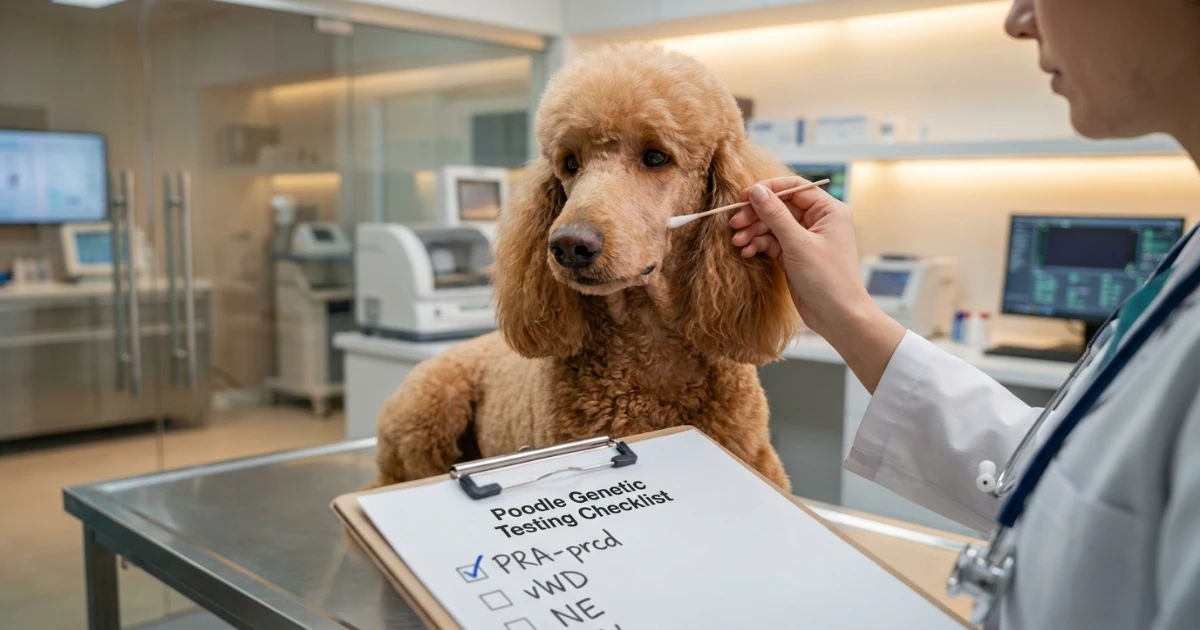
What Poodle Genetic Testing Actually Is (and What It Isn’t)
Poodle genetic testing refers to DNA-based screening that identifies whether a dog carries, is affected by, or is clear of specific inherited mutations known to cause disease in poodles. It’s not a general wellness check. It’s not a substitute for veterinary exams. It’s a targeted look at the dog’s actual genotype for conditions that poodle lines pass down silently.
A common misunderstanding: a “healthy” dog can still be a carrier. Carriers won’t get sick, but if bred to another carrier, roughly 25% of the puppies will be affected. That’s why testing both parents matters, not just the puppy. If both parents are clear for a recessive disease, the puppy is automatically clear by pedigree, though good breeders often test puppies anyway for confirmation.
Testing falls into three broad categories: recessive disease screening (the dog needs two copies of the mutation to be affected), dominant disease screening (one copy is enough), and complex trait screening (like hip dysplasia, which has a genetic component but can’t be reduced to a single gene). Most poodle genetic testing focuses on recessive conditions, because they are devastating and entirely preventable through informed breeding.
Why “Vet Checked” Means Absolutely Nothing for Inherited Poodle Diseases
Walk into any puppy sale conversation and you’ll hear “vet checked” thrown around like a shield. A general veterinary exam does not detect PRA-prcd. It doesn’t detect von Willebrand’s. It doesn’t detect neonatal encephalopathy. Those diseases are invisible on a physical exam in a bouncing eight-week-old puppy. The puppy looks perfect. The genes are already written.
Veterinary checks are important for general health, infectious disease, and structural soundness, but they have zero overlap with genetic testing. A breeder who relies solely on vet checks either doesn’t understand canine genetics or is deliberately hoping you don’t understand it. Either way, it’s a disqualifier.
Genetic testing, conversely, reads the actual DNA sequence and flags known mutations. The major panels used for poodles (Embark, Animal Genetics, Paw Print Genetics, OFA submissions) are highly accurate. False positives are rare; false negatives are even rarer for the core mutations. When a breeder gives you a PDF from one of these labs, you’re looking at the closest thing to a genetic guarantee you can get before purchasing.
The Non-Negotiable Core Tests: PRA-prcd, vWD, and NE
If you remember nothing else, remember these three. They apply to every poodle variety—Toy, Miniature, and Standard. Any breeder producing poodles without these results is not a breeder you should trust with your future family member.
PRA-prcd (Progressive Retinal Atrophy, Progressive Rod-Cone Degeneration)
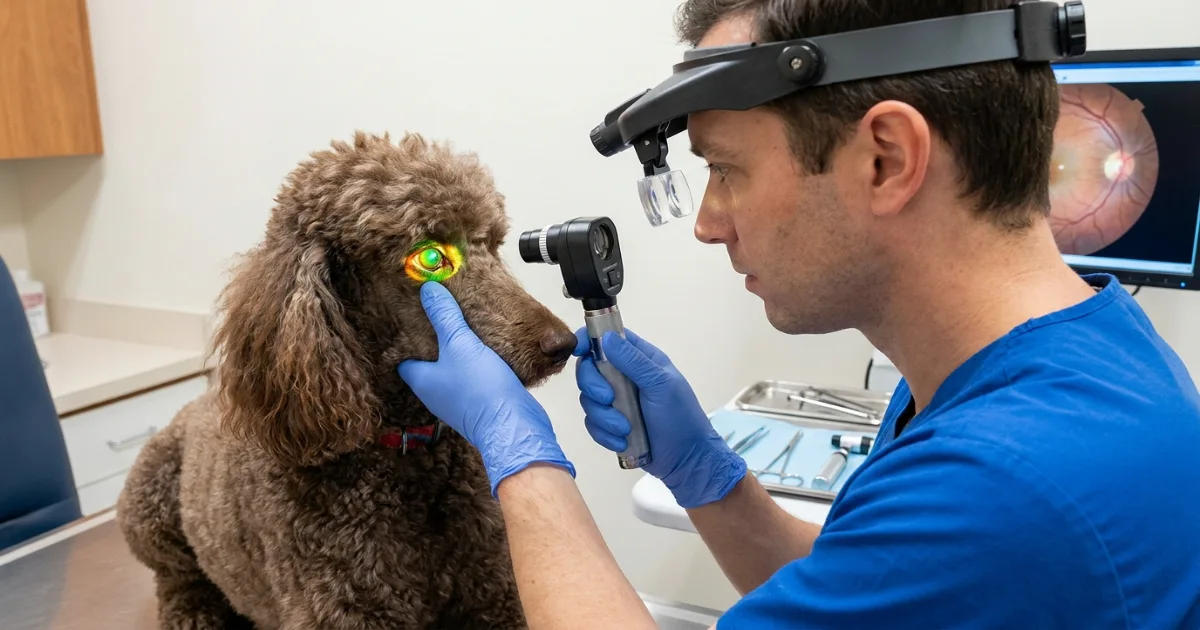
This is the most well-known inherited eye disease in poodles. PRA-prcd causes the photoreceptor cells in the retina to degenerate over time. Night blindness starts first, typically in young adulthood, and progresses to total blindness. There is no treatment and no cure. Affected dogs adapt surprisingly well thanks to their other senses, but the emotional and practical toll on owners is significant.
The mutation is autosomal recessive. A dog must inherit two copies to go blind. Carriers live normal lives with normal vision. The test is incredibly reliable, and responsible breeders have been using it for decades. A poodle from two clear parents will never develop PRA-prcd. The test is an absolute baseline.
vWD (von Willebrand Disease Type I)
vWD is a bleeding disorder similar to hemophilia in humans. Affected dogs lack enough von Willebrand factor, a protein critical for normal blood clotting. A minor cut, a routine spay surgery, or a lost baby tooth can lead to prolonged, dangerous bleeding. In severe cases, owners discover the condition during a standard procedure, and the outcome can be fatal.
Poodles are a breed with a known high carrier rate for vWD Type I. Testing is straightforward. A clear dog has normal clotting function. An affected dog requires lifetime management and alerting any veterinarian before even minor procedures. Again, it’s autosomal recessive, so carrier status alone won’t cause bleeding issues.
NE (Neonatal Encephalopathy with Seizures)
This is less famous than PRA or vWD but absolutely devastating. Affected puppies are born seemingly normal and then develop severe neurological symptoms within the first few weeks of life: ataxia, tremors, seizures, and failure to thrive. Most affected puppies die or are euthanized before weaning age. The mutation is recessive and found specifically in poodle lines. Testing both parents prevents this heartbreak entirely. No puppy buyer should ever have to witness neonatal encephalopathy if the breeder tested.
Size-Specific and Strongly Recommended Additional Tests
Beyond the big three, the poodle variety you choose dictates what else belongs on your testing checklist. A Toy Poodle faces different genetic risks than a Standard Poodle, and a breeder who treats all poodles identically isn’t paying enough attention.
For Toy and Miniature Poodles: OA and Patellar Luxation
Osteochondrodysplasia (OA) is a skeletal disorder that affects cartilage and bone development, leading to shortened, bowed limbs and joint pain. It’s most commonly associated with “dwarf” lines, and in Miniature and Toy Poodles, the mutation can masquerade as a “teacup” or extremely small stature. Some breeders intentionally select for it, which is unethical. A DNA test for the specific OA mutation reveals whether the tiny size is a healthy variation or a genetic time bomb.
Patellar luxation has a strong hereditary component in small breeds. While not a single-gene DNA test, responsible Miniature and Toy breeders have their breeding dogs’ patellas evaluated and certified through OFA. A breeder who tests for OA genetically and has patella evaluations is far ahead of the pack.
For Standard Poodles: Hip Dysplasia, DM, and Cardiac
Standard Poodles are large, active dogs, and hip dysplasia remains a significant concern. You can’t reduce hip dysplasia to a single cheek-swab test; the gold standard is OFA hip radiographs or PennHIP evaluation. A reputable Standard breeder provides hip scores on both parents. Accept nothing less than “Fair” or better, and understand that “Excellent” hips are a strong predictor of soundness.
Degenerative Myelopathy (DM) is a late-onset spinal cord disorder that leads to progressive hind-limb paralysis. It has a known genetic mutation, and while it typically appears in older dogs, it’s brutal and untreatable. Testing is available through all major canine DNA panels, and Standard Poodle breeders should be screening for it routinely.
Cardiac evaluation by a veterinary cardiologist is also standard for responsible Standard Poodle breeders, screening for inherited dilated cardiomyopathy and other structural heart issues. It’s not a DNA test but part of the full health-screening portfolio.
Essential Poodle Genetic Testing Panel Comparison
| Test Name | Poodle Varieties | Disease Consequence | Test Type | Approx. Cost Per Dog |
|---|---|---|---|---|
| PRA-prcd | All | Blindness | DNA Swab | $45–$80 |
| vWD Type I | All | Bleeding disorder | DNA Swab | $45–$80 |
| NE | All | Neonatal seizures, death | DNA Swab | $50–$85 |
| OA | Toy, Miniature | Skeletal deformity | DNA Swab | $45–$75 |
| DM | Standard (all sizes) | Paralysis | DNA Swab | $50–$80 |
| Hip Dysplasia | Standard | Arthritis, lameness | OFA X-ray | $200–$400 |
| Cardiac (Echo) | Standard | Heart failure | Specialist exam | $300–$600 |
What Buyers Usually Get Wrong About Poodle Genetic Testing
After talking to hundreds of poodle buyers, several patterns emerge. Most mistakes stem from good intentions mixed with incomplete information.
Mistake #1: Assuming “Embark tested” equals fully health-tested. Embark and similar kits test for many conditions, but they don’t evaluate hips, patellas, or cardiac function. A breeder can show you a clean Embark panel for 200+ diseases and still produce a puppy with crippling hip dysplasia because radiographs were never done. DNA panels are one tool, not the whole garage.
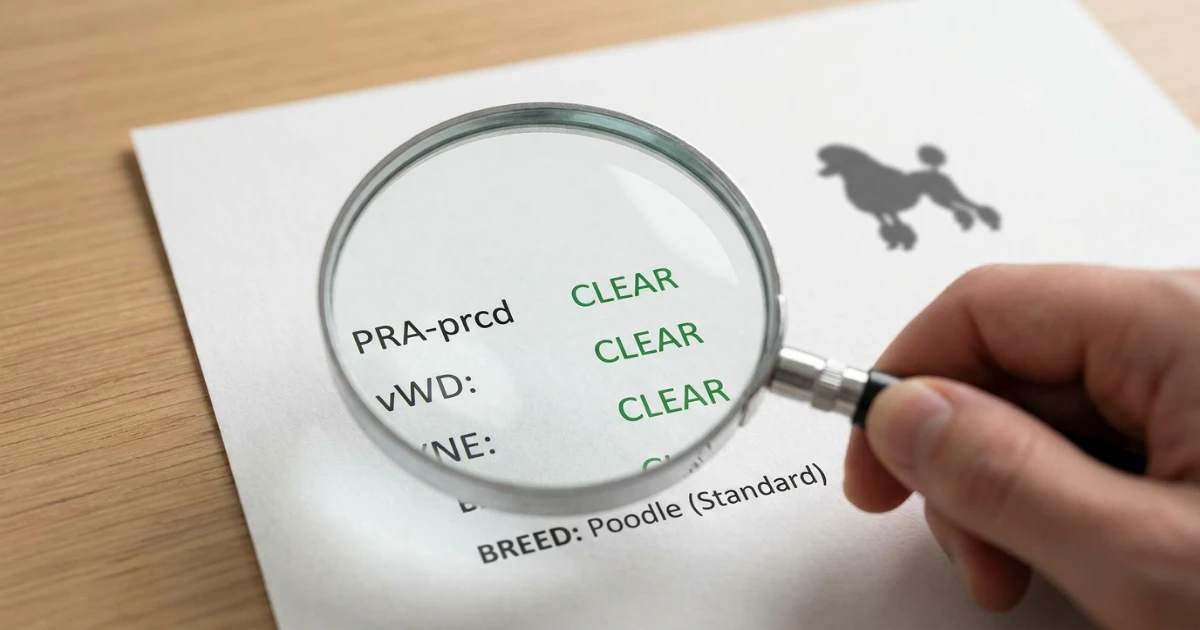
Mistake #2: Thinking a “clear by parentage” statement is enough. If both parents are clear for PRA, the puppy is clear. That’s genetically accurate. But you need to see the parents’ test results to confirm. A breeder who refuses to show you the parents’ official reports, hiding behind “it’s all on the pedigree,” is either disorganized or deceptive.
Mistake #3: Confusing coat color testing with health testing. Poodles come in an array of coat colors, and many breeders test for color genetics to predict phantom, parti, or brindle puppies. That’s fun, but it’s not health testing. A long list of color alleles means nothing for PRA or vWD. Buyers see “DNA tested” in a listing and don’t ask what was tested. Ask explicitly.
Mistake #4: Not understanding the difference between “carrier” and “affected.” You may see a puppy listed as a “carrier” for a condition and panic. A carrier has one copy of a recessive mutation and will never develop the disease. The only risk is if they are later bred to another carrier—something a pet owner with a spay/neuter contract never does. Carriers make perfectly healthy, wonderful companions. Ethically bred carriers are not a problem; affected puppies are.
Pro Tips for Poodle Buyers Evaluating Genetic Testing
- Ask for the dog’s registered name and look it up yourself on the OFA website (ofa.org). All verifiable health tests should appear there. No listing means no verified testing.
- Request both parents’ results, not just the puppy’s. Some breeders test only the litter but not the parents, which can mask a poor breeding decision.
- Check the lab. Acceptable labs include Animal Genetics, Paw Print Genetics, Embark, Wisdom Panel (for certain markers), and OFA-approved university labs. A handwritten note from a “local vet” is not a genetic test.
- Don’t be fooled by “rare color” hype. A flashy merle or phantom poodle without health clearances is a genetic gamble wearing a pretty coat. Health over color, always.
Real-World Cost of Poodle Genetic Testing in 2026
2026 Price Guide: Breeder Testing Investment
Reputable breeders invest heavily in health screening before breeding any dog. Here’s what the full testing portfolio costs them per breeding dog, which explains why well-bred poodles have a higher upfront price that saves thousands in later vet bills.
- Core DNA Panel (PRA, vWD, NE, DM, OA): $150–$280 depending on lab
- OFA Hip Radiographs (Standards): $250–$400
- OFA Patella Evaluation (Toys, Minis): $45–$80
- Cardiac Echo (Standards): $350–$600
- Eye Exam (CAER): $60–$120 annually
- Total breeder investment per dog: $550–$1,500+
A breeder who refuses this investment is cutting corners. When you pay $3,000–$4,500 for a well-bred poodle puppy from fully tested lines, you’re paying for generations of prevention. Compare that to a single emergency surgery for a dysplastic hip, which can cost $5,000–$8,000, and the math becomes painfully clear.
How Poodle Genetic Testing Is Often Misidentified or Misunderstood
Breeders sometimes use slippery language that sounds like testing but isn’t. “Health guarantee” is not genetic testing. A health guarantee typically covers congenital defects for a limited period, often with strings attached like returning the puppy. It’s a contract, not a prevention tool. Genetic testing prevents the issue from existing in the first place.
Another misdirection: “lines are clear.” This phrase should mean “we have tested the dogs in the lineage and have documentation.” Instead, it often means “we’ve never seen a problem, so we assume it’s clear.” That assumption is worth nothing against a recessive mutation that can hide for generations. Demand documentation.
Online marketplaces are particularly bad for this. A listing might say “DNA clear” without specifying which diseases. When asked, the seller clarifies they tested for “coat curl type” or “shedding propensity.” Those are cosmetic and irrelevant to heritable disease. Poodle genetic testing for health is a specific, defined set of markers, not a catch-all term.

What to Expect in Real Life: The Ownership Side of Genetic Prevention
Once you bring home a poodle whose parents passed every recommended genetic test, you’re not done with health management—you’ve just started from the strongest possible position. A genetically clear poodle still needs routine veterinary care, a quality diet, age-appropriate exercise, and regular grooming. But you’ve removed the looming specter of a sudden, predictable disease.
Owners of tested, cleared poodles report a specific kind of peace of mind. When their dog stumbles during a hike, they don’t immediately fear DM. When the dog seems slow to find a treat, they don’t jump to PRA. Those fears never fully vanish, but genetic testing strips them of statistical likelihood. That emotional space matters.
For buyers who want performance dogs—agility, service work, therapy visits—genetic screening becomes even more critical. You can’t invest thousands of hours training a service dog only to have vision fade at five years old. The initial breeder screening is your insurance policy against lost potential.
Comparing Genetic Testing Across Poodle Sizes: One Breed, Different Risks
A common question: “Do the same tests apply to a Toy Poodle as to a Standard?” The core three—PRA, vWD, NE—apply universally. The divergence happens with size-linked disorders. An informed Toy Poodle buyer looks for OA, patella certification, and possibly Legg-Calvé-Perthes screening. A Standard buyer demands hip and cardiac clearance above all. Miniatures sit in the middle, often needing both small-breed orthopedic screening and some large-breed awareness depending on the line’s stature.
This is why “one panel fits all” approaches fail. A breeder specializing in Toys who tests hips but ignores OA is misallocating resources. A Standard breeder who tests for OA is wasting money while potentially missing a cardiac issue. The best breeders tailor their testing to their specific poodle variety and the known issues in their pedigree.
When Genetic Testing Reveals a Carrier Puppy: Should You Still Buy?
Some of the most ethical breeders intentionally pair a clear dog with a carrier to preserve genetic diversity while producing no affected puppies. Those litters are entirely healthy, but some puppies will be carriers. If you’re purchasing a pet poodle that will be spayed or neutered, a carrier puppy is not a health risk. You love the dog exactly the same, and they live a completely normal life.
The problem only arises if someone breeds that carrier irresponsibly later. Reputable breeders often sell carrier puppies on strict spay/neuter contracts with limited registration to prevent exactly that. If a breeder openly discloses carrier status, explains the genetics clearly, and has a sensible contract, they’re demonstrating integrity. That’s the kind of breeder you want.
Frequently Asked Questions About Poodle Genetic Testing
Can I genetically test a poodle puppy myself after purchase?
Yes, and many buyers do for peace of mind. A cheek swab kit from Embark or a similar lab costs under $150 and tests for PRA, vWD, NE, and dozens more. However, testing after purchase means you’ve already committed. If the results reveal a problem, you’re managing it, not preventing it. Always test before finalizing if you have any doubts about the breeder’s documentation.
Is there a single test that covers all poodle genetic diseases?
Not exactly. Large panel tests like Embark screen for the major DNA-based poodle diseases in one kit, but they don’t include structural evaluations like hip radiographs, patella exams, or cardiac echoes. Think of the DNA panel as the genetic screen and the orthopedic/cardiac exams as the physical screen. Both are needed for a complete picture, especially in Standards.
How long do poodle genetic test results take to come back?
Most commercial canine DNA labs return results in 2–4 weeks. OFA radiographic evaluations take a similar window. Breeders typically test their dogs well before breeding age, so results should be available immediately when you’re considering a litter. Any delay excuse is suspicious.
Are there genetic tests for poodle temperament or personality?
No. Despite what some apps promise, there is no validated genetic test for temperament, trainability, or personality in poodles. Those traits are shaped by breeding selection, early socialization, and environment. A breeder who claims a DNA test proves their puppies are “calm” or “hypoallergenic” is either misinformed or misleading you.
What should I do if a breeder refuses to share genetic testing results?
Walk away. Immediately. There is no legitimate reason for a breeder to withhold verifiable health testing on the parents. Privacy concerns don’t apply to anonymous database entries; OFA listings show the dog’s registered name and test results, not the breeder’s home address. Refusal to share is almost always a sign that testing wasn’t done or revealed a problem.
Does genetic testing guarantee a poodle won’t get sick?
No test can guarantee perfect health for a lifetime. Genetic testing covers known heritable conditions, but dogs can still develop cancer, immune-mediated diseases, injuries, and age-related conditions not linked to a single gene. What genetic testing does is eliminate a specific set of preventable tragedies. It’s a powerful filter, not a crystal ball.
Are there new poodle genetic tests being developed in 2026?
Research continues, particularly around immune-mediated conditions and epilepsy in poodles. Some labs are exploring markers for Addison’s disease, a significant concern in Standards. As of 2026, no definitive commercial test exists for Addison’s, but the Poodle Club of America Foundation funds ongoing research. Buyers should expect the testing list to expand over the next decade.
Shopping for a Poodle with Confidence: Your Concrete Pre-Purchase Checklist
After absorbing all this information, reduce it to action. Before you ever agree to buy a poodle puppy, demand and receive the following in writing or as verifiable links:
- Parent PRA-prcd results — both parents clear, or one clear and one carrier (no affected puppies possible)
- Parent vWD results — same logic as above
- Parent NE results — clear or clear-to-carrier pairing only
- Parent OA results (Toys and Minis)
- Parent DM results (Standards and any larger Miniatures)
- OFA hip scores (Standards) — Fair or better
- Cardiac exam report (Standards) — within last year
- Patella certification (Toys, Minis)
- Links to the OFA database entries or original lab reports
If a breeder can produce all of this without hesitation, you’re talking to someone who respects the breed and your future dog. If they deflect, minimize, or say “nobody has ever asked for that,” you’ve just saved yourself from a heartbreak you can’t see yet.

Summary: The Truth About Poodle Genetic Testing Before Buying
Poodle genetic testing is not a luxury, an upsell, or a theoretical exercise. It’s the single most reliable tool buyers have to avoid preventable, life-altering diseases in the dog they’ll love for a decade or more. The core tests—PRA-prcd, vWD, and NE—apply to every poodle, every time. Size-specific screenings for hips, patellas, OA, and cardiac function complete the safety net. A breeder who invests in comprehensive testing and shares results openly is protecting not just their reputation but your puppy’s entire life trajectory.
The price difference between a tested, cleared poodle and an untested bargain puppy is often erased—and then some—by a single emergency veterinary bill. Beyond the money, the emotional cost of watching a young dog go blind from PRA or struggle to walk from dysplasia is something no owner should bear when the tools to prevent it exist. Demand the tests. Read the results. And if the breeder can’t produce them, find one who can. Your future poodle deserves nothing less.