Flying With a Poodle: Airline Rules, Crate Guide & What Every Owner Must Know
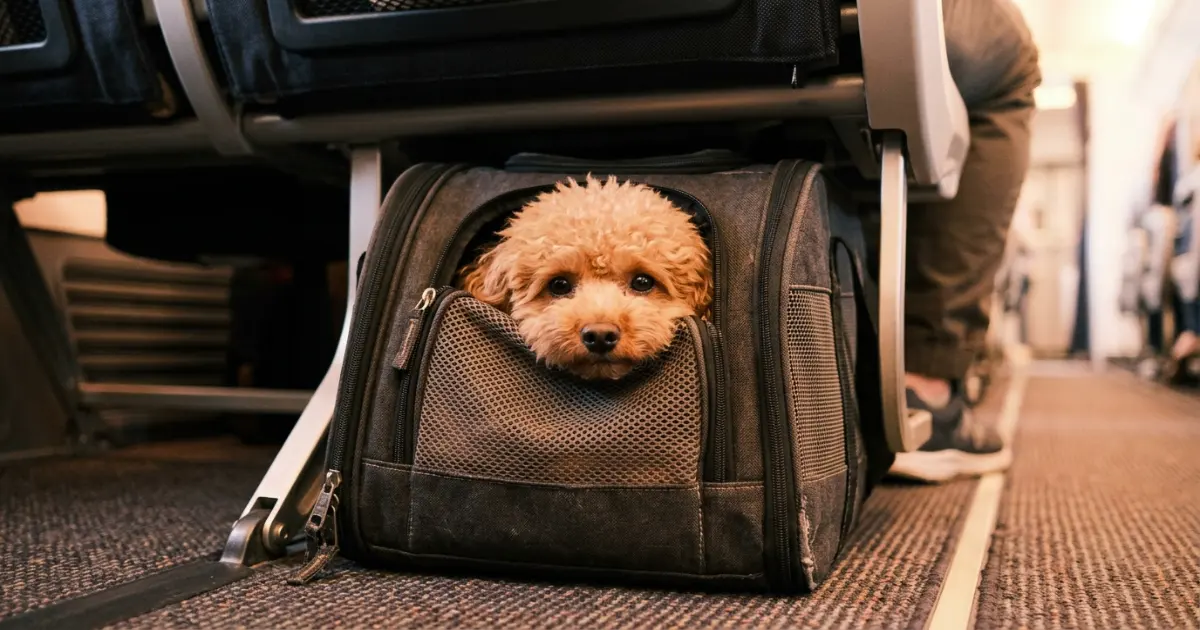
Quick Answer: Flying with a poodle is entirely possible, but your poodle’s size dictates nearly everything. Toy and most Miniature Poodles can ride in the cabin under the seat in an airline-approved soft-sided carrier. Standard Poodles typically must travel in the cargo hold as checked baggage or via pet cargo services. Each airline sets its own weight limits, carrier dimensions, breed restrictions, and seasonal embargoes. Success depends on picking the right airline, the right crate, and preparing your poodle well in advance. This guide covers every rule, fee, and preparation step you’ll need.
You’ve booked the trip. The hotel is confirmed. Then the question lands: Can my poodle come with me? For poodle owners, the answer isn’t a simple yes or no. It’s a layered calculation involving your dog’s weight, the airline’s fine print, the destination’s temperature, and how well your poodle handles confinement. Flying with a poodle demands planning that starts weeks—not days—before departure. This article walks you through every decision point, from choosing between cabin and cargo to selecting a crate that won’t get rejected at the check-in counter.
We’ve researched the latest 2026 airline policies, spoken with poodle breeders who routinely ship puppies, and gathered real owner experiences. The goal: give you a single, authoritative resource that answers the questions most travel blogs gloss over. Whether you’re relocating across the country with your Standard Poodle or bringing your Toy Poodle on a weekend getaway, the rules change dramatically by size. Let’s start with the essentials.
Airline Cabins vs. Cargo: The Decision That Shapes Everything
Flying with a poodle means confronting one binary choice early: will your dog ride in the pressurized passenger cabin with you, or travel below in the climate-controlled cargo compartment? The distinction matters enormously—for your poodle’s comfort, your peace of mind, and the logistics you’ll need to manage. Cabin travel is quieter, more temperature-stable, and keeps your dog within arm’s reach. Cargo travel involves a separate check-in process, a hard-sided crate, and a degree of separation that makes many owners anxious.
But cargo isn’t inherently dangerous. Major U.S. airlines maintain pressurized, temperature-regulated cargo holds specifically designed for live animals. The real variable is which airline you choose. Some have dedicated animal-handling teams; others subcontract ground services with uneven training. When a Standard Poodle must fly, cargo quality matters more than anything else on your checklist.
Cabin Rules at a Glance (2026)
Most U.S. airlines permit small dogs in the cabin if the carrier fits entirely under the seat in front of you. The dog must remain inside the carrier for the entire flight—no peeking out, no laps. The carrier counts as your personal item or carry-on, depending on the airline. Fees range from $95 to $150 each way. There’s almost always a per-flight limit on total in-cabin pets, so you must book your poodle’s spot when you buy your ticket.
Cargo Rules at a Glance (2026)
Dogs too large for cabin travel fly as checked baggage (on the same flight as you) or as manifest cargo (separate shipment). Both go into the same pressurized hold. The difference is logistical: checked baggage means you drop off and pick up at the passenger terminal; manifest cargo uses a separate cargo facility, which may have different hours. Either way, you’ll need a hard-sided crate with metal hardware, absorbent bedding, and attached food/water bowls. Fees typically run $200 to $500+ depending on weight, crate size, and distance.
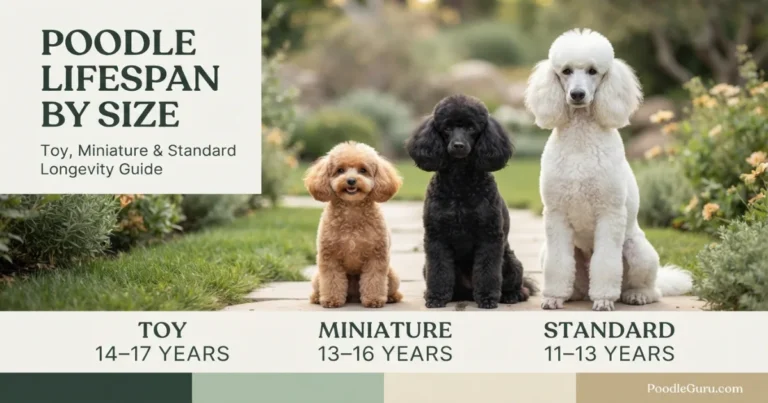
Poodle Size Determines Everything: A Realistic Breakdown
No other factor shapes your flying-with-a-poodle experience as much as your dog’s adult weight. Online forums are filled with stories of owners who assumed their Miniature Poodle would fly in-cabin, only to be turned away at the airport because the carrier plus dog exceeded the airline’s limit. The rule isn’t just about weight—it’s about whether the dog can stand up, turn around, and lie down naturally inside a carrier that fits under a seat. If the carrier is too small for those basic movements, the airline can (and should) refuse boarding.
Toy Poodles: The Easiest Flyers
At 4 to 10 pounds, Toy Poodles are the least complicated. Nearly every airline that accepts in-cabin pets will accommodate a Toy Poodle in a properly sized soft carrier. The key measurement is the carrier’s height: under-seat clearance varies by aircraft, but 9 to 10.5 inches of vertical space is the typical maximum. A soft-sided carrier with some give in the roof can flex to fit. Hard-sided carriers rarely work for cabin travel because they don’t compress.
Miniature Poodles: The Gray Zone
Miniature Poodles weigh 10 to 20 pounds as adults, and this is where things get tricky. A 12-pound Mini in a 3-pound carrier might clear the 15-pound threshold some airlines set. A 19-pound Mini almost certainly won’t. Even if the weight is technically under the limit, a taller Miniature Poodle may not fit comfortably in a carrier short enough to slide under the seat. Measure your dog’s standing shoulder height and add two inches for clearance before choosing a carrier.
Standard Poodles: Cargo Is the Default
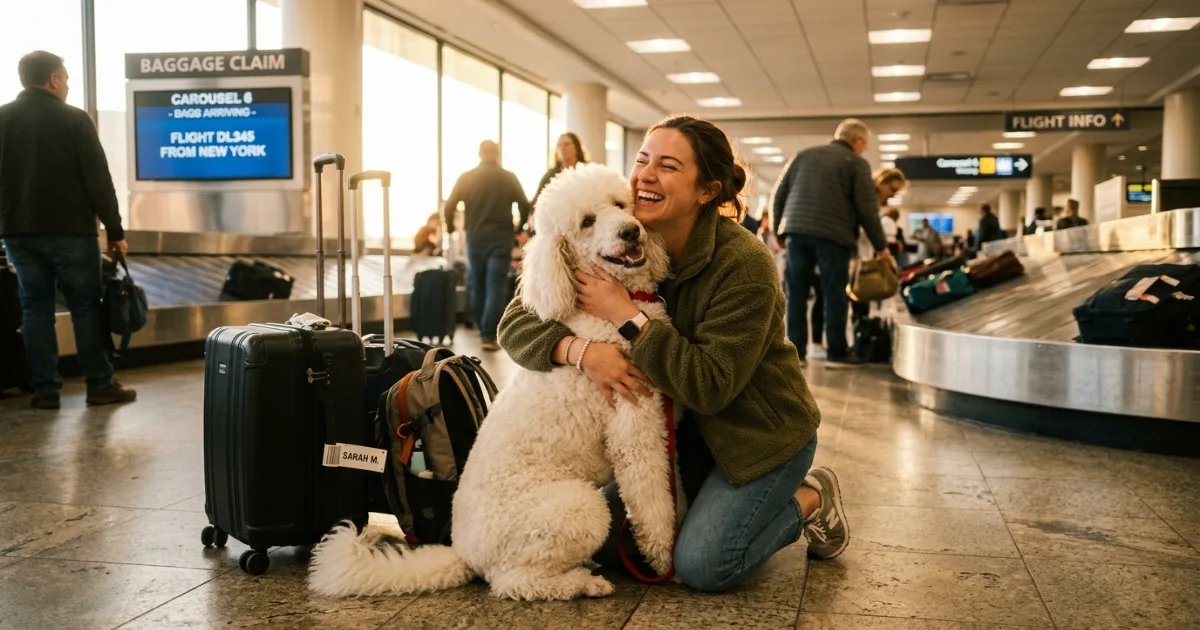
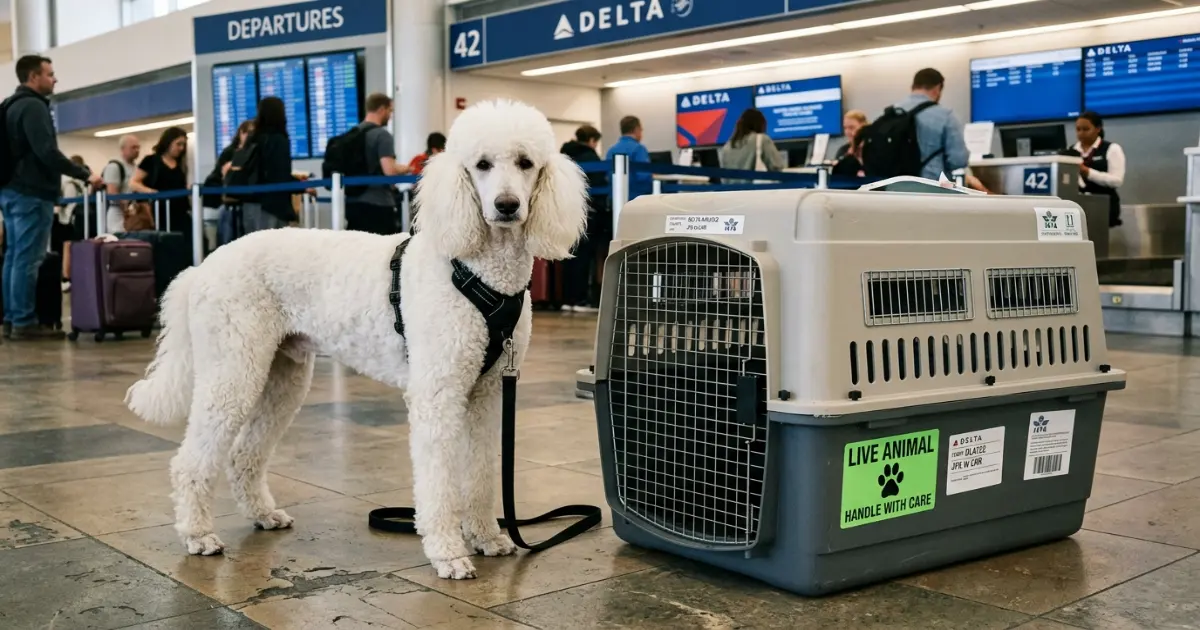
Standard Poodles range from 40 to 70+ pounds and stand 18 to 24+ inches at the shoulder. They will not fly in-cabin on any commercial U.S. airline, period. The only path is cargo—either as checked baggage or via a specialized pet transport service. The upside: cargo crates can be generously sized, giving your Standard Poodle room to stand fully, turn around, and stretch out. The downside: you won’t see them between drop-off and pickup, and you’ll need to be meticulous about crate preparation.
The Perfect Travel Crate for Your Poodle
Buy the wrong crate, and you won’t make it past the check-in counter. Airlines are famously strict about crate specifications, and for good reason: a poorly constructed crate can fail during handling, endangering your dog and ground crew alike. The International Air Transport Association (IATA) sets the baseline standards that most carriers follow. Here’s exactly what to look for.
For Cabin Travel: Soft-Sided Carriers
Your cabin carrier must be well-ventilated on at least two sides, secure against escape, and sized to fit under the seat. Look for carriers labeled “airline-approved,” but verify dimensions against your specific airline’s published limits—they vary by a few inches. Top brands poodle owners consistently recommend include the Sherpa Original Deluxe, the Sturdibag Large, and the Sleepypod Air. The carrier should have a padded, removable bottom panel, a fleece-lined interior, and mesh panels your poodle can see through. A zipper lock or clip prevents mid-flight escape attempts.
For Cargo Travel: Hard-Sided IATA-Compliant Crates
Cargo crates must be hard plastic (no wire crates, no soft fabric) with a metal grated door, metal nuts and bolts (not plastic clips), ventilation on all four sides, and a spring-loaded door mechanism that cannot accidentally open. The crate must be large enough that your poodle can stand without its head touching the top, turn around freely, and lie down in a natural position. For Standard Poodles, a 36-inch or 40-inch crate is typical. The floor must be lined with absorbent material—puppy pads, a thin fleece mat, or shredded paper. No straw, no loose blankets that can tangle.
Many poodle owners don’t realize that airlines require two attached dishes—one for food, one for water—mounted to the inside of the crate door. These must be accessible from outside without opening the door. Fill the water dish and freeze it before travel so it melts gradually during the flight rather than spilling immediately.
Airline Policy Comparison: Five Major U.S. Carriers
Policies shift year to year. The table below reflects 2026 rules as of this writing. Always confirm directly with the airline before booking, especially if you’re flying during summer (many airlines impose heat embargoes) or on international routes.
| Airline | In-Cabin Pets | Cargo / Checked Pets | Weight Limit (Cabin) | Approx. Cabin Fee (Each Way) | Poodle Size Fit |
|---|---|---|---|---|---|
| Delta | Yes | Yes (Delta Cargo) | No stated limit; carrier must fit under seat | $95–$125 | Toy, small Mini |
| American Airlines | Yes | Yes (American PetEmbark) | 20 lbs combined (dog + carrier) | $125 | Toy, some Mini |
| United | Yes | PetSafe cargo only (no checked pets) | No stated limit; carrier must fit | $125 | Toy, small Mini |
| Southwest | Yes | No cargo pets | No stated limit; carrier must fit | $95 | Toy, small Mini |
| Alaska Airlines | Yes | Yes (baggage and cargo) | 20 lbs combined | $100 | Toy, some Mini |
Crucially, Southwest does not accept pets in cargo at all. If you have a Standard Poodle, Southwest won’t work. American and Alaska offer both cabin and cargo options but enforce strict heat embargoes when ground temperatures exceed 85°F at any point on the route. Delta’s cargo program is widely regarded as the most pet-focused, with climate-controlled vehicles and dedicated animal handling staff at major hubs.
How to Prepare Your Poodle for the Flight
Preparation separates a smooth travel day from a stressful one. Start at least four weeks ahead. Your poodle needs to see the carrier as a safe, familiar space—not a sudden prison they’re zipped into at the airport. Here’s a step-by-step timeline that experienced poodle owners and breeders follow.
Week 4: Crate Familiarization
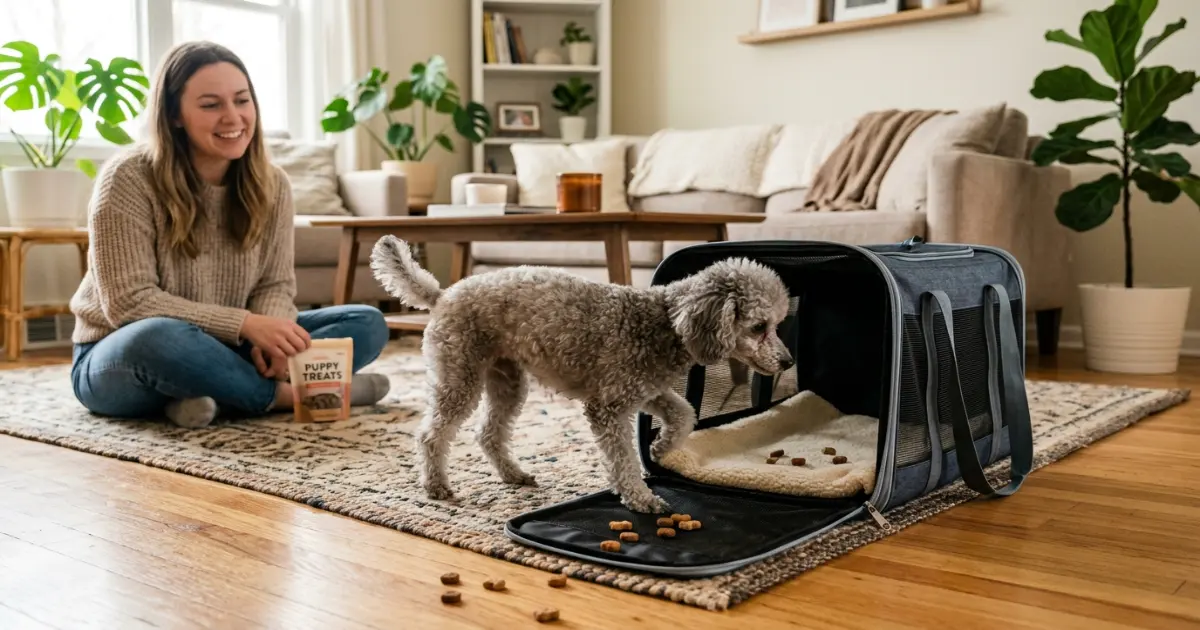
Place the open carrier in your living space with the door removed or tied back. Toss treats inside randomly throughout the day. Feed meals near the entrance, then gradually deeper inside. Let your poodle discover that the carrier produces good things without any pressure. Do not force them in. The goal is voluntary exploration.
Week 3: Short Sessions with the Door
Once your poodle willingly enters the carrier, begin closing the door for 30 seconds while you sit beside it. Reward calm behavior with a high-value treat through the mesh. Gradually extend to two minutes, then five. Practice in different rooms so the association isn’t tied to one location.
Week 2: Motion and Sound Desensitization
Carry the closed carrier around your home. Place it in the car for a short drive. If possible, play recordings of airport ambient noise and aircraft cabin sounds at low volume while your poodle rests inside. Reward calmness consistently. Poodles are highly intelligent and sensitive—they pick up on your energy, so stay relaxed during these sessions.
Week 1: Veterinary Check and Documentation
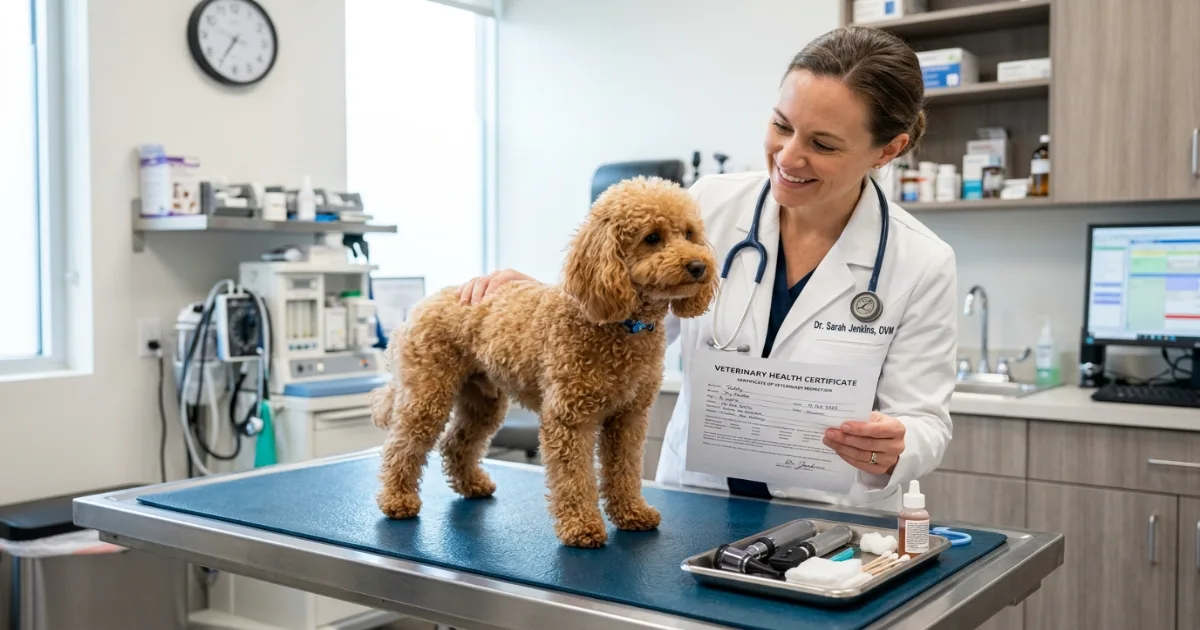
Schedule a vet visit. You’ll need a health certificate issued within 10 days of travel (some airlines require within 7 days). Confirm your poodle is up to date on rabies and any destination-specific vaccinations. Discuss whether a mild anti-anxiety medication is appropriate—do not sedate your poodle without veterinary guidance. Over-sedation at altitude can cause respiratory depression. Many vets recommend against sedation for air travel entirely.
Day Before: Final Prep
Trim your poodle’s nails to prevent snagging on the carrier mesh. Give a thorough potty walk. Pack a small travel kit: collapsible water bowl, portioned food, waste bags, a copy of the health certificate, a recent photo of your poodle, and your airline’s pet policy printed out. Attach a travel tag to your poodle’s collar or harness with your name, phone number, and destination address.
Health and Safety: What Poodle Owners Need to Know
Poodles, as a breed, are not on any airline’s banned breed list. Brachycephalic (flat-faced) breeds like Bulldogs and Pugs face flying restrictions because of respiratory risks; poodles, with their long, open muzzles, do not. That said, poodles have their own considerations. Their single-layer, continuously growing coat offers less natural insulation than double-coated breeds. A Standard Poodle in cargo during a cold-weather flight may benefit from a lightweight, non-restrictive travel jacket—but confirm the airline allows it first.
Anxiety is the bigger concern. Poodles form deep attachments to their people, and separation during cargo travel can trigger stress. Signs to watch for post-flight include excessive panting, trembling, temporary loss of appetite, and clinginess. Most dogs bounce back within 24 hours. If your poodle is prone to severe separation anxiety, consider a professional pet nanny service or ground transport as an alternative to cargo.
Book the earliest direct flight possible. Morning flights have lower ground temperatures and fewer delays. Avoid connections—every plane change is another opportunity for mishandling, missed transfers, and extended crate time. If you must connect, choose a layover long enough for a potty break at a pet relief station (many airports now have them).
What Most Poodle Owners Get Wrong About Flying
After talking with breeders, veterinarians, and dozens of poodle owners who fly regularly, a handful of common mistakes surfaced repeatedly. Avoiding these can save you from a ruined trip—or worse, a denied boarding.
Mistake 1: Assuming all airlines are the same. Owners often book the cheapest flight, then discover the carrier doesn’t accept pets or has a weight limit their dog exceeds. Airline policy is the first filter. Check it before checking ticket prices.
Mistake 2: Buying a carrier based on Amazon reviews alone. “Airline-approved” is a marketing term, not a certification. What matters is whether the carrier’s dimensions match your airline’s under-seat measurements for the specific aircraft you’ll be on. A carrier that fits on a 737 might not fit on a regional jet.
Mistake 3: Withholding water before the flight. Some owners restrict water to prevent accidents, then the dog boards dehydrated. This is dangerous, especially in the dry cabin air at altitude. Provide water right up until check-in. For cargo travel, the freeze-the-water-dish trick keeps hydration available.
Mistake 4: Sedating without veterinary input. Over-the-counter calming chews and owner-guessed Benadryl doses are not a substitute for a vet’s guidance. At altitude, the effects of sedatives can amplify unpredictably. Most airline cargo programs discourage or prohibit sedation.
Mistake 5: Not reserving the pet spot in advance. Airlines cap the number of pets per flight. On popular routes, those slots fill weeks ahead. Add your pet to the reservation the moment you book. Do not show up at the airport expecting to pay at the counter—many airlines require advance pet registration.
2026 Price Guide: What Flying With a Poodle Actually Costs
Cabin pet fee (each way): $95–$150, depending on airline. This is per flight segment, so a round-trip with a connection can add $400+ in pet fees alone.
Cargo / checked pet fee (each way): $200–$600+. Weight-based pricing. A 55-pound Standard Poodle in a 36-inch crate typically falls in the $350–$500 range for a domestic one-way.
Health certificate (vet visit): $75–$200, depending on your vet and whether additional vaccinations or titers are needed.
Travel carrier: $60–$120 for a quality soft-sided cabin carrier; $90–$250 for an IATA-compliant hard-sided cargo crate.
Pet nanny / transport service (alternative): $500–$2,500+ depending on distance and service level. Some poodle breeders offer puppy nanny flights for new owners picking up a puppy across the country.
What inflates the price: last-minute bookings, holiday travel, international routes, oversized crates, and using a third-party pet shipping broker instead of booking directly through the airline.
Alternatives Worth Considering
If the logistics of flying with a poodle feel overwhelming—or if your particular dog isn’t a good candidate for air travel—you have options. Ground transport services specialize in long-distance pet relocation. They drive your dog door-to-door in climate-controlled vehicles with regular potty breaks. It takes longer but eliminates altitude, pressure changes, and airport chaos. For shorter distances, a road trip with your poodle in a crash-tested car harness may be the simplest solution of all.
Some owners also explore shared charter flights through services like JSX or semi-private aviation, which sometimes have more flexible pet policies. These aren’t budget options, but for a one-time relocation, they can be worth the premium.
Frequently Asked Questions About Flying With a Poodle
Can I buy a seat for my poodle on a plane?
What size carrier fits under an airline seat for a poodle?
Do poodles need a health certificate to fly?
Can a Standard Poodle fly in the cabin?
Is sedation safe for flying with a poodle?
How early should I arrive at the airport with my poodle?
What happens if my flight is delayed and my poodle is in cargo?
Final Summary: Flying With a Poodle, Done Right
Flying with a poodle is not a last-minute decision. It rewards owners who plan methodically: choosing the airline based on its pet policy first, matching the carrier type to your poodle’s size, investing weeks in crate familiarization, and never cutting corners on documentation. Toy Poodles fly easiest. Miniature Poodles sit right on the edge of cabin eligibility and need careful measuring. Standard Poodles require full cargo preparation with an IATA-compliant hard crate. Across every size, the single best thing you can do is make the carrier a place of safety and familiarity long before the travel date. A calm, crate-trained poodle is a safe traveler—and a safe traveler makes for a far less stressful trip for everyone involved.