Abstract Poodle: The Complete Guide to This Rare and Misunderstood Coat Pattern
Quick Answer
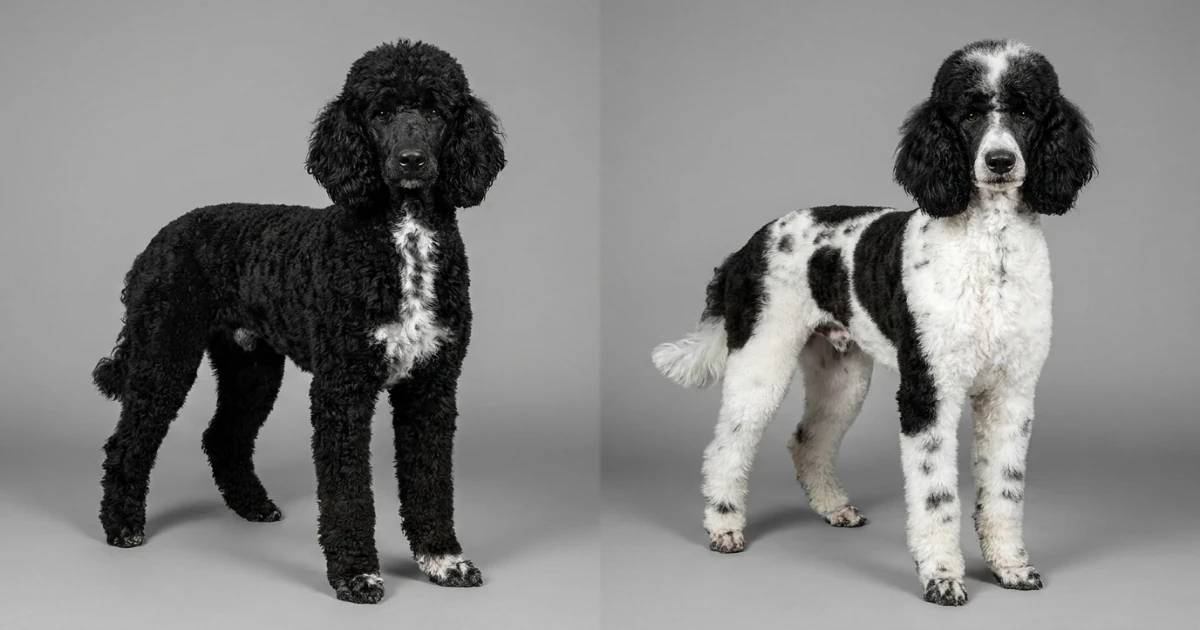
An abstract poodle is a dog whose coat displays less than 50% white — typically small, irregular patches on the chin, chest, paws, or tail tip — against a solid base color. Unlike a parti poodle, which is predominantly white, the abstract pattern is defined by its minority white markings. The pattern results from the piebald gene (S locus) and is considered a mismark by the AKC breed standard, though it has grown into a recognized and celebrated aesthetic among pet owners and specialty breeders.
Of all the coat patterns in the poodle world, few generate as much confusion — or as much fascination — as the abstract. Search any poodle Facebook group or breeder listing and you’ll find owners debating whether their dog is truly abstract, parti, or simply mismarked. The terminology alone sends new buyers down rabbit holes. But once you understand what defines an abstract poodle, the pattern becomes one of the most visually distinctive and genuinely rare looks in the breed.
This guide covers everything: the genetics, the visual identification, how abstract differs from parti and phantom, what buyers need to watch out for, and what life actually looks like with one of these striking dogs.
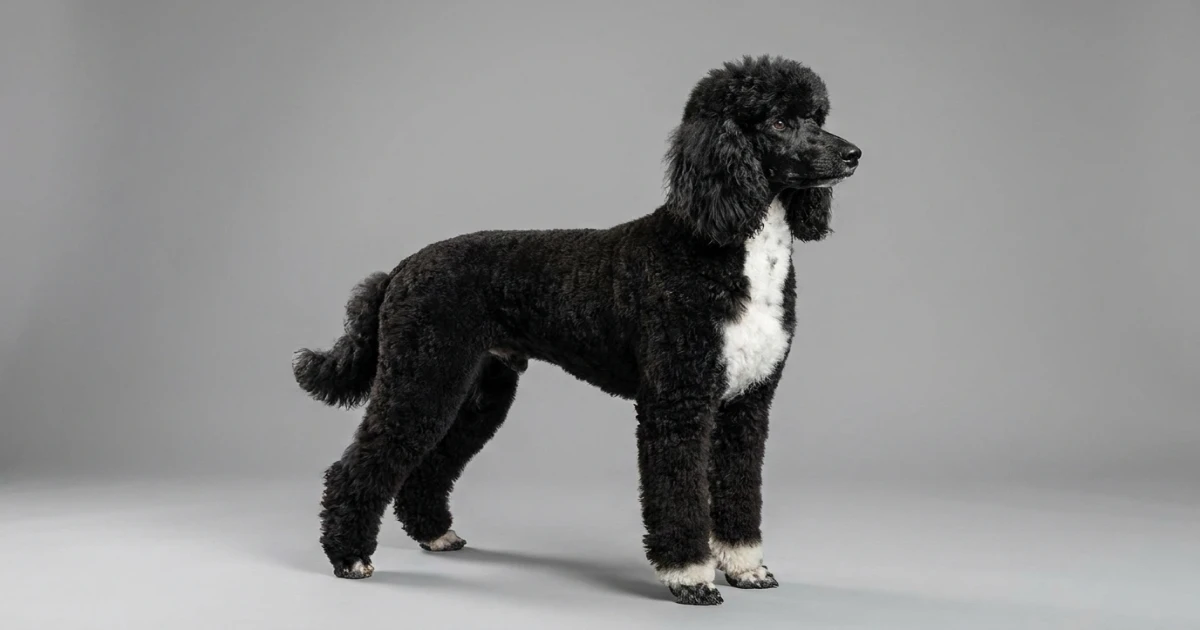
What Is an Abstract Poodle?
The term “abstract” refers to a specific type of poodle coat pattern, not a color. An abstract poodle has a solid base color — black, red, chocolate, apricot, blue, silver, or any recognized poodle color — with small, asymmetrical patches of white appearing on specific areas of the body. These white patches are characteristically random in shape, which is where the name “abstract” comes from. They don’t follow a predictable symmetric template.
The critical distinguishing rule: white must account for less than 50% of the dog’s coat for the dog to qualify as abstract. Once white exceeds 50%, the dog crosses into parti territory. That 50% threshold is the defining line between the two patterns, and breeders take it seriously.
Common locations for white abstract markings include:
- The chin or muzzle (often a small blaze or goatee patch)
- The chest or sternum (sometimes called a “star” or “bib”)
- One or more paws or the tips of toes
- The tail tip
- A small stripe on the face
Not every abstract poodle has all of these. Some have a single white toenail and a tiny chin smudge. Others have a broader chest patch and a white-tipped tail. The pattern is, by its nature, irregular — that’s part of what makes each dog visually unique.
The Genetics Behind the Abstract Pattern
Understanding what creates an abstract poodle makes the pattern far less mysterious. The white areas in abstract (and parti) poodles are caused by the piebald gene, located at what geneticists call the S locus. This locus involves the MITF (Microphthalmia-Associated Transcription Factor) gene, which controls the migration of pigment-producing cells called melanocytes during fetal development.
A poodle can carry the parti gene without showing it in a visually obvious way. That’s why two solid-colored poodles can occasionally produce a puppy with white markings — the gene was lurking in the pedigree. Abstract poodles, sitting at the low-expression end of the piebald spectrum, represent exactly this kind of subtle genetic expression.
This has practical implications for breeders. An abstract poodle bred to another abstract — or to a parti — can produce a litter with a wide range of expressions: some abstract, some fully parti, some nearly solid with a single white toenail.
Abstract vs. Parti vs. Phantom: How to Tell Them Apart
This is where most buyers get lost. The poodle world has several multi-colored patterns, and they are genuinely easy to confuse if you haven’t spent time around the breed. Here’s a clear breakdown.
| Pattern | White Percentage | White Placement | Second Color | AKC Status |
|---|---|---|---|---|
| Abstract | Under 50% | Random / irregular | Only white patches on base | Disqualified |
| Parti | 50% or more | Often large blocks | Only white patches on base | Disqualified |
| Phantom | No white typically | Specific tan/apricot points | Tan, red, or cream points | Disqualified |
| Mismark | Trace amounts | One or two tiny spots | Only white traces | Disqualified |
| Solid | 0% | None | Single color only | AKC accepted |
The abstract and mismark categories are sometimes used interchangeably in casual conversation, though technically a “mismark” can describe any AKC-disqualifying marking — including phantom points, tuxedo patterns, or ticking. In the stricter sense used by specialty breeders and pattern-focused buyers, “abstract” refers specifically to the piebald-gene white pattern under 50%.
How Abstract Poodle Markings Change With Age
One detail that surprises many new owners: abstract markings can shift in appearance as a poodle matures. This isn’t dramatic transformation — the dog won’t gain or lose large patches of white — but subtle changes do happen.
In puppies, white areas sometimes appear slightly larger or more defined against the puppy coat. As the adult coat grows in, the surrounding base color can appear to “encroach” on white areas, particularly around the edges of markings on the face or chest. Some abstract markings that looked prominent at eight weeks can seem slightly smaller and softer by adulthood.
Conversely, some poodles experience a phenomenon called fading in their base coat — particularly blacks that fade to blue and chocolates that fade to café au lait — which can make white abstract patches look relatively larger by contrast as the dog ages. This is entirely cosmetic and has no health implications.
Why Abstract Poodles Are Considered Rare
Rarity in this context is real, not marketing language. To produce abstract poodles intentionally, breeders must work with the piebald gene — which means introducing parti or abstract dogs into breeding programs that have historically prioritized solid, AKC-conforming lines.
For decades, parti and abstract poodles were culled from breeding programs or sold as pet-only dogs because they couldn’t be shown. That history reduced the frequency of the piebald gene in many bloodlines. As parti and abstract poodles have grown in popularity among pet buyers over the past fifteen years, specialty breeders have begun developing dedicated programs — but these remain relatively few compared to solid-color breeders.
The abstract pattern is additionally rare because it represents a narrow band of piebald gene expression. Breeding for a specific low-expression outcome — rather than a full parti — requires careful selection and some tolerance for litter variability. You can’t guarantee an abstract puppy the way you can predict coat color in a more straightforward pairing.

Common Mistakes Buyers Make With Abstract Poodles
This section could save you real money and real disappointment. The abstract pattern has become popular enough that it attracts both honest specialty breeders and opportunistic sellers who lean heavily on terminology without backing it up.
Mistake 1: Confusing “Abstract” With a Breed Variety
Abstract is a coat pattern, not a poodle type. An abstract poodle is still a standard, miniature, or toy poodle. Some listings describe dogs as “abstract poodles” as though it names a separate breed — it doesn’t. You’re buying a poodle with a specific coat pattern.
Mistake 2: Overpaying Based on Pattern Alone
Pattern rarity does not automatically justify a dramatically higher price if the breeder isn’t also investing in health testing, lineage quality, and ethical practices. An abstract poodle from a well-tested, reputable program is worth a premium. An abstract poodle from a high-volume breeder who doesn’t test hips, eyes, or elbows is not.
Mistake 3: Assuming the Pattern Is Stable
Some buyers expect their abstract puppy to look identical at two years old as it did at eight weeks. As noted above, markings can shift subtly. If a perfectly symmetrical abstract look matters deeply to you, be realistic about how coat development works.
Mistake 4: Accepting “Abstract” Labeling Without Verification
A poodle with a single off-white toenail can technically be called abstract by some definitions. That’s very different from a dog with prominent, visually distinct white patches. Ask for clear photos — ideally of the dog in a natural, ungroomed or freshly groomed state — so you can evaluate the actual pattern.
- Ask for pedigree documentation that shows the piebald gene in the lineage — not just verbal assurance.
- Request photos of both parents and previous litters to understand how markings express in that breeder’s program.
- Confirm health testing: OFA hip, elbow, and eye certifications are baseline expectations regardless of coat pattern.
- Don’t pay abstract-specific premiums to a breeder who can’t explain the genetics behind their pairings.
- Visit the breeder in person or via live video if possible — see the puppy’s markings in real lighting, not edited photography.
Abstract Poodle Price Guide (2026)
What to Expect to Pay in 2026
Abstract poodles from reputable specialty breeders typically fall within these ranges:
- Toy abstract poodle: $2,000 – $3,500
- Miniature abstract poodle: $2,200 – $3,800
- Standard abstract poodle: $2,500 – $4,500+
What drives the price up: Rare base color combinations (red, blue, silver abstract), prominent and symmetrical markings, fully health-tested parents, established breeder reputation, and geographic demand.
What inflates price artificially: Marketing language alone (“ultra rare abstract”), high-volume breeders using pattern terminology to justify premiums without corresponding health investments, social-media hype cycles around specific color-pattern combinations.
Is it worth it? From a reputable breeder with proper health testing and transparent breeding practices — yes, the premium reflects real investment. From an untested source, pattern rarity alone is not a reason to pay more than you would for a solid poodle from the same operation.
Grooming an Abstract Poodle: Does the Pattern Change Anything?
In terms of coat texture, curl pattern, and grooming requirements, an abstract poodle is identical to any other poodle. The piebald gene affects pigmentation only — it has no bearing on coat density, curl type, or how quickly the coat grows.
That said, white areas in the abstract pattern do require some attention during grooming. White or light-pigmented coat sections can show staining more readily, particularly around the muzzle and paws. Tear staining and food staining tend to be more visible on the white chin patch than on the base coat, so if your abstract poodle has a prominent white face marking, routine cleaning of that area becomes more important.
White areas also tend to show any topical product residue — shampoos, conditioners, and sprays — more clearly than darker coat. Rinsing thoroughly is worth the extra few minutes. Beyond those minor considerations, grooming an abstract poodle is the same process as grooming any other poodle of the same size and coat stage. For a full breakdown of poodle-specific grooming technique, see our complete poodle grooming guide.
Health Considerations Specific to Abstract Poodles
One question that comes up repeatedly: does the piebald gene carry any health risks in poodles the way it does in some other breeds?
In certain breeds — Dalmatians are the classic example — extreme piebald expression is associated with congenital deafness. This connection exists because the same mechanisms that reduce pigment in the skin can affect the pigmented cells of the inner ear (the stria vascularis). However, this risk is primarily associated with extreme white dogs: dogs with very large white areas, particularly around the head, ears, and eyes.
In abstract poodles, the white coverage is, by definition, minimal. The deafness risk seen in extreme piebald or merle double-dilute dogs is not a documented concern at the low expression levels typical of abstract patterning. Still, if your abstract poodle has significant white coverage around one or both ears, a BAER (Brainstem Auditory Evoked Response) hearing test is a reasonable precaution — and reputable breeders of parti and abstract poodles often include this testing as standard practice.
Otherwise, abstract poodles carry the same health profile as all poodles by size. See our guide on how long poodles live for a full breakdown of lifespan and size-related health factors.
Is an Abstract Poodle Right for You?
If you’re drawn to the abstract pattern, you’re probably someone who appreciates a distinctive look without the full visual drama of a heavily parti coat. Abstract poodles have a sophistication to them — the bold base color with a strategic dash of white reads as polished rather than flashy.
From a personality and temperament standpoint, the abstract pattern carries zero behavioral influence. You are getting a poodle — with all the intelligence, sensitivity, trainability, and social engagement that comes with the breed — in a coat that happens to carry a rare genetic expression. Size, bloodline, socialization, and training will shape your dog far more than whether it has a white chest patch.
Where buyers should pause and think carefully: if show ring eligibility matters to you, an abstract poodle cannot compete in AKC confirmation events. The pattern is a disqualifying fault under the breed standard. For performance sports, therapy work, companion ownership, or any non-conformation purpose, this is completely irrelevant. But it’s worth knowing before you commit.
Frequently Asked Questions About Abstract Poodles
What exactly defines an abstract poodle?
An abstract poodle has a solid base coat color with white markings covering less than 50% of the body. These white patches are typically small and irregular, appearing on areas like the chin, chest, paws, or tail tip. The pattern is caused by a low-expression version of the piebald (S locus) gene.
Is an abstract poodle the same as a mismark?
Not exactly, though the terms overlap. “Mismark” is a broad AKC term for any coat pattern that deviates from the solid-color standard — it includes abstract, tuxedo, phantom points, and other variations. In common breeder usage, “abstract” refers specifically to the piebald-gene white patches under 50%. All abstract poodles are technically mismarks, but not all mismarks are abstract.
Can two solid poodles produce an abstract puppy?
Yes. If both parents carry the piebald gene in recessive form — even if they appear completely solid — they can produce offspring with visible white markings. This is why abstract puppies sometimes appear “unexpectedly” in solid-colored litters, and why pedigree research matters more than the parent’s visual appearance alone.
Are abstract poodles recognized by the AKC?
No. The AKC breed standard for poodles requires a solid coat of one color. Abstract markings are a disqualifying fault in the conformation ring. Abstract poodles can be registered with the AKC, but they cannot compete in breed confirmation events. They are fully eligible for performance sports, rally, obedience, and agility.
Do abstract poodles cost more than solid poodles?
Often yes, due to the relative rarity of the pattern and the additional breeding program investment required to produce it. In 2026, abstract poodles from reputable breeders typically range from $2,000 to $4,500+ depending on size and base color combination. The premium is justified when it reflects health testing and responsible breeding — not when it reflects marketing language alone.
Will my abstract poodle’s markings change as it grows up?
Slightly. White abstract areas don’t disappear or dramatically shift, but edges can soften and the relative appearance of markings may change as the adult coat comes in. Base coat fading — common in blacks, chocolates, and silvers — can also affect how prominent white patches appear by adulthood.
Are there any health concerns unique to abstract poodles?
Not meaningfully. The extreme piebald deafness risk seen in heavily white dogs like Dalmatians is not a documented concern at the low white coverage levels typical of abstract poodles. Dogs with significant white around both ears can optionally be BAER-tested for peace of mind. Otherwise, health considerations are the same as for any poodle of the same size.
How do I know if a breeder is reputable for abstract poodles?
Look for health certifications on both parents (OFA hip, elbow, eye clearances at minimum), pedigree documentation showing the piebald gene in lineage, photos of multiple litters and adult dogs, transparent communication about breeding pairings, and membership in breed clubs. Avoid breeders who emphasize pattern rarity without discussing health, temperament, or lineage.
The Bottom Line on Abstract Poodles
The abstract poodle is a genuinely rare coat pattern — the result of a low-expression piebald gene producing subtle white markings against a solid base color. It sits in a specific niche: more understated than a full parti, more distinctive than a solid. For buyers who want a visually unique poodle without the high-contrast drama of a heavily bicolor coat, the abstract pattern delivers something genuinely special.
What matters most: buying from a breeder who understands the genetics, tests their dogs, and is transparent about what to expect as your puppy matures. The pattern is the starting point, not the whole story. An abstract poodle is, at the end of the day, a poodle — intelligent, sensitive, long-lived, and deeply rewarding to own.
Don’t let the “rare” label lead you to overpay or overlook red flags. And don’t let AKC disqualification status put you off — the conformation ring has nothing to do with what makes a poodle an exceptional companion. Find a reputable breeder, understand what you’re looking at, and enjoy one of the most visually arresting coat patterns the breed has to offer.