Male vs Female Poodles: Temperament Differences (Which Is Better?)
An honest, experience-based comparison from a breeder and trainer perspective — so you can choose the right poodle for your life.
The question of male vs female poodles comes up in almost every conversation I have with people who are getting ready to bring a poodle home. It makes sense — choosing a dog is a big decision, and wanting to understand how gender might shape a dog’s personality is completely reasonable. What surprises most people, though, is that the answer is more nuanced than a simple “males are this way and females are that way.”
Here’s the truth: both male and female poodles make wonderful, loyal companions. The poodle’s foundational personality traits — intelligence, playfulness, sensitivity, and affection — are consistent across the breed regardless of gender. That said, there are genuine behavioral tendencies that show up more reliably in one sex than the other, and understanding those differences can absolutely help you make a more informed decision.
In this guide, we’ll walk through the poodle temperament differences between males and females across all three sizes — Toy, Miniature, and Standard — covering training, affection, energy levels, dominance, and family compatibility. By the end, you’ll have a much clearer picture of which gender is the better fit for your household and lifestyle.
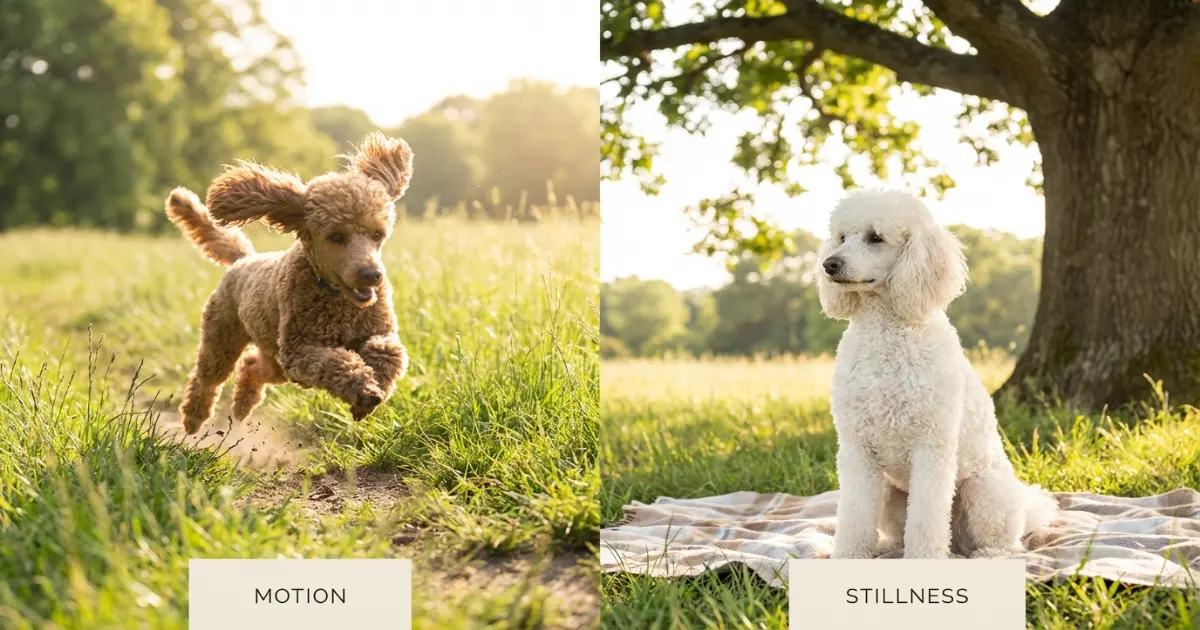
Quick Comparison: Male vs Female Poodles
Here’s a high-level snapshot of how male and female poodles tend to compare across the traits that matter most to new owners. Keep in mind these are tendencies, not guarantees — individual dogs vary widely, and upbringing plays an enormous role.
| Trait | ♂ Male Poodle | ♀ Female Poodle |
|---|---|---|
| Affection Level | Very high — openly affectionate, clingy | High — affectionate on their own terms |
| Trainability | High — eager to please, food motivated | Very high — focused, often more consistent |
| Energy Level | Moderate–High — playful longer into adulthood | Moderate — often settles faster with maturity |
| Independence | Lower — more people-dependent | Higher — can be more self-reliant |
| Dominance / Territorial | Low–Moderate (higher if unneutered) | Low–Moderate (can be assertive with other females) |
| Maturity Speed | Slower — can stay puppy-ish 2–3 years | Faster — often more settled by 18 months |
| Family Compatibility | Excellent — gentle, enthusiastic with children | Excellent — patient, calmer in busy homes |
| Compatibility with Other Dogs | Generally easygoing; intact males may conflict | Can be selective; two females may clash |
| Separation Sensitivity | Higher — more prone to separation anxiety | Moderate — typically handles alone-time better |
Male Poodle Temperament
If you’ve ever met a male poodle, you probably came away thinking: this dog loves everyone, and he wants everyone to know it. Male poodle behavior is typically defined by an open, exuberant affection that can feel almost theatrical at times. They greet you like you’ve been gone for months even if you stepped out for five minutes, and they tend to want to be involved in whatever you’re doing, wherever you are.
This people-centeredness is one of the male poodle’s most endearing qualities — and one that experienced owners frequently cite as a reason they keep choosing males. The flip side is that this same warmth can tip into clinginess or separation anxiety if the dog doesn’t receive enough socialisation and alone-time training from a young age. Male poodles genuinely need their people, and they can struggle if left alone for extended periods without proper preparation.
Playfulness and energy: Males tend to stay in “puppy mode” for longer than females — sometimes well into their second or third year. This makes them fantastic playmates for children and for active owners, but it can occasionally read as immaturity or distractibility during training sessions, especially in the first year. The solution isn’t frustration — it’s shorter, more frequent training sessions that capitalise on their enthusiasm rather than fighting against it.
Social behavior: With other dogs and people, male poodles are typically gregarious and friendly. Unneutered males may display marking behavior, occasional humping, or competitive posturing around other intact males — but these behaviors are substantially reduced with neutering, which most veterinarians recommend by 6–12 months for most household pets.
Training: Males are highly responsive to training thanks to their strong dog bonding behavior with their owners. They want to please you, and they respond well to enthusiastic praise and food rewards. The main challenge is focus — when something interesting is happening nearby, a young male can be easily distracted. Consistent training with engaging, varied exercises channels that enthusiasm effectively.
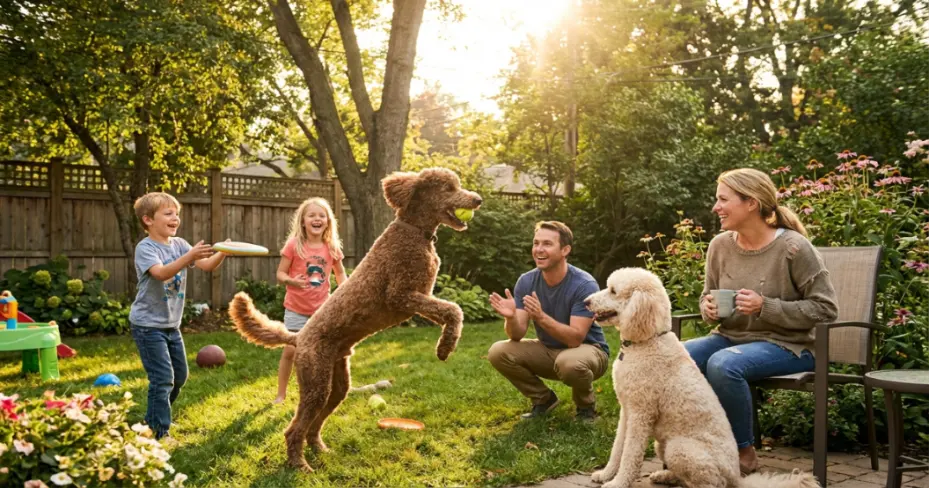
Female Poodle Temperament
The female poodle personality is often described as more refined, more independent, and — if we’re being honest — a little more businesslike. That’s not a criticism. It’s actually one of the traits that many experienced dog owners, particularly those who want a focused training partner or a dog that can handle a busier household, actively seek out in a female.
Where male poodles tend to shower affection broadly on everyone in the room, female poodles are often more selective. They decide who they trust, who they consider their person, and they’ll show deep loyalty to that person without necessarily needing to perform it for an audience. Owners of female poodles frequently describe a quieter, steadier kind of bond — deeply present, but not desperate.
Maturity and focus: Females typically reach emotional and behavioural maturity earlier than males. By around 12–18 months, most female poodles have settled considerably compared to their male counterparts, which can make them feel easier to manage for new owners in that crucial first year. This earlier maturity also translates to better focus in training sessions — females tend to stay on task more consistently, which some trainers find makes them slightly more responsive to dog obedience work in the early stages.
Independence: Don’t mistake independence for aloofness. Female poodles are loving dogs — they simply tend to be comfortable spending time on their own without anxious pacing or destructive behavior. This makes them a pragmatic choice for owners who work regular hours and need a dog that can handle the day with confidence.
Territorial tendencies: Unspayed females may experience hormonal cycles that temporarily affect their temperament — some become more assertive or reactive during these periods. Spaying eliminates these fluctuations entirely and is strongly recommended for pet dogs. Female poodles can occasionally be assertive toward other female dogs, particularly in a multi-dog household, so introductions should always be handled carefully and patiently.
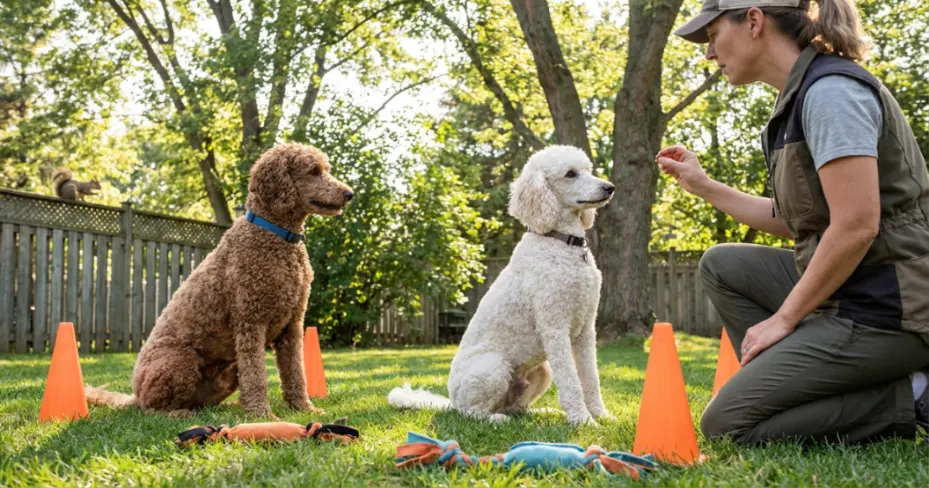
Male vs Female Poodles: Personality Differences Explained
Let’s put the key poodle temperament differences side by side so you can see them clearly. These comparisons reflect common tendencies reported by breeders, trainers, and long-term poodle owners — not hard rules that apply to every dog.
Affection & Bonding
- Openly, demonstrably affectionate
- Bonds warmly with entire family
- Craves physical closeness
- Prone to velcro-dog tendencies
Affection & Bonding
- Affectionate on her own terms
- Often bonds most closely with one person
- Independent — doesn’t demand constant contact
- Deep loyalty expressed quietly
Training & Focus
- Highly motivated by praise and food
- Can be easily distracted when young
- Longer puppy phase affects early training
- Thrives with enthusiastic, varied sessions
Training & Focus
- Often more focused and consistent
- Matures faster — steadier attention span
- Can be independently-minded; tests boundaries
- Responds well to clear, calm leadership
Energy & Playfulness
- High energy; playful well into adulthood
- Enthusiastic about games and interaction
- Needs plenty of physical and mental outlets
- Slower to settle after stimulation
Energy & Playfulness
- Active but tends to self-regulate better
- Settles more quickly after exercise
- Enjoys play without being driven by it
- Calmer overall by 18–24 months
Male vs Female Toy Poodles
When we talk about male vs female toy poodle personality, the gender differences that exist in larger poodles are present here too — but they can feel slightly more pronounced because of the Toy’s naturally heightened sensitivity.
A male Toy Poodle is typically the more ebullient of the two. He’s expressive, affectionate, and absolutely convinced that he is the most important occupant of your home. For apartment dwellers and singles who want a deeply social little companion, the male Toy is hard to beat. His people-focus is intense, and he thrives when he’s with you. The potential downside is separation anxiety — a male Toy Poodle who hasn’t been trained to handle alone time can become vocal and anxious. You can read more about the male Toy’s specific traits in our dedicated male Toy Poodle guide.
A female Toy Poodle is often described as more composed and self-contained. She adapts well to apartment life and is typically quieter and more settled once past the puppy stage. She’s still playful and loving — just less likely to demand your attention every waking moment. For first-time owners managing busy schedules, the female Toy’s greater independence can be genuinely helpful.
🐾 Toy Tip: Because Toys are small and sensitive, early socialisation is critical for both genders. A well-socialised Toy Poodle — male or female — will be far more confident and adaptable than one raised in a sheltered environment, regardless of gender tendencies.
Male vs Female Miniature Poodles
The Miniature Poodle is widely considered the most balanced poodle size for families, and both genders of Mini are genuinely fantastic dogs. For a full overview of the Miniature, check out our complete Miniature Poodle guide.
When comparing male vs female miniature poodle temperament, the contrast is more subtle than you’d find with Toys. Male Miniatures are playful, sociable, and excellent with children — their moderate energy level is well-matched to family life, and their affectionate nature means they tend to form connections with everyone in the household quickly. They’re wonderful dogs for families who want a cheerful, enthusiastic companion.
Female Miniature Poodles bring slightly more calm and focus to the equation. They’re often quicker to house-train, settle into routines faster, and are less likely to test boundaries repeatedly during adolescence. For families with structured routines or owners who want a smoother training experience from the start, a female Mini frequently delivers that. Both genders, however, are exceptional family dogs when socialised well.
💡 Family Pick: The Miniature Poodle — in either gender — is the most recommended poodle size for families with young children and first-time dog owners. The temperament differences between male and female are mild enough that lifestyle fit and individual personality often matter more than gender at this size.
Male vs Female Standard Poodles
With Standard Poodles, the gender differences show up in ways that matter more — partly because of size and partly because Standards carry more of the original working dog drive that makes the behavioral contrasts more visible.
A male Standard Poodle is an imposing, athletic, affectionate companion. They are typically more exuberant and physically demonstrative than their female counterparts, and they often retain a youthful bounciness that can require patient management during the adolescent phase (roughly 8–24 months). Males are usually very social with other dogs and people, making them outstanding therapy dogs, agility competitors, and family companions. Their trainability is exceptional, though early consistency is important to prevent the mild dominance behaviors some intact males display.
A female Standard Poodle carries herself with a natural elegance and quiet authority that many owners find deeply appealing. She is just as intelligent and capable as the male — often more analytically sharp in advanced training contexts — and she tends to mature into her full temperament more gracefully. Female Standards are known for their steady, reliable temperament and are frequently chosen as service dogs and emotional support animals for this reason. They can occasionally be more selective about other dogs, particularly other females, but with proper dog socialisation this is entirely manageable.
For active families and working dog enthusiasts, both Standard genders are outstanding. The male may give you more exuberance and spontaneous affection; the female may give you more focus and composure. Both will give you one of the most rewarding dog-ownership experiences available.
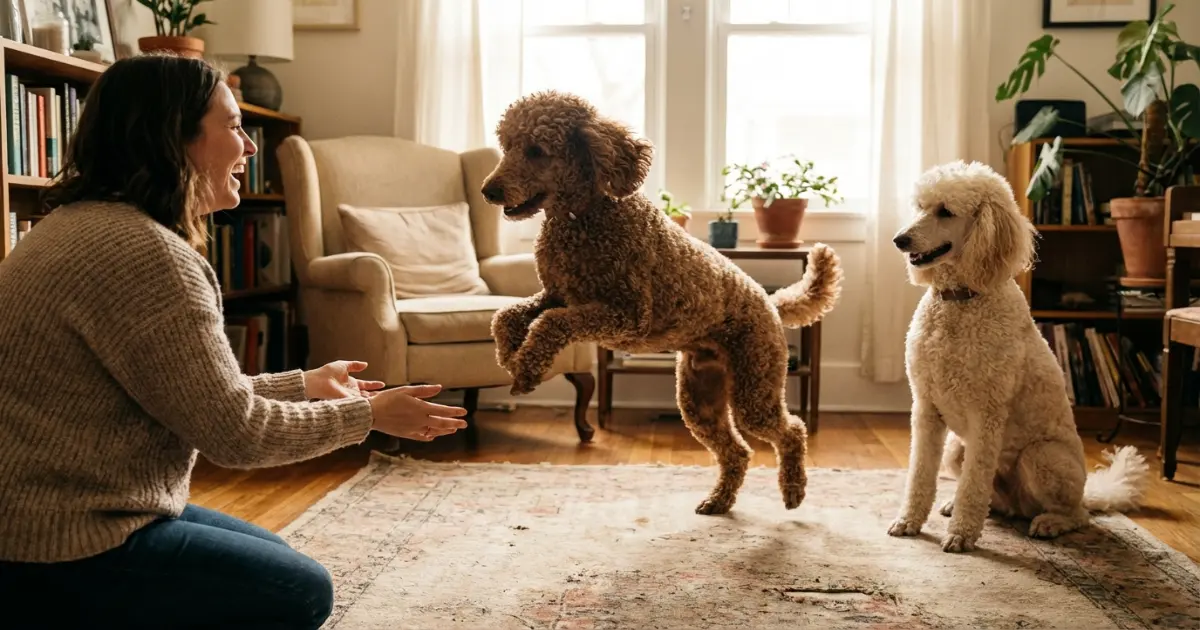
Training Differences Between Male and Female Poodles
Let’s address this directly: both male and female poodles are exceptional at training. The poodle consistently ranks #2 in dog intelligence on Stanley Coren’s widely cited scale, and both genders reflect this brilliance. Neither is difficult to train. The question is more about how training style should be adapted for each.
Male poodles in training sessions respond best to high energy, enthusiasm, and short bursts of engagement. They’re externally motivated — they want to earn your reaction, your praise, your treat. The most common challenge is sustaining focus when distractions are present. Training in controlled environments first, then gradually adding distractions, works well. Keep sessions to 5–10 minutes and end on a high note — males thrive on positive momentum.
Female poodles often demonstrate slightly more consistent focus in training, especially after they reach 12–15 months. They respond well to calm, confident leadership and can handle more complex task sequences earlier than many males of the same age. Some female poodles do exhibit what trainers call “selective compliance” — they understand perfectly well what’s being asked but have independently decided whether to cooperate. This isn’t defiance; it’s intelligence. It calls for clear, firm, positive direction — and the relationship to carry it.
For both genders, the fundamentals of effective poodle training are identical: positive reinforcement, consistency, mental enrichment through puzzle feeders and nose work, and early, broad dog socialisation. A poodle of either sex that receives this foundation will be an exceptional loyal companion and an absolute pleasure to live with.
Are Male or Female Poodles Better for Families?
The honest answer: both are excellent, and the “better” choice depends almost entirely on your family’s specific energy level and lifestyle — not gender alone.
Male poodles tend to be a natural hit with children. Their playful, enthusiastic nature matches the energy of kids beautifully, and they’re typically patient and gentle even in boisterous environments. Boys love playing with male poodles precisely because the dog never seems to run out of enthusiasm for the game. Male poodles are also warmer and more indiscriminate in their affection, which means they’re less likely to retreat to a quiet corner when the household gets chaotic.
Female poodles are equally wonderful with children but may show their affection with slightly more composure. In households with very young children or babies, many experienced breeders actually prefer placing female poodles because their faster maturity and greater capacity for calm means they’re less likely to accidentally knock over a toddler or become overstimulated in a high-energy situation. They’re also generally better at self-regulating during hectic moments.
🏡 Family Verdict: For families with toddlers and very young children, a female poodle often transitions into the household more smoothly. For families with energetic school-age children who want an enthusiastic playmate, a male poodle is frequently the better match. With older children and teens, either gender typically works brilliantly.
Which Gender Is Easier for First-Time Dog Owners?
This is a question I get asked constantly, and there genuinely isn’t a universal answer — but there is a practical framework for thinking about it.
If you’re a first-time dog owner who values a smooth, structured introduction to poodle ownership — quicker house-training, earlier behavioral stability, consistent focus in training — a female poodle will often feel more manageable in that critical first year. Her faster maturity and greater independence mean you’re dealing with fewer adolescent chaos moments, and her training responsiveness is typically very high from an early stage.
If you’re a first-time owner who prioritizes an immediately warm, deeply affectionate bond and wants a dog that is visibly enthusiastic about your presence from day one, a male poodle will give you exactly that. His openness and people-focus are deeply rewarding, especially for new dog owners who may need that obvious emotional feedback to feel confident they’re doing things right. The trade-off is managing a slightly longer puppy phase and putting real effort into alone-time training early on.
In both cases, the most important factors are the same: consistency, early training, proper dog socialisation, regular exercise, and mental enrichment. A well-raised poodle of either gender will make an exceptional first dog.
Male vs Female Poodles: Pros and Cons
Here’s a balanced summary to help you weigh both options at a glance.
✅ Male Poodle — Pros
- Openly affectionate and demonstrably loving
- Enthusiastic playmate for children and active owners
- Bonds warmly with the entire household
- Highly motivated and engaging training partner
- Consistent energy makes daily exercise natural
- Less likely to be moody or selective in affection
⚠️ Male Poodle — Cons
- Slower to mature — longer adolescent “puppy phase”
- More prone to separation anxiety
- Can be easily distracted in early training
- Unneutered males may mark or show dominance
- May need more active management in multi-dog homes
✅ Female Poodle — Pros
- Matures faster — more behaviorally settled by 18 months
- Typically more focused and consistent in training
- Greater independence — handles alone time well
- Often easier to house-train
- Calmer in high-stimulus environments
- Steady, reliable temperament long-term
⚠️ Female Poodle — Cons
- Can be selective or moody with affection
- “Selective compliance” in training if not well led
- May clash with other female dogs in the home
- Hormonal cycles affect temperament if unspayed
- Less likely to bond equally with all family members
✂️ Grooming Note: Grooming needs are identical for male and female poodles. Both require brushing 3–4 times per week and professional grooming every 6–8 weeks. Explore our recommended tools in the poodle grooming tools guide, and learn more about coat care and shedding in our Do Poodles Shed article. For eye care specific to both sexes, see our poodle eyes guide.
Conclusion: The Best Poodle Is the One That Fits Your Life
The debate over male vs female poodles will never have a universally correct answer — and that’s actually reassuring. It means both genders are genuinely excellent dogs. What matters far more than gender is the individual dog’s early socialisation, the consistency of their training, the quality of their care, and the compatibility between their specific personality and your lifestyle. Visit reputable breeders, spend time with both males and females before deciding, ask questions, and trust what you observe. Whether you bring home a bold, affectionate male or a focused, composed female, you’re welcoming one of the most intelligent and rewarding dogs in the world into your life.
People Also Ask: Male vs Female Poodle FAQs
Generally speaking, yes — male poodles tend to express affection more openly, more frequently, and more indiscriminately than females. They are often described as “velcro dogs” who want to be near their owners at all times and who greet every family member with equal enthusiasm. Female poodles are also loving and loyal, but their affection tends to be more selective and expressed on their own schedule. Neither style is better — it depends on whether you prefer a dog that is visibly, constantly affectionate or one that offers deeper but quieter loyalty.
Female poodles are often considered slightly easier to train in the early stages, primarily because they mature faster and maintain better focus during training sessions from a younger age. Male poodles are equally intelligent and ultimately just as trainable — but their longer puppy phase means they can be more distractible in the first 12–18 months. Both genders are highly trainable compared to most breeds, and with consistent, positive reinforcement training, either sex will develop excellent obedience and responsiveness. The difference is more about timing than capability.
Female poodles are generally considered calmer, particularly between the ages of 12 months and 3 years when male poodles are often still in a boisterous adolescent phase. Female poodles tend to self-regulate more effectively — they’ll play enthusiastically and then settle down without prolonged winding-down time. Male poodles can stay in a highly excited state longer after stimulating activities. That said, a well-exercised, well-trained adult male poodle is a very calm dog indoors — the gap in calmness narrows significantly once both dogs are past 2–3 years of age.
There isn’t a strong, consistent difference in barking frequency between male and female poodles. Both genders are naturally alert dogs that will use their voice to communicate. The most significant factors driving excessive barking in poodles — regardless of sex — are boredom, under-stimulation, separation anxiety, or insufficient training. Males may bark more due to excitement or territorial marking behavior when intact, but neutering typically reduces this. A properly trained, well-exercised poodle of either gender is not considered an excessive barker.
Yes — female poodles are generally more independent than males. They are comfortable spending time on their own without significant anxiety and tend not to shadow their owners from room to room the way many males do. This independence is not a sign of lower affection — female poodles form deep bonds — it simply means they express that bond with less physical proximity and fewer demands for constant interaction. For owners who work from home and don’t want a dog that follows them everywhere, or who need a dog that handles regular alone time well, a female poodle is often the more practical choice.
For most people, the choice between a male or female Toy Poodle comes down to lifestyle preference. A male Toy Poodle is ideal if you want a dog that is visibly, constantly affectionate and thrives on close companionship — perfect for people who are home often and want an enthusiastic emotional companion. A female Toy Poodle is often the better choice if you have a busier schedule, want a dog that handles alone time with more confidence, or prefer a slightly more composed, independently-minded personality. Both make exceptional small companions. Explore our male Toy Poodle profile for more detail on the male’s specific traits.